For decades, Search Engine Optimization (SEO) professionals have struggled with a fundamental challenge: accurately, reliably, and dynamically monitoring visibility within search engine results pages (SERPs). Gone are the days when a static, manually updated spreadsheet could capture the nuances of modern search ecosystems. Today, search engines like Google, Bing, Baidu, and Yandex deliver hyper-personalized, location-specific, and device-dependent layouts populated by an evolving array of SERP features, from AI Overviews and Featured Snippets to Knowledge Panels and video carousels.
In 2025, tracking movement in the SERPs is no longer just about checking whether your homepage sits at position three or four. It is about understanding intent, mapping granular keyword movements to business revenue, monitoring fierce competitors in real-time, and scaling insights across thousands of global zip codes.
Investing in robust SERP tracking software has transitioned from a nice-to-have operational asset to an enterprise-grade necessity. Without automated, high-frequency, and accurate rank-tracking infrastructure, digital marketing teams operate blind—unable to justify SEO investments to executive boards, diagnose sudden algorithmic traffic drops, or capture fleeting optimization opportunities.
This comprehensive report evaluates the foundational features modern organizations must demand from their visibility suites, dissects the industry landscape, and provides a rigorous, data-backed analysis of the seven best SERP tracking tools available in 2025. Whether you manage an agency handling dozens of enterprise clients or operate an in-house team steering an e-commerce giant, this guide details how to choose the ideal solution to protect and expand your digital footprint.
Detailed Chronology: The Evolution of Rank Tracking
To fully appreciate the sophisticated capabilities of modern SERP tracking tools, it is helpful to look back at how the industry arrived at its current state. The evolution of search engine tracking mirrors the broader maturation of the digital marketing industry itself.
Phase 1: The Manual Era (Early-to-Mid 2000s)
In the nascent days of search optimization, tracking keyword positions was a grueling manual exercise. SEO practitioners would open private browsing windows, clear their browser caches, type in a target search query, and manually scan the results pages. These positions were then meticulously logged into local Microsoft Excel spreadsheets.
The Limitations: Data was inherently flawed due to localized personalization and data-center shifting. Tracking more than a few dozen keywords was nearly impossible, and historical analysis was restricted to whatever data an individual managed to save locally week-over-week.
As the scale of websites and keyword targets expanded, desktop-based software emerged. Tools installed locally on an SEO’s computer would fire automated queries into search engines to scrape ranking data.
The Limitations: These tools frequently triggered anti-bot mechanisms, leading to blocked IP addresses, distorted data sets, and a reliance on proxies. Furthermore, they required machines to be left running overnight to complete long tracking cycles.
Phase 3: Cloud-Based Platforms and All-in-One Suites (Mid 2010s–Early 2020s)
The rise of cloud computing revolutionized the market. Dedicated SaaS companies and comprehensive all-in-one SEO suites (such as Semrush, Ahrefs, and SE Ranking) moved tracking infrastructure to the cloud. This era introduced automated daily cron jobs, multi-device segmentation (desktop vs. mobile), and basic geo-targeting down to the city level.
The Limitations: While daily updates became the industry standard, data latency remained an issue. If an algorithm update rolled out mid-day, users often had to wait 24 hours or longer for the next scheduled system update to understand the impact on their visibility.
Phase 4: The Real-Time, Feature-Rich Ecosystem of 2025
Today, modern SERP trackers provide on-demand, cloud-native updates capable of refreshing rankings at the click of a button. They track over 50 distinct SERP features, ingest multimodal data (including video and AI-driven answer engines), integrate natively with business intelligence tools like Google Looker Studio and Databox, and directly map keyword visibility metrics to bottom-line revenue and conversions.
Supporting Context & Metrics: Why SERP Tracking is Imperative
In corporate boardrooms, organic search traffic is frequently scrutinized. Unlike paid search (PPC), where a dollar spent yields a predictable, immediate influx of traffic, SEO is an investment in long-term digital real estate. Proving the value of this investment requires rigorous attribution and granular reporting.
Validating SEO Investments
A leading indicator of successful search optimization is the ability to track micro-movements across diverse search engines, device types, and geographic locations. When a stakeholder asks why organic traffic dipped during a specific quarter, a high-level dashboard cannot suffice. SEO teams need the ability to drill down to specific zip codes and individual keyword clusters to isolate whether a drop was caused by localized search behavior, mobile algorithm shifts, or aggressive competitor displacement.
The Financial Impact of SERP Features
Securing a traditional organic position in the top three is no longer the sole path to traffic acquisition. Modern search pages are increasingly dominated by SERP features that push organic blue links further down the page.
AI Overviews & Featured Snippets (Position #0): Capturing these spots can dramatically increase brand visibility and click-through rates, even if the primary organic ranking sits at position two or three.
People Also Ask (PAA) and Video Carousels: Monitoring these elements allows brands to occupy multiple slots on a single search results page, effectively crowding out competitors.
Without sophisticated tracking software that maps your presence across these varied SERP elements, you miss critical opportunities to optimize existing content for maximum click-through yield.
9 Essential Features to Look for in SERP Tracking Software
When evaluating solutions for your organization, ensure the platform delivers across these nine critical vectors:
Accurate On-Demand Ranking Updates: Standard daily updates are no longer enough during volatile core algorithm updates. Leading tools allow users to trigger manual, on-demand data refreshes instantly.
Comprehensive SERP Feature Monitoring: The platform must track whether keywords trigger AI Overviews, featured snippets, local packs, or video carousels, giving you clear pathways to steal "Position #0."
Multi-Engine Support: Beyond Google, enterprise brands operating in international markets or specialized niches must track visibility across Bing, Baidu, Yandex, and YouTube.
Granular Geographic and Device Targeting: Campaigns require tracking capabilities that scale from international oversight down to national, regional, and zip-code levels, alongside clear desktop versus mobile performance separation.
Revenue and Traffic Attribution: The ability to merge ranking metrics with Google Analytics or Adobe Analytics data to show how SERP movements directly influence conversions and revenue.
Deep Historical Data Access: Point-in-time metrics are insufficient. True optimization requires viewing multi-year trend lines to benchmark current performance against historical highs, lows, and competitor trajectories.
Advanced Competitor Benchmarking: Grouping keywords by performance buckets (e.g., positions 1–3, 4–10, 11–50) to evaluate your visibility share against direct market rivals.
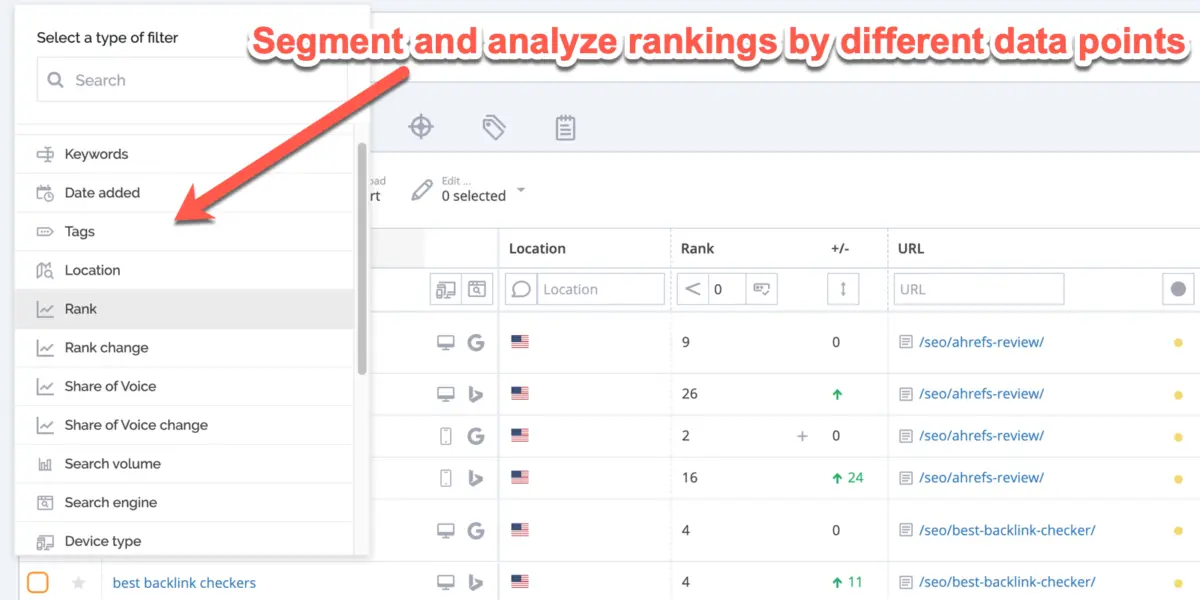
Tagging and Advanced Segmentation: The capacity to organize thousands of keywords by product lines, marketing funnels, intent types, and content formats.
White-Label Reporting and Integrations: Native client-ready reporting capabilities, supplemented by robust API connectors for Looker Studio and Databox.
The 7 Best SERP Tracking Tools for 2025
The market features countless choices, divided into two distinct categories: Dedicated (Standalone) Trackers and All-in-One SEO Platforms that include robust tracking modules. Below is our curated shortlist for 2025.
1. AccuRanker (Best Dedicated SERP Tracker)
AccuRanker is widely recognized as the gold standard for high-speed, standalone rank tracking. Trusted by over 32,000 companies—including enterprise giants like HubSpot, IKEA, and Kinsta—it is built for speed and precision.
Key Features: Automated 24-hour updates with instant on-demand manual refreshes; deep integration with Google Analytics for landing-page revenue attribution; tracking of over 50 SERP features; multi-engine support (Google, Bing, Baidu, Yandex, YouTube).
Ideal For: Agencies, SEO professionals, and enterprise brands demanding ultra-fast data refreshes and sophisticated API integrations.
Pricing: Starts at $116/month for up to 1,000 tracked keywords.
2. Semrush Position Tracker & SERP Gap Analyzer (Best All-in-One Solution)
Semrush is an industry-leading all-in-one digital marketing suite serving over 10 million users, including global brands like Samsung, Vodafone, and Booking.com. Its Position Tracking tool matches the accuracy of dedicated trackers while sitting inside a massive suite of SEO and SEM tools.
Key Features: Hyper-accurate daily tracking from international to hyper-local map pack levels; advanced competitor visibility distribution metrics; and the exclusive SERP Gap Analyzer app in the Semrush App Center, which scans SERPs to find under-optimized content and integrates seamlessly with Google Search Console.
Ideal For: Digital marketing professionals, e-commerce stores, and enterprises seeking an all-in-one platform with enterprise-grade rank tracking.
Pricing: Platform plans start at $139.95/month.
3. ProRankTracker (Best Value Standalone Tracker)
ProRankTracker is a cost-effective, highly scalable standalone tracking and reporting solution trusted by over 60,000 users worldwide.
Key Features: Full-suite local and international tracking across multiple devices and languages; white-label reporting options; mobile apps for on-the-go monitoring.
Ideal For: SEM agencies, international brands, and video marketers looking for budget-friendly scale.
Pricing: Starts at $39/month.
4. Advanced Web Ranking – AWR (Best for Enterprise Customization)
Advanced Web Ranking is a veteran standalone SERP tracker utilized by thousands of enterprises and in-house teams (including Microsoft) for large-scale data processing and custom reporting infrastructure.
Key Features: Highly customizable reporting engines; flexible user permissions; robust multi-location and multi-device tracking capabilities.
Ideal For: Large in-house teams and enterprise agencies requiring deep customization and white-label control.
Pricing: Starts at $99/month.
5. SERPWatcher by Mangools (Best for Simplicity & Startups)
SERPWatcher is the intuitive rank-tracking component of Mangools’ streamlined all-in-one SEO toolset, trusted by brands like Airbnb and Adidas.
Key Features: The proprietary Performance Index, which calculates organic traffic potential based on current rankings and search volumes; clean, highly visual user interfaces.
Ideal For: Startups, small business owners, and consultants who value simplicity and ease of use without sacrificing accuracy.
Pricing: Mangools plans start at $29.90/month.
6. SE Ranking (Best Mid-Market Hybrid Suite)
SE Ranking is a versatile all-in-one SEO platform equipped with an exceptionally accurate Position Tracking tool that models user behavior across specific target locations.
Key Features: 100% accurate simulation-based tracking; comprehensive competitor analysis modules; integrated auditing and backchain monitoring tools.
Ideal For: Digital agencies and SMBs looking for a balanced, feature-rich mid-market alternative.
Pricing: Starts at $52/month (based on daily updates for 500 keywords).
7. Nightwatch (Best for Hyper-Local & Global Scale)
Nightwatch is a precision-engineered daily SERP tracker trusted by brands like Shopify, Coinbase, and Scotiabank. It excels at extracting exact ranking data from over 100,000 global locations.
Key Features: Unmatched geographic granularity; robust data visualization dashboards; flexible segmentation across large keyword portfolios.
Ideal For: Freelancers, SMBs, and global enterprises managing complex geographic campaigns.
Pricing: Starts at $32/month for up to 250 keywords (includes a 14-day free trial).
Official Statements & Industry Expert Perspectives
Industry leaders continue to emphasize the shift toward integrated reporting and automated data pipelines.
"The thing that really got me using [AccuRanker] heavily in the last month or two is their Looker Studio connector. Combining the tag feature, as well as the Share of Voice metric, has been a big help in making these reports immediately digestible."
— Ian Howells, Co-Founder, Traffic Think Tank
"It’s by far the best keyword ranking tracker in the market and has a ton of great reporting functions. If you want visibility on large volumes of keywords housed within a nice dashboard—this is for you."
— Matthew Howells-Barby, Co-Founder, TrafficThinkTank
Future Outlook: The Next Frontier in SERP Visibility
As we look toward the remainder of 2025 and beyond, the SERP tracking landscape will continue to experience rapid transformation. The proliferation of generative AI search experiences (such as Google’s AI Overviews and conversational search agents) means that traditional blue-link ranking metrics are evolving.
Future-proof SERP tracking tools will increasingly incorporate AI visibility scoring, measuring not just whether a domain ranks in a traditional position, but whether a brand is cited as a primary source within generative AI answer blocks. Furthermore, predictive analytics will become standard, utilizing machine learning models to forecast how upcoming algorithmic shifts may impact localized keyword groups before traffic dips occur.
Which Tool Should You Choose?
Choose AccuRanker if your priority is lightning-fast, on-demand data refreshes from a dedicated, best-in-class standalone platform.
Choose Semrush if you want an industry-leading all-in-one SEO suite equipped with world-class rank tracking and innovative add-ons like the SERP Gap Analyzer.
Choose SERPWatcher or ProRankTracker if you are operating on a leaner budget but still require dependable, scaled tracking capabilities.
Evaluate your portfolio size, reporting requirements, and budgetary constraints against this shortlist, and upgrade your tracking infrastructure to maintain a competitive edge in the modern search era.