

Executive Overview
In the modern landscape of search engine optimization, relying on manual spreadsheets or lagging weekly data metrics is no longer viable. As algorithms evolve, digital ecosystems grow more competitive, and search engine results pages (SERPs) become increasingly dynamic, enterprises, agencies, and independent practitioners require instantaneous, precise, and granular insights. Search Engine Results Page (SERP) tracking software has transitioned from a basic keyword monitoring utility into a sophisticated business intelligence layer.

Modern SERP tracking tools do more than just register a numerical position; they map movements across dozens of complex features, correlate rankings directly with revenue and traffic, and decode hyper-local visibility down to specific zip codes. This in-depth review evaluates the top seven SERP tracking tools for 2025. By analyzing both standalone solutions and comprehensive, all-in-one SEO platforms, this report examines what separates mediocre tracking from elite market intelligence, detailing the essential features, performance metrics, and strategic value propositions that define the current industry standards.

Detailed Chronology: The Evolution of Rank Tracking
The methodology of measuring search engine visibility has undergone a dramatic transformation over the past decade.

- The Manual Era (Pre-2012): SEO professionals relied heavily on locally run scripts, browser extensions, and manual spreadsheet entries. Data was prone to severe human error, personalization bias, and significant delays, making it virtually impossible to scale campaigns across multiple international markets or device categories.
- The Advent of Cloud-Based Trackers (2012–2018): Cloud software revolutionized the industry by automating daily checks. However, these early tools were often slow, updating on batch schedules that left users waiting days to see the aftermath of algorithmic updates or technical optimizations. Data was largely restricted to standard desktop queries on Google.
- The Feature-Rich & On-Demand Era (2018–2023): With the proliferation of mobile-first indexing, hyper-local search queries, and rich snippets (Knowledge Cards, People Also Ask, video carousels), simple rank tracking became obsolete. Trackers adapted by introducing multi-device segmentation, localized coordinate tracking, and user-initiated on-demand data refreshes.
- The AI and Integrated Intelligence Epoch (2024–2025): Today, SERP tracking is deeply integrated with business analytics and AI-driven insights. Platforms now monitor AI Overviews, evaluate competitive content gaps dynamically, and seamlessly sync ranking metrics with customer data platforms (CDPs) and web analytics tools like Google Analytics 4 and Adobe Analytics.
Supporting Context & Metrics: Why SERP Tracking is an Executive Imperative
To justify ongoing capital allocation toward digital marketing and SEO initiatives, stakeholders must be able to validate their efforts empirically. Accurate SERP tracking provides the empirical foundation necessary to connect organic visibility improvements directly to organizational key performance indicators (KPIs).

+-----------------------------------------------------------------------+
                THE MODERN SERP DATA PIPELINE
+-----------------------------------------------------------------------+
  Raw Keyword Data ──> Feature Breakdown (AI Overviews, Snippets)
                           │
                           ▼
  Geographic & Device Segmentation (Global to Zip-Code)
                           │
                           ▼
  Attribution Layer (Google Analytics / Revenue Mapping)
                           │
                           ▼
  Executive Dashboards & White-Label Reporting (Databox, Data Studio)
+-----------------------------------------------------------------------+
Essential Features of Modern SERP Tracking Software
When evaluating software options, organizations must ensure tools possess a core set of advanced capabilities:

- On-Demand Ranking Updates: Rapid volatility in modern search results demands real-time data refreshing. Waiting 24 to 48 hours for a scheduled batch update can obscure critical ranking drops or emerging opportunities.
- Comprehensive SERP Feature Monitoring: Ranking #1 is no longer guaranteed top visibility if an AI Overview, Featured Snippet, or People Also Ask (PAA) box dominates the viewport. Trackers must monitor over 50 distinct SERP features to identify true optimization opportunities.
- Multi-Engine Compatibility: While Google commands global market share, localized and international campaigns frequently require visibility across Bing, Yahoo, Baidu, Yandex, and YouTube.
- Granular Geo-Targeting and Device Segmentation: Visibility varies dramatically based on user location and device. High-end tools allow tracking from national campaigns down to precise postal codes, while cleanly separating desktop and mobile performance.
- Traffic and Revenue Attribution: Advanced platforms integrate with analytics suites to merge keyword rankings with bounce rates, session durations, and conversions, mapping SERP movements directly to the bottom line.
- Historical Trend Analysis: Point-in-time snapshots offer limited value. Comprehensive chronological data allows teams to track seasonal trends, algorithmic recovery patterns, and long-term competitor trajectories.
- Robust Competitor Benchmarking: Grouping keyword buckets by position brackets (e.g., positions 1–3, 4–10, 11–50) provides a clear view of market share acquisition versus loss.
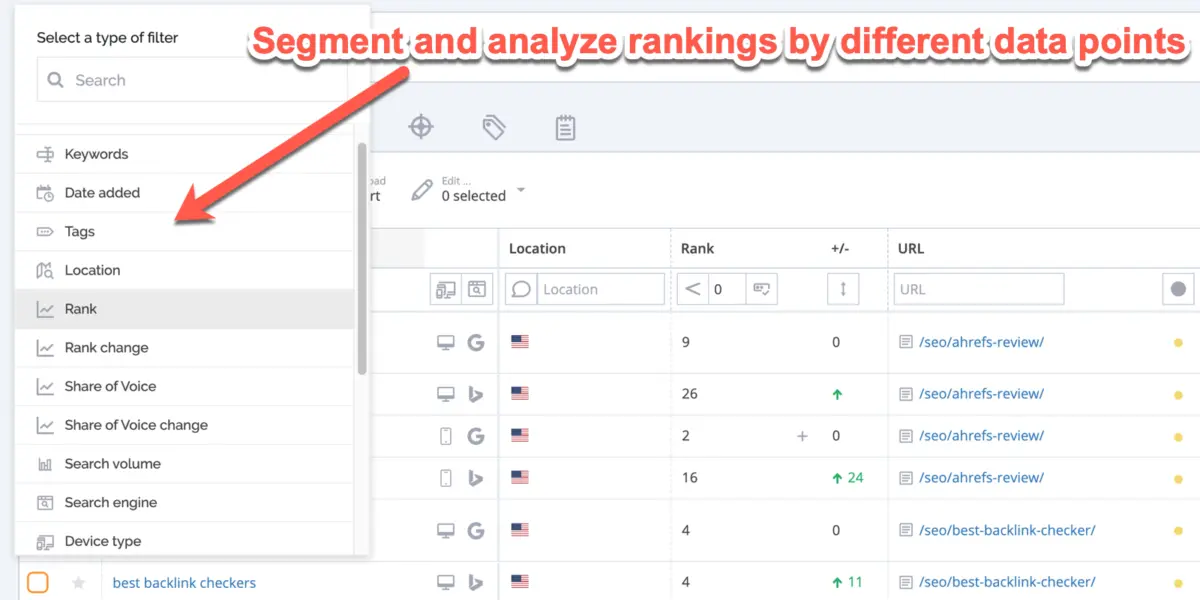
- Advanced Keyword Tagging and Segmentation: Organizing keywords by content pillar, funnel stage, product line, or intent type ensures that large portfolios remain manageable and actionable.
- White-Label Reporting & Integrations: Seamless exporting, automated scheduling, and native API connections to reporting tools like Looker Studio (formerly Google Data Studio) and Databox are vital for client-facing agencies.
Official Industry Evaluations: The 7 Best SERP Tracking Tools for 2025
The market features two distinct categories of software: dedicated standalone trackers focused purely on hyper-accurate ranking data, and all-in-one SEO ecosystems that bundle tracking alongside auditing, backlink analysis, and keyword research suites.

1. AccuRanker
- Category: Standalone SERP Tracker
- Target Audience: Agencies, enterprise brands, and consultants demanding rapid, high-volume data updates.
- Overview: Trusted by over 32,000 companies—including enterprise giants like HubSpot, IKEA, and Kinsta—AccuRanker is widely regarded as an industry benchmark for standalone rank tracking speed and accuracy.
- Standout Features: AccuRanker’s signature capability is its ability to trigger on-demand data refreshes instantly with a single click, alongside automated 24-hour cycles. It tracks over 50 distinct SERP features and integrates deeply with Google Analytics and Adobe Analytics via its comprehensive Landing Pages report. This merges keyword data with actual traffic and revenue metrics to calculate a precise "Share of Voice."
- Pricing: Subscription plans scale based on tracked keyword volume, starting at approximately $116 per month for 1,000 keywords.
2. Semrush (Position Tracker & SERP Gap Analyzer)
- Category: All-in-One SEO Platform Integration
- Target Audience: Digital marketing professionals, e-commerce brands, and enterprise teams seeking an all-in-one solution.
- Overview: Serving over 10 million users globally, Semrush is an industry titan. Its Position Tracking Tool delivers rank tracking accuracy that easily rivals dedicated standalone tools.
- Standout Features: Beyond granular location tracking (from country down to local map packs) and device segmentation, Semrush features the SERP Gap Analyzer via its App Center. This advanced application scans Google SERPs for specific topics, identifies under-optimized content gaps, and integrates with Google Search Console to highlight low-hanging fruit keywords. This significantly reduces the time spent on manual SERP auditing.
- Pricing: Platform plans begin at $139.95 per month.
3. ProRankTracker
- Category: Standalone SERP Tracker
- Target Audience: SEM agencies, international organizations, and video marketers needing multi-language and multi-device scalability.
- Overview: Trusted by over 60,000 users, ProRankTracker delivers robust, cost-effective tracking across diverse global markets without forcing users to invest in unnecessary all-in-one platform bloat.
- Standout Features: Exceptional multi-engine support, intuitive executive reporting dashboards, and precise local tracking capabilities make it a reliable choice for scaling operations across international boundaries.
- Pricing: Entry-level plans start at an accessible $39 per month.
4. Advanced Web Ranking (AWR)
- Category: Standalone SERP Tracker
- Target Audience: In-house marketing teams, enterprise operations, and large agencies.
- Overview: Advanced Web Ranking has long been a staple of enterprise SEO stacks, trusted by major brands like Microsoft for reliable large-scale data harvesting.
- Standout Features: AWR excels in handling massive keyword portfolios with flexible cloud processing, robust API access, and highly customizable white-label reporting suites designed for agency client management.
- Pricing: Subscriptions start at $99 per month.
5. SERPWatcher (by Mangools)
- Category: All-in-One / Specialized Tracker
- Target Audience: Startups, small businesses, and agencies looking for simplicity and affordability.
- Overview: Developed by Mangools (trusted by brands like Airbnb and Adidas), SERPWatcher offers a streamlined, user-friendly interface that strips away enterprise-level complexity.
- Standout Features: The platform utilizes a proprietary Performance Index metric, which calculates organic traffic potential based on current rankings and search volumes. It pairs seamlessly with SERPChecker for qualitative competitor analysis.
- Pricing: Bundled Mangools plans start at $29.90 per month.
6. SE Ranking
- Category: All-in-One SEO Platform
- Target Audience: SMBs, digital agencies, and independent consultants.
- Overview: SE Ranking provides a comprehensive suite of SEO tools underpinned by a highly configurable position tracking module.
- Standout Features: The software simulates authentic user behavior across targeted geographical locations to ensure 100% data fidelity. It offers robust competitor historical tracking, automated white-label reporting, and intuitive project management dashboards.
- Pricing: Plans start at $52 per month (based on daily updates for 500 keywords).
7. Nightwatch
- Category: Standalone SERP Tracker
- Target Audience: Freelancers, scaling agencies, and modern web enterprises.
- Overview: Nightwatch stands out for its sleek UI and massive geographic reach, capable of extracting accurate ranking data across more than 107,000 global locations. Trusted by companies such as Shopify, Scotiabank, and Coinbase.
- Standout Features: Advanced data segmentation, automated reporting, and deep integration capabilities make it a favorite among technical SEOs.
- Pricing: Following a 14-day free trial, paid plans start at $32 per month for up to 250 keywords.
Future Outlook: The Next Generation of SERP Intelligence
As we look toward the remainder of the decade, the nature of search engine results pages will continue to shift rapidly. The widespread integration of generative artificial intelligence, zero-click search mechanics, and personalized, intent-driven query handling means that traditional rank tracking metrics (such as holding a static "Position #1") will evolve into holistic visibility indices.

Future SERP tracking tools must integrate predictive AI modeling to forecast the impact of algorithmic updates before they fully roll out. Furthermore, as privacy regulations tighten and third-party data tracking grows more restrictive, first-party data correlation within rank trackers will become the definitive standard for proving marketing ROI.

When selecting a tool in 2025, organizations must weigh their specific budgetary constraints, data volume requirements, and workflow preferences. For dedicated, lightning-fast standalone tracking, AccuRanker remains the gold standard. For organizations seeking an expansive suite of marketing tools alongside enterprise-grade tracking, Semrush provides unmatched versatility. Ultimately, investing in the right SERP tracking software transforms raw data into actionable intelligence, empowering digital teams to capture market share and drive sustainable business growth.