

Executive Overview
Deep beneath the turquoise swells off the coast of Benin, a submerged time capsule has quietly defied six decades of scientific consensus. Long dismissed in mid-20th-century archives as a barren graveyard of ancient marine life, a deep-water coral formation has been rediscovered, pulsating with vibrant biodiversity and thriving against the odds.
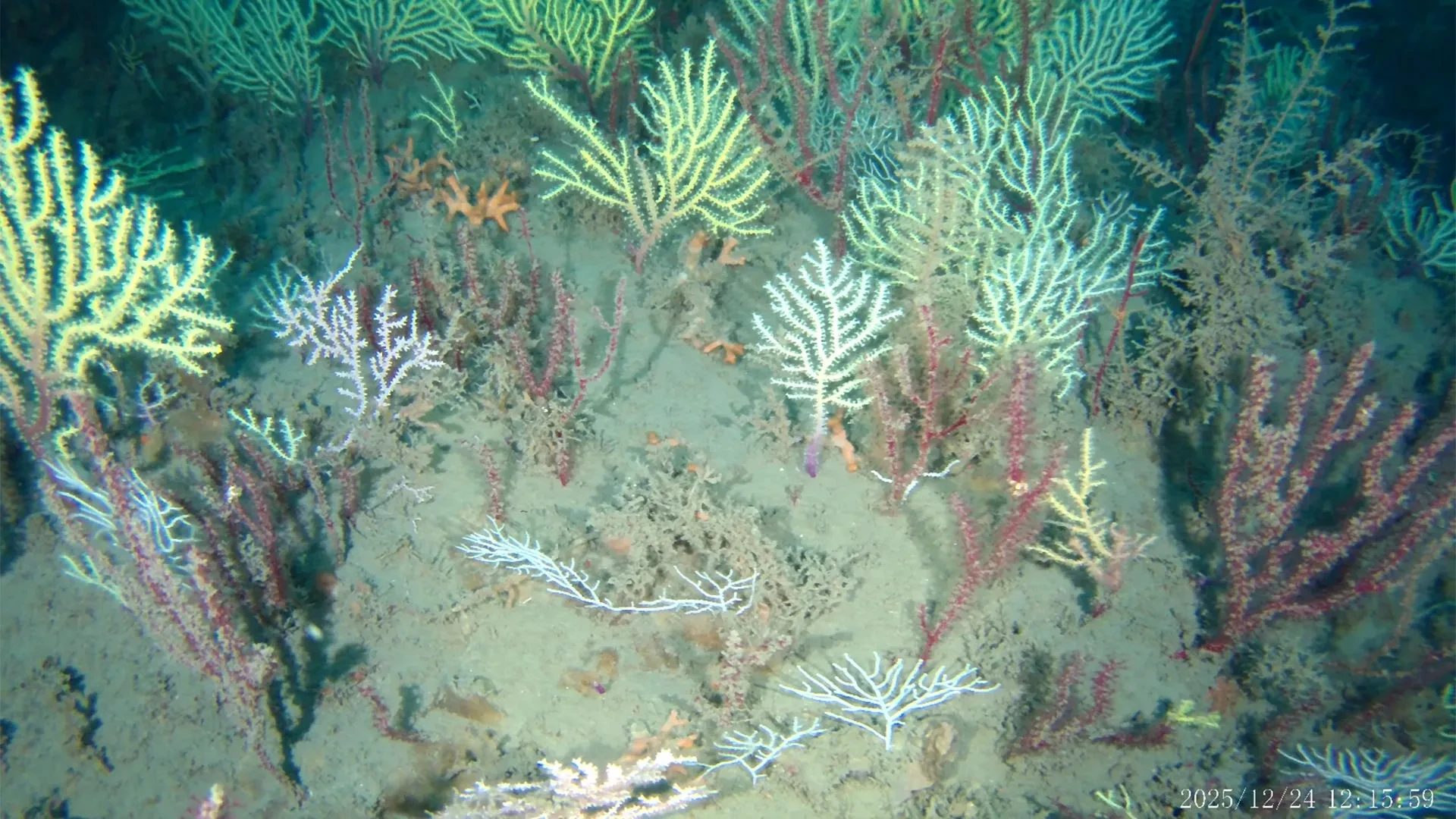
In a landmark marine expedition detailed in the journal Frontiers in Marine Science, an international collaboration of researchers has confirmed the existence of a living mesophotic (middle-light) coral ecosystem resting more than 50 meters below the surface of the Gulf of Guinea. Armed with advanced acoustic sonar and state-of-the-art deep-sea imaging technology provided by the National Geographic Exploration Technology Lab, the scientific team pierced through decades of institutional amnesia to reveal a complex web of life.
Far from being a static monument of the past, the site hosts at least eight distinct coral morphotypes and a bustling community of reef-dependent fish species, ranging from the shimmering golden African snapper to the striking three-banded butterflyfish.
This unexpected discovery does more than merely rewrite local marine maps; it exposes a gaping blind spot in our global understanding of West African coastal waters. If a significant coral ecosystem could sit unremembered and undocumented for over sixty years just off the continental shelf of Benin, scientists are forced to ask an unsettling question: How many other forgotten underwater realms are waiting to be uncovered in the twilight zones of the world’s oceans?
Detailed Chronology: From 1960s Discarded Files to Modern Rediscovery
The Genesis of a Misconception
The story of Benin’s ghost reef begins in the 1960s, an era when marine exploration along the West African coast was largely driven by resource extraction and economic pragmatism rather than pure conservation biology. During this period, marine surveys swept through the Gulf of Guinea with a primary objective: locating and mapping productive commercial fishing grounds to feed burgeoning regional populations.
During these exploratory sweeps, sonar and dredge operations picked up anomalous, highly reflective bottom signatures over 50 meters beneath the surface. To the fisheries researchers of the time, these jagged underwater profiles strongly suggested the skeletal remains of an extensive barrier reef system. Given the rudimentary nature of acoustic technology and the absence of high-resolution visual tools, researchers made an educated—yet ultimately flawed—deduction: the reef was ancient, heavily degraded, and, for all practical purposes, entirely dead.
The data was archived, filed away in dusty government dossiers and academic footnotes, and largely forgotten by the international oceanographic community for more than half a century. Over the decades, coastal development, shifting climate patterns, and intense regional fishing pressure transformed the Gulf of Guinea, while the supposed "dead reef" remained frozen in historical records as a marine relic.
The Return: Technology Meets Perseverance
Decades later, a team led by Gérard Zinzindohoué of the Institut de Recherches Halieutiques et Océanologiques du Bénin (IRHOB) decided to revisit the historical archives. Suspecting that the original 1960s surveys might have misinterpreted the geological and biological nature of the site, Zinzindohoué and his colleagues formulated a bold expedition plan.
The journey to validation, however, was anything but straightforward. Modern marine archaeology and deep-sea biology are frequently romanticized in media, but the reality on the water is a grueling trial of endurance, mechanical failure, and psychological grit.
"It was not an easy field campaign," reflects lead author Gérard Zinzindohoué. "It was a mix of long days at sea, technical problems, and a lot of uncertainty. But then we saw structures on the sonar that looked like they could be reef signatures, which gave us hope that we were close."
Working aboard research vessels under punishing tropical conditions, the team meticulously deployed modern side-scan sonar arrays across an 11.5-kilometer stretch of the seafloor. They were hunting for two specific anomalies identified in the 1960s logs. As acoustic maps materialized on computer monitors in the ship’s control room, ghostly topographic signatures began to emerge—structures that bore an unmistakable resemblance to living reef formations.
The turning point of the expedition arrived with the deployment of advanced underwater surveillance technology. Using a specialized underwater drone and the National Geographic Exploration Technology Lab’s Deep Sea Camera System—a high-tech apparatus that functions essentially as a sophisticated, pressure-resistant trail camera rig for the abyss—the team finally bridged the gap between acoustic data and visual reality.
"That was a big moment for us," Zinzindohoué recalls, describing the first live feeds from the ocean floor. "Suddenly we could actually see the seafloor. I still remember seeing those first images. It was a mix of excitement and disbelief, because after all this time thinking about this reef, suddenly there was something real in front of us."
Supporting Context & Metrics: Decoding the Mesophotic Zone
To fully grasp the magnitude of the Benin discovery, one must understand the unique environmental parameters of the ecosystem in question. The reef is not a traditional sun-drenched, shallow-water coral garden of the sort found in the Caribbean or the Great Barrier Reef. Instead, it belongs to a fascinating and understudied category known as a mesophotic coral ecosystem (MCE).
The Architecture of the Twilight Zone
Mesophotic coral ecosystems typically inhabit depth zones ranging from 30 meters down to 150 meters below the ocean surface. Operating in what scientists call the "twilight zone" of the ocean, these corals face profound environmental challenges, chief among them being severe light attenuation.
- Light Limitations: Receiving only 1% to 10% of the surface sunlight that nourishes shallow reefs, mesophotic corals have evolved specialized physiological adaptations. Many rely heavily on symbiotic algae (zooxanthellae) that are remarkably efficient at harvesting blue-green spectral light, while others supplement their energy requirements by filter-feeding on suspended organic particulate matter.
- Structural Morphology: Unlike shallow reefs that often form sprawling, continuous limestone barriers buffering coastlines from wave action, MCEs frequently present as patchy, fragmented colonies. In the case of the Benin shelf, the corals have anchored themselves to isolated rocky outcrops on the seabed where local hydrodynamic conditions provide adequate nutrient flow and stable substrate attachment.
- The Scale Potential: Historical reports from the 1960s tantalizingly suggested that the Benin formation might represent a continuous coral barrier stretching roughly 40 kilometers parallel to the coastline. While the recent expedition surveyed only a fraction of this vast potential corridor, the sheer spatial scope hints at an interconnected regional system of monumental proportions.
Biodiversity Metrics: Life on the Reef
Despite operating in low-light, high-pressure conditions, the camera footage captured a thriving biological community utilizing the reef structure for survival. Marine biologists cataloged an impressive array of fauna during the initial visual transects:
- Coral Diversity: Preliminary image analysis identified eight distinct types of coral morphotypes, indicating a complex structural habitat capable of supporting diverse ecological niches.
- Fish Communities: The reef acts as an essential sanctuary and feeding ground for at least eight notable fish species, including:
- Golden African snapper (Lutjanus fulgens)
- Blackbar soldierfish (Myripristis jacobus)
- Guinean angelfish (Holacanthus africanus)
- West African goatfish (Pseudupeneus prayensis)
- Monrovia doctorfish (Acanthurus monroviae)
- Three-banded butterflyfish (Chaetodon ellioti)
- Two distinct, unquantified species of damselfish (Pomacentridae)
These species utilize the complex topography of the coral patches to evade pelagic predators, lay eggs, and forage in an otherwise featureless expanse of sandy continental shelf.
Official Statements & Scientific Analysis
The implications of this discovery stretch far beyond the borders of Benin, prompting a reassessment of West African marine biology. In their paper published in Frontiers in Marine Science, the research team emphasizes that this finding challenges long-held assumptions regarding the resilience of marine life in the region.
"To our knowledge, this is the first confirmed record of a living mesophotic coral ecosystem on the Gulf of Guinea continental shelf," states Zinzindohoué with measured academic precision. However, he is quick to dismiss the notion that this reef is a biological anomaly:
"I think what we found is probably not an exception. It is more likely a reflection of how little we still know about coastal regions in West Africa and elsewhere. If we were able to find this reef again after 60 years, how many others are still undocumented or simply forgotten? So yes, I do believe there are likely more coral systems out there that we have not documented yet."
The Limits of Remote Observation
While the imagery is undeniably compelling, the research team maintains a rigorous, conservative scientific posture. They are careful to highlight the current limitations of their study:
- Absence of Physical Samples: Because the expedition relied entirely on acoustic sonar, underwater drones, and remote camera systems, the researchers have not yet collected physical coral specimens. Consequently, species identifications made from digital footage remain provisional and must be verified through future taxonomic collection and genetic sequencing.
- The Historical Paradox: Science is currently unable to determine whether the corals observed in the 1960s were genuinely dead—having suffered a historical mass mortality event and subsequently regenerated—or if the original fisheries surveyors simply lacked the tools to properly identify living mesophotic growth amidst heavy turbidity and deep-water distortion.
- The Need for Empirical Ground-Truthing: "We should not assume they are everywhere," Zinzindohoué warns regarding the potential abundance of other undiscovered reefs. "Each discovery needs to be confirmed. Without going back into the field, we are really just guessing."
Future Outlook: Unlocking a Multi-Decadal Oceanic Archive
As the scientific community digests the implications of the Benin rediscovery, attention is rapidly shifting toward the future. The immediate priority is securing expanded funding and institutional support to transition from initial remote reconnaissance to intensive, boots-on-the-water research.
The Ultimate Scientific Wishlist
When asked what steps he would take with unlimited resources, Zinzindohoué outlines a comprehensive blueprint for deep-water marine research in West Africa:
- Technical Diving and Sampling Programs: Deploying mixed-gas technical divers and specialized submersibles to collect physical coral and substrate samples, enabling precise species cataloging and health assessments.
- Expanded Geographic Surveys: Scaling up acoustic mapping operations to cover the entirety of the suspected 40-kilometer coastal corridor, testing the hypothesis that Benin harbors a massive, contiguous mesophotic reef system.
- Paleoecological Analysis: Extracting core samples from the coral skeletons to read the chemical signatures trapped within the calcium carbonate layers. This would allow scientists to reconstruct historical sea temperatures, pollution levels, and marine chemistry shifts over centuries.
Reading an Unopened Archive
For the researchers who endured the unforgiving seas of the Gulf of Guinea, the discovery represents more than a professional triumph; it is an invitation to decode a natural manuscript that has been writing itself in the dark for millennia.
"For me, the most exciting part is about understanding the reef’s history, and what it can tell us about how the ocean in this region has changed over time," Zinzindohoué concludes. "It feels like we have only just started to read an archive that has been there for a very long time."
In an era defined by headlines of environmental degradation and dying coral reefs around the globe, the ghost reef of Benin offers a rare and powerful counter-narrative. It stands as a testament to the quiet resilience of nature, a reminder of the vast, unexplored mysteries still hidden beneath the waves, and proof that sometimes, what is lost to history is merely waiting for the right moment to be found again.
