

Executive Overview
For more than four decades, a quiet chapter of American true crime lore remained stubbornly unwritten. In the annals of Idaho law enforcement, an unidentified man discovered dead inside a Boise church in December 1982 was known only as the "Unknown Wanderer." To millions of television viewers, his visage became a haunting fixture of the 1990 pop-culture phenomenon Unsolved Mysteries, which broadcasted his profile across living rooms nationwide in hopes of sparking a lead. Yet, despite fingerprints submitted to federal repositories and decades of quiet police work, his identity remained an absolute vacuum.
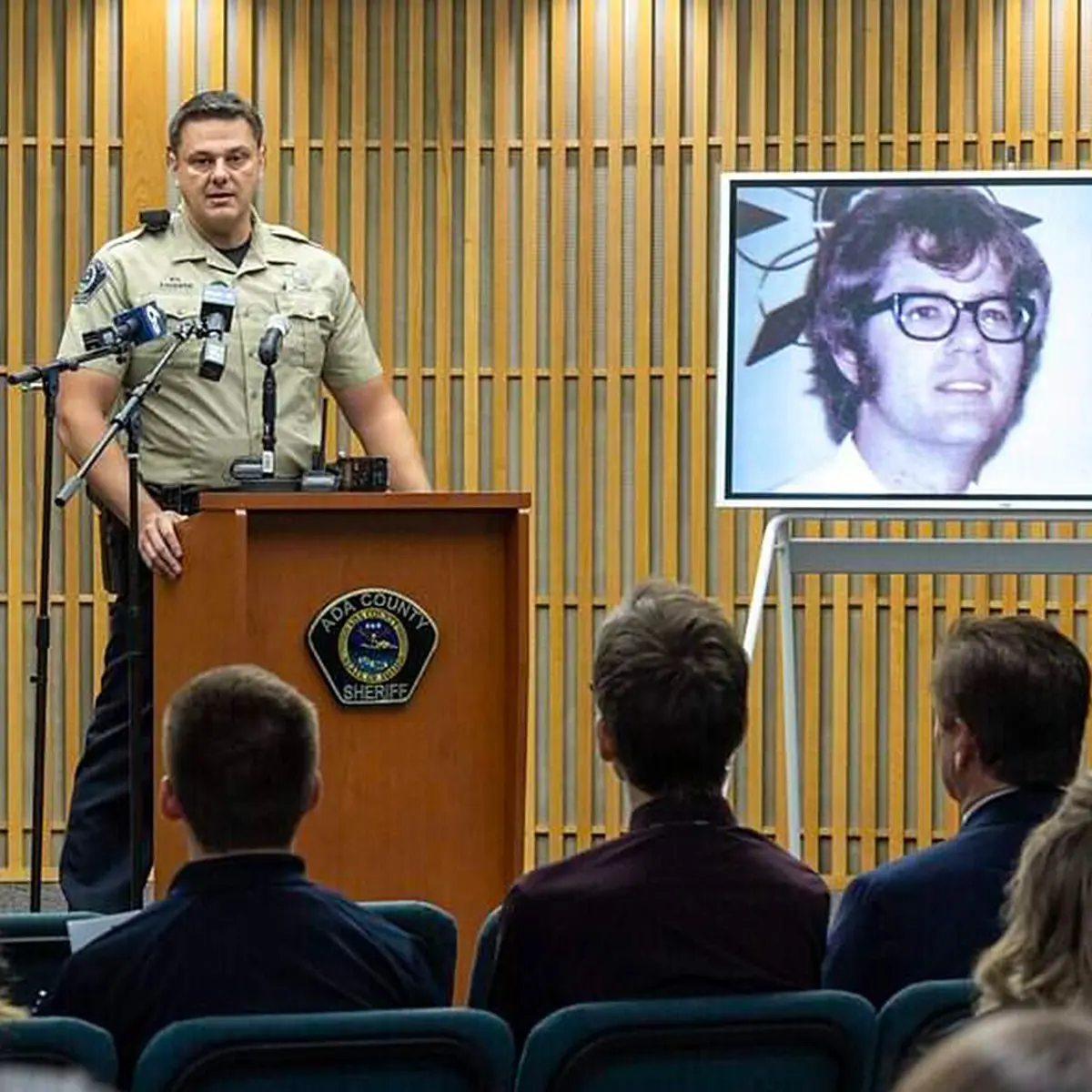
That silence was finally broken during a September 23 press conference held by the Ada County Sheriff’s Office. Officials formally announced that the decades-old cold case is officially closed following a meticulous, old-fashioned detective breakthrough. The "Unknown Wanderer" has been conclusively identified as Dr. Mathew Francis Betkouski, a brilliant scientist hailing from a prominent Los Angeles family whose life took a labyrinthine and troubling turn.
The successful identification hinges not on high-tech familial DNA profiling alone, but on a masterclass in forensic persistence led by Ada County Detective Tim Cooper. Reopening the case file in 2019, Cooper zeroed in on an overlooked piece of physical evidence: a single, stamped key recovered from the deceased man’s personal belongings. That physical artifact bridged a 42-year chasm, linking a transient death in Idaho to property deeds in Florida, a missing persons report in Los Angeles, and a clandestine scientific background that intersected with one of the darkest periods in American consumer safety history.
This comprehensive report examines the meticulous investigation that brought Dr. Betkouski home, explores the extraordinary timeline of his vanishing and discovery, weighs the contextual shadows surrounding his dismissal from a major defense contractor, and outlines the broader implications for the enduring mystery of his final months.
Detailed Chronology: From a Boise Church to a Florida Key
To understand how a decades-old mystery was unraveled, one must trace a timeline spanning over forty years, zigzagging across the American landscape from Jacksonville, Florida, to Los Angeles, California, and finally to the high desert of Boise, Idaho.
December 1982: The Final Days of the "Unknown Wanderer"
The core mystery began in the brisk winter days of December 1982. Inside a church in Boise, Idaho, the body of an unidentified middle-aged man was discovered. Devoid of any official government-issued identification cards, his true name, background, and origin were entirely unknown.
When local authorities processed the scene, they cataloged a fascinating array of personal items that painted a contradictory portrait of a transient yet well-resourced individual. Among his possessions were two distinct keyrings holding nearly thirty individual keys, a wallet entirely stripped of identification, and an envelope containing nearly $2,000 in cash—a significant sum for the early 1980s.
Investigators immediately attempted to establish his identity. Fingerprints were lifted and subsequently run through state databases in Idaho as well as the Federal Bureau of Investigation’s national repositories. The result was a dead end; the fingerprints matched no known criminal records, missing persons reports, or military files. With no leads left to pull, the file went cold, transforming the man into a phantom haunting local detectives and captivating true-crime enthusiasts.
The 1990 Pop Culture Milestone
As the years stretched onward without answers, the case transcended local police files to enter the national consciousness. In 1990, the burgeoning true-crime television program Unsolved Mysteries featured the case of the Unknown Wanderer. Producers highlighted the strange collection of keys, the substantial cash cache, and the poignant reality of a man dying completely anonymous in a house of worship. The broadcast generated a flurry of casual tips, none of which yielded a verified identity, leaving the case to languish in the shadowlands of unresolved American mysteries.
2019: Detective Tim Cooper Reopens the File
The tide turned in 2019 when Ada County Detective Tim Cooper took a fresh look at the stagnant paperwork. Recognizing that historical cold cases often yield breakthroughs not through new technology, but through a granular re-examination of old physical evidence, Cooper pulled the original case files and reviewed the physical inventory stored in the evidence locker.
His focus settled upon a small, seemingly mundane detail: the keys. Among the roughly thirty keys recovered from the man’s possession, Cooper noticed a specific marking stamped onto one of them. The stamp indicated that the key had been manufactured and cut at a hardware store located in Jacksonville, Florida.
The Jacksonville Connection and Property Records
Armed with this geographic anchor, Cooper pursued the paper trail across the country. The etching on the key provided a narrowing vector that led him to a specific street in Jacksonville: Mills Court.
Digging deep into municipal archives, Cooper managed to unearth historical property deeds dating back to the late 1970s and early 1980s for that specific neighborhood. As he combed through the legal documentation of homeownership and leases, a recurring name emerged: Mathew Francis Betkouski.
Intriguingly, public and legal records indicated that Betkouski had officially been declared legally dead in 1989—seven years after the unidentified body was discovered inside the Boise church.
Locating the Family and the DNA Breakthrough
With a potential identity in hand, Cooper expanded his search to living relatives, successfully locating Betkouski’s brother residing in Los Angeles. Through interviews, the brother confirmed a vital piece of the puzzle: Mathew Francis Betkouski had packed up and gone missing in 1982, right around the time the body was found in Idaho.
The final, definitive confirmation required modern science. Investigators obtained reference DNA samples from Betkouski’s brother and compared them against the biological material and DNA profiles extracted from the personal effects recovered with the Unknown Wanderer—specifically items from his wallet and clothing. The genetic comparison provided an irrefutable match, definitively proving that the man who died anonymously in a Boise church in 1982 was indeed Dr. Mathew Francis Betkouski.
Supporting Context & Metrics: The Life and Mind of Dr. Betkouski
The unraveling of the physical mystery opened up a psychological and biographical enigma. Dr. Mathew Francis Betkouski was not a lifelong transient; he was a highly educated professional whose life trajectory included elite academic preparation, prominent employment, and a troubling professional decline.
Background and Professional Career
According to statements released by law enforcement authorities, Betkouski hailed from a prominent, well-established Los Angeles family. Gifted with an analytical mind, he pursued advanced scientific education, ultimately earning a doctorate.
In 1975, Betkouski relocated across the country to Jacksonville, Florida, where he secured employment working for a commercial flavors and fragrances company. His expertise in chemistry and chemical formulations eventually caught the eye of larger corporate entities. By the early 1980s, Betkouski had transitioned into the defense sector, taking a position as a scientist at aerospace and defense giant Lockheed Martin.
The Downward Spiral and Firing in 1982
Despite his impressive credentials and high-level employment, Betkouski’s professional life unraveled rapidly due to increasingly erratic and alarming personal obsessions.
According to police briefings, Betkouski developed a dangerous fixation on poisons and, specifically, the methodology of introducing toxic substances into consumer pill capsules. This obsession did not remain theoretical; his workplace behavior and actions raised severe red flags among colleagues and management. Consequently, Lockheed Martin terminated his employment in 1982—the exact same year he vanished from Florida and ultimately died in Idaho.
The Chilling Coincidence of the Chicago Tylenol Murders
The timing of Betkouski’s firing and disappearance carries a heavy historical shadow. The year 1982 is infamous in American criminal history as the year of the Chicago Tylenol murders, a watershed domestic terrorism event in which an unknown perpetrator laced Extra-Strength Tylenol capsules with potassium cyanide, resulting in seven deaths and triggering a nationwide panic that revolutionized consumer packaging standards.
Given that Betkouski’s termination stemmed directly from an obsession with putting poisons into pill capsules, investigators naturally scrutinized whether there was any connection between the former Lockheed scientist and the unsolved Chicago mass murders.
However, during the September 23 press conference, law enforcement officials were careful to draw a firm boundary between hypothesis and evidence. While acknowledging the eerie chronological and thematic parallels, authorities emphasized that they currently possess no direct evidence linking Betkouski to the Tylenol murders or any other specific crimes outside of his disappearance and death.
Official Statements and Press Conference Highlights
The formal announcement closing the 42-year chapter was delivered by the Ada County Sheriff’s Office on September 23, drawing national media attention. Detective Tim Cooper, who spearheaded the multi-year effort to identify the Unknown Wanderer, addressed the public and the press to detail the investigation.
"While our office may have identified some connection to 1982 events, we’re not naming him as a suspect," Detective Cooper stated clearly during the press conference, directly addressing the speculative chatter regarding the Chicago Tylenol murders. "Our goal today is to generate new leads to this case and possibly others."
Cooper emphasized that the primary motivation behind publicizing the identification was not sensationalism, but a commitment to mapping out the final, unaccounted-for months of Betkouski’s life. The discovery that a man carrying nearly $2,000 in cash and nearly thirty keys could travel across the country, walk into a Boise church, and pass away completely unidentified highlights the gaps that can exist even within well-resourced missing persons investigations of the era.
Law enforcement officials praised the tenacity required to track a single hardware store key stamp across state lines and decades of municipal restructuring. The Ada County Sheriff’s Office noted that without Cooper’s willingness to re-examine the physical evidence lockers with modern analytical curiosity, the "Unknown Wanderer" likely would have remained forever nameless.
Future Outlook: Unanswered Questions Remain
While the mystery of who died inside that Boise church in December 1982 has been definitively answered, the resolution has birthed an entirely new set of investigative questions. The closure of the identity file transitions the case from a missing persons and unidentified remains investigation into a broader historical inquiry into Dr. Mathew Francis Betkouski’s final months.
Tracing the Missing Months (1982)
Investigators are now appealing to the public—particularly historians, former aerospace workers, and residents of Florida, California, and Idaho—to come forward with any information regarding Betkouski’s movements between his termination at Lockheed Martin in 1982 and his death in Boise later that same year.
Key questions remaining for investigators include:
- The Source of Funds: How did Betkouski come to be in possession of nearly $2,000 in cash at the time of his death, and why did his wallet contain no identification cards despite his affluent background?
- The Purpose of the Keys: What do the nearly thirty keys across two keyrings unlock? While one key successfully pointed investigators to a Jacksonville hardware store, the remaining keys could potentially unlock storage units, safety deposit boxes, vehicles, or properties scattered across the country.
- The Journey to Idaho: What compelled Dr. Betkouski to leave Florida, travel across the American West, and ultimately seek refuge or expire inside a church in Boise, Idaho? Did he travel alone, or was he in contact with acquaintances during his cross-country transit?
The Broader Impact on Cold Case Investigations
The identification of Dr. Betkouski serves as a powerful testament to the value of preserving historical physical evidence. In an era dominated by high-tech familial DNA databases and genetic genealogy websites, the breakthrough in the Unknown Wanderer case proves that traditional police work—inspecting stamps on keys, combing through decades-old municipal property deeds, and talking patiently with surviving family members—remains an indispensable tool in the modern detective’s arsenal.
For the family of Dr. Mathew Francis Betkouski, the announcement brings a definitive, if complex, end to four decades of ambiguity regarding his fate. For the community of Boise and the broader true-crime tracking public, a legendary cold case has finally surrendered its primary secret, transforming a faceless moniker into a named individual whose complicated, tragic, and deeply mysterious life story is only now beginning to come into full focus.