

Executive Overview
In the boardrooms of Silicon Valley and across enterprise organizations globally, a silent, pervasive assumption has taken root: that everyone everywhere is desperately craving more artificial intelligence in their daily lives. Corporate leaders operate under the unshakeable conviction that new AI features, autonomous agents, generative workflows, and predictive interfaces will magically sweep away legacy practices and broken corporate processes.
Yet, empirical reality paints a drastically different picture. A widening chasm exists between corporate utopian visions and everyday human experiences. Most people do not want more AI—at least, not in the intrusive, clumsy, and ubiquitous ways tech leaders envision it. Unsurprisingly, a vast graveyard of high-cost AI features suffers from low adoption rates, poor user retention, and high rates of abandonment. Far from sparking joy or transforming productivity, these tools often trigger profound anxiety, worker resistance, and steep operational liabilities.
The core issue lies in a fundamental misdiagnosis of value. For years, organizations have treated "Powered by AI" as an automatic value proposition, forcing uninvited, unpredictable systems onto workers who are already drowning in fragmented digital tools. Rather than reducing workload, poorly integrated AI has amplified organizational shortcomings, intensified cognitive fatigue, and increased the burden of error-checking. To build technology that truly resonates, the industry must pivot from an "AI-first" ethos to an "AI-second" philosophy: designing ambient, predictable, and supportive tools that quietly handle mundane labor while preserving human agency, creativity, and connection.
Detailed Chronology: The Evolution of the AI Adoption Gap
To understand how enterprise technology arrived at this precipice, it is vital to trace the rapid, often erratic trajectory of the current artificial intelligence boom.
Phase 1: The Gold Rush of Generative Capabilities (2022–2023)
Following the public debut of advanced generative models, companies panicked. Fearing obsolescence, executives rushed to mandate enterprise-wide AI integrations. The prevailing corporate sentiment was immediate and reactive: adopt AI everywhere, or risk being left behind. During this phase, software vendors scrambled to bolt conversational chatbots, auto-complete utilities, and automated summary generators onto existing software stacks. Little thought was given to user experience (UX), human mental models, or long-term workflow integration. The primary metric of success was sheer velocity of delivery, not the enduring utility of the feature.
Phase 2: The Reality Check and Productivity Backlash (2024–2025)
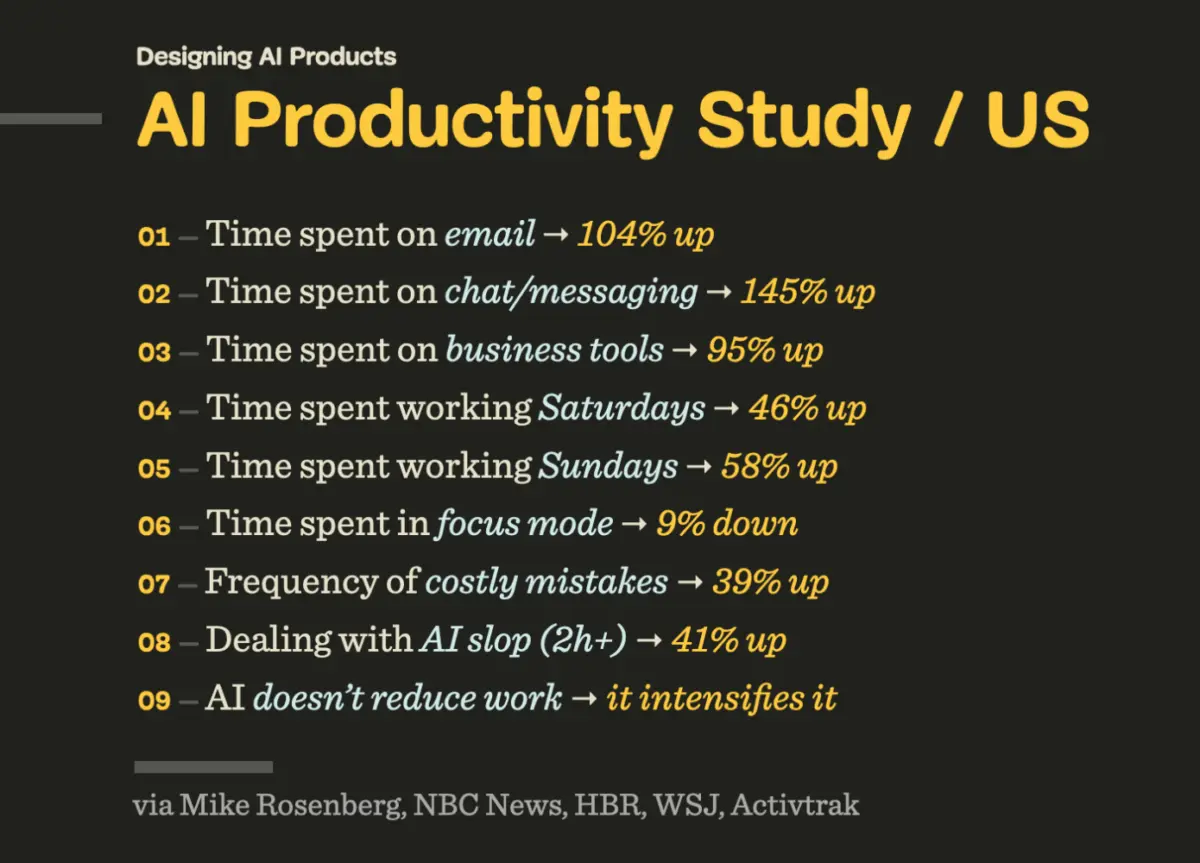
As the dust settled, enterprise productivity studies began revealing uncomfortable truths. Rather than liberating employees, the constant influx of disparate AI tools bloated workflows. Comprehensive workforce analyses demonstrated staggering increases in digital communication overhead—such as a 104% surge in email management time and a 145% spike in messaging apps—alongside a dramatic rise in weekend work. Employees were spending uncounted hours reviewing AI-generated text, weeding out hallucinations, and cleaning up "AI slop." The technological promise of working smarter had devolved into working harder, managing machines rather than executing core creative tasks.
Phase 3: The Movement Toward "AI-Second" Design (2026 and Beyond)
Today, the industry stands at a critical juncture. The novelty of conversational boxes and unpredictable autonomous agents has worn off. Organizations are grappling with low user retention figures and escalating reputational risks caused by hallucinated errors pushed directly onto consumers. Industry leaders, UX experts, and designers are now challenging foundational assumptions. The conversation has shifted away from forced automation toward ambient, humble, and deeply contextual utility—tools that respect human cognitive boundaries and operate quietly in the background.
Supporting Context & Metrics: The Human Cost of Unrequested Automation
The friction between corporate expectations and human reality is well-documented by recent studies across productivity, labor markets, and user experience research.

The Productivity Paradox
Data compiled from prominent workplace studies (including findings highlighted by NBC, Harvard Business Review, and ActivTrak) dismantle the narrative that AI inherently reduces labor. Instead, it intensifies it. Key metrics from enterprise deployments illustrate this phenomenon:
- Email volume and management time: Up 104%
- Chat and messaging platform usage: Up 145%
- Reliance on fragmented business tools: Up 95%
- Weekend burnout (working Saturdays/Sundays): Up 46% to 58%
- Decline in deep focus mode: Down 9%
- Costly oversight mistakes and error corrections: Up 39%
- Time spent filtering low-quality output ("AI slop"): Up 41%
These figures highlight a harsh reality: generating content via AI often feels easier than starting with a blank page, but the downstream cost of finding, verifying, and fixing hallucinations entirely negates that initial time savings.
Amplifying Organizational Dysfunction
Artificial intelligence is a powerful amplifier, but it lacks discernment. It excels at magnifying existing shortcuts, data quality issues, and systemic flaws within organizations. Years of accumulated technical debt, broken corporate cultures, and conflicting internal politics cannot be resolved by an algorithmic patch. When companies layer generative tools over broken workflows, they do not fix the underlying dysfunction—they merely export it directly to the user. Workers are forced to act as perpetual triage units, deciphering inconsistent outputs generated across disconnected, fragmented software systems.
Vulnerability vs. Value in the Labor Market
Research from GovAI and the Brookings Institution, mapped extensively by outlets like The Washington Post, illustrates that vulnerability to automation does not equate to a desire for replacement. While software developers, writers, and public relations specialists face high occupational exposure, the most rewarding elements of these roles rely on human taste, intuition, and lived experience. When AI attempts to replace the holistic human element—such as creative direction, artistic expression, or therapeutic support—it meets fierce psychological resistance.

Official Perspectives and Statements
The backlash against forced AI integration has united voices from prominent thinkers, UX researchers, and corporate strategists who advocate for a human-centric philosophy.
Bo Young Lee captured the collective sentiment regarding the boundaries of automation in a widely shared professional perspective:
"I don’t want to read books written by AI. I don’t want to gaze upon paintings by AI. I don’t want AI to teach my children. I don’t want to have an AI therapist. I don’t want AI making my medical decisions. I want AI to do all the physical and mental labor that taxes me so I can read books written by humans and go to art galleries to engage with art made by humans. I want AI that makes my life easier rather than forces me to change myself."
This perspective underscores the distinction between labor alleviation and human displacement. People do not dream of interacting with AI refrigerators, navigating AI-narrated children’s books, or managing swarms of autonomous agents draining bank accounts in the physical world.

Furthermore, UX design authorities emphasize that AI is fundamentally an operational component, not an independent value proposition. As business design strategist David Bland aptly notes in his framework annotations, AI belongs strictly in Key Activities and Key Resources, rather than being forced into the Value Proposition slot. A tool’s value is judged by its reliability against competitive alternatives, not by the presence of an algorithmic label. If a feature fails unpredictably, users will reject it, regardless of the underlying machine learning sophistication.
Future Outlook: Reclaiming Human-Centric Design
As the enterprise landscape matures past the initial hype cycle, the future of human-computer interaction hinges on a deliberate shift in philosophy.
1. Moving from "AI-First" to "AI-Second"
The most successful products of the coming decade will not advertise themselves as revolutionary AI platforms. Instead, they will adopt an "AI-second" posture. They will be subtle, humble, and ambient, quietly taking over tedious, repetitive, and mentally exhausting tasks without demanding direct user management. They will respect established human mental models built over years of professional practice, adapting to how people think rather than forcing users to learn erratic prompt engineering paradigms.
2. Protecting Human Agency and Joy
Work is more than an output equation; it is a source of personal achievement, skill mastery, and social connection. Stripping away the creative friction of thinking, drafting, and problem-solving through indiscriminate automation risks eroding the sense of reward that makes work meaningful. Future software design must prioritize deep focus, predictability, and emotional resonance.

3. Redefining Success in Product Development
For product designers and corporate leaders, the path forward requires rigorous empathy. Success must no longer be measured by how many generative features can be crammed into an application, but by how effectively a tool reduces friction, honors user autonomy, and preserves the headspace necessary for genuine human connection. Ultimately, people do not yearn for deeper bonds with algorithms; they want efficient tools that clear away the noise, leaving them more time to spend with the people they love.
