

Executive Overview
For decades, the foundational blueprint of the digital world has remained remarkably consistent. Since the commercialization of the Graphical User Interface (GUI) pioneered by systems like the Xerox Star and popularized by the original Apple Macintosh, software has relied heavily on point-and-click interactions. If a user wanted to book a trip, buy a pair of shoes, or research a health symptom, they were expected to navigate a labyrinth of human interfaces.
We grew accustomed to clicking menus, adjusting range sliders, filling out multi-step checkout forms, dismissing intrusive cookie banners, and opening dozens of browser tabs simply to cross-reference basic information. Over time, the digital economy inadvertently trained users to spend more time managing software than actually achieving their human goals.
Today, that digital contract is being rewritten. Propelled by monumental advances in artificial intelligence and large language models (LLMs), a radical new philosophy is sweeping through the tech industry: Intent-Driven Design. Rather than expecting users to master complex menus and click through elaborate sales funnels, modern web platforms capture high-level human objectives and execute the underlying grunt work autonomously in the background.

This paradigm shift does not just mean making buttons prettier or animations flashier; its ultimate goal is to eliminate the interface entirely. For UX designers and product architects, understanding this transformation requires a fundamental re-evaluation of their role—shifting from the design of static, visible elements to the stewardship of transparent, intent-driven AI experiences.
Detailed Chronology: From Mechanical Point-and-Click to Autonomous Intent
To comprehend the magnitude of this transition, it is helpful to trace the historical evolution of how humans communicate with machines and how friction has steadily accumulated over generations of computing.
1. The Command-Line Era (1950s–1970s)
In the early days of computing, interaction was strictly textual and syntax-driven. Users spoke the computer’s language, writing precise code and commands. While powerful for specialists, it offered zero accessibility for the general public, demanding deep technical literacy to accomplish even routine tasks.
2. The Graphical User Interface Revolution (1980s–2010s)
The introduction of the GUI revolutionized digital interaction by translating computer logic into visual metaphors—desktops, folders, icons, and buttons. Pioneered by Xerox and commercialized by Apple and Microsoft, this era democratized computing.
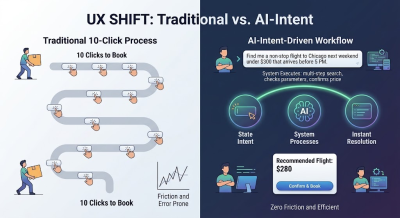
However, as software grew more complex, the GUI became cluttered. Websites and applications transformed into sprawling file cabinets, forcing users to manually drill down through hierarchical menus, multi-page forms, and nested tabs. The "10-click process" became the accepted industry standard for digital workflows.
3. The Generative and Conversational Era (Present Day)
We are now crossing the threshold into the post-GUI era. Grounded in longstanding human-computer interaction (HCI) concepts—such as Golden Krishna’s "The Best Interface Is No Interface" and Don Norman’s principles of human-centered design—modern platforms are bypassing mechanical navigation altogether. Instead of forcing users to navigate how to find a solution, intent-driven architecture asks a singular, human-centric question: What are you trying to accomplish?
Consider the traditional workflow of booking a flight online:
- Open a browser tab and navigate to an aggregator site.
- Manually input departure and arrival airports.
- Select dates using calendar drop-downs.
- Adjust filters for stops, airlines, and baggage.
- Sort through dozens of results, cross-referencing prices across multiple tabs.
- Input passenger details, seat preferences, and payment information through multi-step checkout forms.
Under an intent-driven model, this 10-click process dissolves into a single clear interaction. The user simply states: "Find me a non-stop flight to Chicago next weekend under $300 that arrives before 5 PM." The software reads the intent, executes the multi-step search query behind the scenes, compares options, and presents a single, actionable resolution.
Supporting Context & Metrics: Redefining Digital Efficiency
As traditional workflows yield to autonomous systems, early pioneers are already demonstrating how web platforms can replace static buttons with fluid intent. Three prominent examples highlight this evolution across different digital domains:
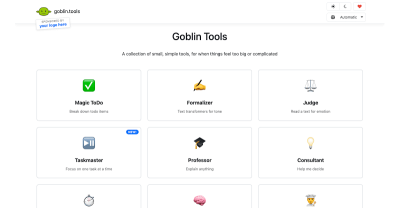
- Perplexity AI (Search Without Open Tabs): Traditional search engines were built as directories, rewarding queries with ten blue links and leaving the manual labor of skimming, ad-dodging, and cross-tabbing to the user. Platforms like Perplexity synthesize contextual information instantly, delivering direct, cohesive answers that bypass traditional link-and-tab fatigue.
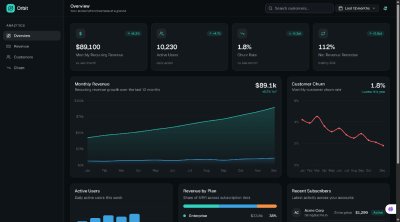
- Vercel v0 (Web Design Without Dragging and Dropping): Historically, building a digital interface required manual layout construction in tools like Figma, followed by tedious CSS and HTML coding. Generative interface builders allow users to describe a functional SaaS dashboard or e-commerce layout in natural language, rendering fully responsive UI components on the fly.
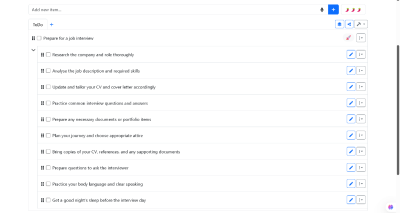
- Goblin.tools (Breaking Down Overwhelming Tasks): Traditional productivity software demands manual task-list generation, Kanban board management, and meticulous deadline assignment. Single-page AI suites designed for cognitive accessibility allow users to input a massive, overwhelming goal (such as "Plan a wedding" or "Prepare for a job interview") and automatically break it down into manageable, step-by-step checklists.
The Core Pillars of Intent-Driven Web Design
When traditional menus, sidebars, and forms are stripped away, how do designers maintain usability? Modern systems rely on three foundational pillars:
| Pillar | Traditional UX Approach | Intent-Driven UX Approach |
|---|---|---|
| User Input | Micro-actions (Clicks, dropdowns, toggles) | High-level goals (Natural language, context, habits) |
| Interface State | Static layouts (Every visitor sees the same page) | Generative UI (Layouts created dynamically on the fly) |
| Task Execution | Manual execution by the human user | Autonomous execution by background AI agents |
1. High-Level Goals & Contextual Awareness
An invisible interface does not always wait for a direct text command; it leverages environmental metadata—such as device state, location, and past interaction patterns—to anticipate user needs. Guided by human interface guidelines on ambient design, modern systems proactively streamline workflows before a user even realizes a hurdle exists.
2. Generative UI
In legacy web design, every user experiences the exact same layout, regardless of whether they are a first-time visitor seeking support or a power user tracking an enterprise account. As highlighted by the Nielsen Norman Group, computing is shifting from command-based interaction to outcome-specification. This enables Generative UI, where interfaces render dynamically based on real-time user intent. If a user expresses a desire to compute complex financial data, the system generates a dynamic calculator widget on demand, which then recedes once the goal is achieved.
3. Execution by AI Agents & Reversibility
Traditional interfaces are obsessed with prevention, constantly interrupting users with intrusive confirmation modals ("Are you sure you want to delete this file?"). Intent-driven interfaces adapt usability heuristics by shifting the safety net from prevention to easy reversibility. Because autonomous agents take actions on behalf of the user, products prioritize frictionless rollback mechanisms, prominent "Undo" buttons, and transparent audit logs over annoying warning pop-ups.
Official Statements and Industry Insights
The philosophical shift away from traditional user interfaces has prompted deep introspection across the design and technology sectors. Industry leaders and academic institutions agree that the metrics governing digital success must fundamentally change.
"The ultimate goal of modern web design is no longer to build prettier buttons or flashy animations; it is to eliminate the interface entirely."
— Golden Krishna, Author of The Best Interface Is No Interface
This perspective is echoed by research organizations examining the intersection of human behavior and artificial intelligence.
"Rather than designing static buttons and rigid forms, we need to learn to map and present dynamic, generative UI components that adapt on the fly to user intent."
— UX Design Research Consensus
However, industry experts also issue cautious warnings regarding the ethical and technical pitfalls of removing visual controls. The Stanford Human-Computer Interaction (HCI) Group notes that when software acts on inferred intent rather than explicit commands, it risks crossing the line into invasive or patronizing behavior. To combat this, frameworks from the Center for Humane Technology emphasize that designers must maintain strict boundaries—automating routine execution while explicitly prompting users for high-stakes confirmations involving financial transactions, public publishing, or privacy modifications.
To address the "black box problem"—where users struggle to diagnose unexpected software outputs—the Google PAIR (People + AI Research) Guidebook advocates for transparent feedback loops. Systems must explicitly state their real-time interpretation (e.g., "Searching for non-stop flights to Chicago under $300…") so users can accurately calibrate trust and correct misinterpretations instantly.
Future Outlook: The Death of the Digital Metric
For decades, the digital industry has evaluated software success through engagement metrics: time spent in app, click-through rates, and page views per session. Websites were deliberately engineered to maximize visual engagement, dopamine loops, and interaction volume.
The philosophy behind the Time Well Spent movement turns these traditional metrics completely on their head. The ultimate test of a modern digital product is no longer how visually captivating its buttons are, but rather: How effectively did this software solve the problem and get out of the user’s way?
We are entering an era where web applications will no longer be measured by the aesthetic complexity of their user interfaces, but by their ability to render those very interfaces completely obsolete. The future of the web is not more interaction—it is seamless, invisible completion. For UX professionals, the challenge of tomorrow will not lie in designing better walls for the labyrinth, but in helping users bypass the labyrinth entirely.