

Executive Overview
For billions of years, Earth’s closest celestial companion has worn a mask of magnetic silence. The Moon no longer generates a global, self-sustaining magnetic field—a planetary dynamo that once shielded it from the harsh solar wind and cosmic radiation. Today, our lunar neighbor is magnetically inert on a global scale. Yet, this planetary quietness is deceptive. Deeply locked inside ancient lunar rocks, regolith, and impact-melt glasses are microscopic molecular archives: pristine traces of primordial magnetism.
These microscopic magnetic minerals serve as nature’s most persistent tape recorders. By studying them, planetary scientists can reconstruct the evolution of the Moon’s ancient magnetic environment, shedding light on core dynamics, internal thermal evolution, and the early bombardment history of the inner solar system. Now, an international team of researchers has cracked open a new chapter in this planetary biography.
Analyzing metallic iron embedded within impact glass retrieved by China’s groundbreaking Chang’e-6 lunar mission, scientists have identified face-centered cubic (FCC) $gamma$-Fe (gamma-iron) for the very first time in natural lunar samples. This rare, high-temperature iron phase—previously thought incapable of surviving under the harsh, ambient conditions of the lunar surface—defies standard metallurgical expectations.
Led by Professor Haifeng Du of the High Magnetic Field Laboratory at the Hefei Institutes of Physical Science (HFIPS), part of the Chinese Academy of Sciences (CAS), the research team published their groundbreaking findings in the prestigious Proceedings of the National Academy of Sciences (PNAS) on September 16. This discovery not only expands the known inventory of magnetic minerals on the Moon but also introduces a powerful, highly stable microscopic recorder of ancient magnetic fields. As researchers peel back the layers of this metallic discovery, they are inching closer to solving one of planetary science’s most enduring mysteries: how the Moon once sustained a magnetic field stronger than Earth’s, and why it ultimately died.
Detailed Chronology of the Discovery
The journey from the dark side of the Moon to the pages of the Proceedings of the National Academy of Sciences represents a triumph of modern analytical instrumentation and international scientific enterprise.
The Chang’e-6 Triumph
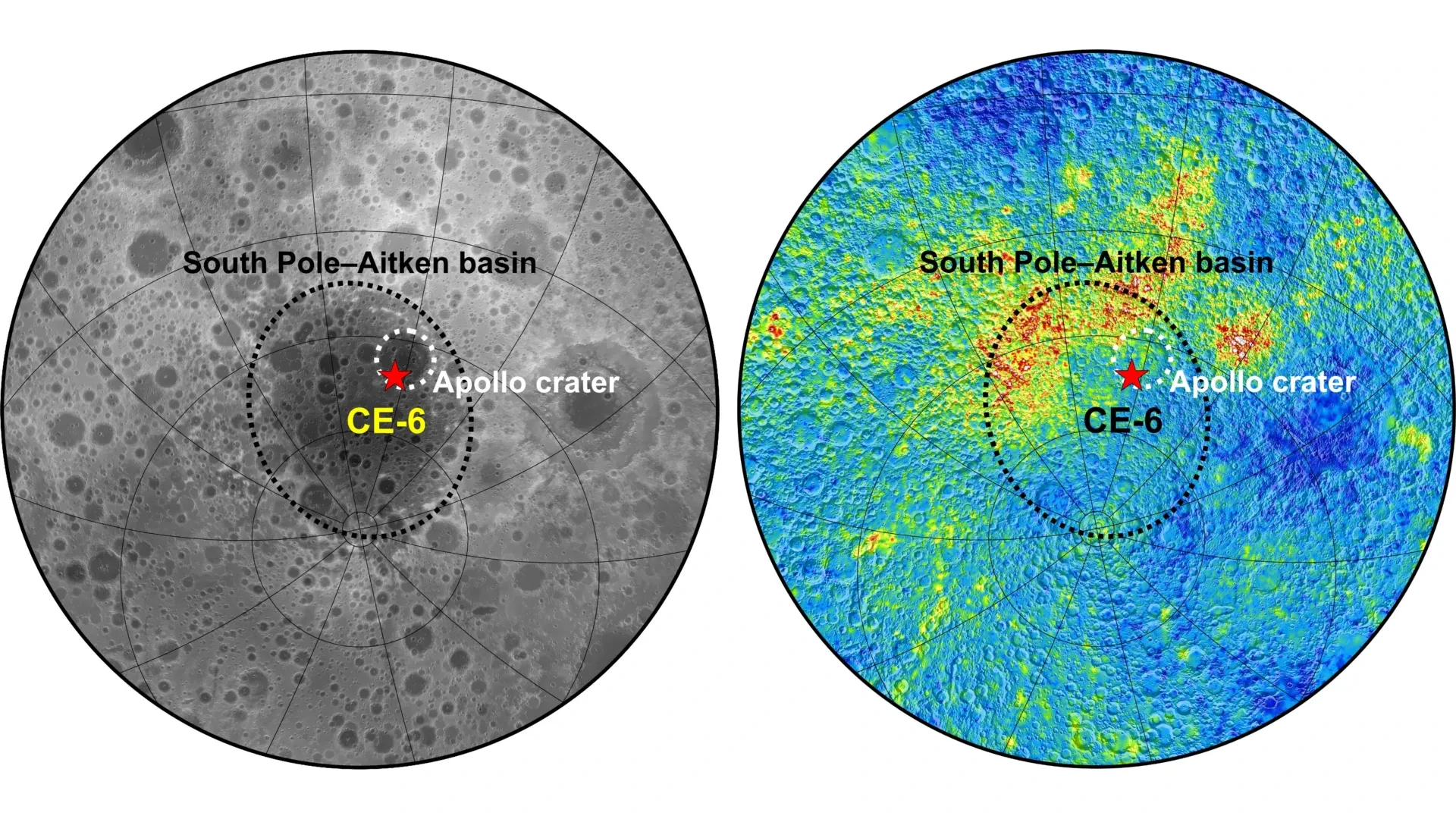
The narrative began with the historic Chang’e-6 mission, China’s ambitious lunar sample-return endeavor targeting the South Pole-Aitken (SPA) Basin—one of the largest, deepest, and oldest impact basins in the entire solar system. Unlike previous missions that sampled the basaltic maria of the lunar nearside, Chang’e-6 returned pristine material from the rugged, impact-scarred farside of the Moon. Among the returned regolith were fragments of impact glass: vitreous beads and shards forged in the extreme heat and pressure of hypervelocity meteorite impacts.
Laboratory Isolation and Nanoscale Imaging
Upon arrival at the High Magnetic Field Laboratory at HFIPS, the Chang’e-6 impact glass underwent rigorous, multi-tiered microscopic interrogation. Recognizing that the secrets of the lunar dynamo would not be found in bulk rock analysis alone, the research team deployed a suite of advanced nanoscale characterization tools.
First, researchers utilized focused ion beam (FIB) preparation to slice ultra-thin electron-transparent lamellae from the glassy matrix without altering their internal mineralogy. These samples were then transferred to state-of-the-art transmission electron microscopes (TEM) equipped with high-resolution imaging and chemical analysis capabilities.
What the team uncovered beneath the electron beam caught them by surprise. Distributed throughout the glassy material were countless nanoscale metallic iron particles, measuring only billionths of a meter across.
Identifying the Elusive $gamma$-Fe Phase
A closer crystallographic examination of these nanoscale iron inclusions revealed a profound anomaly. While terrestrial and previously studied lunar samples predominantly contain body-centered cubic (BCC) $alpha$-Fe (alpha-iron, commonly known as kamacite or ferrite), a significant portion of the particles within the Chang’e-6 impact glass possessed a face-centered cubic crystal lattice—the signature structure of $gamma$-Fe, or austenite.
In fact, $gamma$-Fe emerged as the dominant form of iron in the two distinct impact-glass samples subjected to exhaustive analysis. Under standard thermodynamic and metallurgical conditions on Earth—and presumably across the inner solar system—$gamma$-Fe is stable only at extremely high temperatures (above 912°C for pure iron). As molten iron cools under normal terrestrial rates, it inevitably undergoes a solid-state phase transformation, shedding its face-centered cubic structure to settle into the more stable body-centered cubic $alpha$-phase.
The fact that $gamma$-Fe was preserved in natural lunar samples—exposed to millions of years of thermal cycling, cosmic ray bombardment, and micrometeoroid impacts—presented a profound paradox. How had this high-temperature thermodynamic transient managed to survive on the frozen, airless lunar surface?
Unraveling the Stabilization Mechanism
To solve this metallurgical mystery, the HFIPS research team proposed a sophisticated stabilization model. They deduced that the extreme physics of lunar impacts provided a unique window for the creation and preservation of $gamma$-Fe.
When a hypervelocity impact melts lunar rock, it generates fleeting conditions of immense pressure, superheating silicates and metallic iron into a chaotic, molten aerosol. As this melt rapidly quenches into impact glass, the surrounding glassy matrix acts as an immutable structural cage. This vitreous prison physically restricts the enclosed iron nanoparticles, preventing the atomic rearrangement required for the $gamma$-to-$alpha$ phase transition.
Furthermore, the researchers identified that minute chemical dopants—specifically trace amounts of carbon and other interstitial elements incorporated during the impact event—play a critical stabilizing role. Much like carbon transforms soft iron into hardened steel by locking crystal lattices into place, these trace elements chemically tether the face-centered cubic structure, allowing $gamma$-Fe to defy thermodynamic equilibrium and persist indefinitely at room temperature.
Probing Magnetic Behavior via Electron Holography
With the crystalline structure identified, the team shifted their focus to functionality: how does nanoscale $gamma$-Fe behave in a magnetic field?
To answer this, the researchers employed off-axis electron holography, an advanced transmission electron microscopy technique that allows scientists to map magnetic induction lines inside and around microscopic structures with nanometer-scale spatial resolution.
The holography data revealed that relatively large $gamma$-Fe nanoparticles do not collapse into random magnetic domains. Instead, they form a highly stable, single-vortex magnetic state. When exposed to an external magnetic field, these vortex structures maintained a remarkably consistent and predictable magnetic response. This structural and magnetic resilience confirmed that $gamma$-Fe is not merely a mineralogical curiosity; it is an exceptionally robust archive of paleomagnetic history.
Supporting Context & Metrics
To appreciate the gravity of the CAS findings, one must view them through the broader lens of lunar geophysics, paleomagnetism, and instrumentation metrics.
The Lunar Dynamo Enigma
For decades, planetologists have grappled with the "lunar magnetic paradox." Paleomagnetic analysis of Apollo-era samples revealed that between 3.9 and 3.5 billion years ago, the Moon possessed a roaring global magnetic field with surface intensities comparable to—or even exceeding—modern Earth’s field (ranging from 20 to over 100 microteslas).
However, generating such a powerful magnetic field requires a vigorously convecting, liquid iron-rich core. Given the Moon’s small size (roughly one-quarter Earth’s diameter), its core should have cooled and solidified rapidly, shutting down the dynamo long before 3.5 billion years ago. Various hypotheses have been proposed to explain this anomaly, including mechanical precession driven by Earth-Moon tidal interactions, core crystallization driven by silicate mantle overturn, and impact-generated plasmas.
To test these competing hypotheses, scientists desperately need accurate, high-fidelity records of the Moon’s magnetic field strength and orientation across different geological epochs. This is where the Chang’e-6 discovery becomes transformative.
Key Analytical Metrics & Parameters
The rigor of the PNAS study is underscored by the precision metrics achieved during laboratory analysis:
- Particle Sizing: The identified nanoscale $gamma$-Fe inclusions predominantly measure between 10 and 100 nanometers, placing them squarely in the optimal size range for single-domain and single-vortex paleomagnetic recording.
- Thermal Stability Thresholds: While pure $gamma$-Fe decomposes below 912°C under standard pressure, the stabilized lunar $gamma$-Fe demonstrated survival across ambient lunar surface temperatures ranging from -130°C in shadowed craters to +120°C in direct sunlight.
- Crystalline Fraction: Quantitative electron diffraction analysis confirmed that $gamma$-Fe constituted over 50% of the metallic iron phase within the analyzed impact-glass domains, proving it is not an isolated freak occurrence but a widespread product of lunar impact shock metamorphism.
- Spatial Resolution: Off-axis electron holography achieved magnetic field mapping resolutions down to the sub-nanometer scale, isolating the internal magnetic flux of individual iron particles from background noise.
Comparing $alpha$-Fe and $gamma$-Fe as Magnetic Recorders
| Mineral Phase | Chemical Composition | Crystal Structure | Formation Environment | Magnetic Behavior | Paleomagnetic Utility |
|---|---|---|---|---|---|
| $alpha$-Fe (Kamacite) | Nearly pure metallic iron (low nickel) | Body-Centered Cubic (BCC) | Slow cooling from metallic melts, solar wind reduction | Multi-domain or stable single-domain | Traditional baseline recorder; prone to chemical alteration over billions of years. |
| $gamma$-Fe (Austenite) | Iron alloyed with trace carbon/elements | Face-Centered Cubic (FCC) | Hypervelocity impact melt quenched rapidly in glass | Single-vortex state; high structural resilience | New Frontier: Preserves pristine magnetic memory shielded within impact glass matrices. |
Official Statements & Expert Commentary
The publication of the HFIPS study has generated ripples throughout the global planetary science community, emphasizing the collaborative and forward-looking nature of modern lunar exploration.
Highlighting the significance of the find, Dr. Long Li of the Hefei Institutes of Physical Science and co-author of the study remarked during a press briefing:
"This tiny magnetic fossil may help us better understand the Moon’s ancient magnetic history. For years, we relied heavily on standard iron phases like kamacite to read the lunar tape recorder. Finding face-centered cubic gamma-iron opens up an entirely separate track of data—one that was forged in the explosive violence of hypervelocity impacts and preserved safely within glassy time capsules."
Professor Haifeng Du, who led the research team at CAS, emphasized the methodological leap required to achieve the breakthrough:
"The lunar regolith returned by Chang’e-6 represents a treasure trove from the farside—a region untouched by previous sample-return missions. By combining focused ion beam preparation with high-resolution transmission electron microscopy and off-axis electron holography, we were able to look inside nanoparticles smaller than a virus. What we saw forces us to revise our models of how iron behaves and survives in extraterrestrial impact environments."
International peers have echoed these sentiments, noting that the identification of $gamma$-Fe bridges the gap between material science and planetary geophysics. Dr. Marcus Vance, a senior paleomagnetist unaffiliated with the study, noted:
"Finding $gamma$-Fe in natural lunar samples is a stunning metallurgical achievement. It proves that nature can synthesize and stabilize high-temperature phases through rapid impact quenching. More importantly, because $gamma$-Fe and $alpha$-Fe form under vastly different thermal and chemical conditions, planetary scientists now have two independent thermometers and magnetometers embedded side-by-side in lunar glass. It is like finding a dual-format flight data recorder in the wreckage of an ancient impact."
Future Outlook: The Next Frontier in Lunar Paleomagnetism
As the scientific community digests the implications of the Chang’e-6 $gamma$-Fe discovery, attention is already turning toward future research trajectories and upcoming lunar exploration missions.
Expanding the Sample Inventory
The immediate next step for Professor Du’s team and their collaborators is to expand the survey of Chang’e-6 impact glass. Researchers aim to analyze a wider cross-section of glass beads, impact breccias, and agglutinates from different geological units within the South Pole-Aitken Basin. By mapping the abundance and magnetic orientation of $gamma$-Fe across multiple impact events spanning different geological ages, scientists hope to construct a high-resolution timeline of the lunar dynamo’s rise and fall.
Decoding Impact-Generated Magnetic Fields
A fascinating sub-field of lunar magnetism involves understanding whether hypervelocity impacts themselves can generate transient, powerful magnetic fields via plasma blow-off mechanisms (the impact-dynamo hypothesis). Because $gamma$-Fe is directly born from the shock and melt of hypervelocity impacts, it may hold the key to distinguishing between internal core dynamo signals and impact-induced local magnetic fields. Future paleomagnetic experiments will subject synthetic analogs of the Chang’e-6 $gamma$-Fe nanoparticles to controlled high-pressure shock experiments in terrestrial laboratories to replicate their exact formation pathway.
Synergies with Upcoming Exploration
The timing of this discovery coincides with a golden age of lunar exploration. With NASA’s Artemis program aiming to return humans to the lunar south pole, and China’s Chang’e-7 and Chang’e-8 missions slated to investigate the composition and volatile distribution of the lunar polar regions, the acquisition of pristine, oriented, and cryogenic lunar samples will accelerate dramatically.
Future astronauts and robotic landers equipped with specialized core-drilling tools will be able to extract stratigraphic columns of regolith, preserving the precise directional orientation of magnetic minerals layer by layer. When analyzed using advanced techniques like off-axis electron holography and synchrotron-based X-ray microscopy, these samples will provide an unprecedentedly detailed stereoscopic view of the Moon’s ancient magnetic evolution.
Conclusion
The identification of face-centered cubic $gamma$-Fe in Chang’e-6 lunar soil is a testament to the power of interdisciplinary science—where solid-state physics, materials engineering, and planetary geology converge. By uncovering a microscopic magnetic fossil that defies thermodynamic convention, researchers have secured a new, highly resilient witness to the Moon’s fiery past. As this research advances, the silent Moon may finally yield the full story of the invisible magnetic forces that once shaped its destiny.