

Executive Overview
In a masterclass of orbital mechanics and real-time space navigation, the European Space Agency’s (ESA) Jupiter Icy Moons Explorer—universally known as Juice—skimmed the outer reaches of Earth’s atmosphere on September 28. Executing a highly sophisticated gravity assist, the spacecraft used our home planet’s gravitational well to reshape its trajectory toward the outer Solar System while expending a bare minimum of propellant.
Reaching its point of closest approach at 13:45 CEST (11:45 UTC), Juice soared a mere 8,640 kilometers above the surface of the Indian Ocean. This meticulously calculated maneuver changed the spacecraft’s heading by 20 degrees relative to its previous trajectory and imparted a staggering velocity boost of 3.5 kilometers per second. More importantly, because mission controllers executed the approach with pinpoint precision, the spacecraft consumed only a negligible fraction of the fuel reserved for the encounter. Preserving this propellant is a mission-critical victory; every gram saved now can later be deployed to execute complex orbital adjustments and scientific observations once Juice arrives in the Jovian system.
Beyond its primary function as a celestial slingshot, the Earth flyby served as an invaluable testing ground. Mission specialists used the encounter to calibrate Juice’s suite of 10 state-of-the-art scientific instruments against a real planetary target, navigating complex operational constraints—such as relying solely on battery power while passing through Earth’s shadow. Furthermore, the spacecraft’s passage through Earth’s magnetotail provided a rare, dual-point data-gathering opportunity in tandem with the European-Chinese Smile mission.
As Juice continues its multi-year interplanetary trek—culminating in a final Earth flyby in January 2029 and a planned Jovian arrival in 2031—this successful encounter marks a monumental stepping stone for humankind’s next bold leap into the outer Solar System.
Detailed Chronology: The Anatomy of a Planetary Slingshot
The success of the September 28 Earth flyby was not left to chance; it was the culmination of weeks of intensive monitoring, real-time trajectory adjustments, and years of multidisciplinary coordination.
The Lead-Up: Precision Tracking and Minor Corrections
Mission controllers began intensifying their oversight of the Juice spacecraft on August 17, initiating a monitoring protocol scheduled to run continuously through October 10. Navigating a spacecraft on an interplanetary trajectory requires hyper-accurate calculations, as even the slightest deviation over millions of kilometers can result in missing a planetary target by thousands of kilometers.
Out of six trajectory correction opportunities strategically set aside by mission planners ahead of the encounter, controllers ultimately needed to execute only one small course correction. This singular, minor adjustment was sufficient to place Juice on the exact vector required to take full advantage of Earth’s gravity.
The Close Approach
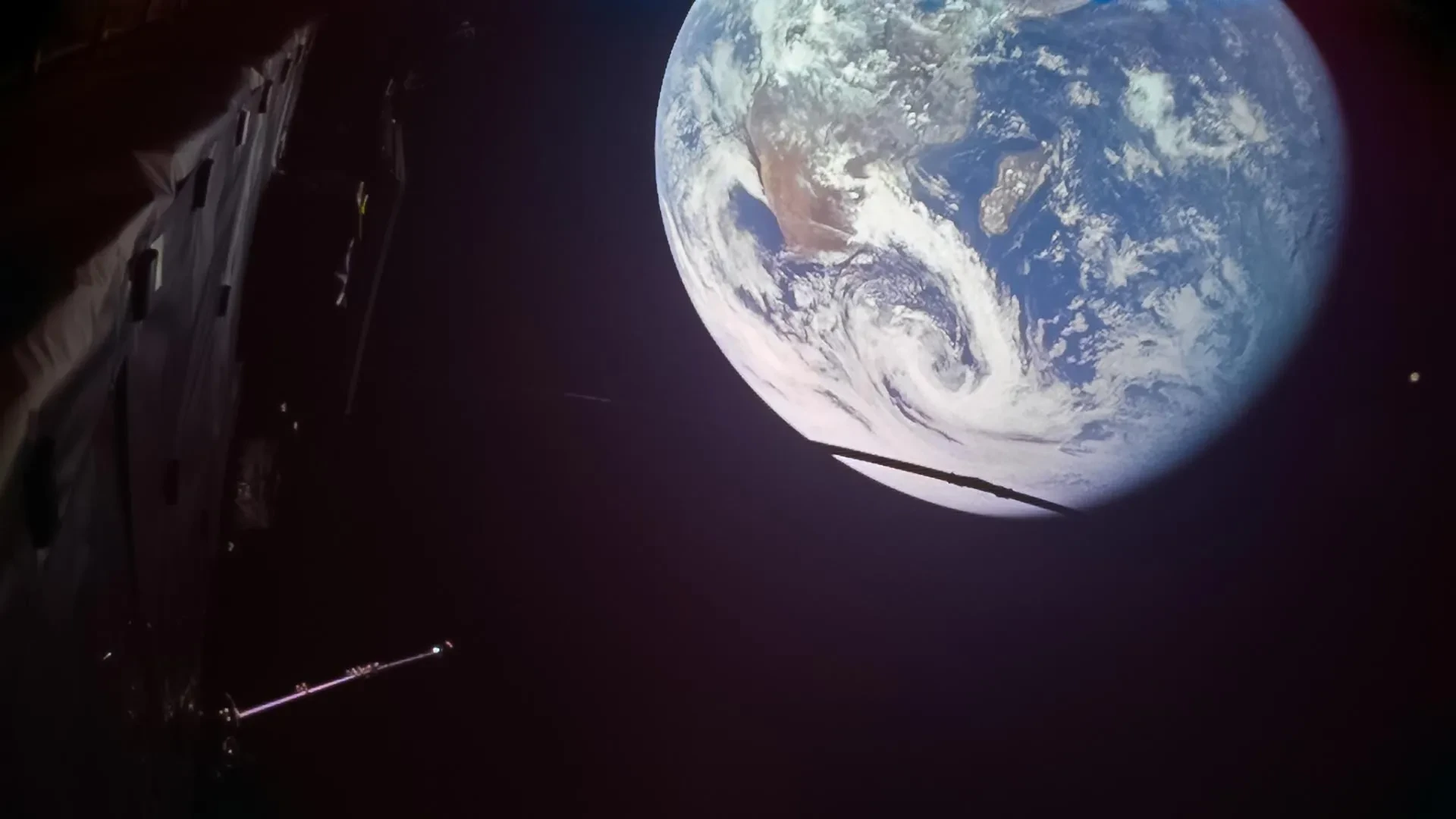
At 13:45 CEST on September 28, Juice reached its perigee—the point of closest approach to Earth. Skimming just 8,640 kilometers above the Indian Ocean, the spacecraft was moving at a ferocious speed. Despite the velocity and the tight operational margins, Juice’s onboard monitoring cameras successfully captured a sequence of high-resolution images as it whipped past the planet.
This gravity assist successfully altered Juice’s trajectory by 20 degrees and accelerated it by 3.5 km/s. The maneuver represents a crucial step in the spacecraft’s eight-year cruise phase, which utilizes a series of planetary flybys (including previous lunar-Earth assists in 2024 and observations of Comet 3I/ATLAS in 2025) to build up the immense energy required to reach Jupiter.
Supporting Context & Metrics: Instruments, Magnetotails, and Rehearsals
While altering the spacecraft’s course was the primary objective, the encounter offered scientists a rare window to test, calibrate, and validate Juice’s sophisticated instrumentation under authentic space-weather and planetary conditions.
Calibrating for the Jovian Unknown
Juice carries 10 scientific instruments designed to study remote sensing, geophysics, and in-situ phenomena. However, operating scientific hardware in the vacuum of deep space often yields behavioral nuances that cannot be fully replicated in terrestrial laboratories.
Months of cross-departmental planning between ESA’s spacecraft operations, science operations, and technical centers—alongside the external consortia responsible for individual instruments—went into scheduling every minute of the flyby. Because Juice’s journey provides only a handful of opportunities to calibrate instruments under well-understood conditions, prioritizing activities was paramount.
For instance, when Juice passed through Earth’s shadow early in the morning of the flyby, it was forced to rely strictly on battery power. During this energy-constrained period, teams prioritized calibration tasks based on two strict criteria:
- The direct relevance of the data to preparing the instruments for their eventual work at Jupiter.
- Whether the calibration opportunity was unique or could be safely scheduled later in the cruise phase.
Exploring Earth’s Magnetotail
In addition to capturing optical imagery, Juice spent several days traveling directly through Earth’s magnetotail—the vast, comet-like extension of our planet’s magnetic field that streams away from the Sun.
This region allowed Juice’s sensors to measure magnetic fields and electrically charged particles far downstream from Earth. Simultaneously, the European-Chinese Smile mission was actively observing Earth’s northern lights while measuring magnetic fields and particles much closer to the planet. By combining the dataset gathered by Juice in the distant magnetotail with the close-range observations of the Smile mission, researchers hope to unlock a holistic understanding of how energy from the solar wind couples with Earth’s magnetic field and precipitates into the polar regions.
Official Statements and Expert Insights
The seamless execution of the flyby drew praise from ESA leadership, highlighting the rigorous preparation invested by international scientific teams.
"The flyby required ultra-precise navigation in real time," noted Angela Dietz, Juice’s Spacecraft Operations Manager. "Thanks to our very careful planning, we used only a small amount of the propellant reserved for this flyby. This gives us more to use at Jupiter to carry out observations of the planet’s icy moons."
Dietz’s comments underscore the unforgiving economics of deep-space exploration. Every drop of hydrazine saved during cruise maneuvers translates directly to extended operational lifetimes and deeper scientific investigations once the spacecraft enters orbit around the Jovian system.
Meanwhile, project scientist Claire Vallat, who spearheaded the multi-institution instrument coordination effort, emphasized the irreplaceable value of Earth as a calibration testbed:
"Juice’s journey to Jupiter provides only a few opportunities to calibrate and validate the instruments under well-understood environmental conditions. Given the limited time available and operational constraints, instrument activities sometimes have to be prioritized… during this flyby, calibration activities were prioritized based on their relevance to preparing the instruments for their work at Jupiter."
Future Outlook: Rehearsals for the Ice Giants and the Final Earth Pass
While the Earth flyby demanded exhaustive planning and flawless execution, mission scientists view it merely as a dress rehearsal for the monumental challenges awaiting Juice at Jupiter.
The Jovian Campaign and Ganymede Orbit
Once Juice reaches the Jovian system in the early 2030s, it will embark on a breathtakingly complex tour consisting of 35 individual flybys of Jupiter’s three largest ocean-bearing moons: Ganymede, Callisto, and Europa.
The planning scale for these encounters is unprecedented. For the Europa flybys, preliminary discussions regarding how sensitive instruments will operate began roughly a decade ago, and planning will continue right up until the spacecraft sweeps past the icy moon.
Because the scientific stakes at Jupiter are extraordinarily high—scientists are hunting for potential habitats for past or present life—the Earth flyby served as a vital proving ground. It allowed researchers to understand how their hardware behaves in space, refine data-analysis pipelines, and ensure that every precious second of observation during future moon flybys yields maximum scientific return.
The Road Ahead: The Final Slingshot
Juice’s relationship with Earth is not yet complete. Following its current trajectory, the spacecraft will loop through the inner Solar System before returning to our home planet in January 2029 for a third and final gravity-assist flyby.
That final encounter will supply the ultimate gravitational push, placing Juice on its definitive terminal trajectory toward a scheduled July 2031 rendezvous with Jupiter. In the coming weeks, as telemetry and raw data make their way back across the interplanetary void, mission teams expect to release stunning high-resolution images of Earth and the Moon captured by JANUS, Juice’s primary scientific camera—offering the public a breathtaking glimpse of our planet through the eyes of an outward-bound explorer.
Quick Reference: About the Juice Mission
- Mission Name: Jupiter Icy Moons Explorer (Juice)
- Space Agency: European Space Agency (ESA)
- Launch Date: April 2023 (via Ariane 5 from Europe’s Spaceport in Kourou, French Guiana)
- Primary Objective: To characterize Jupiter and its three ocean-bearing moons (Ganymede, Callisto, and Europa) as potential habitats for life, while studying the Jovian system as an archetype for gas giant systems across the universe.
- Key Milestones:
- Lunar-Earth gravity assist (2024)
- Comet 3I/ATLAS observations (2025)
- Critical Earth gravity assist (September 28, 2025)
- Final Earth gravity assist (January 2029)
- Jovian System Arrival (July 2031)