

Executive Overview
In the realm of modern science, breakthroughs often rely on particle accelerators, space telescopes, and supercomputers running complex algorithms. Yet, a groundbreaking interdisciplinary study published in the Astrophysical Journal Letters demonstrates that some of the most profound insights into our planet and our star can be found by looking backward—specifically, into the inked bamboo slips and silk scrolls of antiquity.
An international team of historians, geographers, and astrophysicists has successfully revisited one of the oldest precisely dated records of a total solar eclipse in human history. The event, which plunged the ancient capital of China’s Lu Duchy into midday darkness on July 17, 709 BCE, has long fascinated historians. However, by marrying historical geography with modern astronomical calculations, contemporary researchers have transformed a 2,700-year-old administrative chronicle into a precise scientific instrument.
The investigation yielded two monumental realizations. First, by correcting a mere eight-kilometer discrepancy in the historical geography of the ancient capital of Qufu, the team unlocked ultra-precise data regarding the ancient rotational deceleration of Earth. Second, the study sheds new light on an ancient addendum that may represent one of the earliest surviving written descriptions of the Sun’s elusive corona. This description hints at a celestial body emerging from a prolonged epoch of low magnetic activity, providing independent validation for space-climate models derived from tree-ring radiocarbon data.
Ultimately, this research bridges a vast chasm between ancient omenology and modern astrophysics, proving that the meticulous observations of imperial court astronomers continue to shape our understanding of the cosmos.
Detailed Chronology: The Re-examination of 709 BCE
To understand the significance of the 709 BCE eclipse, one must traverse a historical landscape stretching back over two millennia. The narrative of this scientific breakthrough unfolds across three distinct eras: the original observation, the subsequent archival addendums, and the modern methodological breakthrough.
The Dawn of Precision Record-Keeping
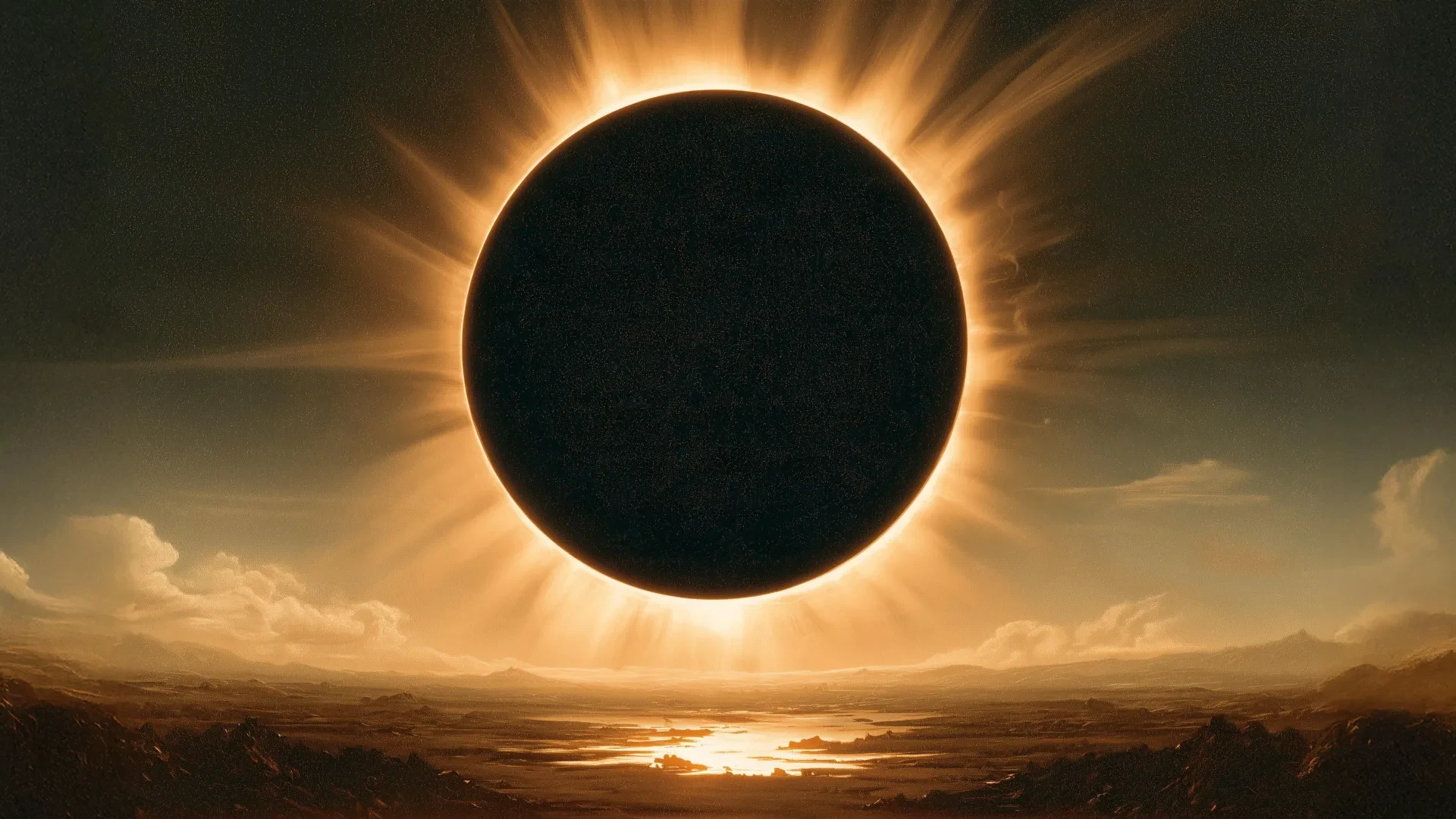
On July 17, 709 BCE, skywatchers stationed at the court of the Lu Duchy witnessed a terrifying and awe-inspiring celestial phenomenon: day turned to night as the Moon completely obscured the face of the Sun. This event was meticulously preserved in the Chunqiu (Spring and Autumn Annals), a foundational historical chronicle traditionally attributed to Confucius, compiled roughly two hundred to three hundred years after the event. The original entry is stark and direct: "The Sun was totally eclipsed."
Centuries later, during the Han Dynasty, court historians expanded upon these earlier annals. The Hanshu (Book of Han), compiled approximately seven centuries after the eclipse occurred, contains an extraordinary addendum. It describes the eclipsed Sun as "completely yellow above and below." To modern solar physicists, this phrase has long been a subject of intense intrigue, as it strongly implies an eyewitness account of the solar corona—the pearly white halo of plasma that flashes into view only during the fleeting moments of totality.
The Geographic Puzzle
When the international research team initially attempted to model the 709 BCE eclipse, they encountered a stubborn paradox. Using standard, accepted estimates for Earth’s historical rotation speed, their computer simulations dictated that a total solar eclipse should not have been visible from Qufu, the traditionally accepted capital of the Lu Duchy. The mathematical path of totality missed the ancient city by a margin wide enough to invalidate the historical account—or so it seemed.
Rather than dismissing the ancient scribes as mistaken, the researchers dug deeper into the archaeological record. They discovered that previous reconstructions of Earth’s rotation had relied on flawed geographic coordinates for ancient Qufu. By consulting archaeological excavation reports, ancient maps, and regional historical texts, the team realized that earlier studies had mislocated Qufu by approximately eight kilometers.
Solving the Equation
Correcting this eight-kilometer error changed everything. When plugged into modern astronomical models, the corrected coordinates aligned the path of totality perfectly with Qufu on the afternoon of July 17, 709 BCE.
This spatial accuracy acted as a master key. With the observer’s exact location verified beyond a doubt, the researchers were able to work backward to measure variables that cannot be directly observed from the present day: the precise speed at which Earth was spinning during the eighth century BCE, the orientation of the solar rotation axis, and the simulated morphology of the Sun’s corona as it would have appeared to the naked eye of an ancient observer.
Supporting Context & Metrics: Earth’s Rotation and the Awakening Sun
The implications of the 709 BCE eclipse extend far beyond historical trivia, offering crucial data points for geophysical and solar-terrestrial research.
Quantifying Earth’s Decelerating Spin
Earth does not rotate at a uniform, unchanging rate. Over geological and historical timeframes, our planet’s spin is gradually slowing down. This deceleration is primarily driven by tidal friction—the gravitational interactions between Earth’s oceans, the solid crust, and the Moon. Because the Moon’s gravity constantly tugs at the oceans, it acts as a cosmic brake, lengthening our days by a fraction of a second every century.
To account for this variation when calculating historical astronomical events, scientists use a metric known as $Delta T$ (Delta T). This represents the difference between Terrestrial Time (a uniform, idealized time scale) and Universal Time (which is determined by Earth’s actual, irregular rotation).
By utilizing the corrected geographic position of Qufu and the undeniable totality of the 709 BCE eclipse, the researchers constrained $Delta T$ for the period spanning the eighth through sixth centuries BCE to a range between 20,264 and 21,204 seconds. This newly refined dataset irons out discrepancies in prior Earth rotation studies, allowing scientists to model ancient and future celestial mechanics with unprecedented accuracy.
The Sun’s Great Awakening
Perhaps the most tantalizing aspect of the study is its intersection with solar physics. The Sun is not a static furnace; it operates on an approximate 11-year cycle of magnetic activity, sunspots, and coronal ejections. Furthermore, the Sun occasionally falls into extended periods of extreme quiescence known as "grand minima," during which sunspots virtually vanish and magnetic activity plummets.
Between 808 and 717 BCE, the Sun was locked in such a slump, an interval referred to by astrophysicists as the Neo-Assyrian or Homer Grand Minimum. The eclipse of 709 BCE occurred mere years after this prolonged quiet period ended.
The Hanshu addendum describing the eclipsed Sun as "completely yellow above and below" suggests a structured, magnetically robust corona. According to the research team, this morphological description is entirely consistent with a star that was rapidly returning to a vigorous, active phase near the peak of its sunspot cycle.
Crucially, this historical inference provides an invaluable cross-check for paleoclimatologists. For years, scientists have reconstructed ancient solar activity by measuring radioactive carbon-14 isotopes preserved in the annual growth rings of ancient trees, as well as beryllium-10 trapped in polar ice cores. Cosmic rays from deep space create these isotopes, but a magnetically active Sun deflects cosmic rays away from Earth, lowering C-14 production. The 709 BCE eclipse record offers an independent, historical spot-reference that supports these radiocarbon-based solar models, bridging the gap between proxy data and eyewitness testimony.
Official Statements & Expert Perspectives
The multidisciplinary nature of this research brought together leading experts from diverse academic institutions across the globe. Their commentary underscores the profound synergy between ancient history and cutting-edge science.
Lead author Dr. Hisashi Hayakawa, an assistant professor at Nagoya University’s Institute for Space-Earth Environmental Research and Institute for Advanced Research—who holds doctorates in both solar physics and oriental history—highlighted the unique nature of the Chinese archives:
"What makes this record special isn’t just its age, but also a later addendum in the ‘Hanshu’ based on a quote written seven centuries after the eclipse. It describes the eclipsed Sun as ‘completely yellow above and below.’ This addendum has been traditionally associated with a record of a solar corona. If this is truly the case, it represents one of the earliest surviving written descriptions of the solar corona.
This correction allowed us to accurately measure the Earth’s rotation during the total eclipse, calculate the orientation of the Sun’s rotation axis, and simulate the corona’s appearance."
Co-author Dr. Mitsuru Sôma of the National Astronomical Observatory of Japan emphasized the technical utility of the geophysical data recovered during the study:
"This new dataset fixes coordinate errors in previous Earth rotation studies. Additionally, it improves the accuracy of dating and reconstructing historical astronomical events across antiquity."
Addressing the climatological and solar implications, Dr. Mathew Owens, a professor of space physics at the University of Reading, noted the importance of historical validation for modern predictive models:
"This unique historical addendum for the possible solar coronal structure is critical for providing a spot reference on solar activity reconstructions from tree rings and ice cores, as well as providing independent validation of solar activity models."
Finally, Dr. Meng Jin of the Lockheed Martin Solar and Astrophysics Laboratory summarized the philosophical and scientific weight of looking to our ancestors for modern answers:
"Some of our ancestors were very skilled observers. When we combine their careful records with modern computational methods and historical evidence, we can potentially find new information about our planet and our star from thousands of years ago."
Future Outlook: The Intersection of History and Space Weather
The success of the 709 BCE eclipse study opens an exciting frontier in scientific research. It challenges the academic divide between the humanities and the hard sciences, demonstrating that historical texts are not merely stories of human political drama, but sprawling, unmined databases of geophysical and astrophysical phenomena.
Why Ancient Records Matter Today
In an era dominated by satellite telemetry and digital sensors, it is easy to overlook the value of naked-eye observations. Yet, modern instruments only provide data spanning a few decades or, at most, a couple of centuries. To understand long-term cycles of solar behavior—such as grand minima and grand maxima—scientists require baselines that stretch across millennia. Understanding these multi-century cycles is not just an academic exercise; it has vital practical applications for modern society.
A severe solar storm, akin to the Carrington Event of 1859, could devastate modern power grids, knock out global satellite communications, and disrupt internet infrastructure. By studying how the Sun behaved during ancient transitions—such as its emergence from the Neo-Assyrian Grand Minimum in the eighth century BCE—astrophysicists can better model the probability and mechanics of future extreme space weather events.
The Path Forward
Armed with the methodological framework established by Hayakawa and his colleagues, researchers are now casting a wider net. Thousands of unexamined or under-analyzed astronomical records languish in the imperial archives of China, Korea, Japan, the Middle East, and Europe.
As geographic information systems (GIS) become more sophisticated, and as international collaborations between historians and astrophysicists grow more common, we can expect a renaissance in historical astronomy. The meticulous record-keeping of ancient scribes—who watched the skies out of fear, reverence, or political duty—is proving to be an irreplaceable asset. Two thousand seven hundred years after an anonymous court observer watched the sky go dark over Qufu, their words are still illuminating the inner workings of our planet and our star.