

Executive Overview
Amidst a whirlwind schedule defined by a burgeoning book tour, the onboarding of a new canine household member, and the relentless final stretches of manuscript composition, the annual ritual of deep-dive apple reviewing faces structural constraints. Yet, the immutable pull of the pomological season remains impossible to ignore. Rather than abandoning the pursuit of seasonal critique altogether, this year’s evaluation transitions into a comprehensive series of capsule reviews—a meticulous, highly subjective, and frequently chaotic examination of ten distinct apple varieties sampled across multiple geographic regions and orchards.
From the historic orchards of Vermont’s Scott Farm to Wisconsin’s esteemed Brightonwoods, this survey documents the triumph of dramatic culinary glow-ups, the peculiar sensory anomalies of crabapple genetics, and the structural frustrations of overly dense flesh. Far from a dispassionate scientific study, this investigative tasting provides granular ratings, flavor profiles, and zero-gravity commentary on an erratic harvest. Furthermore, this survey serves as a vital checkpoint for enthusiasts tracking seasonal fruit variance, proving that an apple’s character is as mutable as the weather systems that nurture it.

Detailed Chronology & Variety Evaluations
The tasting itinerary spans traditional European heirlooms, lesser-known American discoveries, and utilitarian crabapples. Each specimen was evaluated based on skin resistance, flesh density, juice volume, and aromatic evolution from the initial bite to the lingering aftertaste.
1. Gravenstein
- Origin: Scott Farm (Vermont / Historical Danish lineage)
- Rating: 7.5 / 10
The Gravenstein—not to be confused with any cinematic medical professionals—proved to be a delightful surprise despite the variety’s notorious reputation for being finicky in American soils. While falling slightly short of maximum structural crispness, the fruit compensated with an abundance of juice and a profound flavor profile. Tasting notes revealed deep undertones of vanilla and rooibos tea, gracefully complemented by subtle whispers of honey and elderflower. The skin offered a satisfying pop upon biting, proving entirely unobtrusive to the sensory experience.

2. Hubbardston Nonesuch
- Origin: Scott Farm (Vermont)
- Rating: 3.7 / 10
Bearing a moniker evocative of a Depression-era snake-oil salesman, the Hubbardston Nonesuch yielded a thoroughly underwhelming result across two separate tastings. Initial impressions were defined by a tongue-scrubbing astringency that quickly transitioned into a dull, flat profile—what can best be described as a "bright white nothingness" touched by a brief ping of florality. A subsequent test weeks later revealed a sweeter, sub-acid profile that completely lacked structural zip, ghosting off the palate with alarming speed. The decimal-heavy score reflects an arbitrary precision designed to mirror mathematical rigor where none truly exists.
3. Lamb Abbey Pearmain
- Origin: Regional Harvest
- Rating: 7.5 / 10
Revisited after a five-year hiatus that previously yielded a decidedly mediocre impression, the Lamb Abbey Pearmain underwent a striking redemption. Eschewing its former reputation for boredom, this specimen emerged as a near-platonic ideal of the fruit: crunchy-crisp flesh, an impeccably balanced tart-sweet axis, and classic apple flavors underscored by tangerine citrus and a bizarrely pleasant umami note. This dramatic seasonal shift underscores a fundamental truth of pomology: apples are chaos fruits, shifting unpredictably from one harvest to the next.

4. Hewes Crab (Virginia Crab)
- Origin: Regional Harvest
- Rating: 5.0 / 10
Categorized primarily as a cider stock or an instrument for playful, disdainful child-deterrence, the Hewes Crab is an inherently bizarre specimen. Lacking substantial juice and leaning toward a mealy texture, it nevertheless captivated the palate through an extraordinary flavor evolution. Starting with a confounding synthesis of pear, pineapple, and savory tamarind, the experience culminated in an unexpected, rich butterscotch finish. It is a fruit recommended strictly for its novelty thrill and its aerodynamic utility.
5. Opalescent
- Origin: Regional Harvest
- Rating: 8.0 / 10
In one of the most stunning redemptions of the current season, the Opalescent executed a definitive turnaround. After receiving a dismal 2.5 rating in previous evaluations, this year’s batch showcased a complete metamorphosis from dud to stud. The fruit delivered exceptional density and crispness, backed by a tart-sweet berry burst and a delicate floral edge. It stands as a testament to the unpredictable nature of orchard maturation.

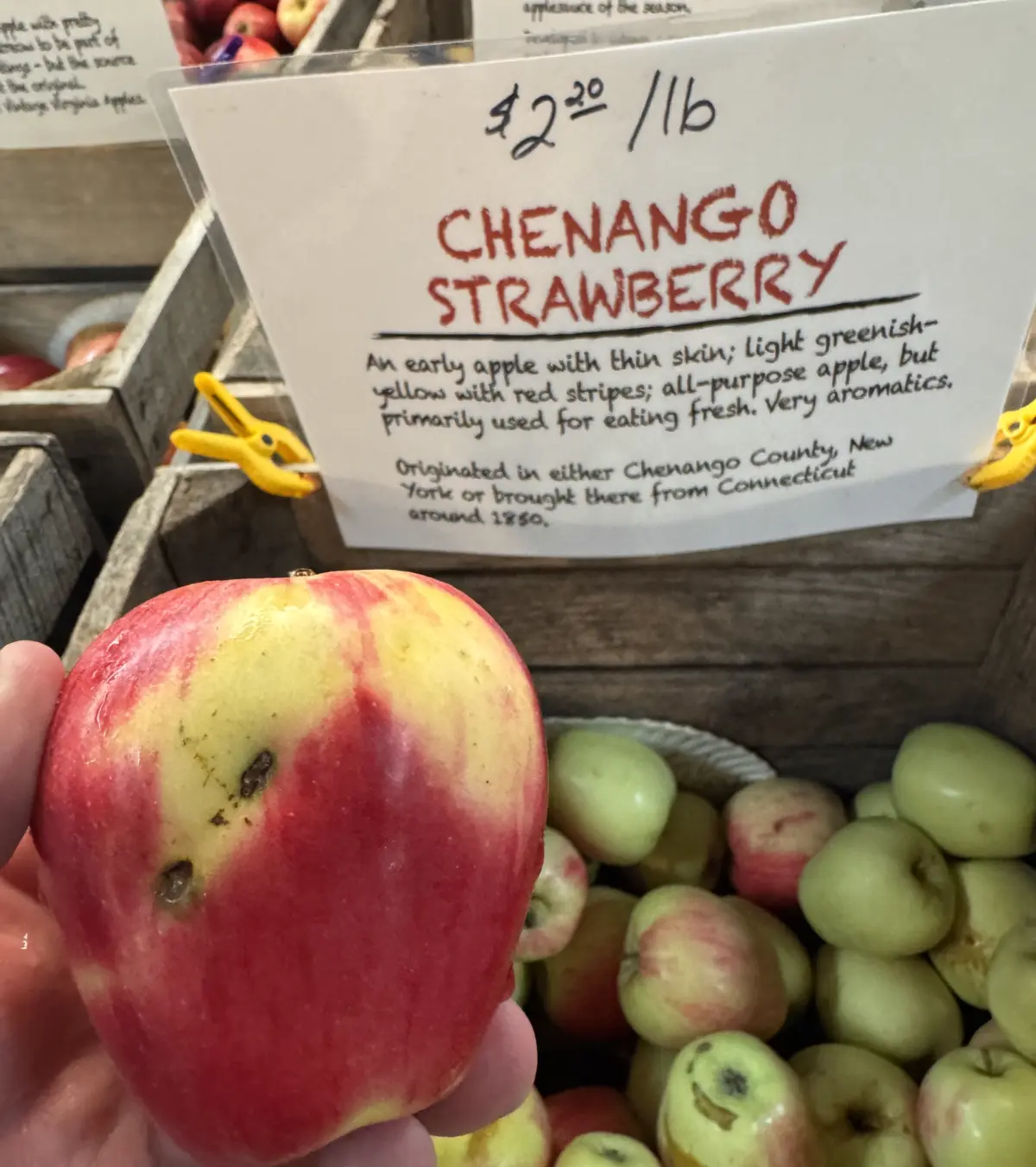
6. Chenango Strawberry
- Origin: Brightonwoods Orchard (Wisconsin)
- Rating: 4.0 / 10
Sourced during an extensive excursion through Wisconsin orchards, the Chenango Strawberry delivered a masterclass in olfactory advertising, immediately projecting a profound, authentic strawberry aroma upon handling. Unfortunately, the internal reality failed to match the nose. The flesh suffered from an advanced, gushy-mushy mealy consistency that rendered mechanical mastication entirely optional, transforming a promising fruit into a pre-softened tragedy.
7. William’s Pride
- Origin: Regional Harvest
- Rating: 6.3 / 10
Characterized by a uniquely pronounced botanical structure (affectionately dubbed a "juicy butt"), William’s Pride occupied a middle ground of texture—soft, yet safely removed from terminal mealiness. The profile was exceptionally drippy, offering warming autumn pie spices (cinnamon, clove, nutmeg) followed by a distinctly surreal aftertaste reminiscent of the ambient air inside a secondhand bookstore. While lacking a sharp tart punch, it earned a respectable score through sheer juiciness.

8. Blenheim Orange
- Origin: Regional Harvest
- Rating: 7.0 / 10
The Blenheim Orange presented a physical paradox: a skin so formidably tough that biting into it felt like tearing through industrial plastic packaging, housing an interior density akin to a gravitational singularity. Once breached, however, the flesh revealed the sunny, optimistic disposition of a Cox’s Orange Pippin. Bursting with floral zip and an electric lemon tickle, it balanced culinary brilliance with structural defiance.
9. Golden Nugget
- Origin: Regional Harvest
- Rating: 5.9 / 10
Visually resembling a discarded ogre-canker harvested directly from a swamp, the Golden Nugget is an uncompromisingly gnarly specimen. Its flavor profile bypassed standard ripening trajectories entirely, launching straight into the unyielding, green-tangy bitterness of an entirely unplucked banana hanging from its shrub. Despite defying conventional culinary expectations, its sheer strangeness engaged the palate, hinting at untapped potential if subjected to prolonged cold storage.

10. Doctor Harvey
- Origin: Regional Harvest
- Rating: 5.1 / 10
Classified historically as a culinary apple intended for sauce and baking, Doctor Harvey proved too soft for standard pie applications, threatening to dissolve instantly into structural goop. Yet, it redeemed itself via an astonishing, ASMR-worthy skin pop—unrivaled in recent memory—and an initial flavor rush comparable to a berry wine cooler. Though the flavor evacuated the crime scene with undue haste, the tactile brilliance secured a passing grade.
Supporting Context & Metrics
Evaluating heirloom and craft apples requires a departure from standard grocery store metrics (such as uniform sizing and unyielding shelf-life). The data compiled from this season’s tastings highlight critical variables in modern fruit critique:

- Geographic Variance: Orchard microclimates in Vermont and Wisconsin produce radically different sugar-to-acid ratios within identical varietal lines.
- Storage Maturation: Varieties such as the Golden Nugget and Opalescent demonstrate that post-harvest cold storage can fundamentally alter structural density and aromatic expression.
- Sensory Volatility: Unlike commercial monocultures (e.g., Red Delicious), heirloom varieties exhibit high seasonal volatility, driven by weather anomalies, pollination rates, and tree age.
Official Statements & Industry Outlook
Pomological observers note that interest in heirloom and cider apples continues to experience a cultural renaissance, driven by consumers seeking complex flavor profiles—ranging from rooibos tea notes to unexpected butterscotch finishes—that are entirely absent from mass-market industrial agriculture. Industry experts emphasize that the resurgence of forgotten varieties relies heavily on regional orchards committed to preserving genetic diversity against the homogenizing pressures of global food supply chains.
Future Outlook
As the autumn harvest progresses into its final phases, the survey schedule will expand to encompass additional New England orchards and rare regional finds. Enthusiasts are advised to monitor ongoing field reports as evaluation teams navigate the treacherous intersection of book tour commitments, canine training regimens, and relentless fruit consumption. For those seeking a deeper literary engagement with the darker side of pomology, the acclaimed horror novel Black River Orchard—exploring a sinister orchard governed by malevolent fruit—remains widely available through independent booksellers, offering signed and personalized editions for the definitive seasonal reading experience.