The landscape of search engine optimization (SEO) has undergone a fundamental transformation. Gone are the days when a digital marketer could rely on manually updated, static spreadsheets to track keyword rankings or wait weeks for batch-processed data. In today’s hyper-competitive digital ecosystem, Search Engine Results Pages (SERPs) are volatile, fluid environments influenced by real-time algorithm shifts, localized map packs, and an ever-expanding array of interactive SERP features—including the rapid integration of generative AI components like Google’s AI Overviews.
To validate SEO efforts, justify continuous capital investment, and directly correlate organic visibility with bottom-line revenue, modern enterprises, agencies, and in-house teams require robust, highly accurate SERP tracking software.
This in-depth review evaluates the 7 best SERP tracking tools for 2025. We analyze their core capabilities, architectural strengths, and unique value propositions. By examining both dedicated standalone trackers and robust modules nested within all-in-one SEO platforms, this guide provides the authoritative benchmark needed to select the optimal tracking infrastructure for your specific business objectives.
Detailed Chronology: The Evolution of Rank Tracking
To fully understand the sophistication of modern SERP tracking tools, one must look at how the technology has evolved over the past decade.
The Spreadsheet Era (Pre-2015): SEO practitioners manually queried search engines or used rudimentary, desktop-bound scrapers that frequently ran into CAPTCHAs and IP bans. Data was fragmented, unverified, and prone to human error.
The Rise of Automated Cloud Trackers (2015–2018): Cloud-native platforms emerged, offering automated daily cron jobs that checked keyword positions across major search engines. However, data updates were largely restricted to once every 24 hours, and tracking SERP features remained an afterthought.
The Granular & Integrated Era (2018–2022): Software providers began introducing hyper-local tracking (down to the zip-code level), mobile versus desktop segmentation, and crucial API integrations with analytics platforms (such as Google Analytics and Looker Studio). This allowed marketers to map rank changes directly to conversion metrics.
The AI and On-Demand Real-Time Era (2023–2025+): With the rollout of AI-driven search experiences and complex SERP layouts featuring dozens of interactive modules, static daily checks became insufficient. Today’s tools offer on-demand, real-time data refreshes, advanced SERP feature monitoring, and predictive analysis to capture high-value real estate like Position #0 and AI Overviews.
Supporting Context & Metrics: Why Modern SERP Tracking Matters
Investing in enterprise-grade SERP tracking software is no longer a luxury; it is a foundational business requirement. According to industry analyses, top-performing digital agencies and enterprise brands attribute their ability to secure ongoing SEO budgets to granular, data-backed reporting.
When evaluating solutions, professionals must prioritize platforms that deliver on nine essential feature sets:
On-Demand Ranking Updates: Eliminating the wait for batch updates by allowing users to refresh keyword sets instantly via manual triggers.
SERP Feature Monitoring: Tracking the presence and volatility of 50+ SERP features—including AI Overviews, featured snippets, People Also Ask (PAA) boxes, and video carousels—to uncover quick-win optimization opportunities.
Multi-Engine Support: Going beyond Google to monitor visibility on Bing, Baidu, Yandex, and YouTube, which is vital for international campaigns.
Granular Geo-Targeting and Device Differentiation: Segmenting data by country, state, city, or zip code while separating desktop and mobile performance metrics.
Revenue and Traffic Mapping: Integrating directly with analytics suites (like Google Analytics and Adobe Analytics) to tie ranking shifts directly to organic traffic, bounce rates, and conversion goals.
Historical Performance Tracking: Storing deep historical archives to analyze long-term trends rather than relying solely on point-in-time snapshots.
Competitor Benchmarking: Grouping keywords into performance buckets (e.g., positions 1–3, 4–10, 11–50) to measure your share of voice against industry rivals.
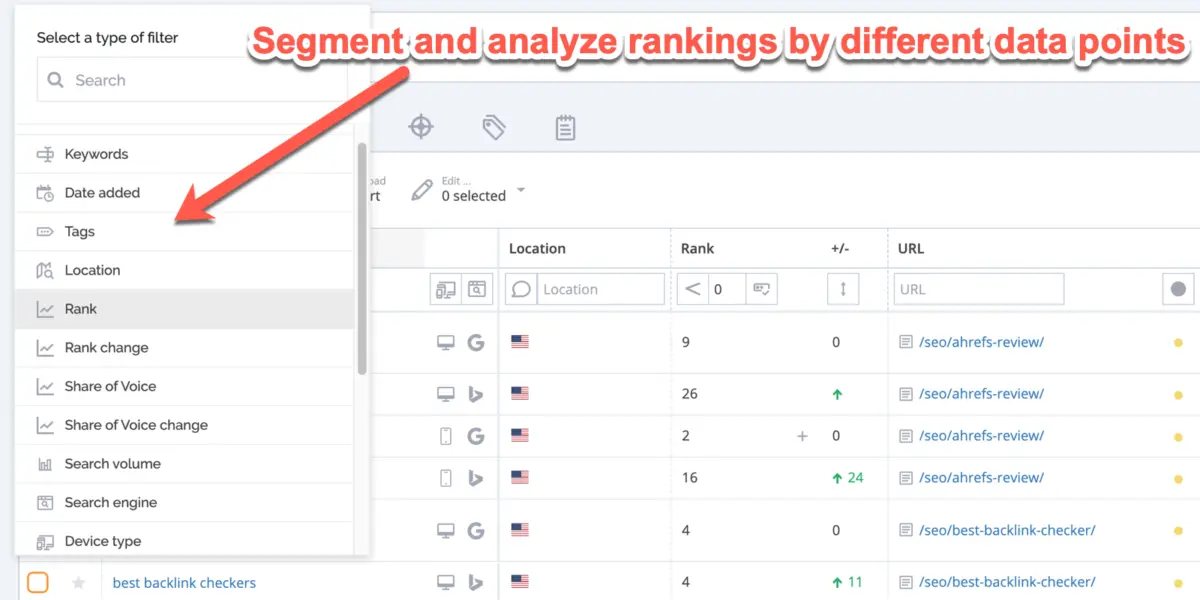
Tagging and Segmentation: Organizing keywords by content type, sales funnel stage, or topic cluster for targeted analysis.
White-Label & BI Integration: Delivering polished, automated reports natively or pushing clean data streams into Looker Studio and Databox dashboards.
The 7 Best SERP Tracking Tools for 2025
1. AccuRanker
As a premier standalone SERP tracking platform trusted by over 32,000 companies—including enterprise giants like HubSpot, IKEA, and Kinsta—AccuRanker sets the gold standard for speed and accuracy.
Key Strengths: AccuRanker provides true on-demand, real-time data refreshes alongside automated daily updates. Its advanced SERP Analysis module tracks over 50 distinct features in a single view, while its robust landing pages report seamlessly merges ranking data with Google Analytics to showcase true ROI and Share of Voice metrics.
Best For: Agencies, SEO professionals, and enterprise brands requiring lightning-fast, highly accurate data across all major devices, locations, and search engines (including Google, Bing, Baidu, Yandex, and YouTube).
Pricing: Subscription plans scale based on tracked keyword volume, starting at approximately $116/month for up to 1,000 keywords.
2. Semrush (Position Tracker & SERP Gap Analyzer)
As an all-in-one digital marketing powerhouse serving over 10 million users (including Samsung and Vodafone), Semrush offers a tracking suite that rivals the best standalone tools on the market.
Key Strengths: The Semrush Position Tracker delivers exceptional daily accuracy from national down to local map-pack levels. Furthermore, the platform’s App Center features the innovative SERP Gap Analyzer, which automatically scans search results to uncover under-optimized content, identifies low-hanging fruit via Google Search Console integration, and saves teams hours of manual keyword research.
Best For: Digital marketing professionals, e-commerce brands, and large enterprises looking for an all-in-one platform that combines world-class SEO tools with scalable rank tracking.
Pricing: Comprehensive platform subscriptions start at $139.95/month.
3. ProRankTracker
Serving over 60,000 customers, ProRankTracker is recognized as a highly scalable, cost-effective standalone solution engineered for deep data analysis and multi-language tracking.
Key Strengths: Exceptional global reach, advanced multi-format reporting, and specialized tracking capabilities tailored for international companies and video marketers needing insights across diverse localized ecosystems.
Best For: SEM agencies, international brands, and video marketers who demand accurate data across any device, language, or global coordinate.
Pricing: Entry-level plans begin at an accessible $39/month.
4. Advanced Web Ranking (AWR)
A veteran in the SEO software space, Advanced Web Ranking is a trusted standalone tracker utilized by enterprise brands like Microsoft for its robust infrastructure and customizable reporting engine.
Key Strengths: AWR excels in deep historical data retention, multi-tier user permission management for agencies, and highly flexible white-label reporting capabilities that can be scheduled automatically for clients.
Best For: In-house marketing teams, enterprise organizations, and agencies seeking reliable, highly customizable tracking infrastructure.
Pricing: Plans begin at $99/month.
5. SERPWatcher (by Mangools)
Part of the Mangools all-in-one ecosystem and trusted by major global brands like Airbnb and Adidas, SERPWatcher is celebrated for its intuitive interface and unique performance index metric.
Key Strengths: The proprietary Performance Index calculates a website’s overall organic traffic potential based on current keyword positions and search volumes. Coupled with its sister tool, SERPChecker, it offers a streamlined approach to SERP analysis without a steep learning curve.
Best For: Startups, small business owners, freelancers, and agencies seeking a simplified, visually appealing tracking solution.
Pricing: Mangools bundles its toolsets starting at an economical $29.90/month.
6. SE Ranking
SE Ranking is a versatile all-in-one SEO platform equipped with a robust Position Tracking module that simulates real user behavior to guarantee precise local data collection.
Key Strengths: SE Ranking stands out for its comprehensive coverage of major search engines, deep competitive metrics, professional site audit tools, and flexible pricing structures tailored to growing businesses.
Best For: Digital agencies, consultants, and SMBs requiring an accurate, all-inclusive toolkit that doesn’t compromise on tracking depth.
Pricing: Plans start at $52/month based on daily tracking for 500 keywords.
7. Nightwatch
Trusted by industry leaders like Shopify, Scotiabank, and Coinbase, Nightwatch is an advanced daily SERP tracker capable of uncovering rankings across over 107,000 global locations.
Key Strengths: Nightwatch features a uniquely flexible data segmentation engine, robust site-auditing capabilities, and custom reporting dashboards that allow users to aggregate data from multiple search engines effortlessly.
Best For: Freelancers, expanding SMBs, and enterprise-level agencies requiring granular, hyper-local global tracking capabilities.
Pricing: Following a 14-day free trial, paid plans start at $32/month for up to 250 keywords.
Official Statements & Industry Perspectives
Industry leaders continue to emphasize the vital role that integrated, automated tracking plays in modern marketing workflows.
"It’s by far the best keyword ranking tracker in the market and has a ton of great reporting functions. If you want visibility on large volumes of keywords housed within a nice dashboard—this is for you."
— Matthew Howells-Barby, Co-Founder, TrafficThinkTank
Furthermore, the integration of Business Intelligence (BI) tools has transformed how agencies present data to stakeholders:
"The thing that really got me using them heavily in the last month or two is their Looker Studio connector. Combining the tag feature, as well as the Share of Voice metric… has been a big help in making these reports immediately digestible."
— Ian Howells, Co-Founder, Traffic Think Tank
Future Outlook: What Lies Ahead for SERP Tracking
As we look deeper into 2025 and beyond, the role of SERP tracking software will continue to evolve in response to artificial intelligence and shifting consumer search habits.
AI-Driven Search Integration: Traditional ten blue links are rapidly being supplemented—and in many cases superseded—by conversational AI search experiences. Future SERP trackers must evolve to monitor brand visibility and citations inside AI-generated answers, moving beyond standard position numbers.
Hyper-Personalization and Real-Time Volatility: As search engines increasingly tailor results based on user intent, micro-location, and browsing history, trackers will lean heavier on cloud simulation and machine learning to map out true localized visibility scores.
Holistic BI Consolidation: Standalone silos are fading. The future belongs to platforms that offer frictionless data pipelines, uniting rank tracking data with customer data platforms (CDPs) and advanced attribution models to prove definitive marketing ROI.
Making Your Decision
When choosing your SERP tracking software for 2025, evaluate your budget, keyword volume, and reporting requirements. For a dedicated, high-speed standalone solution, AccuRanker remains the definitive industry choice. If you prefer a comprehensive ecosystem that bundles rank tracking with broader competitive research, Semrush provides unmatched versatility. Assess your core goals today, abandon the manual spreadsheets, and equip your team with the precision tools required to dominate the modern SERP.


![7 Best SERP Tracking Tools for 2022 [In-Depth Review]](https://www.robbierichards.com/wp-content/uploads/2020/05/Best-SERP-Trackers.jpg)
![7 Best SERP Tracking Tools for 2022 [In-Depth Review]](https://www.robbierichards.com/wp-content/uploads/2020/04/image16-2.png)
![7 Best SERP Tracking Tools for 2022 [In-Depth Review]](https://www.robbierichards.com/wp-content/uploads/2020/04/image2-3.png)
![7 Best SERP Tracking Tools for 2022 [In-Depth Review]](https://www.robbierichards.com/wp-content/uploads/2020/04/image6-2.png)
![7 Best SERP Tracking Tools for 2022 [In-Depth Review]](https://www.robbierichards.com/wp-content/uploads/2020/04/image15.jpg)
![7 Best SERP Tracking Tools for 2022 [In-Depth Review]](https://www.robbierichards.com/wp-content/uploads/2020/04/image12-1.png)
![7 Best SERP Tracking Tools for 2022 [In-Depth Review]](https://www.robbierichards.com/wp-content/uploads/2020/04/image13-2.png)
![7 Best SERP Tracking Tools for 2022 [In-Depth Review]](https://www.robbierichards.com/wp-content/uploads/2020/04/image3.jpg)
![7 Best SERP Tracking Tools for 2022 [In-Depth Review]](https://www.robbierichards.com/wp-content/uploads/2018/08/rj-employee_Robbie-color-new.png)
![7 Best SERP Tracking Tools for 2022 [In-Depth Review]](https://www.robbierichards.com/wp-content/uploads/2020/05/Databox-SEO-dashboard-1.jpg)
![7 Best SERP Tracking Tools for 2022 [In-Depth Review]](https://www.robbierichards.com/wp-content/uploads/2020/04/image4-2.png)
![7 Best SERP Tracking Tools for 2022 [In-Depth Review]](https://www.robbierichards.com/wp-content/uploads/2020/04/image5.jpg)
![7 Best SERP Tracking Tools for 2022 [In-Depth Review]](https://www.robbierichards.com/wp-content/uploads/2020/05/AccuRanker-Google-Data-Studio-integration.jpg)
![7 Best SERP Tracking Tools for 2022 [In-Depth Review]](https://www.robbierichards.com/wp-content/uploads/2018/11/Ian-Howells2.png)
![7 Best SERP Tracking Tools for 2022 [In-Depth Review]](https://www.robbierichards.com/wp-content/uploads/2019/01/Google-Data-Studio-KW-rankings-dashboard.png)
![7 Best SERP Tracking Tools for 2022 [In-Depth Review]](https://www.robbierichards.com/wp-content/uploads/2025/01/AccuRanker-home-page.jpg)
![7 Best SERP Tracking Tools for 2022 [In-Depth Review]](https://www.robbierichards.com/wp-content/uploads/2015/01/matthew-barby.jpg)
![7 Best SERP Tracking Tools for 2022 [In-Depth Review]](https://www.robbierichards.com/wp-content/uploads/2022/06/image1-1.png)