

Executive Overview
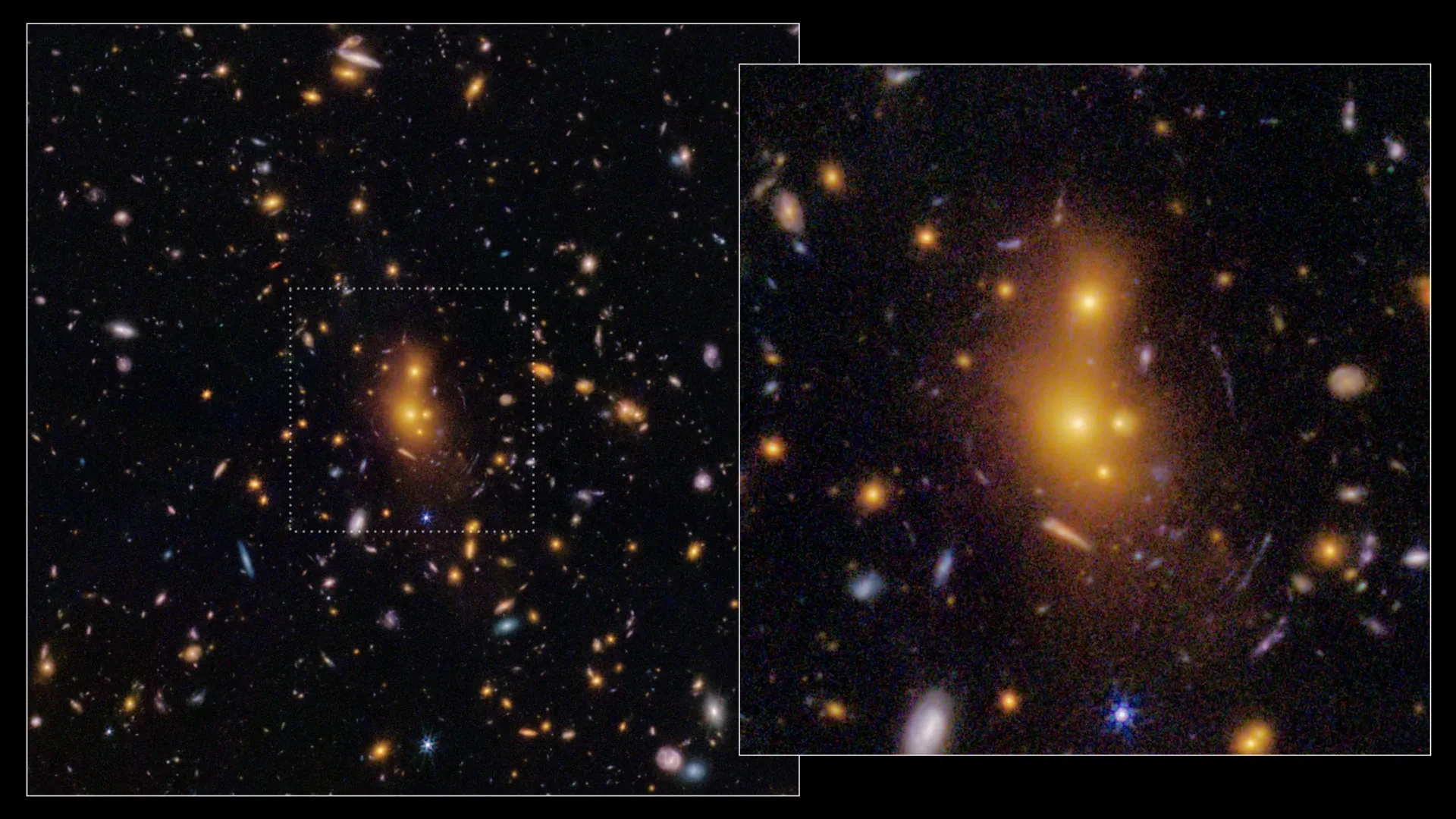
Deep within the cosmic tapestry, an astronomical anomaly has emerged from the dawn of time to test the foundational pillars of modern cosmology. Observations captured by NASA’s premier flagship observatory, the James Webb Space Telescope (JWST), have unveiled an extraordinarily massive, hyper-dense galaxy cluster known as XLSSC 122. Located approximately 10.4 billion light-years from Earth, this ancient colossal structure dates back to an epoch colloquially known as "cosmic noon"—a period roughly 10 billion years ago when the universe was experiencing its most hyperactive era of star formation and structural assembly.
XLSSC 122 defies conventional theoretical models. According to standard cosmological paradigms—which describe how matter clumped together via gravity following the Big Bang 13.8 billion years ago—massive, highly organized galaxy clusters should not have matured this quickly. Yet, XLSSC 122 not only exhibits the advanced structural maturity typically reserved for clusters in the modern, present-day universe, but it also possesses an anomalously dense concentration of mass at its core.
Presented at a press conference on June 17, 2026, during the 248th meeting of the American Astronomical Society, a trio of groundbreaking studies led by researchers at IPAC—Caltech’s science and data center for astrophysics and planetary science—has established XLSSC 122 as the most distant galaxy cluster known to exhibit strong gravitational lensing. This rare cosmic phenomenon has allowed scientists to peer into the invisible architecture of the cluster, exposing a profound mismatch between physical reality and theoretical predictions. If similar ancient structures are found across the cosmos, astrophysicists may be forced to rewrite the temporal playbook of cosmic evolution.
Detailed Chronology
The discovery and subsequent analysis of XLSSC 122 represent a triumph of multi-wavelength astronomy, stretching across more than a decade of technological advancements and collaborative international research.
2014: The Initial X-Ray Discovery
The journey of XLSSC 122 began over a decade ago when the European Space Agency’s (ESA) XMM-Newton spacecraft scanned the heavens using X-ray imaging. During this wide-area survey, astronomers flagged a faint, diffuse patch of X-ray emission indicative of hot, trapped gas—a hallmark signature of a massive galaxy cluster. However, the true nature and precise distance of the object remained shrouded in uncertainty due to the limitations of contemporary instrumentation.
The Hubble Space Telescope Era
Years later, follow-up observations conducted with the Hubble Space Telescope helped refine our understanding of the system. Hubble’s high-resolution optical and near-infrared optics confirmed that XLSSC 122 was situated roughly 10.4 billion light-years away. Even more intriguing, the cluster appeared remarkably well-developed for its age. Despite these insights, Hubble’s capabilities hit a hard ceiling: it could not detect definitive evidence of strong gravitational lensing, leaving astronomers unable to map the precise internal mass distribution of the cluster or accurately weigh its hidden reservoirs of dark matter.
The JWST Breakthrough and the IPAC Studies
The paradigm shifted permanently when the James Webb Space Telescope turned its golden, hexagonal mirrors toward XLSSC 122. Equipped with unprecedented infrared sensitivity and resolving power, JWST immediately captured striking, unmistakable arcs of distorted light bending around the cluster’s center.
Recognizing the goldmine of astrophysical data, a collaborative research team spearheaded by IPAC scientists launched a three-pronged investigative effort:
- The First Study (Led by Kyle Finner): Focused on the discovery of the record-shattering strong gravitational lensing, establishing XLSSC 122 as the most distant cluster to display this effect and probing its central mass concentrations.
- The Second Study (Led by Zachary Scofield, Yonsei University): Utilized weak gravitational lensing and multi-wavelength data to analyze the wider outer regions of the cluster, ultimately identifying an ongoing, violent galaxy cluster merger.
- The Third Study (Led by Hyungjin Joo, Yonsei University): Investigated the diffuse "intracluster light" produced by unbound stars, discovering that this ancient starlight mirrors the underlying distribution of invisible dark matter.
This cumulative body of work culminated in a major scientific unveiling at the American Astronomical Society meeting in June 2026, redefining our comprehension of early cosmic architecture.
Supporting Context & Metrics
To appreciate the gravity of the challenge XLSSC 122 poses to astrophysics, it is essential to examine the underlying metrics, physical mechanisms, and cosmological models governing our universe.
Cosmic Noon and the Timeline of Structure Formation
The universe is approximately 13.8 billion years old. "Cosmic noon," occurring roughly 10 billion years ago (around 3.8 billion years after the Big Bang), was the golden age of galactic manufacturing. During this epoch, galaxies were churning out stars at rates up to 100 times higher than those observed in the modern local universe.
Concurrently, gravity was pulling smaller gas clouds, proto-galaxies, and galaxy groups together to form sprawling clusters. Standard Lambda-CDM (Cold Dark Matter) cosmological models dictate that this hierarchical assembly should have been a sluggish, gradual process. Massive, relaxed, and highly concentrated structures were theoretically supposed to emerge much later in cosmic history. XLSSC 122 shatters this expected timeline by arriving fully formed and densely packed during the mid-stages of cosmic noon.
The Physics of Gravitational Lensing: Strong vs. Weak
Gravitational lensing is a direct consequence of Albert Einstein’s General Theory of Relativity, which dictates that massive objects warp the fabric of spacetime. When light from a distant background galaxy travels past a massive foreground cluster like XLSSC 122, its path is bent.
- Strong Gravitational Lensing: Occurs when background light passes close to the hyper-dense core of a massive cluster. This creates dramatic visual distortions, including long, curved arcs, multi-imaged galaxies, and occasionally Einstein rings. XLSSC 122 now holds the distance record for this phenomenon. Because the degree of bending depends directly on the gravitational field, strong lensing gives astronomers a microscopic scale for weighing the cluster’s core.
- Weak Gravitational Lensing: Involves subtle, statistically measurable distortions in the shapes of thousands of background galaxies across a wider spatial area. While strong lensing maps the center, weak lensing allows scientists to trace the diffuse matter spreading across the far-flung outer peripheries of the cluster.
Unmasking the Invisible: Dark Matter and Intracluster Light
Ordinary baryonic matter—the stars, planets, gas, and dust that make up everything we interact with daily—accounts for only a tiny fraction of XLSSC 122’s mass. The vast majority of the cluster’s immense gravitational pull stems from dark matter, an elusive substance estimated to be roughly five times more abundant than ordinary matter. Because dark matter neither absorbs, reflects, nor emits light, it can only be detected via its gravitational imprint.
Adding a revolutionary dimension to dark matter cartography, JWST’s deep infrared imaging detected intracluster light (ICL)—faint, diffuse starlight originating from stars that were violently stripped away from their parent galaxies during gravitational interactions.
In XLSSC 122, the researchers discovered a striking geometric correlation: near the cluster’s center, the spatial distribution of this orphan starlight maps almost perfectly onto the distribution of dark matter inferred through strong gravitational lensing. This breakthrough suggests that intracluster light can act as a luminous proxy for dark matter, giving astronomers a new, highly accessible tool for mapping invisible cosmic scaffolding across deep time.
Official Statements
The implications of the XLSSC 122 observations have sparked intense excitement and rigorous debate throughout the international astronomical community. Speaking on the implications of the data, lead researcher Kyle Finner emphasized the profound shift in observational capability brought on by NASA’s flagship telescope:
"When we got those first images back from JWST, we said, ‘wow, look at this, there’s strong lensing coming from this cluster!’ XLSSC 122 has now set the record for the most distant galaxy cluster displaying strong lensing, which is a valuable tool for astronomers. Before JWST, we couldn’t do this level of science in the early, distant universe."
Addressing the core scientific crisis—the mismatch between observed mass concentrations and theoretical predictions—Finner noted:
"XLSSC 122 is one of the first clusters we know of that formed in the universe, and it has a mass concentration that doesn’t agree with our cosmological model predictions."
Expounding upon the utility of gravitational lensing as a diagnostic tool, Finner explained:
"Strong lensing is a way to measure the dark matter without actually seeing the dark matter. It gives us a sensitive probe of our cosmological models."
Discussing the mechanical state of the cluster and its connection to the newly discovered diffuse starlight, Finner added:
"Weak gravitational lensing can constrain mass much further out, so you can get a better picture of the surrounding cluster area. In this cluster, the intracluster light essentially traces the dark matter. That light tells us that the cluster is in a merging state."
Finally, looking toward the broader horizon of observational cosmology, Finner summarized the collective ambition of the research team:
"It’s still early in the JWST era, and if we can start to get data on tens or hundreds of these types of objects at this stage in the universe, then we can really start putting our cosmological models to the test."
Future Outlook
The discovery of XLSSC 122 is not merely an isolated astronomical curiosity; it serves as a stress-test for humanity’s understanding of cosmic evolution. If an anomaly, it must be explained; if a trend, it signals that standard cosmological models require fundamental revisions regarding how rapidly matter coalesced in the early universe.
However, resolving this cosmic mystery presents a logistical hurdle. While the James Webb Space Telescope possesses peerless sensitivity and resolving power, its optical design yields a relatively narrow field of view. Consequently, JWST is exceptionally well-suited for taking deep, detailed portraits of pre-selected targets, but it is inefficient for wide-area spatial sweeps designed to find needles in a cosmic haystack.
To build a robust statistical sample, astronomers must adopt a multi-tiered search strategy. The hunt for dozens—and potentially hundreds—of similar ancient galaxy clusters will rely heavily on wide-area X-ray and radio surveys. Additionally, astronomers are increasingly deploying techniques centered on the Sunyaev-Zel’dovich effect. This phenomenon occurs when ultra-energetic electrons residing within the blistering gas of massive clusters scatter low-energy photons from the cosmic microwave background (CMB)—the primordial afterglow of the Big Bang. By identifying distinct "shadows" or holes left in the CMB maps, researchers can unearth hidden ancient clusters that elude traditional optical detection.
As the astronomical community pushes deeper into the JWST era, the discovery of more systems akin to XLSSC 122 will determine whether our current textbooks on cosmic history require rewriting. For now, this ancient leviathan stands as a monument to the unexpected complexities of the universe—reminding us that the deeper we peer into the dark corridors of space and time, the more our most cherished scientific models are forced to evolve.