In the rapidly evolving digital ecosystem of 2025, search engine results pages (SERPs) are no longer static lists of blue links. Driven by artificial intelligence integrations, generative search experiences, and dynamic multi-format layouts—ranging from AI Overviews and People Also Ask boxes to interactive video carousels and localized map packs—tracking search engine performance has become exceptionally complex.
For modern enterprises, digital marketing agencies, and independent consultants, relying on manual spreadsheets or outdated weekly ranking reports is a recipe for strategic failure. Today’s competitive search marketing demands real-time data, granular local insights, and precise multi-device tracking. Without enterprise-grade SERP tracking software, organizations risk flying blind, unable to accurately validate their search engine optimization (SEO) investments or tie keyword fluctuations directly to revenue generation.
This in-depth review explores the critical criteria for selecting modern SERP tracking tools, evaluates the top platforms on the market for 2025—spanning both dedicated standalone solutions and comprehensive all-in-one SEO suites—and provides actionable insights to help you choose the right software for your operational scale.
Detailed Chronology: The Evolution of Rank Tracking
To understand why modern SERP trackers operate the way they do, it is essential to look at how search engine monitoring has evolved over the past decade:
The Spreadsheet Era (Early 2010s): SEO professionals relied heavily on manual data entry or basic, screen-scraping desktop scripts to check keyword positions once a week. Data was frequently inaccurate due to personalization and localization variables.
The Rise of Automated Cloud Trackers (Mid-2010s): Dedicated SaaS platforms emerged, offering automated daily cron jobs that checked keyword positions across major search engines. However, these tools were often slow, providing data updates only once every 24 hours with limited capability for on-demand refreshes.
The Multi-Device & Localization Shift (Late 2010s – 2020s): With mobile search traffic overtaking desktop and Google aggressively rolling out hyper-localized results down to the zip-code level, tracking tools evolved to segregate device metrics and pinpoint geographic performance.
The AI and SERP Feature Era (2024–2025): The introduction of AI-driven search experiences and complex SERP features forced rank-tracking software to mature into comprehensive intelligence platforms. Modern tools now monitor dozens of dynamic elements (such as AI Overviews) and correlate keyword movements directly with traffic, bounce rates, and conversion metrics via deep analytics integrations.
Supporting Context & Metrics: Why Invest in SERP Tracking Software?
Validating SEO efforts to stakeholders and securing ongoing marketing budgets requires concrete, defensible data. Modern SERP tracking software provides the granular visibility needed to connect tactical search performance to overarching business objectives.
Industry benchmarks indicate that organizations utilizing automated, real-time rank tracking achieve a significantly higher ROI on their content operations compared to those relying on delayed data. Specifically, a robust SERP tracking solution empowers teams to:
Validate SEO Investments: Instantly showcase progress and rank improvements to clients or executive leadership.
Identify Quick-Win Opportunities: Pinpoint keywords currently sitting in striking distance (positions 4–10) that can be optimized to capture top-three rankings or lucrative SERP features.
Monitor Competitor Threats: Continuously track rival domains to see where market share is being gained or lost.
Isolate Revenue Impact: Map keyword movements directly to organic traffic, user engagement metrics, and ultimate bottom-line conversions.
The 9 Essential Features to Look for in SERP Tracking Software
When evaluating the market for the best SERP tracking software in 2025, decision-makers must look beyond basic vanity metrics. A comprehensive tracking tool should incorporate the following nine core features:
1. Accurate On-Demand Ranking Updates
SERP positions fluctuate rapidly throughout the day. Waiting 24 hours or longer for scheduled data refreshes can leave your team reacting too slowly to algorithmic shifts. Leading tools offer automated daily updates alongside an on-demand refresh button that pulls fresh data instantly.
2. Comprehensive SERP Feature Monitoring
Ranking in position #0 or capturing a specific feature (such as an AI Overview, featured snippet, or video carousel) requires knowing which queries trigger these elements. Top trackers monitor 50+ distinct SERP features in a single dashboard view, helping you identify opportunities to steal visibility from competitors.
3. Multi-Engine Search Support
While Google dominates global market share, robust SEO strategies often require monitoring performance across alternative search engines—such as Bing, Baidu, Yandex, and YouTube—especially for international campaigns or specific regional markets.
4. Granular Geographic and Device Segmentation
A high-level national dashboard is no longer sufficient. Enterprise-grade tools allow you to track rankings down to the country, state, city, or even zip-code level, while seamlessly separating mobile and desktop performance data.
5. Revenue and Traffic Mapping
Tracking rank changes is only half the battle. The best software integrates with analytics platforms like Google Analytics or Adobe Analytics to merge keyword data with organic visitor counts, bounce rates, load times, and revenue goals into a unified landing page report.
6. Historical Performance Analysis
Point-in-time ranking snapshots lack context. Look for platforms that retain deep historical data archives, allowing you to visualize long-term ranking trends and benchmark your trajectory against competitors over months or years.
7. Advanced Competitor Benchmarking
Because the search landscape is inherently volatile, your tool must categorize competitor performance—grouping keywords into buckets (e.g., positions 1–3, 4–10, 11–50) to clearly highlight shifting competitive dynamics.
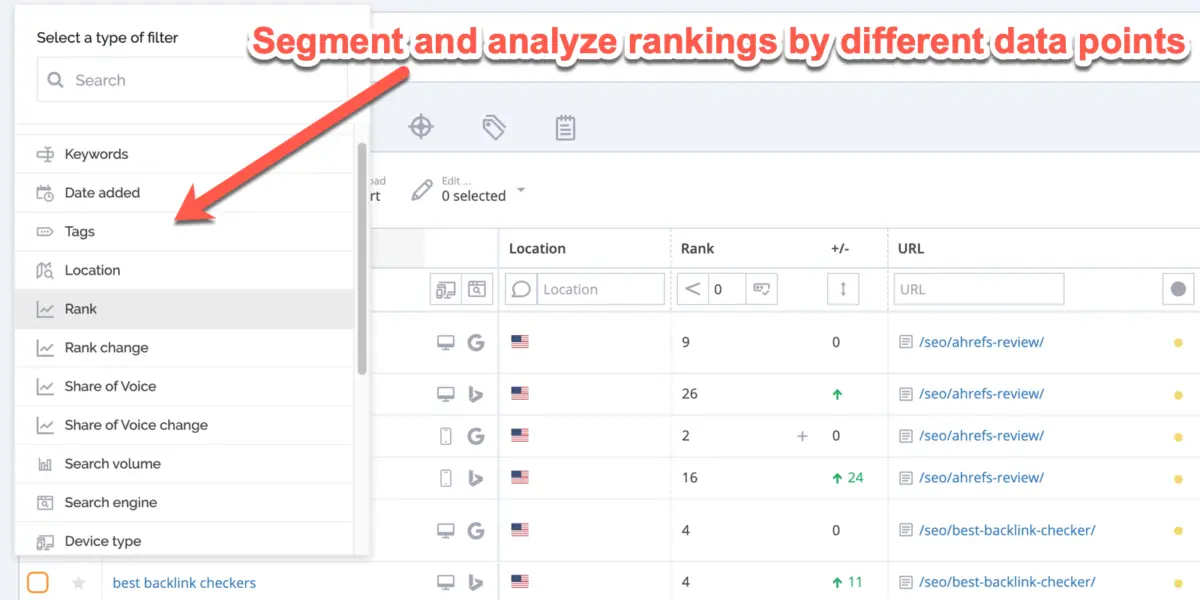
8. Custom Tagging and Data Segmentation
Not all keywords hold equal business value. Advanced tagging functionality enables you to segment and filter rankings by topic, buyer funnel stage, content asset type, device, and Share of Voice metrics.
9. White-Label Reporting & Integrations
Whether scheduling automated client reports natively or connecting data pipelines to visualization suites like Google Looker Studio (formerly Data Studio) or Databox, your tracking tool must make complex data immediately digestible.
The 7 Best SERP Tracking Tools to Consider in 2025
The software market features countless options, categorized primarily into dedicated standalone trackers and comprehensive all-in-one SEO platforms. Below is our curated shortlist for 2025.
1. AccuRanker
Overview: AccuRanker is a premier standalone SERP tracking platform trusted by over 32,000 companies, including global brands like HubSpot, IKEA, and Kinsta. It is widely recognized for delivering some of the fastest and most accurate ranking data in the industry.
Standout Features: On-demand data refreshes, comprehensive SERP feature tracking (50+ features), deep historical data, powerful keyword tagging, and robust integrations with Google Analytics and Looker Studio.
Best For: Agencies, enterprise brands, and SEO professionals who require real-time data accuracy, robust API access, and granular multi-engine tracking.
Pricing: Subscription plans scale based on tracked keyword volume, starting at $116/month for up to 1,000 keywords.
2. Semrush (Position Tracker & SERP Gap Analyzer)
Overview: Semrush is an industry-leading all-in-one SEO and digital marketing platform utilized by over 10 million users, including enterprises like Samsung and Vodafone. Its Position Tracker tool rivals dedicated trackers while offering access to a massive suite of complementary marketing tools.
Standout Features: Hyper-accurate daily position tracking, multi-device and local map pack monitoring, competitive distribution analysis, and the unique SERP Gap Analyzer app in the Semrush App Center, which scans SERPs to uncover under-optimized content and integrates directly with Google Search Console.
Best For: Marketing teams and agencies seeking a powerful, all-in-one ecosystem that combines top-tier rank tracking with exhaustive keyword research and site auditing capabilities.
Pricing: Plans start at $139.95/month.
3. ProRankTracker
Overview: ProRankTracker is a robust, cost-effective standalone tracking and reporting solution trusted by over 60,000 users worldwide.
Standout Features: Extensive localization support across international markets, multi-language tracking, and specialized video ranking capabilities for YouTube marketers.
Best For: E-commerce brands, international businesses, and digital agencies looking for scalable, budget-friendly tracking.
Pricing: Subscription tiers begin at $39/month.
4. Advanced Web Ranking (AWR)
Overview: AWR is a long-standing, enterprise-grade standalone SERP tracker utilized by thousands of in-house marketing teams and major tech companies like Microsoft.
Standout Features: Unlimited user seats on most plans, highly customizable white-label reporting, robust local search tracking, and deep historical analytics.
Best For: In-house corporate teams and enterprise agencies that prioritize customizable reporting workflows.
Pricing: Plans start at $99/month.
5. SERPWatcher (by Mangools)
Overview: Part of the Mangools all-in-one SEO suite, SERPWatcher is designed for simplicity and ease of use, trusted by brands like Airbnb and Adidas.
Standout Features: The proprietary Performance Index metric, which evaluates organic traffic potential across all tracked keywords in real time, complemented by an intuitive interface and clean reporting dashboards.
Best For: Small business owners, startups, and freelancers seeking an affordable, user-friendly rank-tracking experience.
Pricing: Bundled Mangools plans start at $29.90/month.
6. SE Ranking
Overview: SE Ranking is a versatile, all-in-one SEO toolset featuring a highly reliable Position Tracking module that simulates real user behavior across precise geographic targets.
Standout Features: 100% accurate location-based tracking, comprehensive competitor analysis, automated reporting, and broad search engine coverage.
Best For: Small-to-medium agencies and growing businesses needing a balance of affordability, ease of use, and multi-tool utility.
Pricing: Plans start at $52/month based on daily tracking for 500 keywords.
7. Nightwatch
Overview: Nightwatch is an advanced, high-precision daily SERP tracker relied upon by enterprise giants like Shopify, Scotiabank, and Coinbase. It boasts the ability to retrieve exact rankings from over 107,000 geographic locations worldwide.
Standout Features: Unmatched location granularity, flexible data segmentation, automated reporting, and sophisticated site audit integrations.
Best For: Organizations of all sizes—from independent consultants to large enterprises—requiring hyper-local, global tracking capabilities.
Pricing: Offers a 14-day free trial, with paid tiers starting at $32/month for up to 250 keywords.
Official Statements & Industry Perspectives
Industry experts consistently emphasize the strategic importance of choosing the right tracking infrastructure. Reflecting on the integration capabilities of modern tools, Ian Howells, Co-Founder of Traffic Think Tank, notes:
"The thing that really got me using [AccuRanker] heavily in the last month or two is their Looker Studio connector. Combining the tag feature, as well as the Share of Voice metric… has been a big help in making these reports immediately digestible."
Similarly, echoing the sentiment around enterprise-grade performance visibility, Matthew Howells-Barby, Co-Founder of Traffic Think Tank, highlights:
"It’s by far the best keyword ranking tracker in the market and has a ton of great reporting functions. If you want visibility on large volumes of keywords housed within a nice dashboard—this is for you."
Future Outlook: What’s Next for SERP Tracking?
As we look further into the back half of 2025 and toward 2026, the SERP tracking industry will continue to be reshaped by artificial intelligence and automated search delivery. Traditional ranking positions (1 through 10) are increasingly being overshadowed by AI Overviews and zero-click search experiences.
Future-proof SERP tracking software will need to incorporate advanced semantic analytics that measure brand visibility within AI-generated summaries, rather than just tracking numeric grid positions. Furthermore, predictive machine learning models will likely become standard, alerting marketers to algorithmic volatility before it impacts bottom-line organic traffic.
Choosing Your Solution
When selecting your organization’s SERP tracker, weigh your budget against your operational needs. If your primary requirement is a dedicated, lightning-fast standalone engine with robust API flexibility, AccuRanker remains the gold standard. Conversely, if you prefer an all-in-one marketing powerhouse that combines world-class position tracking with deep technical SEO and content analysis, Semrush provides unmatched value.
Evaluate your keyword volume, geographic scope, and reporting requirements today to ensure your SEO stack is fully prepared for the demands of modern search.


![7 Best SERP Tracking Tools for 2022 [In-Depth Review]](https://www.robbierichards.com/wp-content/uploads/2020/05/Best-SERP-Trackers.jpg)
![7 Best SERP Tracking Tools for 2022 [In-Depth Review]](https://www.robbierichards.com/wp-content/uploads/2020/04/image16-2.png)
![7 Best SERP Tracking Tools for 2022 [In-Depth Review]](https://www.robbierichards.com/wp-content/uploads/2020/04/image2-3.png)
![7 Best SERP Tracking Tools for 2022 [In-Depth Review]](https://www.robbierichards.com/wp-content/uploads/2020/04/image6-2.png)
![7 Best SERP Tracking Tools for 2022 [In-Depth Review]](https://www.robbierichards.com/wp-content/uploads/2020/04/image15.jpg)
![7 Best SERP Tracking Tools for 2022 [In-Depth Review]](https://www.robbierichards.com/wp-content/uploads/2020/04/image12-1.png)
![7 Best SERP Tracking Tools for 2022 [In-Depth Review]](https://www.robbierichards.com/wp-content/uploads/2020/04/image13-2.png)
![7 Best SERP Tracking Tools for 2022 [In-Depth Review]](https://www.robbierichards.com/wp-content/uploads/2020/04/image3.jpg)
![7 Best SERP Tracking Tools for 2022 [In-Depth Review]](https://www.robbierichards.com/wp-content/uploads/2018/08/rj-employee_Robbie-color-new.png)
![7 Best SERP Tracking Tools for 2022 [In-Depth Review]](https://www.robbierichards.com/wp-content/uploads/2020/05/Databox-SEO-dashboard-1.jpg)
![7 Best SERP Tracking Tools for 2022 [In-Depth Review]](https://www.robbierichards.com/wp-content/uploads/2020/04/image4-2.png)
![7 Best SERP Tracking Tools for 2022 [In-Depth Review]](https://www.robbierichards.com/wp-content/uploads/2020/04/image5.jpg)
![7 Best SERP Tracking Tools for 2022 [In-Depth Review]](https://www.robbierichards.com/wp-content/uploads/2020/05/AccuRanker-Google-Data-Studio-integration.jpg)
![7 Best SERP Tracking Tools for 2022 [In-Depth Review]](https://www.robbierichards.com/wp-content/uploads/2018/11/Ian-Howells2.png)
![7 Best SERP Tracking Tools for 2022 [In-Depth Review]](https://www.robbierichards.com/wp-content/uploads/2019/01/Google-Data-Studio-KW-rankings-dashboard.png)
![7 Best SERP Tracking Tools for 2022 [In-Depth Review]](https://www.robbierichards.com/wp-content/uploads/2025/01/AccuRanker-home-page.jpg)
![7 Best SERP Tracking Tools for 2022 [In-Depth Review]](https://www.robbierichards.com/wp-content/uploads/2015/01/matthew-barby.jpg)
![7 Best SERP Tracking Tools for 2022 [In-Depth Review]](https://www.robbierichards.com/wp-content/uploads/2022/06/image1-1.png)
![7 Best SERP Tracking Tools for 2022 [In-Depth Review]](https://www.robbierichards.com/wp-content/uploads/2025/01/Semrush-SERP-Gap-Analyzer-1024x447.png)
![7 Best SERP Tracking Tools for 2022 [In-Depth Review]](https://www.robbierichards.com/wp-content/uploads/2025/01/Semrush-SERP-Gap-Analyzer-Search-Console-integration.png)
![7 Best SERP Tracking Tools for 2022 [In-Depth Review]](https://www.robbierichards.com/wp-content/uploads/2020/04/image10-2.png)
![7 Best SERP Tracking Tools for 2022 [In-Depth Review]](https://www.robbierichards.com/wp-content/uploads/2025/01/Advanced-Web-Ranking.jpg)
![7 Best SERP Tracking Tools for 2022 [In-Depth Review]](https://www.robbierichards.com/wp-content/uploads/2020/04/image11-1.png)
![7 Best SERP Tracking Tools for 2022 [In-Depth Review]](https://www.robbierichards.com/wp-content/uploads/2020/04/image14-2.png)