

Executive Overview
In the fast-evolving landscape of contemporary gastronomy and agricultural curation, few empirical endeavors match the rigorous, unvarnished scrutiny of independent pomological fieldwork. As the autumn of 2026 reaches its zenith, the consumer-driven vanguard—affectionately self-identified as the "Apple Snack Gang"—has returned with the second installment of its exhaustive sensory audit. Spearheaded by leading culinary commentators and itinerant tasters, this ongoing assessment bypasses the sterile marketing paradigms of mass-market monoculture, plunging directly into the idiosyncratic, historic, and occasionally hazardous world of heirloom and specialty cultivars.
This report synthesizes the sensory profiles, structural integrity, and historical provenance of seven distinct apple varieties sampled during the initial phases of the 2026 harvest cycle. Utilizing a standardized yet deeply subjective rating scale, our investigation evaluates specimens ranging from the deeply spiced and botanical to the aggressively tannic cider fruits and the structurally defiant. Beyond mere flavor profiling, this journalistic survey examines the broader socio-agricultural implications of heirloom preservation, the linguistic anomalies of historic nomenclature, and the psychological interplay between tactile tasting notes and deep-seated cultural memory.
As the tasting delegation prepares for an impending expedition across the orchards of New York, New England, and the Canadian frontier, the data compiled herein offers an indispensable benchmark for pomologists, culinary historians, and devoted orchard enthusiasts alike.

Detailed Chronology of the Tasting Cohort
The evaluation protocol followed a strict, randomized sequencing to prevent palate fatigue, assessing each specimen across multiple vectors: skin texture, acoustic and physical snap upon first bite, juice-to-flesh ratio, volatile aromatic compounds, and lingering aftertaste.
1. Kickapoo Spice
- Designation: Kickapoo Spice
- Quantitative Score: 6.9 / 10
- Sensory Architecture: Eliciting immediate mental associations with classic rock anthems, the Kickapoo Spice presents as a remarkably dense pomological specimen. Structurally, it is a heavy, compact fruit—described colloquially within the tasting notes as a "dense boy" and a "weird friend."
The dominant characteristic of this cultivar is its formidable spice profile. Rather than relying on the standard sweet-tart dichotomy, the Kickapoo Spice leans heavily into warm, autumnal aromatics, registering prominent notes of freshly grated nutmeg, subtle cinnamon, and sharp clove. Contrary to expectations for a spiced fruit, the flesh lacked notable juiciness, presenting instead a somewhat dry, granular interior. A distinct vegetative aftertaste reminiscent of freshly cut grass lingered on the palate, suggesting potential mistimings in storage duration. Apples are notoriously fickle in their post-harvest maturation curves; some varieties ascend in quality off the branch, while others begin an immediate descent toward mediocrity. The Kickapoo Spice lands firmly in the former camp of interesting, albeit eccentric, offerings.
2. St Edmunds Pippin
- Designation: St Edmunds Pippin
- Quantitative Score: 8.3 / 10
- Sensory Architecture: Marking the inauguration of the core seasonal tasting calendar, the St Edmunds Pippin delivered an overwhelmingly positive sensory return. The physical interaction begins with an aggressively textured exterior—its skin carrying a coarse roughness likened poetically to tactile friction against marine wildlife.
Upon breach, the cultivar rewards the consumer with an exceptionally satisfying acoustic and physical snap: a crisp, sharp-breaking crunch that registers intensely in the auditory cortex. Internally, the St Edmunds Pippin balances a high juice yield with an extraordinarily bright, herbal aromatic profile. Analysts noted distinct fennel pollen undertones harmonizing effortlessly with a natural, unforced sweetness. This specimen stands as a quintessential exemplar of the "funky yet balanced" heirloom class, offering immense satisfaction through its complex interplay of tart baseline structures and high-end botanical aromatics.

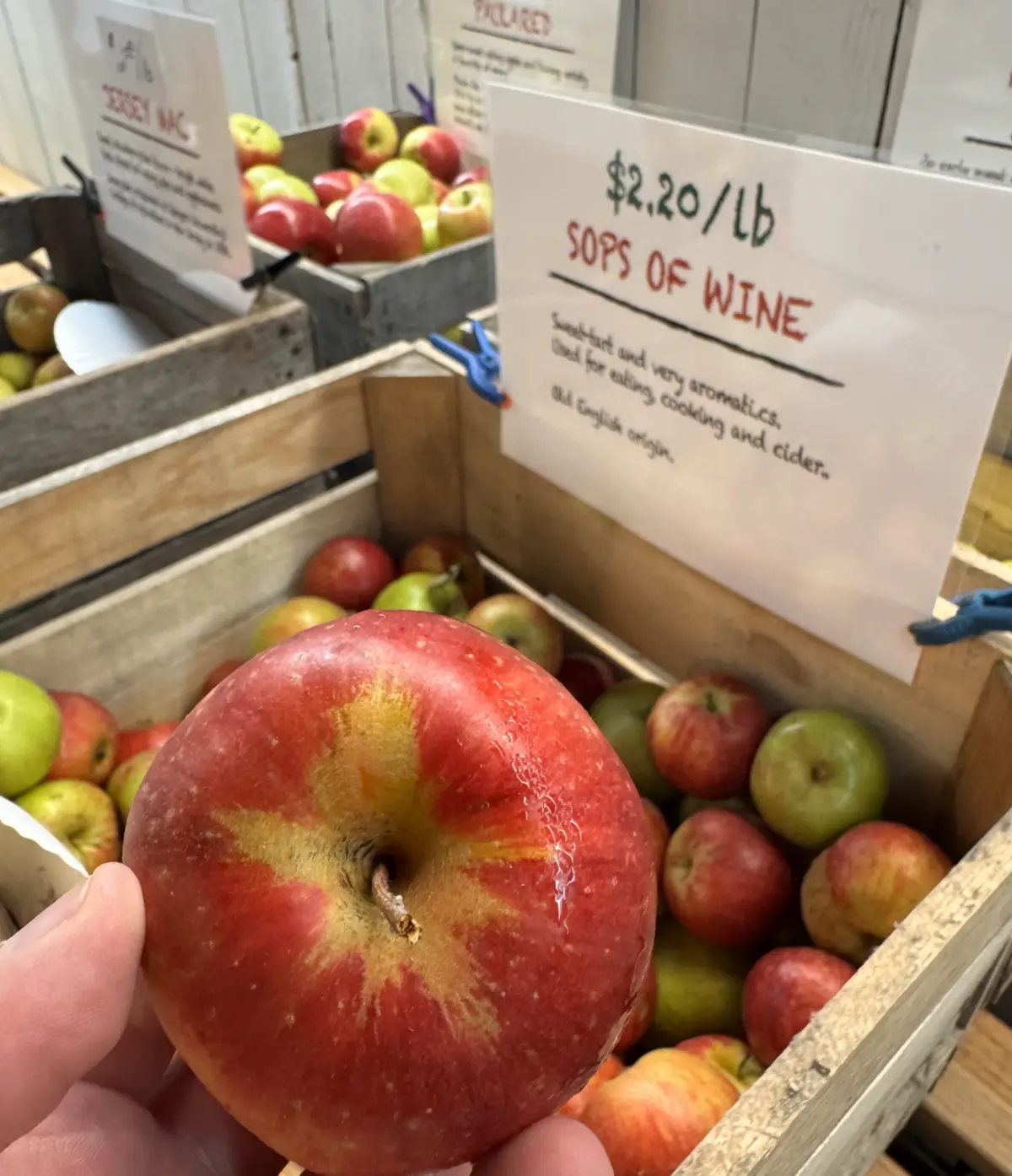
3. Sops of Wine
- Designation: Sops of Wine
- Quantitative Score: 3.5 / 10
- Sensory Architecture: Few culinary experiences evoke such immediate, involuntary cinematic flashbacks as the Sops of Wine. The mere contemplation of the moniker triggers deep-seated auditory memory loops of classical cinematic tragedy—specifically, the hollow, resonant tones of Tolkienian adaptation echoing in the chambers of the taster’s consciousness.
Unfortunately, the physical reality of the fruit failed to match the dramatic weight of its title. Exhibiting a pronounced deficit in structural integrity, the specimen suffered from a mealy, gritty texture, likely exacerbated by post-harvest over-ripening due to a delayed consumption window. Flavor-wise, the fruit offered pleasant, subdued complexities—drifting into "subacid" territory with subtle infusions of vanilla and spice. However, botanical taxonomy complications clouded the tasting: while classic historical descriptions cite the Sops of Wine as possessing striking red-fleshed interiors or distinct red staining, this particular sample yielded standard white flesh. Compounded by historical ambiguities surrounding whether "Sops of Wine" represents a single distinct cultivar or a loose umbrella term for a cluster of historic British types, the overall experience yielded substandard culinary metrics.
4. Fenceline Surprise
- Designation: Fenceline Surprise
- Quantitative Score: 1.0 / 10
- Sensory Architecture: The "surprise" inherent to this cultivar is its unmitigated failure to deliver basic culinary pleasure. While linguistic punnery suggests a continental French pronunciation over a standard agrarian fence line, the romanticism of the name evaporates upon first contact with the pulp.
The fruit presented as a uniformly bland, mushy matrix. A fleeting, ethereal top-note resembling a light misting of pear juice vanished almost instantaneously upon mastication, leaving behind an unpleasant mouthfeel comparable to fine beach sand. Despite official signage designating the batch as "firm," the physical evidence pointed overwhelmingly to advanced cellular degradation—either a fundamentally flawed harvest batch or severe over-storage prior to retail acquisition. Were it not for the saving grace of its aesthetically pleasing exterior and sophisticated nomenclature, this cultivar would have plumbed the absolute depths of the scoring metric.
5. Americus Crab
- Designation: Americus Crab
- Quantitative Score: 2.5 / 10
- Sensory Architecture: Evoking the aura of a Victorian steampunk inventor or a bygone era’s maritime superhero standing against the forces of brine, the Americus Crab commands attention through its very title. As a bona fide crabapple, however, its direct-consumption utility is inherently limited.
This specimen is an exercise in agricultural extremity. It is aggressively savory, fiercely tart, mechanically tough, and heavily laden with astringent tannins. It is a fruit fundamentally unsuited for casual, out-of-hand consumption by the uninitiated public. Yet, within the subculture of wild-foraging and esoteric fruit appreciation, it holds a niche appeal. It is an adventurous, uncompromising entity designed not for immediate pacification of hunger, but for those who actively seek out the wild, untamed edges of the botanical spectrum.

6. Campfield (False?)
- Designation: Campfield (False?)
- Quantitative Score: 4.1 / 10
- Sensory Architecture: Labeled mysteriously with the diagnostic qualifier "(false)," this cultivar presented as an enigmatic, almost adversarial entity within the tasting array. Structurally, the flesh offered a dense, chewy consistency reminiscent of a callused thumb, while simultaneously waging a biochemical war on the consumer’s oral mucosa through high concentrations of astringent tannins.
The presence of heavy tannins immediately categorizes this as a quintessential cider apple rather than a table fruit—an ingredient demanding biochemical transformation via the monastic arts of fermentation before it becomes truly hospitable to the human palate.
Supporting Context & Historical Metrics
To fully appreciate the weight of the 2026 harvest, one must contextualize these cultivars within the broader socio-historical tapestry of North American pomology. The historical record surrounding specific varieties—such as the Campfield—connects contemporary tasting notes directly to the foundational eras of colonial settlement.
Historical archives attribute the lineage of the Campfield apple to Matthew Canfield (variously spelled Campfield), an anti-royalist Puritan who emigrated from Harleston, England, during the Great Puritan Migration prior to 1637. As a foundational figure in the establishment of the New Haven Colony, Norwalk, Connecticut, and Newark, New Jersey, Canfield operated within an agricultural framework where land ownership was legally tethered to arboricultural cultivation. Early municipal town records from New Haven and Newark mandated that voting "freeholders" cultivate designated acreage explicitly for fruit tree propagation, transforming colonial landscapes into sprawling networks of cider orchards.

Canfield’s descendants participated actively in the Revolutionary War across fractured loyalties, with factions eventually settling as United Empire Loyalists in Nova Scotia. The physical soils of his historical New Jersey farm—where municipal records document routine payments in "three barrels of good cider made of winter fruit"—provided the ancestral terroir for the Campfield apple. Today, as tasters encounter these dense, tannic cultivars, they are essentially engaging in a sensory time-travel exercise, consuming the exact biochemical profiles that fueled colonial jurisprudence, civic infrastructure disputes over swine damage, and early American fermentation industries.
Official Statements & Industry Perspectives
The resurgence of interest in heirloom and esoteric apple varieties has sparked dialogue among professional horticulturists, cider makers, and culinary critics. While commercial markets have spent the past half-century consolidating around a homogenous oligopoly of uniform, shelf-stable cultivars (such as the Red Delicious and Granny Smith), independent pomologists argue for an urgent diversification of the agricultural gene pool.
Industry analysts emphasize that historical cultivars like the St Edmunds Pippin and the complex spice-driven Kickapoo Spice offer vital genetic reservoirs for disease resistance, climate adaptability, and complex flavor compounds that modern, industrial breeding programs have systematically bred out in favor of sheer visual symmetry and shipping durability.

Furthermore, the growing acceptance of low-scoring, highly specialized cider and culinary crabapples—such as the Americus Crab and the Campfield—signals a maturation in consumer literacy. The modern palate is increasingly willing to look beyond immediate, unmitigated sweetness, embracing astringency, high tannin loads, and structural eccentricity as markers of agricultural authenticity.
Future Outlook
As the 2026 pomological season shifts its geographical focus northward, the trajectory of this ongoing investigation points toward rich new hunting grounds. The impending expedition across New York, New England, and the Canadian provinces places the tasting delegation squarely within some of the oldest and most densely concentrated orchard districts in the Western Hemisphere.
With regional microclimates yielding distinct seasonal variations, subsequent phases of the 2026 survey are expected to uncover further anomalies, historical rediscoveries, and structural marvels. Observers anticipate that colder northern latitudes will produce tighter cellular structures, intensified acid profiles, and deeper aromatic complexities in late-harvest varieties.

As independent evaluators continue to bridge the gap between historical archival research and uninhibited sensory critique, the "Apple Snack Gang" remains at the forefront of a quiet culinary revolution—one crunch, one historical footnote, and one score at a time. The apples of the northeast await, and the audit has only just begun.