

Executive Overview
In the realm of seasonal fruit consumption, few phenomena garner as much unbridled fervor and rigorous, highly subjective analysis as the annual apple harvest. Following the widespread critical reception of part one of this season’s evaluations, the self-proclaimed "Apple Snack Gang" has returned with a secondary batch of field notes, examining obscure heritage varieties, deceptive cider apples, and physical anomalies that test the absolute limits of human dental anatomy.
This investigative report chronicles the evaluation of seven distinct apple cultivars: Kickapoo Spice, St Edmunds Pippin, Sops of Wine, Fenceline Surprise, Americus Crab, Campfield (False), and the notoriously robust Graham. Through a lens that marries pomological science with unhinged culinary critique, these evaluations provide a comprehensive snapshot of orchard yields, structural integrity, and unexpected flavor profiles ranging from heavy nutmeg to nostalgic chewing gum. As regional distribution shifts toward the northeastern territories of North America, this analysis serves as both a consumer guide and a cautionary tale regarding the unpredictable nature of fruit maturation.

Detailed Chronology of the Tasting Trials
The secondary tasting cohort presented a diverse array of physical characteristics, demanding a systematic approach to structural and gustatory assessment. The evaluations proceeded across several distinct phases, categorized by the fruit’s origin, structural resistance, and post-mastication aftertaste.
1. Kickapoo Spice
- Structural Profile: Dense, compact, and exhibiting minimal surface juice upon initial fracture.
- Flavor Profile: Dominated by a robust spice matrix featuring heavy notes of nutmeg, supplemented by subtle undertones of cinnamon and clove. The tasting session noted an anomalous, grass-like aftertaste reminiscent of freshly cut lawns.
- Maturational Assessment: Agricultural analysts note that the fruit may have suffered from premature harvesting or insufficient storage time. The dichotomy of apple maturation—where certain specimens improve post-harvest while others degrade rapidly—was acutely observed.
- Assigned Metric: 6.9 / 10
2. St Edmunds Pippin
- Structural Profile: Characterized by a remarkably rough cutaneous exterior, described anecdotally as akin to "licking a shark backward," which yielded to a satisfying, high-tension auditory and physical pop upon biting.
- Flavor Profile: Highly balanced, featuring a sharp, clean break, vibrant herbal notes with distinct fennel pollen undertones, and a robust underlying sweetness.
- Maturational Assessment: Serving as the taster’s inaugural proper apple of the season, it demonstrated optimal tart-sweet equilibrium, proving that functionally unusual exteriors frequently harbor exceptional internal quality.
- Assigned Metric: 8.3 / 10
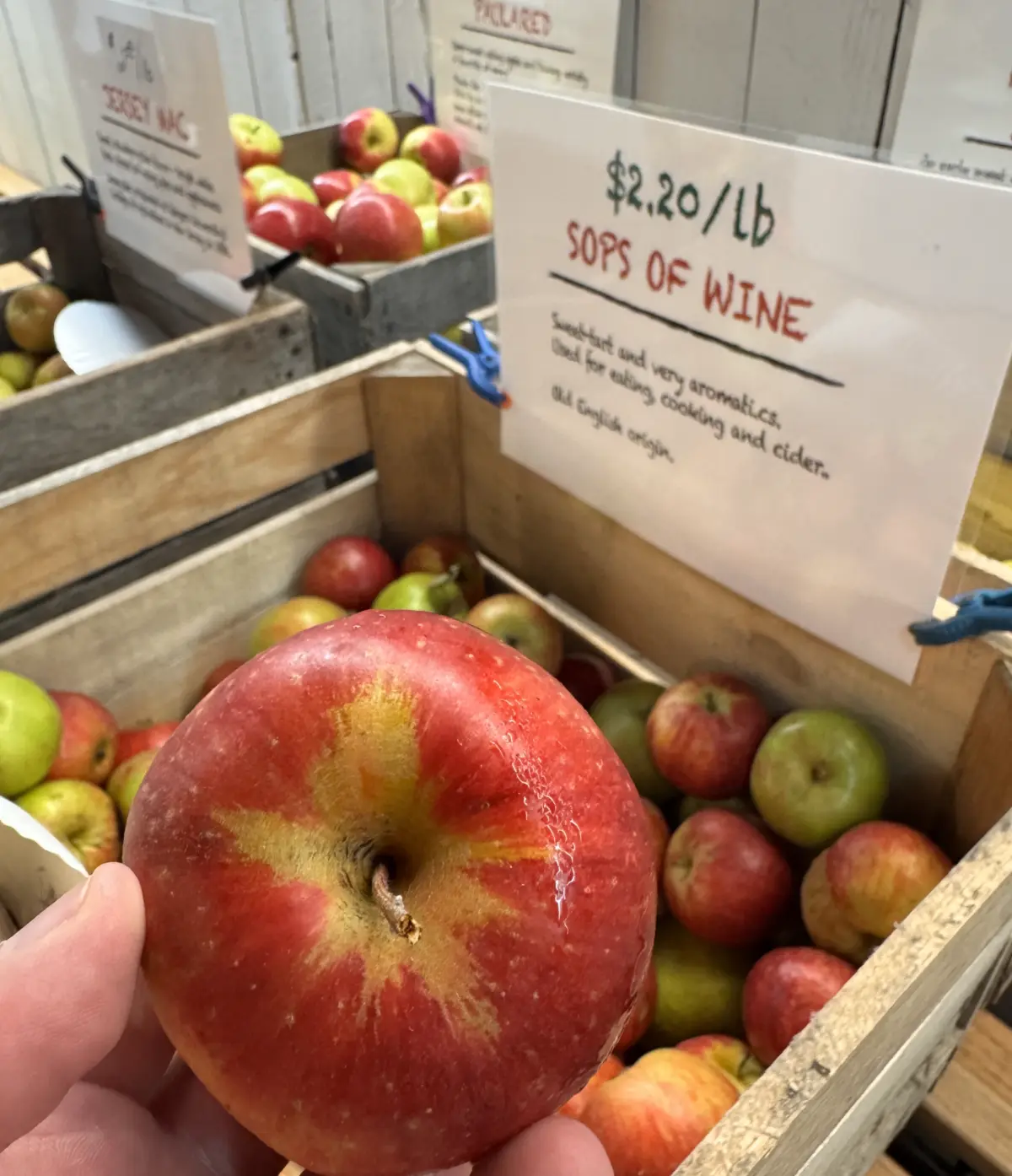
3. Sops of Wine
- Structural Profile: Compromised structural integrity. Exhibited a mealy and gritty texture, heavily implying that the specimen had remained detached from the branch for an unsustainable duration prior to consumption.
- Flavor Profile: Subacid (possessing a sweetness marginally eclipsing its tartness), accompanied by secondary notes of vanilla and spice.
- Maturational Assessment: Historical nomenclature surrounding the "Sops of Wine" remains murky; while some historical iterations boast red-fleshed anomalies, this specific specimen represented a more mundane expression of the cultivar. The psychological phenomenon of auditory intrusion—specifically involuntary mental echoes of cinematic characters demanding the consumption of "SOPS OF WINE"—was noted as a confounding variable during the tasting.
- Assigned Metric: 3.5 / 10
4. Fenceline Surprise
- Structural Profile: Ostensibly marketed as a "firm apple" via signage, the specimen presented as a severely degraded, soft, and texturally offensive mass.
- Flavor Profile: Exceptionally bland, save for a fleeting, superficial misting of pear-like flavor that dissipated almost instantly, leaving behind a mouthfeel comparable to beach sand.
- Maturational Assessment: Classified as an absolute failure of post-harvest handling or genetic expression. The discrepancy between the merchant’s description and the physical reality points toward severe over-ripening or compromised cold-storage chains.
- Assigned Metric: 1.0 / 10
5. Americus Crab
- Structural Profile: Extremely tough, highly tannic, and structurally unyielding.
- Flavor Profile: Savory, astringent, and aggressively tart. Unfit for casual, out-of-hand consumption by the layperson.
- Maturational Assessment: As a classic crabapple, its utility lies outside direct snacking. It remains a polarizing specimen recommended exclusively to consumers with a penchant for high-tannin experimentation.
- Assigned Metric: 2.5 / 10
6. Campfield (False)
- Structural Profile: Chewy, fibrous consistency that yielded a sensation akin to masticating a callused thumb.
- Flavor Profile: Overly sweet yet intensely laden with tannins, producing a bi-directional sensory illusion wherein the fruit appeared to consume the taster simultaneously.
- Maturational Assessment: Identified explicitly as a cider apple, rendering its raw consumption profile largely irrelevant to its intended industrial purpose. The cultivar carries deep historical significance tied to anti-royalist Puritan migration and early American cider production.
- Assigned Metric: 4.1 / 10
7. Graham
- Structural Profile: Impenetrably dense and hard. The physical resistance of the fruit necessitated extreme muscular engagement, described colloquially as structural "looksmaxxing," resulting in immediate localized jaw strain. Upon finally breaching the skin, the flesh fractured with the dramatic force of a calving glacier.
- Flavor Profile: Astoundingly, the intense structural battle yielded a flavor profile universally identified as unadulterated, unrestrained Juicy Fruit chewing gum.
- Maturational Assessment: A high-variance apple that combines extreme physical fortification with a bizarrely nostalgic and rewarding flavor payoff.
- Assigned Metric: 8.0 / 10
Supporting Context & Pomological Metrics
Evaluating heirloom and specialty apples requires an understanding of historical pomology, agricultural distribution, and the subjective psychology of taste. The table below outlines the aggregate performance metrics of the tested batch:

| Cultivar | Structural Integrity (1-10) | Flavor Complexity (1-10) | Historical / Cultural Oddity | Final Metric |
|---|---|---|---|---|
| Kickapoo Spice | 6.5 | 7.0 | Tenacious D reference | 6.9 |
| St Edmunds Pippin | 8.5 | 8.0 | Shark-skin texture | 8.3 |
| Sops of Wine | 3.0 | 4.0 | Cinematic auditory hallucinations | 3.5 |
| Fenceline Surprise | 1.0 | 1.0 | Deceptive nomenclature | 1.0 |
| Americus Crab | 4.0 | 2.5 | Steampunk inventor pseudonym | 2.5 |
| Campfield (False) | 4.0 | 4.5 | Puritan historical lineage | 4.1 |
| Graham | 9.0 | 9.0 | Juicy Fruit flavor anomaly | 8.0 |
The data illustrates a distinct inverse relationship between physical resistance and flavor palatability in outlier varieties—though exceptions such as the Fenceline Surprise prove that poor structural integrity can occasionally coincide with total gustatory failure.
Official Statements and Historical Dispatches
The investigation into the Campfield (False) variety uncovered a profound historical narrative submitted by independent arborists and descendants of the original New Jersey cultivators. According to historical records linked to the Orange Pippin pomological database, the lineage of the Campfield apple traces back to Matthew Canfield (alternatively spelled Campfield), an anti-royalist Puritan who arrived in North America prior to 1637 during the Great Puritan Migration.

As a founding father of the New Haven Colony, Norwalk, Connecticut, and Newark, New Jersey, Canfield’s legacy is physically anchored in the agricultural mandates of early colonial governance. Town records mandate that voting freeholders cultivate four acres of land, a regulation that directly catalyzed the mass planting of regional orchards dedicated to the production of hard winter-fruit cider. Canfield’s historical footprint—ranging from municipal service as a judge and customs collector to his ultimate resting place beneath the floorboards of Newark City Hall—underscores the deep-rooted symbiotic relationship between early American settlement and pomological development.
The inclusion of the "(False)" designation in modern labeling systems highlights the ongoing taxonomic challenges faced by contemporary orchardists attempting to accurately map heritage DNA against centuries of cross-pollination and linguistic drift.

Future Outlook & Upcoming Expeditions
As the autumn harvest transitions into its next operational phase, consumer attention pivots toward northern latitudes. The lead investigator and evaluation team have officially announced an extensive cross-border expedition scheduled for the coming weeks, encompassing targeted agricultural investigations throughout New York State, New England, and the provinces of Canada.
Stakeholders, orchard owners, and local purveyors of rare pomological specimens have been formally advised to prepare for heightened consumer scrutiny. With regional microclimates yielding distinct seasonal variations, the upcoming leg of the tour promises further discoveries within the heritage apple sector. Observers anticipate that colder northern climates may yield higher tannin concentrations and denser cellular structures, potentially challenging the structural limits of human dentition once more.

Further updates, itinerary details, and submission drop-off points for artisanal apple contributions remain accessible via official regional appearance schedules. The pursuit of the ultimate pomological specimen continues unabated.