In the grand pantheon of autumn traditions, few rituals evoke as much passionate discourse—or erratic sensory experiences—as the annual tasting of heritage, rare, and unconventional apple varieties. As orchardists and pomology enthusiasts harvest the fruits of a year’s labor, a critical segment of the culinary and agricultural community has turned its analytical gaze toward a sprawling, highly unpredictable batch of pomes.
Welcome back, Apple Snack Gang. Following the initial rollout of this season’s extensive evaluations, a secondary wave of scrutiny has emerged, detailing an eclectic array of cultivars that range from aromatic masterpieces to structural hazards capable of challenging even the most resilient human jawline.
This investigative review examines seven distinct varieties evaluated during this latest phase: the nutmeg-heavy Kickapoo Spice, the exceptionally crisp St Edmunds Pippin, the texturally disappointing Sops of Wine, the subterranean-grade Fenceline Surprise, the industrial-fantasy-adjacent Americus Crab, the revolutionary history-laden Campfield (False), and the jaw-training, gum-flavored powerhouse known simply as Graham.
Through rigorous qualitative assessment, structural analysis, and historical contextualization, this report details the triumphs, the tragedies, and the outright anomalies defining the current state of pomological enjoyment.
Detailed Chronology & Sensory Evaluations
The evaluation period captured a wide spectrum of arboreal maturity, underscoring the delicate balance between optimal harvest timing, cold storage dynamics, and post-picking degradation. The following chronological breakdown outlines the sensory profiles, structural integrity, and final scores of the tested specimens.
Opening the current phase of evaluations is the Kickapoo Spice, a cultivar whose nomenclature immediately triggers cultural touchstones. Exhibiting a robust, high-spice aromatic profile, this specimen leans heavily into nutmeg dominance, complemented by subtle undertones of cinnamon and clove. True to its moniker, the spice notes are front and center.
However, structural deficiencies temper its overall success. The apple completely lacked interior juiciness, presenting instead a dry, somewhat perplexing finish characterized by an aftertaste reminiscent of freshly cut grass. Pomological experts note that such anomalies often point toward storage timing issues; apples are notoriously fickle, with some varieties improving off the branch while others rapidly decline. Despite these setbacks, its distinct profile earns it a respectable, highly memeable score of 6.9 out of 10.
As the inaugural "proper" apple of the season, the St Edmunds Pippin set a remarkably high baseline. Visually and tactilely, the exterior skin presents a rugged texture—comparable to tactile friction against marine life. Yet, this rough exterior gives way to a phenomenal sensory experience upon the initial bite.
The cultivar delivers a sharp, resonant pop and crunch, followed by an abundance of juice. Flavor-wise, it defies simple categorization, introducing bright, herbal notes reminiscent of fennel pollen balanced delicately against a robust natural sweetness. It stands as a premier example of a wonderfully weird, funky heirloom apple that maintains a masterclass balance of tartness and sugar. Securing an 8.3 out of 10, it is a triumph of early-season harvesting.
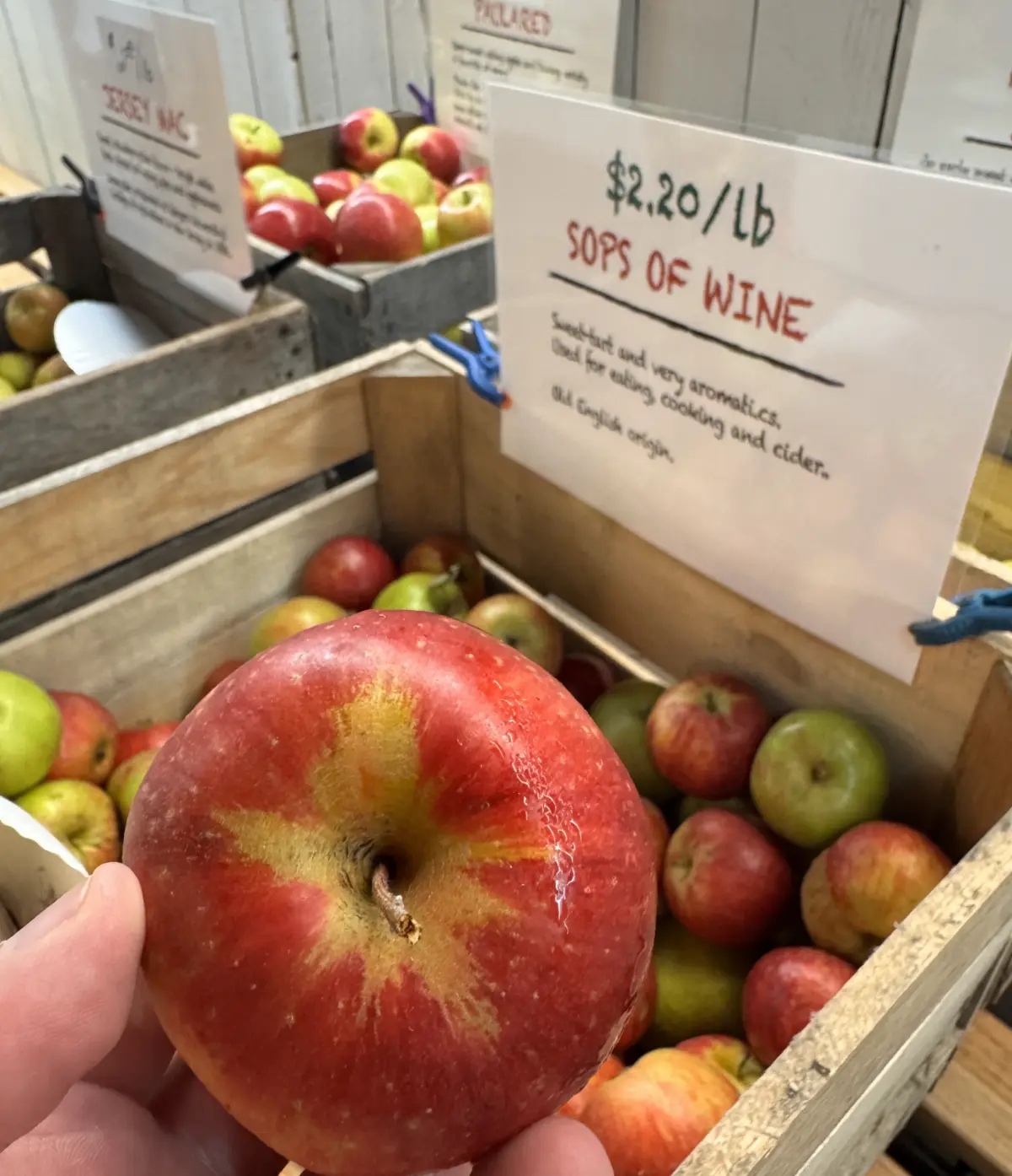
3. Sops of Wine
Score: 3.5 / 10
Structural Profile: Subacid, vanilla-spiced, mealy, and gritty texture.
Evoking cinematic literary associations—specifically the stark, haunting imagery of historical tragedy—the Sops of Wine offers a complex case study in the divergence between aromatic potential and physical execution.
Possessing a pleasant flavor profile characterized by subacid sweetness (leaning sweeter than tart) alongside subtle notes of vanilla and spice, the apple promised a delightful tasting experience. Unfortunately, its structural integrity had severely degraded, likely a consequence of over-ripening or excessive time spent off the tree prior to consumption. The resulting texture was notably mealy and gritty.
Furthermore, historical and horticultural discrepancies surround the name itself. While some sources identify Sops of Wine as a distinct red-fleshed or red-streaked variety, and others suggest the title functions as a blanket umbrella term for a cluster of antiquated regional types, the physical sample tested failed to deliver structural satisfaction. It earns a disappointing 3.5 out of 10.
True to its foreboding title, the "surprise" delivered by the Fenceline Surprise is entirely unwelcome. Despite linguistic wordplay inviting a continental pronunciation, the reality contained within the skin is decidedly pedestrian.
The apple presented as a thoroughly bland mush. While a fleeting, highly diluted whisper of pear juice could be detected upon initial entry, this micro-flavor vanished almost instantaneously, leaving behind a persistent, unpleasant mouthfeel comparable to beach sand. Although signage at the point of acquisition categorized it as a "firm apple," the specimen exhibited all the biological traits of advanced post-harvest decay—suggesting it was essentially compromised well before reaching the consumer. Absent a slightly appealing name and exterior presentation, this specimen hovered dangerously close to a complete zero, ultimately settling at a meager 1.0 out of 10.
The Americus Crab reads less like a standard agricultural product and more like a character straight out of a Victorian industrial-fantasy novel or a silver-age pulp hero comic.
As a true crabapple, it demands a specialized frame of reference. It is aggressively unconventional: intensely savory, sharply tart, physically resilient, and profoundly rich in astringent tannins. This is unequivocally not an apple intended for casual, out-of-hand consumption during a leisurely afternoon walk. Instead, it serves as a fascinating curiosity for experimental culinary adventurers willing to test the limits of what the human palate can tolerate. For its sheer audacity, it claims a 2.5 out of 10.
Labelled intriguingly with the caveat "(false)," the Campfield specimen presents an enigmatic profile. Structurally, it offers a dense, chewy mouthface that feels almost adversarial—possessing a high concentration of tannins that create a reciprocal sensation of the fruit consuming the consumer.
However, pomological context explains this aggressive profile: the Campfield is fundamentally a cider apple, engineered not for raw human consumption, but for the transformative alchemy of fermentation.
Historical Footnote: The Matthew Canfield Legacy
Horticultural records connect the lineage of the Campfield apple to early American colonial history. Originating from the lineage of Matthew Canfield (alternatively spelled Campfield), an anti-royalist Puritan migrant from Harleston, England, who arrived during the Great Migration prior to 1637, this strain is deeply embedded in the founding of colonial settlements including New Haven, Norwalk, and Newark. Historical town records indicate that Canfield’s agricultural endeavors required the cultivation of four acres of land, heavily prioritizing orchards and the production of robust winter-fruit ciders. Bearing the weight of centuries of colonial history and hard cider heritage, the Campfield scores a 4.1 out of 10 for raw consumption, though its industrial utility remains undisputed.
Rounding out the evaluation phase is the Graham, an apple whose physical density suggests it has spent significantly more time in a rigorous athletic training program than on a standard orchard branch. Protected by an exterior hardness that easily threatens temporomandibular joint (TMJ) stability and resists casual penetration, biting into a Graham requires genuine mechanical effort. Upon structural failure, the interior fractures with the dramatic force of a calving glacier.
Yet, the reward for this physical exertion is extraordinary. Once breached, the Graham yields an abundance of juice accompanied by an astonishing, unmistakable flavor profile: unadulterated, vividly nostalgic Juicy Fruit gum. This remarkable, out-of-left-field flavor note elevates the experience immensely, securing a rock-solid 8.0 out of 10, docked slightly only due to the mandatory jaw-conditioning required to consume it.
Supporting Context & Metrics
To provide a comprehensive overview of the 2026 harvest batch analyzed in this report, the following metrics illustrate the distribution of scores, structural traits, and primary culinary applications across the tested cultivars:
Cultivar Name
Evaluation Score (/10)
Primary Flavor Characteristic
Structural Integrity
Intended Use / Classification
Kickapoo Spice
6.9
Nutmeg, Cinnamon, Clove
Dry, Dense
Fresh / Storage-dependent
St Edmunds Pippin
8.3
Fennel Pollen, Herbal Sweet
Crisp, Juicy
Fresh Consumption
Sops of Wine
3.5
Vanilla, Subacid Spice
Mealy, Gritty
Historical / Fresh (Degraded)
Fenceline Surprise
1.0
Faint Pear Water
Mushy, Sandy
Decayed / Sub-standard
Americus Crab
2.5
Savory, Astringent, Tart
Tough, Tannic
Culinary Curiosity / Foraging
Campfield (False)
4.1
Tannin-Heavy, Sweet
Chewy, Tough
Cider Production
Graham
8.0
Juicy Fruit Gum
Rock-Hard, Dense
Fresh (High-Endurance)
Official Statements & Industry Observations
Pomological experts and independent field researchers continue to emphasize the unpredictable nature of regional apple yields influenced by seasonal weather fluctuations and cold-storage management.
In a statement reflecting on the broader implications of heirloom harvesting, lead evaluators noted:
"Apples are inherently eccentric biological entities. Some varieties reward patience, maturing gracefully away from their parent branches, while others initiate an immediate, irreversible descent into culinary obsolescence the moment they are severed from the tree. Consumers must navigate a minefield of textural variability—ranging from the miraculous snap of an early-season Pippin to the structural hostility of high-tannin cider apples."
Furthermore, historical horticulturists have stressed the importance of preserving antiquated lineages—such as the colonial-era Campfield—not necessarily for raw snacking utility, but to maintain the genetic biodiversity essential for regional cider economies and agricultural continuity.
Future Outlook
As the autumn harvest cycle progresses, the focus of the pomological community shifts northward and eastward. Upcoming field investigations are scheduled across New York State, New England, and Canadian agricultural belts.
These expeditions promise to uncover further localized anomalies, rare heirloom discoveries, and seasonal surprises as orchards drop their final yields before the onset of winter frost. Observers and orchardists are encouraged to submit specimens for future evaluations, maintaining the vital intersection of rigorous agricultural critique and unbridled snack-enthusiasm.
The pursuit of the ultimate pomological specimen continues unabated.