

Executive Overview
In the grand tradition of agricultural journalism and unhinged sensory exploration, the self-appointed connoisseurs of the "Apple Snack Gang" have returned with Part Two of their exhaustive, highly idiosyncratic apple review series. Following an initial batch that left orchard traditionalists reeling, this latest installment delves deeper into the esoteric underworld of heritage fruits, rare cider apples, and varietals that actively test the limits of human dental architecture.
Spanning seven distinct cultivars—ranging from the nutmeg-heavy Kickapoo Spice to the jaw-shattering, Juicy Fruit-infused Graham—this latest tasting expedition highlights the bizarre genetic lottery of pomology. Far from the uniform, waxy, supermarket-standard Red Delicious, these heirloom and obscure apples offer a chaotic spectrum of flavors, textures, and existential threats.

This report provides a comprehensive, structured breakdown of the evaluated cultivars, analyzing their sensory profiles, historical anomalies, and ultimate scores on the sacred 10-point scale. Furthermore, it examines the cultural implications of heritage fruit consumption and looks ahead to the reviewer’s upcoming migratory tour across New York, New England, and Canada.
Detailed Chronology of the Tasting Trials
The evaluation process followed a rigorous, albeit chaotic, methodology. Each specimen was subjected to visual inspection, tactile assessment (ranging from "dense boy" to "beach sand"), and eventual mastication—often at the peril of the taster’s enamel.

1. Kickapoo Spice
- Sensory Profile: High spice component dominated by heavy notes of nutmeg, coupled with subtle whispers of cinnamon and clove. Lacking in interior juiciness. Notable, albeit suboptimal, aftertaste redolent of freshly cut grass.
- Structural Integrity: Described colloquially as a "dense boy" and a "weird friend." The fruit suggests a need for prolonged post-harvest storage, highlighting the fickle nature of apples that either mature gracefully or descend rapidly into decay post-picking.
- Final Verdict: 6.9 / 10
2. St Edmunds Pippin
- Sensory Profile: The opening salvo of the primary tasting window. Encased in a rough, shark-skin-esque exterior, it yields an explosive, satisfying pop and crunch upon impact. Flavor notes lean bright, herbal, and surprisingly complex, featuring distinct fennel pollen undertones harmonized with a balanced tart-sweet core.
- Structural Integrity: Exceptionally crunchy, remarkably juicy, and sharp-breaking.
- Final Verdict: 8.3 / 10
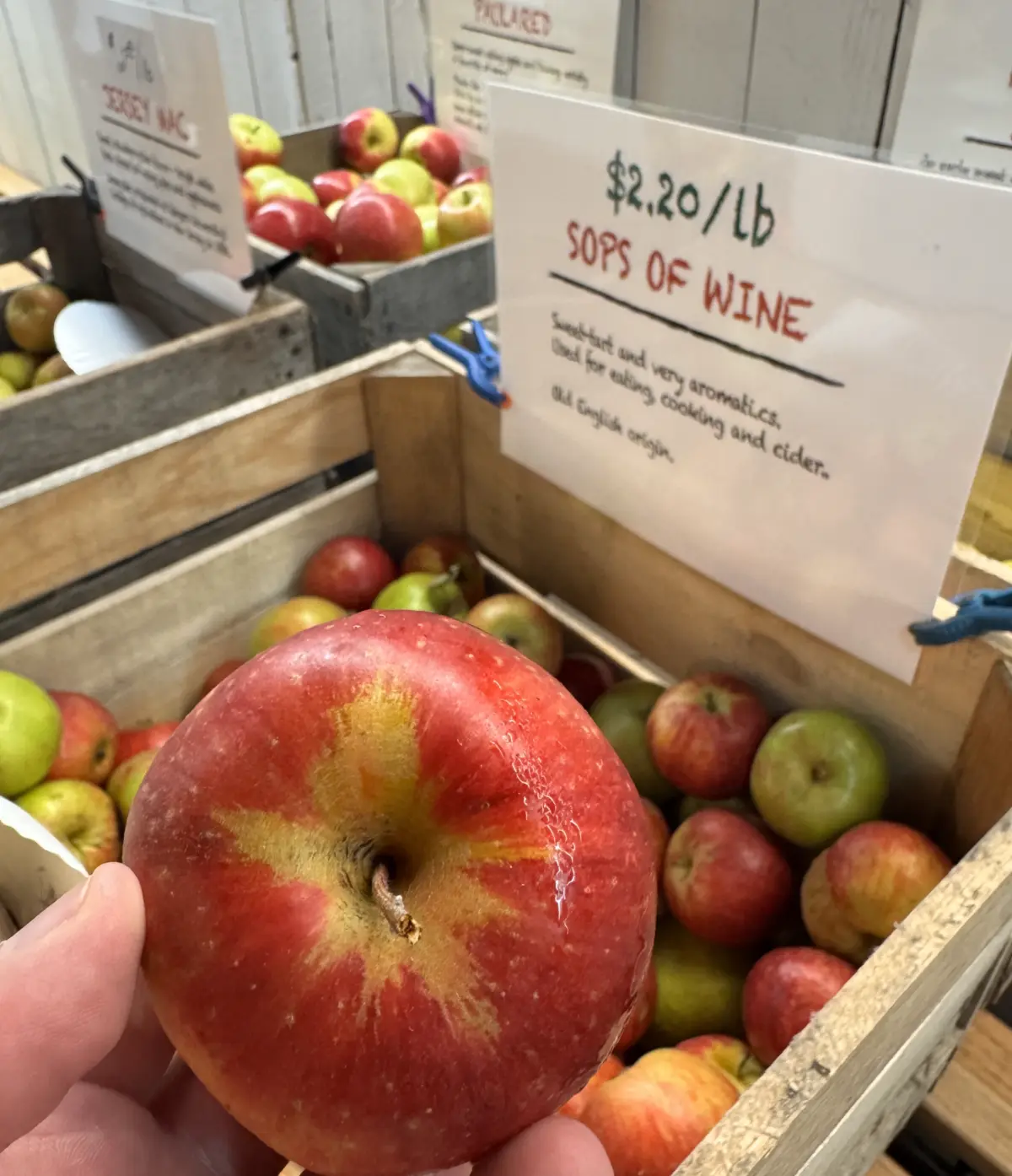
3. Sops of Wine
- Sensory Profile: Exhibiting a classic "subacid" profile (sweet eclipsing tart), this cultivar delivered pleasant vanilla and spice nuances. However, historical claims of red-fleshed interiors or streaked white flesh went unfulfilled in this specific specimen.
- Structural Integrity: Compromised. Suffering from prolonged shelf-life post-harvest, the texture devolved into a mealy, gritty experience that undermined its otherwise decent flavor bouquet.
- Final Verdict: 3.5 / 10
4. Fenceline Surprise
- Sensory Profile: A linguistic linguistic misdirection—inviting a faux-French pronunciation rather than a standard agrarian "fence line." Flavor-wise, it delivered a fleeting, highly diluted mist of pear essence before vanishing entirely into oblivion.
- Structural Integrity: Complete structural failure. Described as "bland mush" that leaves the palate feeling as though it has ingested beach sand.
- Final Verdict: 1.0 / 10 (Saved from absolute zero solely by its charming nomenclature and aesthetically pleasing exterior).
5. Americus Crab
- Sensory Profile: A crabapple of profound eccentricity. Heavily savory, intensely tart, and thoroughly abrasive. It boasts a high concentration of tannins that render it entirely unsuitable for casual out-of-hand consumption.
- Structural Integrity: Tough, uncompromising, and mechanically challenging.
- Final Verdict: 2.5 / 10 (Recommended exclusively for the thrill-seeking hedonist).
6. Campfield (False?)
- Sensory Profile: Labeled tantalizingly with a "(false)" tag, this cultivar behaves less like a fruit and more like a biochemical defense mechanism. It presents an aggressive dual-action assault: overly sweet yet simultaneously drowning in astringent tannins that make the taster feel as though the apple is consuming them.
- Structural Integrity: Chewy, callused, and structurally dense. Recognized rightfully as a cider apple requiring the alchemical intervention of fermentation.
- Final Verdict: 4.1 / 10
7. Graham
- Sensory Profile: The undisputed heavyweight champion of the tasting batch. Despite initial fears of catastrophic jaw trauma, penetrating the interior revealed an astonishing, unreserved flavor profile matching classic Juicy Fruit chewing gum.
- Structural Integrity: Impossibly dense and hard. Requiring immense mechanical force to breach, the flesh fractures with the geological drama of a calving glacier.
- Final Verdict: 8.0 / 10 (Deductions made solely due to the sheer physical toll exacted upon the taster’s TMJ).
Supporting Context & Metrics
To fully comprehend the gravity of these findings, one must examine the broader metrics governing heritage fruit evaluation. The modern consumer is largely conditioned to value uniformity, shelf-life, and predictable sweetness. The cultivars analyzed in Part Two subvert these industrial metrics entirely:
- The Tannin Index: Highly prevalent in historical cider apples like the Campfield and Americus Crab, high tannin levels act as a natural deterrent to fresh consumption while serving as the foundational backbone for complex hard ciders.
- Storage Sensitivity: As demonstrated by the Kickapoo Spice and Sops of Wine, the post-harvest timeline is a razor’s edge. Days spent sitting on retail displays can shift an apple from peak crispness to "crap-town" meagerness.
- Mastication Resistance (The TMJ Factor): Measured on a scale from "yielding peach" to "calving glacier" (Graham), structural density remains a vital metric for determining whether an apple requires casual snacking or preparatory dental work.
Official Statements and Historical Anomalies
The investigation into these cultivars unearthed several fascinating historical and psychological anomalies worthy of academic record.

Most notably, the evaluation of the Campfield apple brought to light a deep genealogical account regarding Matthew Canfield (alternatively spelled Campfield), an anti-royalist Puritan who migrated from England during the Great Migration of 1637. As a founding father of New Haven, Norwalk, and Newark—where he lies buried beneath City Hall—Canfield’s colonial legacy is inextricably linked to early American pomology. Town records from New Haven mandate that "freeholders" cultivate four acres of land, heavily spurring the proliferation of orchards designed to produce the winter-fruit ciders that sustained early American settlements.
Concurrently, psychological phenomena heavily influenced the tasting panel:

- The name Kickapoo Spice involuntarily invoked the iconic Tenacious D track "Kickapoo."
- The moniker Sops of Wine triggered vivid cinematic auditory hallucinations of Denethor dramatically consuming a tomato in The Lord of the Rings: The Return of the King, echoing the actor’s booming baritone across the taster’s consciousness.
- Americus Crab was universally agreed upon as both a prime candidate for a steampunk inventor protagonist and a remarkably niche, salt-water-battling superhero ("America’s Crab").
Future Outlook
As the autumn season reaches its zenith, the Apple Snack Gang shows no signs of slowing its pomological crusade. Preparations are officially underway for an upcoming expedition across New York, New England, and Canada.
Given the rich agrarian history and dense concentration of heritage orchards in these northern territories, aficionados can anticipate Part Three of this review series to feature an even wilder assortment of forgotten pomes, localized oddities, and regional cider fruits. The public is formally invited to consult the official appearances page, attend upcoming live events, and—most importantly—bring offerings of rare, local apples to the reviewing table.

Until then, the crusade continues: one dense, weird, tooth-shattering bite at a time.