The landscape of search engine optimization (SEO) is undergoing a structural evolution. Gone are the days when digital marketers and enterprise SEO teams could rely on manual spreadsheets, updated sporadically, to gauge visibility in search engine results pages (SERPs). In an era characterized by hyper-volatile algorithmic shifts, advanced artificial intelligence integrations (such as Google’s AI Overviews), and intensely localized search queries, precision and speed are non-negotiable.
Tracking the movement of high-volume keyword portfolios, dynamic SERP features, and relentless competitors across multiple search engines, devices, and global locations requires robust software infrastructure. Modern SERP tracking tools do not merely log static rank positions; they serve as diagnostic powerhouses that map keyword visibility directly to crucial business metrics, including organic traffic surges, user engagement, conversion rates, and bottom-line revenue.
This comprehensive market review evaluates the leading SERP tracking software available in 2025. By analyzing a curated shortlist of specialized, standalone trackers and all-in-one SEO platforms, this report examines the essential features digital marketing professionals must demand, reviews the top solutions on the market, and provides a strategic framework for choosing the right software to align with your enterprise objectives.
Detailed Chronology & Industry Evolution: From Spreadsheets to Real-Time Intelligence
To fully understand the sophistication of modern SERP tracking tools, one must examine how the discipline has matured over the past decade.
The Early Era (Pre-2015): SEO reporting relied heavily on manual data collection or rudimentary desktop-installed scrapers. Digital marketers checked rankings once a week—or even once a month—and pasted data into sprawling Excel spreadsheets. These systems were prone to human error, blind to localized rank variations, and utterly incapable of capturing complex SERP features.
The Rise of Cloud-Based Trackers (2015–2020): As search engines grew more personalized through machine learning and localized intent, cloud-based SaaS tools emerged. Platforms introduced automated daily rank updates, allowing agencies and in-house teams to monitor desktop and mobile visibility separately across national and regional parameters.
The Modern Era of Real-Time, Multi-Engine Intelligence (2020–2025+): Today, SERPs are dynamic ecosystems crowded with AI Overviews, People Also Ask (PAA) boxes, video carousels, and localized map packs. Modern tracking software utilizes advanced cloud architecture to deliver on-demand, real-time data refreshes. Furthermore, advanced reporting integrations—such as seamless connectors with Google Looker Studio (formerly Data Studio) and business intelligence suites like Databox—have transformed rank data from isolated vanity metrics into comprehensive revenue attribution dashboards.
Supporting Context & Essential Metrics: 9 Must-Have Features in 2025
When evaluating software investments, digital marketing leaders must look past simple ranking tables. A best-in-class SERP tracking solution should deliver granular insights backed by specific operational capabilities. Here are the nine core features to look for:
1. Access Accurate On-Demand Ranking Updates
SERP positions fluctuate continuously throughout the day due to real-time algorithm tweaks and local personalization. Waiting days for scheduled weekly or daily batch updates is unacceptable in fast-moving industries. Leading tools like AccuRanker automate daily checks while offering instantaneous, on-demand ranking refreshes at the click of a button, ensuring teams always act on fresh data.
2. Monitor Performance Across Diverse SERP Features
Ranking at "Position #0" or securing a prominent AI Overview, featured snippet, or local pack placement can dramatically amplify click-through rates. Trackers must identify which target keywords trigger specific SERP features and evaluate what optimizations are necessary to capture them from competitors. Comprehensive tools track over 50 distinct SERP features within a unified dashboard.
3. Track SERP Movement Across All Major Search Engines
While Google commands a massive market share globally, robust SEO strategies often require international visibility across alternative search engines such as Bing, Baidu, Yandex, and YouTube—particularly for global brands operating in diverse international markets.
4. Granular Tracking (By Location and Device)
Modern consumer search behavior is deeply contextual. Software must provide high-level national dashboards alongside hyper-local tracking capabilities down to the state, city, or even zip-code level. Additionally, seamless toggling between desktop and mobile rankings is vital for multi-device optimization.
5. Map SERP Movements to Traffic, Conversions, and Revenue
The ultimate justification for SEO investment is its impact on corporate revenue. Advanced tracking platforms integrate natively with Google Analytics or Adobe Analytics, synthesizing keyword rankings with user behavior data (such as bounce rates, page load times, goal completions, and generated revenue) into a single, cohesive landing page report.
6. View Historical Rank Performance
Point-in-time snapshots offer limited strategic value. Comprehensive historical data allows analysts to observe long-term ranking trends, evaluate the impact of past algorithm updates, and benchmark performance trajectory against aggressive market competitors over months or years.
7. Run Advanced Competitor Comparisons
Search visibility is a zero-sum game: when a competitor gains ground, your brand likely loses it. Top-tier tools categorize keywords into performance buckets (e.g., positions 1–3, 4–10, 11–50) to make it easy to monitor shifting market share, identify emerging threats, and discover unexploited ranking opportunities.
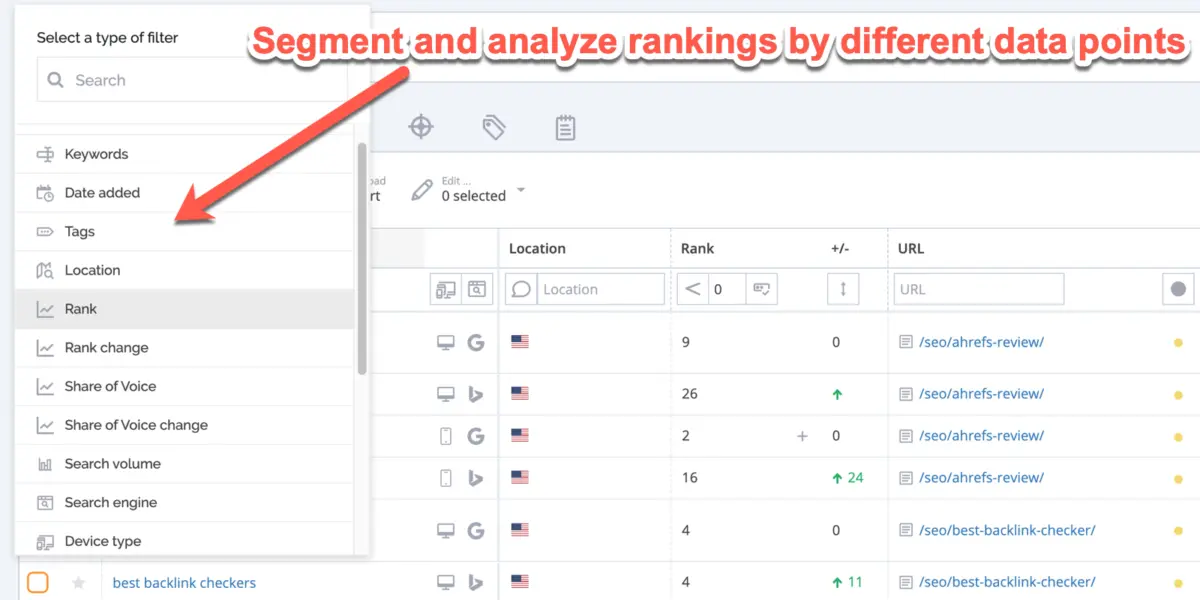
8. Tag and Segment Rankings Data
Not all keywords hold equal business value. Effective software allows users to tag, filter, and segment keywords by topic, sales funnel stage, asset type, or device, enabling precise analysis of Share of Voice (SoV) across different product lines or audience segments.
9. Generate White-Label Reports
For agencies and enterprise consultants, client communication is paramount. Native white-label reporting capabilities—supplemented by robust API connections and data connectors for tools like Google Looker Studio and Databox—ensure that stakeholders receive clean, professional, and easily digestible performance updates.
Official Industry Feedback & Expert Perspectives
Industry leaders emphasize the operational necessity of integrating advanced tracking tools with broader business intelligence ecosystems.
Ian Howells, Co-Founder of Traffic Think Tank, highlights the power of modern reporting integrations:
"The thing that really got me using them heavily in the last month or two is their data connector capabilities. Combining the tag feature, as well as the Share of Voice metric, has been a big help in making these reports immediately digestible for stakeholders."
Matthew Howells-Barby, Co-Founder of Traffic Think Tank and former HubSpot executive, echoes this sentiment regarding dedicated enterprise trackers:
"It’s by far the best keyword ranking tracker in the market and has a ton of great reporting functions. If you want visibility on large volumes of keywords housed within a nice dashboard, this is for you."
Comprehensive Review: The 7 Best SERP Tracking Tools for 2025
The market features an array of software solutions, divided primarily into two categories: standalone, dedicated SERP trackers and all-in-one SEO platforms that incorporate robust ranking modules.
1. AccuRanker (Best Dedicated SERP Tracker)
Overview: AccuRanker is a premier standalone SERP tracking tool relied upon by over 32,000 companies, including global brands like HubSpot, IKEA, and Kinsta. It is celebrated for its blazing-fast data processing speeds and precise accuracy.
Best Features: On-demand data refreshing, comprehensive SERP feature analysis (covering 50+ features), multi-engine support (Google, Bing, Baidu, Yandex, YouTube), deep analytics integrations, and powerful Share of Voice segmentation.
Target Audience: SEO agencies, enterprise marketing teams, and consultants requiring real-time data accuracy and robust API access.
Pricing: Subscription tiers scale based on keyword volume, starting at approximately $116/month for up to 1,000 keywords.
2. Semrush Position Tracker & SERP Gap Analyzer (Best All-in-One Platform)
Overview: Semrush is an industry-standard digital marketing suite utilized by over 10 million users, including brands like Samsung, Vodafone, and Booking.com. Its Position Tracking tool and specialized App Center add-ons provide enterprise-grade rank tracking.
Best Features: Highly accurate daily position tracking across global and local map packs, advanced competitor benchmarking, and the innovative SERP Gap Analyzer app which automatically scans search results to uncover under-optimized content and low-hanging fruit keywords.
Target Audience: Digital marketing agencies, e-commerce enterprises, and businesses seeking an all-in-one marketing suite with world-class rank tracking.
Pricing: Comprehensive platform subscriptions start at $139.95/month.
Overview: ProRankTracker is a trusted standalone tracking and reporting solution utilized by more than 60,000 users worldwide.
Best Features: Advanced multi-language reporting, comprehensive video rank tracking (YouTube), hyper-local geographic breakdowns, and intuitive white-label client portals.
Target Audience: SEM agencies, international brands, and video marketers seeking robust tracking at a competitive price point.
Pricing: Flexible pricing plans start at an accessible $39/month.
4. Advanced Web Ranking – AWR (Best for Enterprise & Custom Reporting)
Overview: AWR is a long-standing, robust standalone SERP tracker utilized by massive tech enterprises like Microsoft. It is renowned for its flexibility in handling massive keyword databases.
Best Features: Unlimited user seats on most plans, robust white-label report customization, deep historical data access, and flexible cloud infrastructure.
Target Audience: Large in-house marketing teams and enterprise agencies managing massive keyword portfolios.
Pricing: Plans begin at $99/month.
5. SERPWatcher by Mangools (Best for Simplicity & Beginners)
Overview: Developed by Mangools, SERPWatcher offers an approachable, streamlined user interface paired with powerful underlying tracking mechanics trusted by brands like Airbnb and Adidas.
Best Features: The proprietary Performance Index metric (which gauges organic traffic potential across all tracked terms), clean UI design, and tight integration with Mangools’ suite of research tools (including SERPChecker).
Target Audience: Startups, small business owners, and freelancers looking for straightforward, uncluttered SEO tools.
Pricing: Subscription packages start at $29.90/month.
6. SE Ranking (Best Value All-in-One Solution)
Overview: SE Ranking is a feature-rich, all-in-one SEO platform equipped with a powerful Position Tracking module that simulates real user behavior across all major search engines and precise geographic coordinates.
Best Features: 100% accurate location-based simulation, competitor ranking distribution charts, automated professional reporting, and comprehensive site audit tools.
Target Audience: Small-to-medium businesses and digital agencies looking for a balanced mix of affordability and deep feature sets.
Pricing: Plans start at $52/month for daily updates on 500 keywords.
7. Nightwatch (Best for Hyper-Local & Global Scale)
Overview: Nightwatch stands out as an elite daily SERP tracker capable of pulling data from over 100,000 global locations. It is trusted by high-growth companies like Shopify, Scotiabank, and Coinbase.
Best Features: Exceptional geographic granularity, clean data visualization dashboards, anomaly detection, and advanced segmentation capabilities.
Target Audience: Freelancers, expanding SMBs, and global enterprises requiring multi-region local tracking.
Pricing: Offers a 14-day free trial, with paid tiers starting at $32/month for up to 250 keywords.
Future Outlook: The Next Frontier in SERP Intelligence
As we look further into 2025 and beyond, the role of SERP tracking tools will continue to expand in response to artificial intelligence and evolving search interfaces.
Search engines are no longer simple lists of ten blue links. With the rapid proliferation of generative AI search experiences, standard rank positions will increasingly share space with conversational AI summaries, dynamic knowledge graphs, and personalized content feeds. Consequently, tomorrow’s leading SEO tools will evolve beyond traditional rank tracking into comprehensive visibility and brand-share analytics platforms.
Marketers will no longer just ask, "What position do I rank for this keyword?" Instead, they will evaluate:
How frequently does my brand appear within AI-generated synthesis panels?
What is our total Share of Voice across both traditional organic results and generative search features?
How do localized user intent shifts immediately impact multi-channel conversion pathways?
Selecting the right SERP tracking software today is not merely an operational checkbox—it is a strategic decision that lays the foundation for data-driven growth, competitive dominance, and measurable revenue attribution in an increasingly complex digital economy. Assess your organization’s specific scale, budget, and reporting requirements, leverage free trials where available, and invest in the platform that best positions your brand for long-term organic success.


![7 Best SERP Tracking Tools for 2022 [In-Depth Review]](https://www.robbierichards.com/wp-content/uploads/2020/05/Best-SERP-Trackers.jpg)
![7 Best SERP Tracking Tools for 2022 [In-Depth Review]](https://www.robbierichards.com/wp-content/uploads/2020/04/image16-2.png)
![7 Best SERP Tracking Tools for 2022 [In-Depth Review]](https://www.robbierichards.com/wp-content/uploads/2020/04/image2-3.png)
![7 Best SERP Tracking Tools for 2022 [In-Depth Review]](https://www.robbierichards.com/wp-content/uploads/2020/04/image6-2.png)
![7 Best SERP Tracking Tools for 2022 [In-Depth Review]](https://www.robbierichards.com/wp-content/uploads/2020/04/image15.jpg)
![7 Best SERP Tracking Tools for 2022 [In-Depth Review]](https://www.robbierichards.com/wp-content/uploads/2020/04/image12-1.png)
![7 Best SERP Tracking Tools for 2022 [In-Depth Review]](https://www.robbierichards.com/wp-content/uploads/2020/04/image13-2.png)
![7 Best SERP Tracking Tools for 2022 [In-Depth Review]](https://www.robbierichards.com/wp-content/uploads/2020/04/image3.jpg)
![7 Best SERP Tracking Tools for 2022 [In-Depth Review]](https://www.robbierichards.com/wp-content/uploads/2018/08/rj-employee_Robbie-color-new.png)
![7 Best SERP Tracking Tools for 2022 [In-Depth Review]](https://www.robbierichards.com/wp-content/uploads/2020/05/Databox-SEO-dashboard-1.jpg)
![7 Best SERP Tracking Tools for 2022 [In-Depth Review]](https://www.robbierichards.com/wp-content/uploads/2020/04/image4-2.png)
![7 Best SERP Tracking Tools for 2022 [In-Depth Review]](https://www.robbierichards.com/wp-content/uploads/2020/04/image5.jpg)
![7 Best SERP Tracking Tools for 2022 [In-Depth Review]](https://www.robbierichards.com/wp-content/uploads/2020/05/AccuRanker-Google-Data-Studio-integration.jpg)
![7 Best SERP Tracking Tools for 2022 [In-Depth Review]](https://www.robbierichards.com/wp-content/uploads/2018/11/Ian-Howells2.png)
![7 Best SERP Tracking Tools for 2022 [In-Depth Review]](https://www.robbierichards.com/wp-content/uploads/2019/01/Google-Data-Studio-KW-rankings-dashboard.png)
![7 Best SERP Tracking Tools for 2022 [In-Depth Review]](https://www.robbierichards.com/wp-content/uploads/2025/01/AccuRanker-home-page.jpg)
![7 Best SERP Tracking Tools for 2022 [In-Depth Review]](https://www.robbierichards.com/wp-content/uploads/2015/01/matthew-barby.jpg)
![7 Best SERP Tracking Tools for 2022 [In-Depth Review]](https://www.robbierichards.com/wp-content/uploads/2022/06/image1-1.png)
![7 Best SERP Tracking Tools for 2022 [In-Depth Review]](https://www.robbierichards.com/wp-content/uploads/2025/01/Semrush-SERP-Gap-Analyzer-1024x447.png)
![7 Best SERP Tracking Tools for 2022 [In-Depth Review]](https://www.robbierichards.com/wp-content/uploads/2025/01/Semrush-SERP-Gap-Analyzer-Search-Console-integration.png)
![7 Best SERP Tracking Tools for 2022 [In-Depth Review]](https://www.robbierichards.com/wp-content/uploads/2020/04/image10-2.png)
![7 Best SERP Tracking Tools for 2022 [In-Depth Review]](https://www.robbierichards.com/wp-content/uploads/2025/01/Advanced-Web-Ranking.jpg)
![7 Best SERP Tracking Tools for 2022 [In-Depth Review]](https://www.robbierichards.com/wp-content/uploads/2020/04/image11-1.png)