

Executive Overview
For digital marketers, enterprise SEO strategists, and agency owners, the modern Search Engine Results Page (SERP) is a shifting digital landscape. Gone are the days when organic visibility could be reliably evaluated through static, manually updated daily spreadsheets or sporadic weekly rankings reports. Today, managing visibility across hyper-targeted geographic locations, multiple device types, and a sprawling ecosystem of advanced SERP features—including AI Overviews, featured snippets, people-also-ask (PAA) boxes, and video carousels—demands a sophisticated technological approach.
Investing in robust SERP tracking software is no longer a luxury; it is a fundamental operational requirement. Modern platforms do much more than record a numerical position. They validate digital marketing investments, correlate ranking shifts with downstream business metrics like traffic and revenue, analyze competitor vulnerabilities, and deliver granular insights down to the zip-code level.

This comprehensive, in-depth review explores the essential features required in modern rank tracking software and evaluates the top seven SERP tracking tools for 2025. By dividing our analysis between elite standalone rank trackers and powerful position-tracking modules nested inside major all-in-one SEO suites, this guide provides the clarity needed to select the ideal platform for your operational scale and business objectives.
Detailed Chronology: The Evolution of SERP Tracking
To understand why modern rank tracking software operates the way it does, it is helpful to trace the evolution of search engine intelligence over the past two decades.

- The Early Era of Manual Optimization (Late 1990s – Mid 2000s): In the nascent days of search engines, optimization was largely text-based and keyword-density driven. Marketers tracked their success by manually typing queries into search boxes and noting their positions in raw text documents or early spreadsheet software. Data updates were erratic, localized variations were nonexistent, and search results were largely uniform regardless of user context.
- The Rise of Automated Desktop Scraping (2005 – 2012): As search engine algorithms grew more complex, desktop-based software emerged to automate rank checking by pinging search engines from local IP addresses. While these tools reduced manual labor, they were heavily bottlenecked by CAPTCHAs, IP bans, and the inability to process large volumes of keywords without crashing or returning inaccurate data.
- Cloud-Based Scalability and Global Data Centers (2012 – 2020): Cloud computing revolutionized the SEO software industry. Dedicated SaaS platforms like AccuRanker and ProRankTracker introduced cloud-based architectures capable of processing massive keyword portfolios on demand. This era also marked the birth of localized search tracking, mobile-first indexing considerations, and the proliferation of distinct SERP features designed to keep users on search engine result pages longer.
- The AI-Driven, Hyper-Personalized SERP Ecosystem (2021 – Present): Today, search engines have transformed from simple blue-link directories into dynamic, artificial intelligence-powered answer engines. With the introduction of generative search experiences and AI Overviews, SERPs change by the minute based on user intent, location, device, and browsing history. Modern SERP trackers have evolved into deeply integrated analytical engines, combining real-time cloud data scraping with machine learning to measure Share of Voice, predict organic traffic potential, and seamlessly integrate with data visualization tools like Looker Studio and Databox.
Supporting Context & Metrics: Why SERP Tracking Matters
To justify ongoing operational budgets and secure executive buy-in, SEO professionals must bridge the gap between technical search metrics and financial performance. Tracking SERP movements in isolation provides limited value unless it is directly mapped to business outcomes.
Industry benchmarks indicate that organizations utilizing advanced, real-time SERP tracking software experience several distinct operational advantages:

- Elimination of Reporting Latency: Traditional rank trackers update data on a rolling 7-to-30-day cycle, leaving teams blind to sudden algorithmic penalties or competitor surges. On-demand cloud tracking reduces latency to zero, allowing teams to trigger manual updates instantly after executing major on-page optimizations.
- Granular Local and International Precision: With consumer behavior heavily favoring "near me" queries and localized map packs, tracking at the national level is obsolete. Top-tier tools allow agencies to monitor keyword fluctuations down to specific city, state, or zip-code coordinates across international search engines such as Google, Bing, Baidu, and Yandex.
- Holistic Share of Voice (SoV) Measurement: Raw ranking positions can be deceiving. A website might rank #1 for a low-volume keyword while losing ground on high-volume terms. Modern tools calculate Share of Voice based on search volume and position, providing a true metric of market dominance.
- Revenue Attribution: By integrating SERP tracking platforms with web analytics tools (such as Google Analytics or Adobe Analytics), digital marketers can directly tie organic ranking improvements to bounce rates, conversion goals, and bottom-line revenue generation.
9 Essential Features to Look for in SERP Tracking Software
When evaluating software solutions for your organization, ensure the platform incorporates the following nine critical capabilities:
1. Access Accurate On-Demand Ranking Updates
SERP positions are volatile. Relying on scheduled daily or weekly data batches can leave your team reacting to critical algorithmic shifts days too late. Look for platforms that offer automated 24-hour updates supplemented by manual, on-demand refresh buttons that update your entire keyword dataset instantly.

2. Monitor Performance Across Diverse SERP Features
Ranking #1 in traditional organic blue links is only half the battle. To capture high-value real estate like AI Overviews, featured snippets, and video carousels, your software must track the presence of 50+ SERP features across your keyword portfolio. This allows you to identify which queries trigger specific features and formulate strategies to steal them from competitors.
3. Track Movement Across All Major Search Engines
While Google commands the lion’s share of global search traffic, comprehensive SEO strategies often require monitoring alternative engines. Whether you manage clients targeting local audiences via Bing or international markets relying on Baidu and Yandex, multi-engine tracking is vital.

4. Granular Tracking (Location and Device Segmentation)
Consumer search behavior diverges sharply between desktop and mobile devices. Your tracking software must clearly separate desktop and mobile rankings. Furthermore, geographical granularity—ranging from national campaigns down to hyper-local neighborhood zip codes—is non-negotiable for multi-location enterprises and local brick-and-mortar brands.
5. Map SERP Movements to Traffic and Revenue
Rankings do not pay the bills; conversions do. Advanced rank trackers integrate seamlessly with analytics suites to combine keyword performance data with organic visitor metrics, load times, bounce rates, and conversion values into a single dashboard.

6. View Historical Rank Performance
Point-in-time snapshots offer little context. A superior SERP tracker maintains deep historical archives, allowing strategists to review multi-year performance trends, analyze the long-term impact of past algorithm updates, and benchmark historical trajectories against direct competitors.
7. Run Comprehensive Competitor Comparisons
Understanding your own ranking velocity is helpful only if you know how your competitors are moving. Effective software groups keywords into performance buckets (e.g., positions 1–3, 4–10, 11–50) to let you audit competitor visibility gains and identify immediate threat vectors and content gaps.

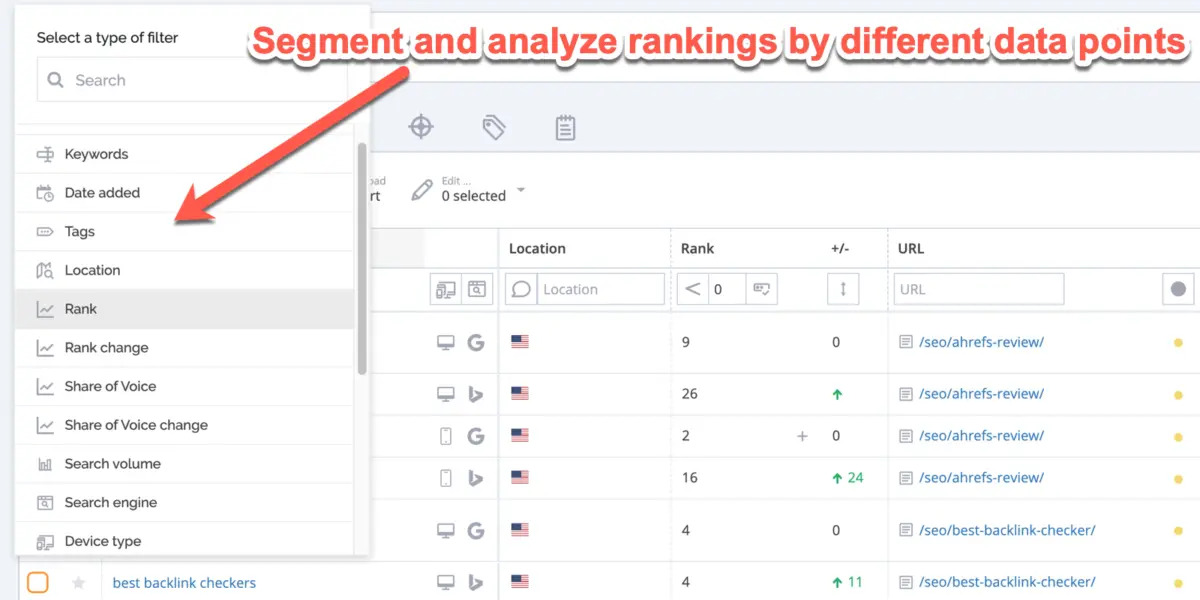
8. Tag and Segment Rankings Data
Large keyword portfolios become unmanageable without robust tagging architectures. You should be able to segment your data by content type, marketing funnel stage, product category, or custom tags to evaluate performance across specific silos of your website.
9. Generate White-Label Reports and Integrations
Client-facing agencies and enterprise teams require clean, digestible reporting. Look for native white-label scheduling capabilities or powerful API and native connectors that feed data directly into business intelligence tools like Looker Studio and Databox.

The 7 Best SERP Tracking Tools to Consider in 2025
The market is saturated with options, but a select few platforms consistently deliver the accuracy, speed, and analytical depth required by top-tier SEO professionals. Below is our curated shortlist of the best standalone and all-in-one SERP tracking tools.
1. AccuRanker
- Overview: AccuRanker is widely recognized as the gold standard for dedicated, standalone SERP tracking. Trusted by over 32,000 companies—including enterprise giants like HubSpot, IKEA, and Kinsta—it is engineered specifically for speed and precision.
- Key Features: Lightning-fast, on-demand data refreshes; comprehensive SERP feature tracking (covering 50+ features); robust Share of Voice analytics; deep historical data retention; and seamless Google Analytics and Looker Studio integrations.
- Best For: Agencies, enterprise brands, and SEO professionals who demand real-time data accuracy and deep API access without the bloat of an all-in-one suite.
- Pricing: Subscription tiers scale based on tracked keyword volume, starting at $116/month for up to 1,000 keywords.
2. Semrush (Position Tracker & SERP Gap Analyzer)
- Overview: Semrush is an industry-leading, all-in-one digital marketing platform utilized by over 10 million users globally. Its Position Tracking tool rivals the speed and accuracy of standalone trackers while existing within a massive ecosystem of competitive research, keyword discovery, and technical auditing tools.
- Key Features: Hyper-accurate daily rank tracking across national and local levels; device segmentation; competitor visibility scorecards; and the innovative SERP Gap Analyzer app in the Semrush App Center, which scans search results to uncover under-optimized content and low-hanging fruit keywords.
- Best For: Digital marketing agencies, ecommerce brands, and large enterprises looking for an enterprise-grade all-in-one platform that includes world-class rank tracking.
- Pricing: Platform plans start at $139.95/month.
3. ProRankTracker
- Overview: ProRankTracker is a robust, highly cost-effective standalone rank tracking and reporting solution trusted by over 60,000 users worldwide. It specializes in delivering accurate localized and international SERP data across diverse media types.
- Key Features: Excellent multi-language support; comprehensive local map pack tracking; video ranking tracking (YouTube); and intuitive white-label reporting engines.
- Best For: Small-to-medium agencies, international companies, and video marketers seeking reliable rank data on a budget.
- Pricing: Plans start at an accessible $39/month.
4. Advanced Web Ranking (AWR)
- Overview: Advanced Web Ranking is a venerable standalone SERP tracker utilized by thousands of in-house marketing teams and global enterprises, including Microsoft. Known for its highly flexible reporting infrastructure and robust data handling capabilities.
- Key Features: Cloud-based data processing; customizable white-label reporting templates; granular location and device tracking; and comprehensive competitor benchmarking modules.
- Best For: In-house teams and enterprise agencies that require deep data customization and scalable reporting frameworks.
- Pricing: Plans start at $99/month.
5. SERPWatcher (by Mangools)
- Overview: SERPWatcher is the dedicated rank tracking component of the Mangools all-in-one SEO suite. Celebrated for its exceptionally clean, user-friendly interface, it is trusted by massive global brands like Airbnb and Adidas.
- Key Features: Proprietary Performance Index metric that evaluates organic traffic potential; interactive visual charts; user-friendly keyword tagging; and seamless integration with Mangools’ auxiliary tools like SERPChecker.
- Best For: Small business owners, startups, freelancers, and agencies seeking simplicity, ease of use, and aesthetic reporting without a steep learning curve.
- Pricing: Mangools bundles start at $29.90/month.
6. SE Ranking
- Overview: SE Ranking is a versatile all-in-one SEO platform equipped with a powerful Position Tracking module. It stands out by simulating actual user behavior across specific search engines and exact geographic locations to ensure 100% data fidelity.
- Key Features: 100% accurate localized tracking; comprehensive competitor historical comparison; website auditing tools; and professional white-label reporting capabilities.
- Best For: Small business owners and digital agencies looking for a balanced, feature-rich SEO toolkit with reliable position tracking.
- Pricing: Plans start at $52/month based on daily updates for 500 keywords.
7. Nightwatch
- Overview: Nightwatch is a modern, highly accurate daily SERP tracker trusted by major brands like Shopify, Scotiabank, and Coinbase. It is celebrated for its ability to extract precise search engine rankings from over 100,000 distinct global locations.
- Key Features: Ultra-precise geographic targeting; advanced data segmentation; automated reporting engines; and clean, distraction-free dashboards.
- Best For: Freelancers, SMBs, and growing agencies looking for modern UI design paired with hyper-accurate global location tracking.
- Pricing: Offers a 14-day free trial, with paid plans starting at $32/month for up to 250 keywords.
Official Statements & Industry Perspectives
Industry leaders continue to emphasize the transformative impact of advanced SERP tracking and visualization tools on modern agency workflows.

“It’s by far the best keyword ranking tracker in the market and has a ton of great reporting functions. If you want visibility on large volumes of keywords housed within a nice dashboard—this is for you.”
— Matthew Howells-Barby, Co-Founder, TrafficThinkTank
Furthermore, the integration of rank tracking data with business intelligence platforms has redefined how client success is communicated.

“The thing that really got me using them heavily in the last month or two is their Google Data Studio connector. Combining the tag feature, as well as the Share of Voice metric… has been a big help in making these reports immediately digestible.”
— Ian Howells, Co-Founder, Traffic Think Tank
Agency directors similarly leverage aggregated metric dashboards to prove tangible ROI:

“My agency uses Databox to bring in rank distribution data from tools like Semrush to show the impact SERP movements are having on organic traffic and conversions.”
— Robbie Richards, Agency Founder & Editor
Future Outlook: The Next Generation of SERP Intelligence
As we look further into the future of digital marketing, SERP tracking technology will continue to undergo radical transformation. The traditional paradigm of ranking simply for static keyword positions is steadily giving way to holistic visibility tracking across multi-platform generative search environments.

- AI-Driven Generative Engine Tracking: As search engines increasingly rely on generative AI answers (such as Google’s Search Generative Experience and standalone AI search platforms), future SERP trackers will need to monitor brand citations, source attributions, and conversational query visibility rather than traditional numerical rankings alone.
- Predictive Analytics and Machine Learning: Next-generation trackers will increasingly incorporate predictive algorithms that analyze historical volatility and competitor velocity to forecast future ranking drops or traffic surges before they fully manifest in organic analytics.
- Deeper Real-Time API Synergies: The boundary between rank tracking software and business intelligence ecosystems will continue to blur. Direct, zero-latency API pipelines into data visualization tools will allow marketers to build custom, real-time command centers that correlate keyword visibility directly with enterprise revenue streams.
Choosing the Right Tool for Your Business
Selecting the ideal SERP tracking tool ultimately depends on your organization’s unique operational scale, budget, and strategic goals. If your primary requirement is a dedicated, lightning-fast, standalone rank tracker with exceptional API access and granular data, AccuRanker remains the premier choice. Conversely, if you require an all-in-one marketing suite that bundles world-class position tracking alongside competitor intelligence and content optimization apps like the SERP Gap Analyzer, Semrush provides unmatched value.
Evaluate your keyword volume, reporting requirements, and geographic targets carefully, take advantage of free trials where available, and equip your team with the data-driven clarity needed to dominate the SERPs in 2025 and beyond.