In the rapidly shifting landscape of modern search engine optimization, relying on manual spreadsheets or outdated weekly data is no longer a viable strategy for digital marketers, agencies, or enterprise brands. As search engine results pages (SERPs) become increasingly dynamic—dominated by AI Overviews, localized map packs, instant answers, and localized visual carousels—the margin for error has evaporated. Tracking movement across these volatile digital real estate spaces demands specialized infrastructure.
Modern SERP tracking software eliminates the guesswork of manual data collection. By allowing digital marketing professionals to monitor thousands of target keywords, shifting competitor landscapes, and hyper-specific device or regional parameters in real time, these platforms provide the empirical foundation necessary to validate SEO investments.
This comprehensive review explores the critical features to look for when choosing a SERP monitoring solution, examines the absolute best tools available on the market for 2025, and evaluates how dedicated tracking solutions stack up against comprehensive all-in-one SEO ecosystems. Whether you manage local brick-and-mortar campaigns or international enterprise portfolios, selecting the right platform is the ultimate differentiator between stagnation and scalable organic growth.
Detailed Chronology: The Evolution of Search Position Monitoring
To understand why modern SERP tracking tools operate the way they do today, it is essential to look back at how search monitoring has evolved over the past decade.
The Early Era (Pre-2015): Manual Tracking and Basic Scrapers
In the early days of SEO, professionals relied heavily on locally run desktop software or hand-updated Excel spreadsheets. These tools were prone to IP blocks from search engines, offered limited geographic targeting (often restricted to a national level), and lacked any real-time update capabilities. Data was collected once a week—or even once a month—making agile campaign adjustments nearly impossible.
The Rise of Cloud-Based SaaS Trackers (2015–2020)
As cloud computing matured, dedicated SaaS rank tracking platforms emerged. Tools like AccuRanker and ProRankTracker disrupted the market by shifting processing to the cloud, introducing automated daily updates, and expanding metrics to include early iterations of search visibility and "Share of Voice." During this period, the industry also saw major all-in-one SEO suites—such as Semrush and SE Ranking—integrate robust rank tracking modules directly into their wider toolsets, giving users an alternative to standalone software.
The Modern Era (2020–Present): Granular Data, AI Integration, and Hyper-Localization
Today, rank tracking is no longer just about knowing whether you rank #1 or #5. The proliferation of diverse SERP features, zero-click searches, AI-generated overviews, and deep Google Analytics and Looker Studio (formerly Google Data Studio) integrations have transformed SERP trackers into comprehensive business intelligence dashboards. Modern platforms can pull on-demand data down to the exact zip code, separate desktop and mobile performance flawlessly, and map ranking shifts directly to revenue, conversions, and customer acquisition costs.
Supporting Context & Metrics: Why SERP Tracking Drives Business ROI
Investing in high-end SERP tracking software is rarely just an IT or content-team decision; it is a fundamental business necessity. According to industry analyses, top-tier SEO agencies and enterprise digital marketing teams utilize rank tracking metrics to secure budgets, prove campaign validity, and pivot content strategies before traffic drops impact the bottom line.
Consider the core operational metrics that justify this software investment:
Granular Visibility: Moving beyond simple average rankings to analyze visibility at the city, state, and zip-code level.
SERP Feature Capture Rate: Quantifying how many featured snippets, AI Overviews, People Also Ask (PAA) boxes, and video carousels your brand controls relative to competitors.
Revenue Attribution: Bridging the gap between raw keyword movement and real-world business outcomes by connecting tracking tools directly with web analytics platforms (Google Analytics, Adobe Analytics) to track landing page conversions, bounce rates, and overall revenue contribution.
Without these data points, proving the tangible value of organic search efforts to stakeholders remains an uphill battle.
Essential Features to Look for in Modern SERP Tracking Software
When evaluating software options for your organization, a generic feature list won’t suffice. The market’s leading tools separate themselves through a specific set of advanced capabilities:
1. Access Accurate On-Demand Ranking Updates
SERP positions fluctuate by the minute. Waiting days for a batch update is counterproductive. Look for tools like AccuRanker, which automates daily updates while offering on-demand, single-click data refreshes whenever you launch a new optimization campaign.
2. Monitor Performance Across Diverse SERP Features
Ranking in traditional organic position #3 is only half the battle if Positions #0 and #1 are dominated by AI Overviews, featured snippets, and video carousels. Advanced trackers allow you to monitor 50+ unique SERP features simultaneously, pinpointing which keywords trigger them and what content adjustments are required to steal that digital real estate from competitors.
3. Track Movement Across All Major Search Engines
While Google commands the lion’s share of global search traffic, international campaigns—particularly those targeting markets utilizing Baidu, Yandex, Bing, or YouTube—require multi-engine tracking capabilities.
4. Granular Localization and Device Segmentation
A truly robust tracker accommodates localized search behavior down to the neighborhood level, while giving you the flexibility to segment and compare desktop versus mobile rankings independently.
5. Map SERP Movements Directly to Traffic and Revenue
The best tools do not operate in a vacuum. Integrations with Google Analytics and Adobe Analytics enable landing-page level reporting that blends keyword positions and search volumes with bounce rates, load times, and monetary conversion values.
6. Historical Data and Trend Analysis
"Point-in-time" snapshots are insufficient for deep strategic planning. You need full historical visibility to identify seasonal trends, algorithm update impacts, and long-term competitor trajectories.
7. Competitor Benchmarking
Understanding your own ranking movements is vital, but tracking how your competitors gain or lose ground across defined keyword buckets (e.g., positions 1–3, 4–10, 11–50) exposes immediate market threats and untapped opportunities.
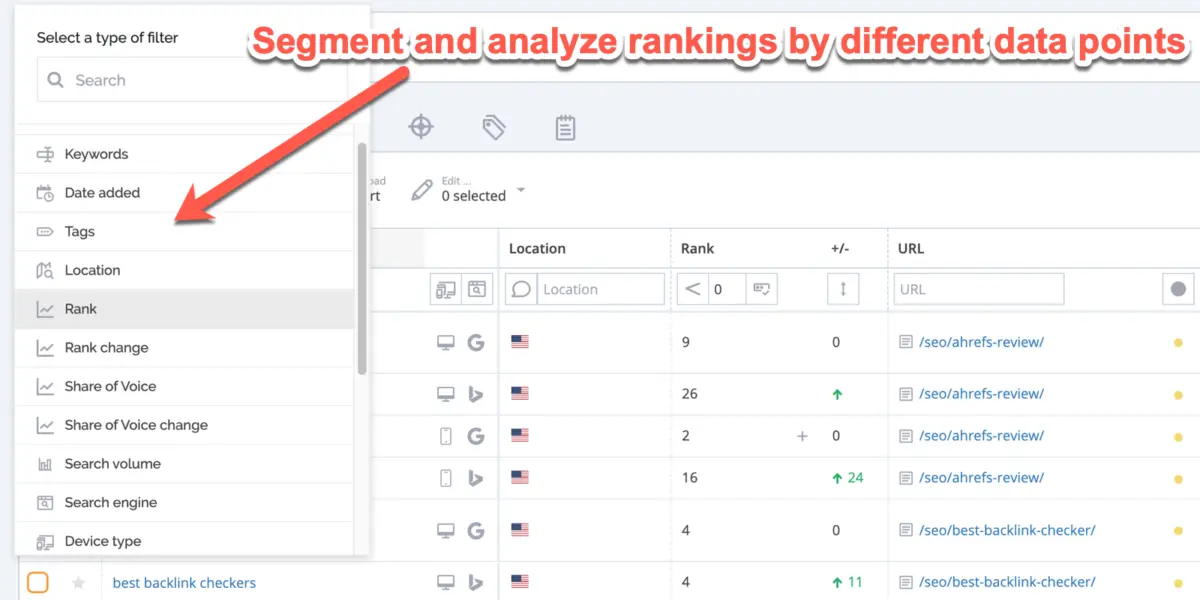
8. Custom Tagging and Data Segmentation
Not all keywords carry equal weight. Robust tagging features allow you to filter and analyze performance by customer journey funnel stage, content asset type, topic cluster, and device category.
9. White-Label and Automated Client Reporting
For agencies and consultants, the ability to generate clean, digestible, and white-labeled reports—or seamlessly pipe data into dashboards via Looker Studio or Databox—is non-negotiable.
The 7 Best SERP Tracking Tools to Consider in 2025
The software market offers countless options, but the following curated shortlist highlights the top dedicated trackers and all-in-one SEO platforms dominating the industry.
1. AccuRanker (Best Dedicated Standalone Tracker)
Overview: AccuRanker is widely regarded as the premier standalone SERP tracking platform. Trusted by over 32,000 companies—including enterprise giants like HubSpot, IKEA, and Kinsta—it is built for speed, accuracy, and deep agency-level reporting.
Key Features: Lightning-fast on-demand data refreshes, comprehensive SERP feature tracking, deep Google Analytics/Adobe Analytics integrations for revenue attribution, and robust white-label reporting.
Pricing: Subscription plans scale based on tracked keyword volume, starting at approximately $116/month for up to 1,000 keywords.
2. Semrush Position Tracker & SERP Gap Analyzer (Best All-in-One Solution)
Overview: Serving over 10 million users globally, Semrush is an industry-standard all-in-one digital marketing suite. Its dedicated Position Tracking tool rivals the speed and accuracy of standalone trackers while functioning as part of a massive ecosystem used by brands like Samsung, Vodafone, and Booking.com.
Key Features: Hyper-accurate daily rank tracking across devices and hyper-local regions, advanced competitor comparison buckets, and the unique SERP Gap Analyzer (available in the Semrush App Center), which scans search engine results to uncover under-optimized content and integrates seamlessly with Google Search Console.
Overview: ProRankTracker is a scalable, highly reliable standalone rank tracking and reporting tool utilized by over 60,000 customers worldwide.
Key Features: Broad multi-engine and multi-device tracking, multilingual support, advanced reporting dashboards, and accurate local tracking capabilities tailored for agencies and ecommerce brands.
Pricing: Entry-level plans start at an accessible $39/month.
4. Advanced Web Ranking – AWR (Best for Enterprise Scalability)
Overview: Advanced Web Ranking (AWR) is a veteran standalone SERP tracker utilized by thousands of in-house marketing teams and enterprise giants like Microsoft.
Key Features: Exceptional cloud infrastructure, deep data customization, extensive white-label reporting configurations, and broad international search engine coverage.
Pricing: Subscription tiers begin at $99/month.
5. SERPWatcher by Mangools (Best for Simplicity and Usability)
Overview: Developed by Mangools, SERPWatcher is designed to cut through the analytical clutter. It provides an intuitive, streamlined user interface favored by small businesses, startups, and lean agencies.
Key Features: The proprietary Performance Index metric (which gauges organic traffic potential across tracked keywords), simplified reporting views, and bundled access to complementary tools like SERPChecker.
Pricing: Mangools plans start at $29.90/month, making it one of the most budget-friendly entry points on the market.
6. SE Ranking (Best Feature-Rich Value Platform)
Overview: SE Ranking is a comprehensive all-in-one SEO platform known for simulating exact user behavior across targeted locations to ensure hyper-accurate ranking data.
Key Features: Comprehensive position tracking across all major search engines, automated reporting, competitor visibility graphs, and modular pricing.
Pricing: Plans start at $52/month based on daily tracking for 500 keywords.
7. Nightwatch (Best for Hyper-Local and Global Scale)
Overview: Nightwatch distinguishes itself through its massive geographic database, allowing users to pull accurate rankings from over 100,000 distinct locations worldwide. Trusted by brands like Shopify, Scotiabank, and Coinbase.
Key Features: Sophisticated data filtering, automated white-label reporting, clean visualizations of ranking distributions, and exceptional local search accuracy.
Pricing: Offers a 14-day free trial, with paid plans starting at $32/month for up to 250 keywords.
Official Industry Statements & Expert Perspectives
"It’s by far the best keyword ranking tracker in the market and has a ton of great reporting functions. If you want visibility on large volumes of keywords housed within a nice dashboard—this is for you." — Matthew Howells-Barby, Co-Founder of TrafficThinkTank
"The thing that really got me using them heavily in the last month or two is their integration capabilities… Combining the tag feature, as well as advanced metrics, has been a big help in making these reports immediately digestible for clients." — Ian Howells, Co-Founder of Traffic Think Tank
Future Outlook: What Lies Ahead for SERP Tracking?
As artificial intelligence continues to fundamentally rewrite how search engines deliver information to users, the role of SERP tracking software will only expand in complexity. We are rapidly moving past a world defined strictly by "blue links" and rigid numbered positions.
In the near future, the most successful SEO tools will need to provide deeper insight into generative engine optimization (GEO)—tracking how brands are cited within AI-generated summaries, chat interfaces, and dynamic zero-click environments. Platforms that successfully bridge raw position data with qualitative content optimization recommendations—similar to early innovations like Semrush’s SERP Gap Analyzer—will dominate the marketplace.
For digital marketers, agencies, and enterprise brands alike, choosing a flexible, forward-thinking SERP tracking solution today ensures that your organization remains agile, visible, and profitable amidst the ongoing evolution of search.


![7 Best SERP Tracking Tools for 2022 [In-Depth Review]](https://www.robbierichards.com/wp-content/uploads/2020/05/Best-SERP-Trackers.jpg)
![7 Best SERP Tracking Tools for 2022 [In-Depth Review]](https://www.robbierichards.com/wp-content/uploads/2020/04/image16-2.png)
![7 Best SERP Tracking Tools for 2022 [In-Depth Review]](https://www.robbierichards.com/wp-content/uploads/2020/04/image2-3.png)
![7 Best SERP Tracking Tools for 2022 [In-Depth Review]](https://www.robbierichards.com/wp-content/uploads/2020/04/image6-2.png)
![7 Best SERP Tracking Tools for 2022 [In-Depth Review]](https://www.robbierichards.com/wp-content/uploads/2020/04/image15.jpg)
![7 Best SERP Tracking Tools for 2022 [In-Depth Review]](https://www.robbierichards.com/wp-content/uploads/2020/04/image12-1.png)
![7 Best SERP Tracking Tools for 2022 [In-Depth Review]](https://www.robbierichards.com/wp-content/uploads/2020/04/image13-2.png)
![7 Best SERP Tracking Tools for 2022 [In-Depth Review]](https://www.robbierichards.com/wp-content/uploads/2020/04/image3.jpg)
![7 Best SERP Tracking Tools for 2022 [In-Depth Review]](https://www.robbierichards.com/wp-content/uploads/2018/08/rj-employee_Robbie-color-new.png)
![7 Best SERP Tracking Tools for 2022 [In-Depth Review]](https://www.robbierichards.com/wp-content/uploads/2020/05/Databox-SEO-dashboard-1.jpg)
![7 Best SERP Tracking Tools for 2022 [In-Depth Review]](https://www.robbierichards.com/wp-content/uploads/2020/04/image4-2.png)
![7 Best SERP Tracking Tools for 2022 [In-Depth Review]](https://www.robbierichards.com/wp-content/uploads/2020/04/image5.jpg)
![7 Best SERP Tracking Tools for 2022 [In-Depth Review]](https://www.robbierichards.com/wp-content/uploads/2020/05/AccuRanker-Google-Data-Studio-integration.jpg)
![7 Best SERP Tracking Tools for 2022 [In-Depth Review]](https://www.robbierichards.com/wp-content/uploads/2018/11/Ian-Howells2.png)
![7 Best SERP Tracking Tools for 2022 [In-Depth Review]](https://www.robbierichards.com/wp-content/uploads/2019/01/Google-Data-Studio-KW-rankings-dashboard.png)
![7 Best SERP Tracking Tools for 2022 [In-Depth Review]](https://www.robbierichards.com/wp-content/uploads/2025/01/AccuRanker-home-page.jpg)
![7 Best SERP Tracking Tools for 2022 [In-Depth Review]](https://www.robbierichards.com/wp-content/uploads/2015/01/matthew-barby.jpg)
![7 Best SERP Tracking Tools for 2022 [In-Depth Review]](https://www.robbierichards.com/wp-content/uploads/2022/06/image1-1.png)
![7 Best SERP Tracking Tools for 2022 [In-Depth Review]](https://www.robbierichards.com/wp-content/uploads/2025/01/Semrush-SERP-Gap-Analyzer-1024x447.png)
![7 Best SERP Tracking Tools for 2022 [In-Depth Review]](https://www.robbierichards.com/wp-content/uploads/2025/01/Semrush-SERP-Gap-Analyzer-Search-Console-integration.png)
![7 Best SERP Tracking Tools for 2022 [In-Depth Review]](https://www.robbierichards.com/wp-content/uploads/2020/04/image10-2.png)
![7 Best SERP Tracking Tools for 2022 [In-Depth Review]](https://www.robbierichards.com/wp-content/uploads/2025/01/Advanced-Web-Ranking.jpg)