

Executive Overview
The digital landscape of the 21st century is littered with the ghosts of disruptive technologies that burned brightly before succumbing to regulatory pressures, shifting consumer habits, or technological obsolescence. Few names, however, evoke as much nostalgic recognition—and regulatory baggage—as LimeWire. Once the undisputed titan of peer-to-peer (P2P) file sharing during the dial-up and early broadband eras of the mid-2000s, the brand became a battleground for copyright infringement lawsuits that ultimately led to its court-mandated shutdown in 2010.
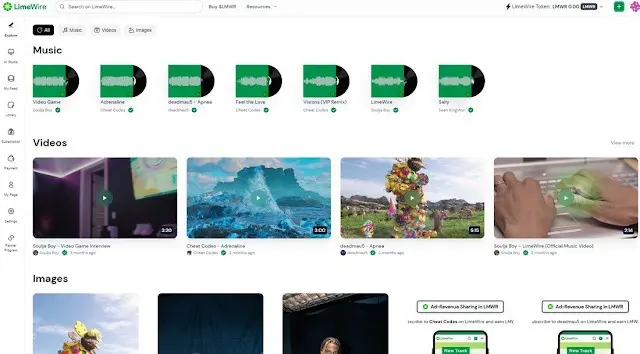
More than a decade later, LimeWire has engineered one of the most improbable and ambitious corporate resurrections in tech history. Stripped of its legacy file-sharing software, the brand has been entirely reimagined. Today, LimeWire operates as a cutting-edge, decentralized generative artificial intelligence (AI) content studio and Web3 publishing platform.
By merging state-of-the-art text-to-image AI models—such as Stable Diffusion and DALL-E 2—with blockchain-based monetization tools, automated NFT minting, and a native utility token ($LMWR), the platform positions itself as a comprehensive ecosystem for modern digital creators. Major cultural figures and musical artists, including Soulja Boy, Sean Kingston, and deadmau5, have already utilized the platform to release digital assets and music.
This comprehensive investigation examines LimeWire’s technological architecture, its novel Web3 monetization framework, tiered pricing structures, and its strategic pivot to redefine how digital artists generate income in an increasingly automated world.
Detailed Chronology: The Evolution from Infringement to Innovation
To understand LimeWire’s current positioning in the generative AI market, one must trace its trajectory across two distinct epochs of internet history: the Wild West of early P2P networks and the modern era of algorithmic art and decentralized finance (DeFi).
Era 1: The P2P Genesis (2000–2010)
Founded in 2000 by Mark Gorton, LimeWire quickly grew to become the world’s most popular file-sharing client. Built on the Java platform, it allowed millions of users worldwide to trade music, movies, and software via the Gnutella network. At its peak, LimeWire was installed on hundreds of millions of computers.
However, its decentralized nature made it a primary vehicle for unauthorized media distribution. This prompted a coalition of major record labels, represented by the Recording Industry Association of America (RIAA), to file a massive copyright infringement lawsuit (Arista Records LLC v. Lime Group LLC). In May 2010, U.S. District Judge Kimba Wood ordered LimeWire to disable its search, downloading, uploading, and file-creation functionalities. The platform went dark, paying a landmark $105 million settlement in 2011 to resolve claims of widespread copyright infringement.
Era 2: The Web3 and AI Rebirth (2022–Present)
The dormant intellectual property was acquired by Austrian software entrepreneurs Julian and Paul Zehetmayr. Recognizing the cultural equity remaining in the LimeWire brand, the new leadership chose to pivot away from file-sharing entirely, focusing instead on the legal, creator-driven economy of Web3 and generative AI.
- 2022: The new team initially launched LimeWire as an NFT marketplace focused primarily on digital art and music collectibles. Recognizing the surging demand for accessible AI tools, the platform quickly pivoted to integrate generative models.
- Early 2023: LimeWire introduced its AI Studio, allowing users to generate high-definition images using advanced open-source and proprietary algorithms.
- Mid-2023 to Present: The platform launched its native utility token, $LMWR, through a public token generation event, integrated automated NFT minting across the Polygon and Algorand blockchains, and established a robust ad-revenue-sharing model designed to pay creators monthly dividends based on platform engagement.
Supporting Context & Metrics: Inside the LimeWire AI Studio Architecture
LimeWire’s current infrastructure is designed to bridge the gap between complex machine learning frameworks and everyday content creators. Rather than forcing users to manage complicated local installations of open-source models (such as Automatic1111 or ComfyUI), LimeWire abstracts the technical friction of AI generation behind a polished, browser-based dashboard known as LimeWire Studio.
Multi-Model AI Integration
At the core of the platform is its flexible image-generation engine. LimeWire does not rely on a single proprietary model; instead, it aggregates industry-leading architectures to offer users specialized artistic outputs:
- Stable Diffusion (Versions 2.1 and XL): Provides hyper-realistic rendering, intricate detail scaling, and exceptional prompt-adherence for complex landscape and portrait photography.
- DALL-E 2: Renowned for its conceptual depth, surrealist capabilities, and graphic design adaptability.
- Proprietary LimeWire Models: The platform continues to train and deploy in-house models optimized specifically for community-driven aesthetic trends.
Granular Creative Controls
Users are provided with an expansive suite of stylistic modifiers and parameters:
- Style Presets: Creators can effortlessly switch between visual modalities, including cinematic, digital art, pixel art, anime, analog film, 3D render, and abstract styles.
- Samplers and Steps: Advanced users can fine-tune inference steps, guidance scales (CFG), and sampler algorithms to achieve exact aesthetic specifications.
- Inpainting and Outpainting: Tools that allow users to modify specific regions of an existing image or expand the canvas beyond its original borders using textual prompts.
The Blockchain Backbone: Automated NFT Minting
A distinguishing feature of LimeWire Studio is its frictionless Web3 integration. Every time a user generates and publishes an image, music track, or video clip on the platform, they are given the option to publish it. Upon publication, LimeWire automatically mints the creation as a Non-Fungible Token (NFT) on either the Polygon or Algorand blockchain.
This automated minting process assigns a cryptographic certificate of authenticity and ownership to the digital asset. Creators retain total control over distribution:
- Public Access: Content can be published globally, allowing discoverability across the platform and enabling secondary market trading among collectors.
- Subscriber-Only Exclusivity: Creators can gate content behind a paywall, offering premium access exclusively to paying subscribers within their community.
Official Statements and Monetization Frameworks
LimeWire has structured its business model around a creator-first philosophy, aiming to address the historical revenue deficits plaguing traditional social media and content platforms.
The Ad-Revenue Sharing Model
According to official company documentation and leadership statements, LimeWire aims to distribute the majority of its platform ad revenue directly back to the artists and designers generating traffic.
- Revenue Split: Creators receive up to 70% of all ad revenue generated when other users view their published images, music, or videos on the platform.
- Secondary Market Royalties: Whenever an NFT tied to a creator’s work is traded on secondary markets within or connected to the LimeWire ecosystem, the original creator automatically earns a 2.5% royalty on the transaction.
$LMWR Tokenomics
The financial engine powering this ecosystem is the $LMWR token. Built as an ERC-20 utility token, $LMWR serves multiple functions within the LimeWire economy:
- Payout Currency: All monthly ad-revenue shares and creator earnings are distributed in $LMWR tokens.
- Platform Utility: Users can spend $LMWR tokens to purchase additional AI prompt credits, bypassing traditional fiat payment methods if they choose.
- Liquidity and Exchange Access: $LMWR is traded on major centralized and decentralized cryptocurrency exchanges, including Kraken, Bybit, and Uniswap, providing immediate liquidity for creators looking to convert their digital earnings into fiat currency.
Subscription Pricing Tiers and Credit Economics
LimeWire operates on a freemium SaaS (Software-as-a-Service) model designed to accommodate casual hobbyists alongside professional enterprise creators:
- Free Tier ($0/month):
- 10 complimentary credits upon signup (permitting up to 20 AI image generations per day).
- 50% ad revenue share.
- Basic access to standard AI models.
- Basic Tier ($9.99/month):
- 1,000 monthly credits (up to 2,000 image generations).
- 50% ad revenue share.
- Early access to newly released AI models.
- Pro profile badge, full creation history, faster generation queues, and an ad-free interface.
- Plus Tier ($29/month):
- 3,750 monthly credits (up to 7,500 image generations).
- 60% ad revenue share.
- All Pro profile perks and early model access.
- Pro Tier ($49/month):
- 5,000 monthly credits (up to 10,000 image generations).
- 70% ad revenue share.
- Priority generation queue and full commercial rights.
- Advanced/Enterprise Tier ($99/month):
- 11,250 monthly credits (up to 22,500 image generations).
- 70% ad revenue share.
- Maximum processing priority and dedicated support channels.
Future Outlook: Expanding Beyond Generative Imagery
While LimeWire’s current market penetration relies heavily on its sophisticated text-to-image AI tools, the platform’s strategic roadmap points toward a multi-modal future that extends far beyond static visuals.
Upcoming AI Music and Video Generation Tools
Industry analysts tracking the generative AI sector note that video and audio synthesis represent the next major frontiers for digital monetization. LimeWire has announced aggressive development plans to roll out native AI music and video generation suites in the near future.
By integrating these tools into the existing LimeWire Studio interface, the platform aims to capture a larger share of the creator economy. Musicians will be able to generate backing tracks, sound effects, or entire compositions using specialized audio models, while digital filmmakers can produce short-form video content directly within the browser. These assets will seamlessly integrate into the platform’s automated NFT minting and ad-revenue pipelines, providing musicians and videographers with the same monetization structures currently enjoyed by digital artists.
Navigating Regulatory and Market Challenges
Despite its ambitious trajectory, LimeWire faces significant headwinds. The generative AI space is fiercely competitive, with tech giants like OpenAI (DALL-E 3, Sora), Midjourney, and Stability AI constantly pushing the boundaries of media fidelity. Furthermore, the integration of Web3 mechanics (such as tokens and NFTs) introduces regulatory complexities across various global jurisdictions, particularly regarding securities laws and consumer protections.
However, by transforming a once-infamous brand into a legitimate, creator-centric web ecosystem, LimeWire has positioned itself as an intriguing case study in corporate reinvention. Whether its revenue-sharing model and multi-modal AI studio can sustain long-term growth against deeply entrenched tech behemoths will depend on its ability to continually innovate and retain its growing community of independent creators.