

Executive Overview
The digital renaissance of the 2020s has been defined by a fundamental democratization of creativity, accelerated heavily by the rapid integration of generative artificial intelligence. Yet, as the market becomes saturated with text-to-image and multimodal AI platforms, a persistent challenge remains for independent creators: how to sustainably monetize, protect, and distribute digital art in a crowded ecosystem. Enter LimeWire.
Once notorious as a peer-to-peer (P2P) file-sharing titan of the early 2000s, the brand has undergone one of the most radical corporate and technological transformations in internet history. Today, LimeWire is a cutting-edge, AI-powered content publishing and monetization studio. By seamlessly merging state-of-the-art generative artificial intelligence—including integrations with Stable Diffusion and DALL-E—with Web3 infrastructure such as automated NFT minting and utility token payouts, LimeWire is carving out a distinctive niche.
This platform does not merely offer tools to generate stunning AI visuals; it closes the loop between creation, community building, and direct financial reward. Creators can publish their works publicly or lock them behind exclusive subscriber gates, all while transforming their digital assets into tradeable non-fungible tokens on the Polygon and Algorand blockchains. Furthermore, an innovative ad-revenue-sharing model paid out in LMWR tokens redefines how creators can earn a passive income from their digital output. This report provides an exhaustive analysis of LimeWire’s technological architecture, creator economy mechanics, monetization models, and future roadmap in the generative AI landscape.
Detailed Chronology: From Underground File-Sharing to AI Innovation
To understand the weight of LimeWire’s current trajectory, one must trace its journey across two distinct epochs of the internet.
The 2000s: The P2P Pioneer
In its original incarnation launched in 2000, LimeWire was a household name. Built on the Gnutella network, it was one of the most popular Java-based file-sharing applications in the world. At its peak, millions of users relied on the software to download music, movies, and software. However, the platform became embroiled in catastrophic legal battles with the Recording Industry Association of America (RIAA). In 2010, a federal judge ordered a permanent injunction that crippled the software, forcing LimeWire offline and leaving behind a legacy deeply intertwined with the dawn of digital piracy and copyright debates.
The 2022–2023 Pivot: Entering the Creator Economy
More than a decade after its forced shutdown, the LimeWire brand was acquired by new leadership aiming to repurpose its immense brand recognition for a completely legal, highly innovative purpose. Initially envisioned as an NFT marketplace for digital art and music, the platform quickly recognized the explosive potential of generative AI.
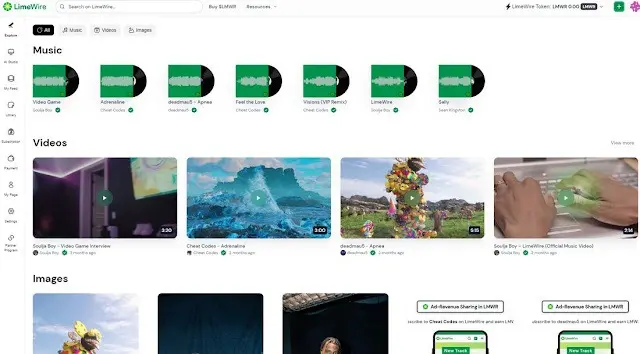
By pivoting into an AI studio model, LimeWire positioned itself at the intersection of creation and distribution. High-profile artists and musicians—including household names like Deadmau5, Soulja Boy, and Sean Kingston—began testing and adopting the platform to distribute drops, establishing early cultural credibility for the rebranded entity.
The Present Day: Multimodal AI Studio and Web3 Hub
Today, LimeWire operates as an advanced AI content studio. It integrates advanced machine learning image generators with built-in Web3 tokenomics. The platform has successfully transitioned from a simple art generator into a comprehensive ecosystem where users can generate, refine, mint, monetize, and trade digital assets entirely under one roof.
Supporting Context & Metrics: Inside the LimeWire AI Studio Architecture
LimeWire’s technological backbone is designed to cater to everyone from absolute beginners to professional digital designers. By integrating industry-standard open-source and proprietary models, the platform delivers enterprise-grade generation capabilities through an accessible web interface.
Advanced AI Image Generation Tools
The core of the platform currently centers on its AI Image Generation suite. LimeWire supports several of the most powerful foundational models available in the generative AI space, including:
- Stable Diffusion 2.1 and Stable Diffusion XL (SDXL): Known for photorealistic outputs, intricate detail handling, and flexibility with complex text prompts.
- DALL-E 2: Renowned for its conceptual understanding and ability to combine disparate visual concepts into coherent artistic compositions.
Users can craft images using simple natural language prompts or dive deep into advanced configurations. What elevates the LimeWire AI Studio above basic wrapper applications is its deep stylistic versatility. Creators can effortlessly toggle between design styles—such as cinematic lighting, vivid digital art, retro pixel art, anime aesthetics, and moody analog film—giving every generated asset a distinct visual identity.
Furthermore, the platform incorporates advanced features such as customizable samplers, negative prompting, and prompt guidance. This allows experienced creators to fine-tune details, aspect ratios, and fidelity levels. LimeWire is also actively developing its own proprietary AI model, signaling a strategic shift away from total reliance on third-party integrations toward homegrown generative technology.
Automated NFT Minting and Blockchain Integration
One of LimeWire’s most frictionless features occurs the moment a user decides to publish a creation. Eschewing the historically complex processes associated with Web3 technology, LimeWire automates the minting of user-generated content as Non-Fungible Tokens (NFTs).
Leveraging either the Polygon or Algorand blockchains, the platform automatically generates a unique digital signature for every piece of art, music, or video published. This immutably anchors ownership and authenticity to the creator.
Once minted, creators have granular control over their distribution strategy:
- Public Access: Publishing content publicly makes it discoverable across the global LimeWire ecosystem. Anyone can view, interact with, and trade these NFTs on secondary markets.
- Subscriber-Only Exclusivity: Creators seeking to build an intimate community can restrict access to their posts, making them available exclusively to dedicated, paying subscribers.
To ensure a continuous incentive loop, the platform implements a built-in royalty structure: whenever a creator’s NFT asset is traded among community members, the original artist automatically receives a 2.5% royalty on the transaction.
Revenue Sharing and the LMWR Token Economy
LimeWire stands out among AI generators by sharing its advertising revenue directly with its user base. When users publish content that attracts views from other platform visitors, the original creator receives 70% of all ad revenue generated by those views.
This financial model is underpinned by LMWR (LimeWire Token), the platform’s native cryptocurrency.
- Monthly Payouts: Creator earnings are calculated and distributed monthly in LMWR tokens.
- Liquidity and Exchangeability: Because LMWR is listed on prominent global crypto exchanges—including Kraken, ByBit, and Uniswap—creators can readily convert their digital earnings into fiat currency or other digital assets.
- Utility Within the Ecosystem: Beyond cashing out, users can utilize LMWR tokens to purchase additional generation credits, pay for premium prompts, or unlock exclusive content from other creators on the platform.
Subscription Tiers and Pricing Models
LimeWire utilizes a freemium business model designed to accommodate casual hobbyists and professional design studios alike.
-
Free Tier:
- Cost: $0/month
- Credits: 10 complimentary credits daily (allowing up to 20 image generations per day)
- Ad Revenue Share: 50%
- Ideal for users looking to experiment with generative AI art without upfront financial commitments.
-
Standard / Basic Creator Tier ($9.99/month):
- Credits: 1,000 credits per month (up to 2,000 image generations)
- Perks: Early access to new AI models, 50% ad revenue share, Pro profile badge, complete creation history, faster processing speeds, and an ad-free experience.
-
Growth Tier ($29/month):
- Credits: 3,750 credits per month (up to 7,500 image generations)
- Perks: Early access to advanced models, 60% ad revenue share, Pro badge, and priority generation queues.
-
Pro Tier ($49/month):
- Credits: 5,000 credits per month (up to 10,000 image generations)
- Perks: 70% ad revenue share, all Pro profile features, and maximum generation speed.
-
Advanced Studio Tier ($99/month):
- Credits: 11,250 credits per month (up to 22,500 image generations)
- Perks: Tailored for power users and agencies, featuring a 70% ad revenue share, top-tier generation limits, and comprehensive portfolio management tools.
Official Statements and Industry Perspective
Leadership behind the LimeWire transformation emphasizes that the platform is built to solve the modern creator’s dilemma: high output effort paired with low compensation on traditional social media networks.
In public disclosures regarding the platform’s renaissance, executives have reiterated that LimeWire is no longer merely a software application, but a decentralized publishing network. By bridging the gap between artificial intelligence and blockchain verification, the company aims to give power back to individual artists.
Industry analysts have noted that LimeWire’s integration of recognizable music artists—such as Soulja Boy and Deadmau5—serves as a vital proof-of-concept. By demonstrating that established celebrities can utilize the platform to release digital drops and monetize fan engagement, LimeWire validates its utility for independent creators who lack massive legacy followings but possess raw artistic vision.
Future Outlook
As the generative AI market matures, platforms that fail to provide sustainable monetization strategies risk becoming mere novelty toys. LimeWire’s strategic roadmap addresses this reality head-on.
Expanding into Multimodal Generation: Music and Video
While LimeWire’s current primary focus remains on advanced AI image generation, the platform has announced aggressive expansion plans. In the near future, LimeWire Studio will roll out AI-powered music and video generation tools.
This expansion is poised to transform the platform into a true multimodal creative suite. Imagine an independent musician generating album art, a backing track, and a promotional music video entirely within the LimeWire ecosystem, minting the final compilation as an interactive NFT, and immediately publishing it to a subscriber-base—all while earning ad revenue in LMWR tokens.
Decentralization and Community Governance
Looking further ahead, LimeWire aims to deepen its decentralization efforts. By handing more operational and governance control over to holders of the LMWR token, the platform envisions a community-run ecosystem where content guidelines, feature rollouts, and fund allocations are decided collectively by its active creator base.
Conclusion
LimeWire’s evolution from an infamous 2000s file-sharing client into a sophisticated, Web3-integrated AI content studio is nothing short of historic. By democratizing access to high-end generative models like Stable Diffusion and DALL-E, automating blockchain-based NFT minting, and offering a lucrative 70% ad revenue share paid in LMWR tokens, LimeWire has engineered a compelling blueprint for the future of the creator economy.
For artists, designers, musicians, and digital creators navigating the complex waters of AI art, LimeWire offers a rare combination: accessible creative freedom paired with tangible financial reward. As the platform prepares to launch its anticipated music and video generation tools, the digital content landscape watches closely to see how this reborn pioneer will continue to shape the future of human and machine collaboration.