

Executive Overview
In the high-stakes world of modern search engine optimization (SEO), visibility is everything. Gone are the days when a weekly manual spreadsheet update could suffice to gauge a brand’s digital footprint. Today’s search engine results pages (SERPs) are volatile, hyper-personalized, and heavily crowded with dynamic features—from AI Overviews and featured snippets to video carousels and local map packs. For digital marketing agencies, enterprise brands, and growing ecommerce operations, tracking thousands of dynamic keywords across various search engines, devices, and geographical locations demands robust, automated infrastructure.

Investing in dedicated SERP tracking software is no longer a luxury; it is a fundamental prerequisite for validating SEO efforts, justifying campaign budgets, and tying organic visibility directly to revenue and customer acquisitions. This comprehensive review examines the current landscape of SERP tracking tools for 2025, evaluating seven of the market’s leading options. We will dissect their core capabilities, explore essential evaluation metrics, and analyze how specialized software and all-in-one SEO platforms stack up against one another in an increasingly complex search environment.

Detailed Chronology: The Evolution of Rank Tracking
To understand why modern SERP tracking tools operate the way they do, it helps to examine how the industry evolved from primitive data collection methods to the sophisticated intelligence engines we rely on today.

The Era of Static Spreadsheets (Early 2000s)
In the formative years of search engine optimization, tracking rankings was a straightforward, albeit tedious, manual process. Marketers would open a web browser, clear their cache, type a target keyword into Google or Yahoo, and scroll through the pages until they found their client’s URL. These positions were recorded in local Microsoft Excel spreadsheets, updated weekly or—if time permitted—daily.

As search algorithms grew more complex and personalized based on user history, location, and device type, manual tracking quickly became obsolete. A ranking reported in New York looked entirely different to a user in Los Angeles, rendering static spreadsheets inaccurate and misleading.

The Rise of First-Generation Automated Trackers (2010–2018)
As the SEO industry matured, desktop-based rank trackers and early cloud software emerged to automate the data-gathering process. These tools used custom scripts and proxy networks to scrape search engine results pages at scheduled intervals (typically every 24 to 48 hours).

While this eliminated manual data entry, these early automated trackers faced severe limitations. Frequent algorithm updates by Google often broke scrapers, leading to data outages. Furthermore, these platforms focused almost exclusively on a single metric: the blue link position. They completely overlooked the proliferation of Universal Search features, such as image blocks, news boxes, and early knowledge panels.

The Modern Era of Granular Intelligence and AI Integration (2020–Present)
Today, SERP tracking software has evolved into sophisticated business intelligence engines. Modern platforms process massive volumes of data in real time, accounting for hyper-local zip-code targeting, multi-engine tracking (including Bing, Baidu, Yandex, and YouTube), and mobile-versus-desktop variance.

Furthermore, the introduction of AI-driven search features—such as Google’s AI Overviews—has fundamentally transformed the SERP real estate. Modern tracking tools now look beyond simple positional metrics, integrating Share of Voice (SoV), advanced SERP feature monitoring, and direct API connections with business analytics tools to map keyword movements directly to revenue and customer conversions.

Supporting Context & Metrics: 9 Essential Features to Look For
When evaluating SERP tracking software for your organization or agency, not all platforms are created equal. A robust evaluation framework requires looking beyond basic price points and focusing on nine critical feature categories.

1. Access Accurate On-Demand Ranking Updates
SERP positions fluctuate faster than ever. Relying on tools that update your database only once every few days leaves you blind during critical algorithm rollouts or sudden technical SEO failures. You need a platform capable of real-time, on-demand data refreshes. Leaders in this category, such as AccuRanker, automate daily updates while offering a manual refresh button that pulls live data with a single click.

2. Monitor Performance Across SERP Features
Securing a traditional top-3 organic ranking is only half the battle. Modern SERPs are dominated by "Position #0" elements, including featured snippets, People Also Ask (PAA) boxes, video carousels, and AI Overviews. Effective software must track which keywords trigger these features, allowing your team to execute targeted content updates to steal visual real estate from competitors.

3. Track Movement Across All Major Search Engines
While Google commands the lion’s share of global search traffic, relying solely on Google metrics can blindside international campaigns. Comprehensive SEO strategies require multi-engine tracking capabilities across platforms like Bing, Baidu (for Chinese markets), Yandex (for Russian markets), and YouTube for video-centric optimization.

4. Granular Tracking (Location and Device)
Local SEO campaigns require hyper-targeted data collection. Top-tier tools allow you to track keyword movements down to the state, city, or even zip-code level. Additionally, because mobile searches often yield drastically different SERP layouts and rankings compared to desktop searches, segmenting data by device type is non-negotiable.

5. Map SERP Movements to Traffic, Revenue, and Conversions
Ranking higher is a vanity metric if it does not impact the bottom line. The best SERP trackers integrate seamlessly with web analytics platforms like Google Analytics or Adobe Analytics. By combining keyword positions and search volume with organic sessions, bounce rates, and conversion values, tools like AccuRanker generate a complete picture of how SEO impacts business revenue.

6. View Historical Rank Performance
Point-in-time snapshots provide a very narrow view of your SEO health. Advanced platforms retain deep historical data archives, enabling marketers to analyze long-term ranking trends, identify seasonal dips, and evaluate the historical impact of past algorithm updates against competitor benchmarks.
7. Run Competitor Comparisons
Search visibility is a zero-sum game. When your rankings rise, a competitor’s visibility usually drops. Comprehensive tracking suites categorize keywords into performance buckets (e.g., positions 1-3, 4-10, 11-50) and track competitor movement trends over time to spot emerging threats and untapped keyword gaps.

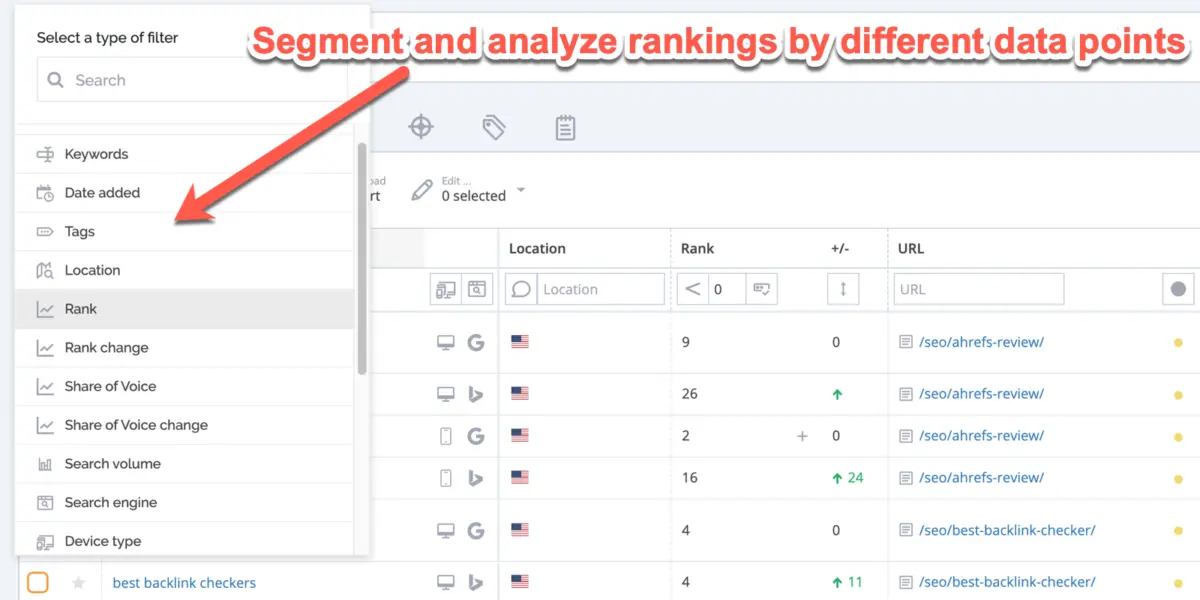
8. Tag and Segment Rankings Data
Large enterprise websites manage tens of thousands of keywords. Without proper organization, data analysis becomes overwhelming. Robust tagging functionality allows marketers to segment keywords by topic, funnel stage, content asset type, and device, facilitating precise Share of Voice calculations across specific product categories.

9. Generate White-Label Reports and Integrations
For agency professionals and consultants, client reporting is a major time sink. The ability to generate scheduled, automated, white-label PDF reports—or push live data seamlessly into visualization tools like Looker Studio (formerly Google Data Studio) and Databox—streamlines client communication and showcases immediate value.

Official Industry Analysis: The 7 Best SERP Tracking Tools for 2025
The market features countless rank-tracking solutions divided into two distinct categories: dedicated standalone trackers and comprehensive all-in-one SEO platforms. Below is an in-depth review of the top seven tools to consider this year.

1. AccuRanker
- Type: Standalone SERP Tracker
- Best For: Agencies, enterprises, and high-volume SEO teams requiring lightning-fast, highly accurate data.
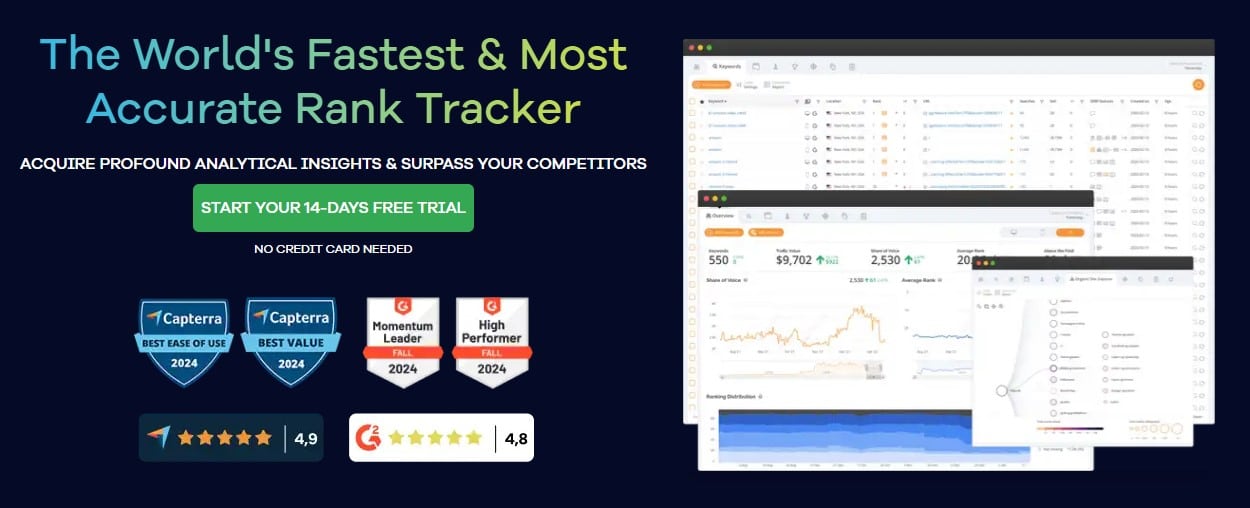
- Overview: Trusted by over 32,000 companies—including major brands like HubSpot, IKEA, and Kinsta—AccuRanker is widely regarded as one of the fastest and most accurate standalone rank-tracking platforms on the market. It offers automatic 24-hour updates accompanied by an on-demand manual refresh feature. Its deep integration with Google Analytics and Adobe Analytics allows users to effortlessly correlate SERP movements with revenue generation.
- Pricing: Plans start at $116/month for up to 1,000 tracked keywords.
2. Semrush (Position Tracker & SERP Gap Analyzer)
- Type: All-in-One SEO Platform
- Best For: Digital marketing professionals, ecommerce brands, and large enterprises looking for an all-encompassing toolset.
- Overview: Semrush serves over 10 million users globally, including heavyweights like Samsung, Vodafone, and Booking.com. Its Position Tracking tool matches the accuracy of dedicated standalone trackers while providing granular multi-device, multi-location reporting. Additionally, the platform’s App Center features innovative add-ons like the SERP Gap Analyzer, which automatically scans search results to identify under-optimized content and surface low-hanging fruit keywords from Google Search Console.
- Pricing: Subscription plans start at $139.95/month.
3. ProRankTracker
- Type: Standalone SERP Tracker
- Best For: International companies, video marketers, and agencies seeking a cost-effective, scalable tracking solution.
- Overview: Trusted by over 60,000 users, ProRankTracker delivers robust, highly accurate SERP analytics across global locations, multiple languages, and diverse device types without breaking the bank.
- Pricing: Plans start at an accessible $39/month.
4. Advanced Web Ranking (AWR)
- Type: Standalone SERP Tracker
- Best For: In-house teams and enterprise agencies managing complex, localized campaigns.
- Overview: Advanced Web Ranking has built a stellar reputation among enterprise-level brands (such as Microsoft) for providing reliable rank tracking, deep competitor benchmarking, and highly customizable white-label reporting engines.
- Pricing: Subscription plans begin at $99/month.
5. SERPWatcher (by Mangools)
- Type: All-in-One SEO Platform Component
- Best For: Small business owners, startups, and freelancers wanting a streamlined, user-friendly interface.
- Overview: Created by Mangools—a suite trusted by global brands like Airbnb and Adidas—SERPWatcher simplifies keyword monitoring through its proprietary Performance Index, which calculates organic traffic potential based on current rankings and search volumes.
- Pricing: Mangools bundles plans starting at $29.90/month.
6. SE Ranking
- Type: All-in-One SEO Platform
- Best For: Small-to-medium agencies and growing businesses.
- Overview: SE Ranking simulates precise local user behavior to store accurate rank data across major search engines. It offers comprehensive site auditing, competitor research, and rank tracking bundled into a single intuitive interface.
- Pricing: Plans start at $52/month based on daily updates for 500 keywords.
7. Nightwatch
- Type: Standalone SERP Tracker
- Best For: Freelancers, SMBs, and enterprise agencies requiring hyper-local tracking capabilities.
- Overview: Trusted by major enterprises like Shopify and Coinbase, Nightwatch provides ultra-accurate daily tracking across more than 100,000 global locations, supported by robust data visualization and segmentation tools.
- Pricing: Offers a 14-day free trial, with paid plans starting at $32/month for up to 250 keywords.
Future Outlook: The Next Generation of SERP Intelligence
As we look toward the remainder of 2025 and beyond, the role of SERP tracking software is undergoing a profound structural shift. The rapid expansion of generative AI search experiences means that traditional "blue link" rankings are gradually sharing space with dynamic, synthesized answers generated directly by search engines.

In response, the next generation of SERP trackers is shifting focus from mere positional monitoring to Share of Screen and Generative Engine Optimization (GEO) tracking. Future tools will increasingly measure how often a brand is cited within AI-generated summaries, conversational search dialogs, and multi-modal results.

For SEO professionals and business leaders, choosing the right SERP tracker today is no longer just about monitoring where you rank—it is about securing the actionable insights needed to maintain digital visibility in an AI-driven, highly fragmented search ecosystem. Assess your organization’s specific scale, budget, and reporting requirements, choose the platform that aligns with your operational goals, and stop relying on guesswork and static spreadsheets.