

Executive Overview
For decades, Search Engine Optimization (SEO) professionals wrestled with a rudimentary yet ubiquitous ritual: the manual spreadsheet. Diligently updated day after day, these static files served as the primary ledger for keyword positions, traffic estimates, and ranking fluctuations. Today, however, the digital landscape moves too fast for manual entry. Modern search engines are dynamic, localized, hyper-personalized ecosystems driven by complex algorithms and evolving interface layouts—including AI Overviews, People Also Ask (PAA) boxes, video carousels, and local map packs.

Relying on outdated, weekly data batches or error-prone spreadsheets is no longer an option for brands, agencies, and enterprises managing thousands of keywords across multiple search engines, devices, and geographic jurisdictions. To validate SEO investments and correlate organic visibility with bottom-line revenue, organizations must deploy specialized SERP tracking software.

This comprehensive, in-depth review evaluates the structural shifts in search engine results page (SERP) monitoring, outlines the nine non-negotiable features every modern SEO stack requires, and provides a critical analysis of the top seven tracking solutions for 2025. Whether you seek a specialized, high-frequency standalone platform or a robust tracker integrated into an all-in-one marketing suite, this guide will help you navigate your choices with clarity and authority.

Detailed Chronology: The Evolution of Rank Tracking
To understand why modern SERP tracking tools operate with such sophisticated depth today, it is essential to trace how search monitoring has evolved over the past fifteen years:

- The Early 2010s (The Desktop & Static Era): Rank tracking was primarily a desktop-centric enterprise. Basic desktop scrapers checked keyword positions once a day against Google’s localized data centers. SERPs were predictable, consisting largely of ten blue links with minimal ad intrusion.
- The Mid 2010s (The Mobile & Local Revolution): With mobile search traffic surpassing desktop searches, search engines fundamentally altered their delivery mechanisms. Local intent became paramount, and algorithms began tailoring results based on precise geographic coordinates. Trackers had to adapt to handle hyper-local (city and zip-code level) monitoring and split desktop-versus-mobile ranking histories.
- The Late 2010s to Early 2020s (SERP Feature Diversification): Google and other major search engines saturated the results page with rich media elements: knowledge panels, featured snippets (Position #0), image packs, and video carousels. Tracking tools evolved from simple number-position logs into multi-faceted analysis engines capable of capturing structural real estate changes.
- 2025 and Beyond (The AI-Driven Era): Today, the integration of generative AI experiences—such as Google’s AI Overviews—has fundamentally transformed click-through rates and visibility metrics. Modern SERP trackers must now process real-time on-demand updates, integrate seamlessly with business intelligence dashboards, and parse complex SERP layout shifts to protect and expand a brand’s "Share of Voice."
Supporting Context & Metrics: Why SERP Tracking is an Executive Imperative
Investing in professional-grade SERP tracking software is not merely a technical checkbox for webmasters; it is a core business intelligence requirement.

Validating the SEO Investment
Executives and financial stakeholders demand accountability. When allocating budgets to content creation, technical audits, and link acquisition, stakeholders want to see empirical proof of progress. Granular SERP tracking software allows SEO professionals to map ranking movements directly to key business objectives. According to industry analyses, organizations utilizing real-time, tag-segmented rank trackers can reduce reporting overhead by up to 60% while providing clearer attribution between keyword gains and incoming organic revenue.

The Cost of Inaccuracy
A single day of inaccurate rank reporting can lead to misguided optimization efforts. If a tracking tool fails to capture a localized algorithm update or misreports a drop in ranking caused by a transient SERP feature insertion, teams might panic and rewrite high-performing content unnecessarily. Premium tools mitigate this risk by running multi-point verification checks, simulating authentic user behavior, and refreshing data on-demand.

9 Essential Features to Look for in SERP Tracking Software
When auditing software solutions for your enterprise or agency, ensure the platform delivers on these nine operational pillars:

- Access Accurate On-Demand Ranking Updates: Standard batch updates occur every 24 hours, but rapid market shifts require the ability to manually trigger real-time data refreshes at the click of a button.
- Monitor Performance Across SERP Features: To capture Position #0, AI Overviews, or PAA boxes, you must track which keywords trigger these features and identify actionable gaps against competitors.
- Track SERP Movement Across Major Search Engines: While Google dominates global market share, monitoring alternative search engines (such as Bing, Baidu, Yandex, and YouTube) is vital for international campaigns and localized enterprise reach.
- Granular Tracking (Location and Device): True capability requires scaling from national campaigns down to specific zip-code granularity, alongside simultaneous desktop and mobile comparison metrics.
- Map SERP Movements to Traffic and Revenue: Advanced trackers integrate with Google Analytics or Adobe Analytics, combining keyword positions with bounce rates, load times, and conversion goals.
- View Historical Rank Performance: Point-in-time metrics are insufficient; comprehensive trend histories allow teams to visualize long-term algorithm impacts and competitive shifts.
- Run Competitor Comparisons: Grouping keywords into position buckets (e.g., 1–3, 4–10, 11–50) provides immediate visibility into where you are gaining or losing ground against market rivals.
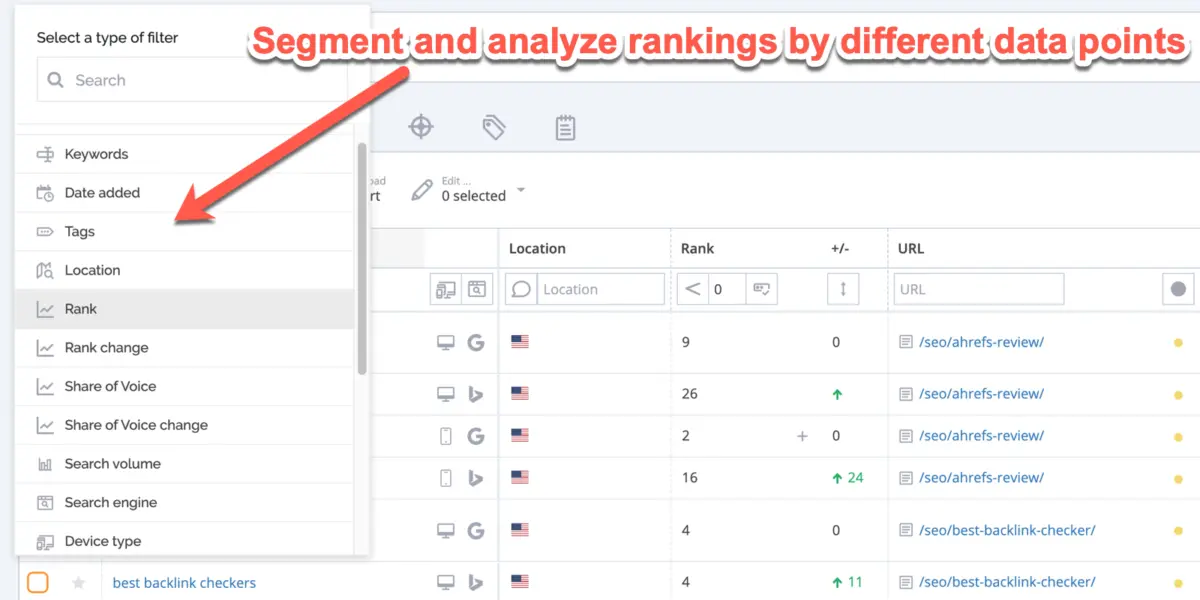
- Tag and Segment Rankings Data: Keyword tagging enables granular analysis by topic, funnel stage, content asset type, and device category.
- Generate White-Label Reports: Automated, beautifully formatted reports or deep integrations with visualization suites (such as Google Looker Studio or Databox) streamline client communications.
The 7 Best SERP Tracking Tools to Consider in 2025
The market features countless options, but the following seven solutions represent the gold standard for accuracy, feature depth, and reliability.

1. AccuRanker
- Overview: AccuRanker is a premier standalone SERP tracking tool trusted by over 32,000 companies, including global brands like HubSpot, IKEA, and Kinsta. Built specifically for high-volume agencies and enterprises, it prioritizes speed and raw data accuracy.
- Key Features: On-demand data refreshing, comprehensive tracking across 50+ SERP features, support for major search engines (Google, Bing, Baidu, Yandex, YouTube), deep Google Analytics integrations, and native white-label reporting.
- Best For: Agencies, enterprise brands, and professionals who demand rapid, real-time updates and granular API access.
- Pricing: Subscription plans scale based on tracked keywords, starting at $116/month for up to 1,000 keywords.
2. Semrush (Position Tracker & SERP Gap Analyzer)
- Overview: Semrush is an industry-leading all-in-one SEO platform utilized by over 10 million digital marketing professionals and global enterprises like Samsung, Vodafone, and Booking.com.
- Key Features: Its dedicated Position Tracking Tool rivals standalone trackers in accuracy, operating across international, national, and hyper-local levels. Additionally, the SERP Gap Analyzer (available via the Semrush App Center) scans SERPs to identify under-optimized content and integrate seamlessly with Google Search Console.
- Best For: Organizations seeking an all-in-one marketing suite that includes world-class rank tracking alongside deep competitive intelligence.
- Pricing: Comprehensive SEO platform plans start at $139.95/month.
3. ProRankTracker
- Overview: ProRankTracker is a scalable, cost-effective standalone SERP tracking, analysis, and reporting tool trusted by over 60,000 users worldwide.
- Key Features: High-volume keyword tracking, comprehensive multi-language support, accurate local pack monitoring, and advanced client reporting modules.
- Best For: SEM agencies, international businesses, and ecommerce brands needing reliable data across diverse geographic markets.
- Pricing: Tiered plans begin at $39/month.
4. Advanced Web Ranking (AWR)
- Overview: Advanced Web Ranking is a veteran standalone SERP tracker utilized by thousands of in-house marketing teams and enterprise brands (including Microsoft) for robust, highly customizable reporting.
- Key Features: Extensive device and location flexibility, white-label report builder, deep historical data access, and robust multi-user permission controls.
- Best For: In-house enterprise teams and agencies managing complex reporting structures.
- Pricing: Subscription plans start at $99/month.
5. SERPWatcher (by Mangools)
- Overview: SERPWatcher is the dedicated SERP tracking tool within the Mangools all-in-one SEO ecosystem, trusted by major brands like Airbnb and Adidas.
- Key Features: The proprietary Performance Index metric (which calculates organic traffic potential based on current rankings and search volumes), user-friendly dashboards, and alerts for significant rank changes.
- Best For: Small business owners, startups, and agencies looking for a simplified, budget-friendly interface.
- Pricing: Plans start at $29.90/month.
6. SE Ranking
- Overview: SE Ranking is a comprehensive all-in-one SEO toolset featuring a powerful Position Tracking module that simulates real user behavior across major search engines, locations, and device types.
- Key Features: 100% accurate data simulation, competitor ranking matrix, comprehensive SEO audits, and custom reporting.
- Best For: Small-to-medium businesses and digital agencies looking for a balanced mix of rank tracking and foundational SEO tools.
- Pricing: Plans start at $52/month (based on daily updates for 500 keywords).
7. Nightwatch
- Overview: Nightwatch is recognized as one of the most precise daily SERP trackers on the market, trusted by major organizations like Shopify, Scotiabank, and Coinbase.
- Key Features: Unprecedented granularity spanning over 107,296 worldwide locations, flexible segmentation, and clean, modern visualization dashboards.
- Best For: Freelancers, SMBs, and agencies requiring hyper-local global tracking capabilities.
- Pricing: Paid plans start at $32/month for up to 250 keywords, backed by a 14-day free trial.
Future Outlook: The Next Generation of SERP Intelligence
As we look deeper into 2025 and beyond, the role of SERP tracking software will continue to transform. The proliferation of artificial intelligence in search results means that traditional rank tracking—measuring simply whether a URL sits at position #1, #2, or #3—is no longer the sole indicator of digital success.

Future-proof SERP trackers are shifting toward Share of Screen metrics, measuring how much visual real estate a brand commands across text ads, organic links, AI summaries, and rich snippets. Furthermore, predictive analytics driven by machine learning will soon allow platforms to forecast ranking volatility before algorithm updates fully roll out.

Conclusion: Which Tool Should You Choose?
Selecting the right tool depends entirely on your organizational structure and operational scope:

- If you require a dedicated, lightning-fast standalone tracker with unmatched on-demand refresh capabilities, AccuRanker remains the industry benchmark.
- If you need a comprehensive digital marketing ecosystem that combines elite rank tracking with robust content and technical SEO tools, Semrush is the definitive choice.
Evaluate your keyword volume, reporting requirements, and budget constraints against the nine core features outlined above, and abandon the spreadsheet era for good.