

Executive Overview
In the grand tradition of agricultural assessment and culinary critique, the annual evaluation of heritage, obscure, and contemporary apple cultivars has yielded a kaleidoscopic array of sensory triumphs and abysmal pomological failures. As consumers and connoisseurs increasingly look beyond the supermarket duopolies of Red Delicious and Granny Smith, a burgeoning counter-culture—affectionately or otherwise styled the "Apple Snack Gang"—has taken it upon themselves to rigorously test the limits of human dentition, taste perception, and historical horticulture.
This report documents the second installment of a comprehensive seasonal audit conducted during the peak of the 2026 apple harvest. Traversing a vast spectrum of physical structures, tannin profiles, and geographic pedigrees, this investigation highlights seven distinct cultivars: Kickapoo Spice, St Edmunds Pippin, Sops of Wine, Fenceline Surprise, Americus Crab, Campfield (False), and Graham.
Through meticulous organoleptic analysis, historical cross-referencing, and uncompromising scoring metrics, this inquiry exposes the deceptive marketing of mass-produced fruit, celebrates the eccentricities of heirloom varieties, and offers a definitive roadmap for pomological enthusiasts ahead of the impending northeastern regional expeditions spanning New York, New England, and Canada.
Detailed Chronology of the 2026 Harvest Evaluations
The evaluation period, executed across a series of domestic tastings in the early weeks of October 2026, followed a strict protocol of immediate post-acquisition consumption, structural integrity checks, and flavor profile charting.

1. Kickapoo Spice
- Metric Score: 6.9 / 10
- Structural Profile: Dense, non-juicy, structurally compact.
- Flavor Profile: Nutmeg-heavy, prominent cinnamon and clove integration, accompanied by an anomalous, grass-clipping finish.
The evaluation sequence commenced with the Kickapoo Spice, a cultivar whose nomenclature immediately evokes rustic Americana and classic rock references. Structurally characterized as a "dense boy" with a notably rigid cellular matrix, this specimen exhibited a high spice component dominated by nutmeg, secondary notes of cinnamon, and a subtle undertone of clove.
Despite its aromatic promise, the fruit lacked essential hydration, registering entirely devoid of juice. Furthermore, an unexpected aftertaste reminiscent of freshly cut grass suggested sub-optimal post-harvest storage. As agricultural scientists note, fruit maturation is a delicate dichotomy: certain cultivars elevate in quality detached from the tree, while others enter an immediate descent toward degradation. Kickapoo Spice sits comfortably in a middle tier—interesting, structurally robust, but hindered by its botanical idiosyncrasies.
2. St Edmunds Pippin
- Metric Score: 8.3 / 10
- Structural Profile: Rough exterior, sharp-breaking, exceptional crispness.
- Flavor Profile: Bright, herbal, fennel pollen undertones balanced by a harmonious tart-sweet matrix.
Serving as the premier baseline evaluation of the seasonal cycle, the St Edmunds Pippin subverted its tactile deterrents—specifically a rugged exterior akin to retrograde dermal contact with a marine predator—with explosive textural and flavor dynamics. Upon compression, the fruit yielded an audible and deeply satisfying structural collapse.
Flavor-wise, the Pippin introduced a sophisticated herbal complexity dominated by notes of fennel pollen, seamlessly tethered to a traditional sweet-tart architecture. It stands as a definitive benchmark for how historically "funky" heritage cultivars can deliver profound culinary satisfaction when harvested at peak physiological maturity.

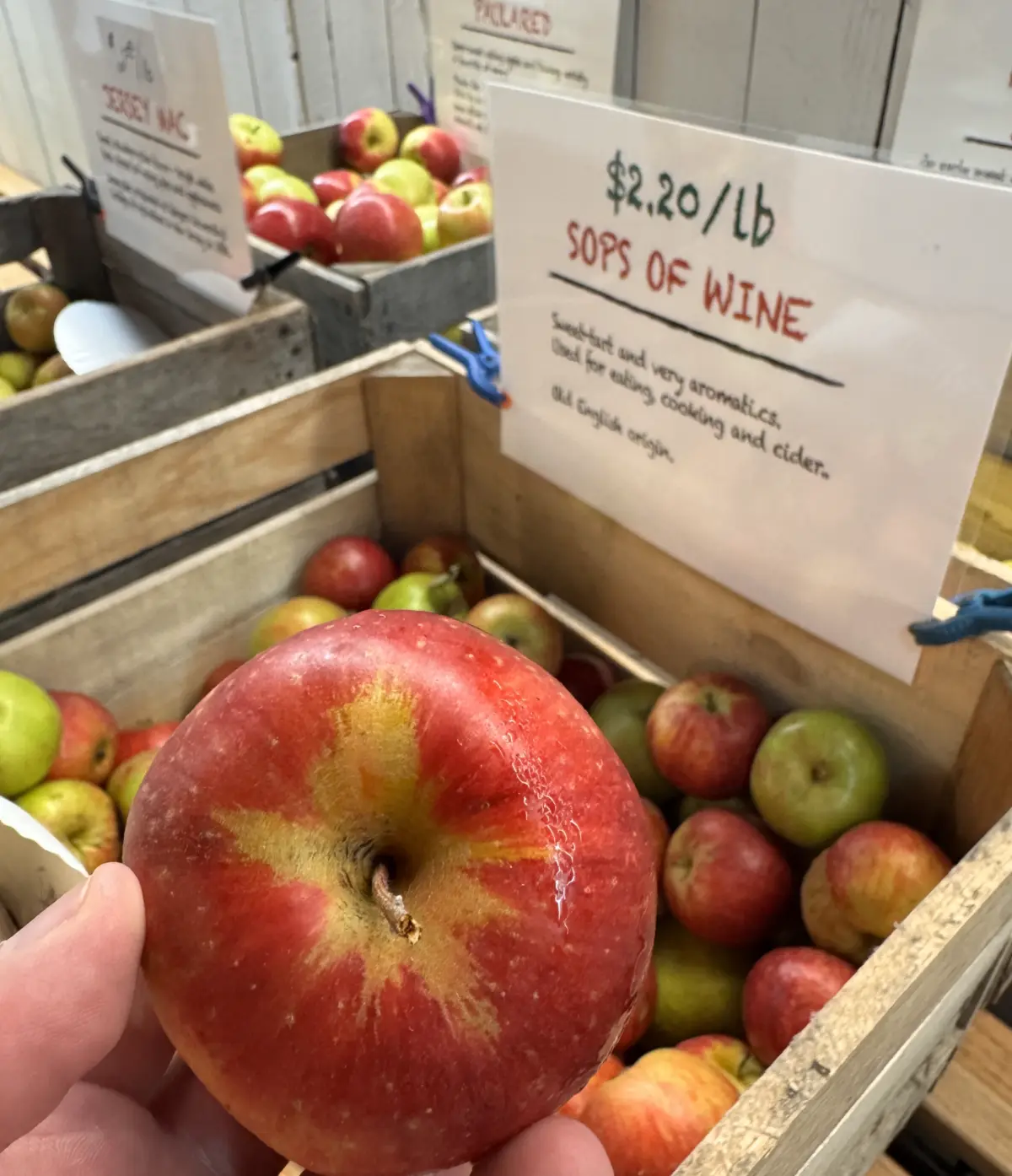
3. Sops of Wine
- Metric Score: 3.5 / 10
- Structural Profile: Mealy, gritty, structurally degraded due to extended post-harvest shelf life.
- Flavor Profile: Subacid, vanilla-forward, spiced undertones with historical anomalies.
The evaluation of Sops of Wine unveiled the psychological hazards of nomenclature. Rather than pure gustatory analysis, testers reported involuntary cognitive associations with cinematic literary tropes, specifically historical dramatic sequences involving tomato consumption and the invocation of the title moniker within the inner consciousness.
Beyond psychological interference, the physical specimen disappointed. Exhibiting a mealy and gritty texture, it underscored the perils of over-extended cold storage. Although the underlying flavor profile offered subtle vanilla and spice notes within a subacid sweet-to-tart framework, the cellular breakdown rendered the eating experience subpar. Furthermore, the absence of the legendary red-fleshed vascularity or reliable varietal purity cements Sops of Wine as a taxonomic enigma wrapped in a subpar physical delivery.
4. Fenceline Surprise
- Metric Score: 1.0 / 10
- Structural Profile: Soft, sandy, structurally compromised.
- Flavor Profile: Bland, fleeting pear-essence top notes dissolving into a sensation akin to masticating beach sand.
True to its colloquial designation, the Fenceline Surprise offered the shocking realization that an apple could fail so comprehensively across all sensory metrics. Despite a linguistic flourish that might lead an uninitiated consumer to mistake its moniker for a continental luxury item, the reality was a bland, yielding mush.
A fleeting top note of artificial pear mist offered a momentary reprieve before collapsing into an unpalatable, sandy mouthfeel. Marketed on retail signage as a "firm apple," the specimen’s degraded state indicated premature senescence prior to retail acquisition. Were it not for its aesthetically pleasing exterior geometry and poetic nomenclature, this cultivar would have plumbed the absolute depths of a zero-point valuation.

5. Americus Crab
- Metric Score: 2.5 / 10
- Structural Profile: Inflexibly tough, highly tannic.
- Flavor Profile: Savory, astringent, aggressively tart.
Entering the domain of the crabapple, the Americus Crab—a name more suited to a nineteenth-century industrialist or a maritime comic book vigilante—challenged the boundaries of fresh-market consumption. Crabapples are inherently insurgent foodstuffs, defying the casual snacker with their aggressive biochemistry.
High in tannins, structurally formidable, and aggressively savory-tart, the Americus Crab is unequivocally unsuited for raw consumption out of hand. However, within the taxonomy of culinary experimentation, it provides a fascinating diversion for those willing to brave high astringency levels.
6. Campfield (False)
- Metric Score: 4.1 / 10
- Structural Profile: Chewy, callused texture, astringent.
- Flavor Profile: Overly sweet clashing with aggressive tannins; industrial cider profile.
Labeled cryptically as "(false)" in its cataloging, the Campfield offered a dual sensory assault: a chewy, resilient texture paired with a biochemical warfare of high tannins that seemed intent on digesting the consumer just as quickly as the consumer digested it. Recognized primarily as an industrial cider apple, its failure on the fresh-market table is an expected feature rather than a bug; its true evolutionary destiny demands chemical alteration via fermentation.
+-------------------------------------------------------------------------+
| HISTORICAL INTERLUDE: THE CANFIELD/CAMPFIELD LEGACY                     |
| Archival cross-referencing reveals deep historical roots connected to   |
| Matthew Canfield (variously spelled Campfield), an anti-royalist Puritan|
| who migrated from England in 1637 during the Great Migration. A founding|
| father of New Haven, Norwalk, and Newark, Canfield’s historical land   |
| grants mandated orchard cultivation and the production of winter cider.  |
| Today, his legacy literally underpins municipal architecture, resting  |
| eternally beneath the City Hall of Newark, New Jersey.                   |
+-------------------------------------------------------------------------+
7. Graham
- Metric Score: 8.0 / 10
- Structural Profile: Rock-solid density, glacier-like cleavage.
- Flavor Profile: Unrestrained, chemical-grade commercial confectionery (specifically, authentic Juicy Fruit gum).
The crown jewel of structural fortitude within this testing cohort was the Graham. Possessing a density capable of inflicting severe temporomandibular joint (TMJ) trauma upon the uninitiated, this cultivar required immense mechanical force to breach, fracturing structurally like a calving alpine glacier.

Yet, the physiological labor was exceptionally rewarded. Upon breaching the cellular walls, the fruit delivered an utterly distinct, unapologetic, and chemically vivid flavor profile identical to mass-market Juicy Fruit chewing gum. Had the cultivar not required a jaw-strengthening regimen to penetrate, its score would have challenged the upper limits of pomological perfection.
Supporting Context & Metrics
To contextualize the performance of the 2026 harvest batch, analytical parameters were weighted across four primary pillars: structural integrity (bite resistance and crispness), hydration index (juice content), flavor complexity (balance of sugars, acids, and aromatics), and post-harvest stability.
| Cultivar | Metric Score (/10) | Structural Classification | Primary Flavor Notes |
|---|---|---|---|
| St Edmunds Pippin | 8.3 | Sharp-breaking, crisp | Fennel pollen, bright herbs, balanced sweet-tart |
| Graham | 8.0 | Glacial, ultra-dense | Juicy Fruit gum, high sugar, profound density |
| Kickapoo Spice | 6.9 | Dense, non-juicy | Nutmeg, cinnamon, clove, cut grass finish |
| Campfield (False) | 4.1 | Chewy, tannic | High tannin, cider profile, woodsy astringency |
| Sops of Wine | 3.5 | Mealy, gritty | Subacid, vanilla, fleeting spice |
| Americus Crab | 2.5 | Tough, highly fibrous | Savory, extreme tartness, heavy tannin |
| Fenceline Surprise | 1.0 | Soft, sandy mush | Bland pear mist, structural collapse |
The data clearly indicates a bimodal distribution within heirloom and specialty pomology: cultivars that prioritize structural integrity (such as the St Edmunds Pippin and Graham) dramatically outperform those suffering from rapid post-harvest mealy degradation (such as Fenceline Surprise and Sops of Wine).
Official Statements and Horticultural Perspectives
Industry experts and regional orchardists emphasize that the variance observed in the 2026 harvest is largely symptomatic of shifting climate patterns and the inherent complexities of reviving obscure genetic lineages.

"The apple does not merely grow; it wages a silent war against gravity, pests, and the limitations of human storage technology," notes a leading voice within the modern foraging collective.
"When a consumer bites into a heritage cultivar like the Campfield or the St Edmunds Pippin, they are not consuming a standardized grocery item engineered for infinite shelf stability. They are participating in a historical dialogue spanning centuries of Puritan land grants, agricultural trial-and-error, and biochemical roulette."
Orchard curators further stress that cider varieties—such as the aforementioned Campfield—must never be judged by the standards of fresh-market snackability. To evaluate a processing apple by raw mastication is akin to critiquing raw baking flour for its lack of structural crumb; its redemption lies strictly within the vats of the fermenter.
Future Outlook & Expedition Roadmap
As the 2026 harvest season progresses, the operational focus of the inquiry shifts northward. With upcoming field expeditions scheduled across the geographic corridors of New York State, New England, and the Canadian provinces, the investigative apparatus is primed for an influx of novel, frost-kissed, and regionally isolated pomological specimens.

Stakeholders, orchard owners, and local agrarian communities are formally advised that the inspection team will be actively soliciting physical donations for audit. Cultivars exhibiting unusual spice notes, historical anomalies, or terrifying structural densities are encouraged to submit themselves for immediate sensory evaluation.
The pursuit of pomological truth is relentless. As the Apple Snack Gang expands its geographical footprint, consumers can rest assured that no fruit shall go un-scored, no historical pseudonym un-investigated, and no jawbone left unpunished in the relentless quest for the ultimate harvest.