

Executive Overview
In the modern digital economy, the demand for high-velocity, high-quality written material has completely outpaced human production capacity. Businesses, marketing agencies, solopreneurs, and independent bloggers face an unrelenting daily imperative: publish engaging content across multiple platforms, optimize for search engines, and maintain a consistent brand voice—all while managing core operations. This perpetual bottleneck has catalyzed the rapid maturation of Artificial Intelligence (AI) content generation.
No longer a futuristic novelty, AI copywriting software has evolved into a sophisticated suite of tools capable of producing everything from short-form social media hooks and high-converting product descriptions to fully realized, SEO-optimized long-form articles. Driven by advanced Large Language Models (LLMs), these platforms analyze vast datasets to identify optimal phrasing, syntactic structures, and thematic relevance for specific target audiences.

However, the market has become saturated with competing software options, each promising superior efficiency, unique niche capabilities, and unmatched pricing models. Choosing the right platform can be a daunting endeavor for professionals seeking to optimize their workflow. To cut through the marketing noise, this report examines the top ten AI content generator tools available on the market, analyzing their core strengths, operational mechanics, and pricing structures to help you identify the ideal solution for your strategic requirements and budget.
Detailed Chronology: The Evolution of AI Writing Assistants
To understand the current landscape of AI content generation, one must examine the rapid trajectory of natural language processing (NLP) technologies over the past half-decade.
- The Early Experimental Phase (Pre-2019): Early automated writing tools relied heavily on rudimentary rule-based systems, template-matching, and basic synonym-swapping (spinning). The resulting output was frequently clunky, repetitive, and plagued by severe grammatical anomalies, requiring extensive manual intervention to achieve readability.
- The Transformer Revolution (2019–2020): The introduction of transformer-based neural network architectures marked a watershed moment for machine-generated text. Systems began to understand context, nuance, and semantic relationships across paragraphs rather than merely processing words in isolated sequences.
- The Commercial Explosion (2021–2022): Capitalizing on these breakthroughs, specialized software startups emerged, transforming raw foundational models into user-friendly SaaS (Software as a Service) platforms. Tools like Jasper (formerly Jarvis) and Copy.ai democratized access to advanced AI, equipping marketers with intuitive dashboards, pre-built templates, and specialized workflow modes. This era established the foundational ecosystem of prompt-based content creation that defines the industry today.
Supporting Context & Metrics: The Mechanics and Utility of AI Copywriting
The shift toward AI-assisted content creation is supported by compelling operational metrics. Industry analyses consistently demonstrate that content marketers spend an average of several hours drafting, editing, and optimizing a single long-form blog post. By leveraging AI content generators, organizations report a reduction in draft creation time by up to 60–80%, significantly lowering operational overhead and content acquisition costs.
How These Systems Operate
While different platforms employ proprietary algorithms and user interfaces, AI content generators generally fall into two operational categories:

- Prompt-and-Response Engines: Tools such as Jasper require users to provide contextual briefs, tone guidelines, and specific prompts to guide the AI’s output in real time.
- Keyword-Driven Generators: Platforms like Article Forge operate autonomously, requiring only a target keyword or brief topic outline to scrape data, synthesize information, and assemble a complete, multi-section article.
Despite these efficiency gains, human oversight remains vital. The most successful content strategies utilize AI as a powerful force multiplier—handling heavy lifting, ideation, and initial drafting—while human editors provide strategic direction, factual verification, and brand voice refinement.
The Top 10 AI Content Generators: In-Depth Analysis
1. Jasper AI (Formerly Known as Jarvis)
Jasper stands as one of the most recognized and powerful content writing and generation platforms in the industry. It utilizes advanced machine learning to analyze the best-performing words and sentence structures, tailoring text to specific writing styles, tones, and target mediums.
- Key Strengths: Exceptional versatility, advanced long-form assistants, and a vast library of specialized marketing templates. Its premium "Boss Mode" gives users direct command over the AI via custom commands, significantly accelerating complex writing tasks.
- Pricing & Value: Features tier-based structures, with advanced tiers like Boss Mode starting around $99 per month. Users leveraging specific promotional access points can secure valuable introductory perks, such as free introductory credits.
2. Copy.ai
Designed primarily for marketing and digital advertising professionals, Copy.ai excels at producing rapid-fire copy across more than 90 specialized templates, including bullet-to-blog converters, general ad copy, and social media hooks.
- Key Strengths: Intuitive user interface, exceptional speed in generating short-form copy (product descriptions, sales reports, and ad variations), and a generous 7-day free trial featuring high daily run limits.
- Pricing & Value: Offers a robust free trial, with Pro plans priced around $49 per month (scaling down to approximately $35 per month with annual commitments). Special partnership incentives frequently offer expanded word counts and introductory discounts.
3. Frase AI
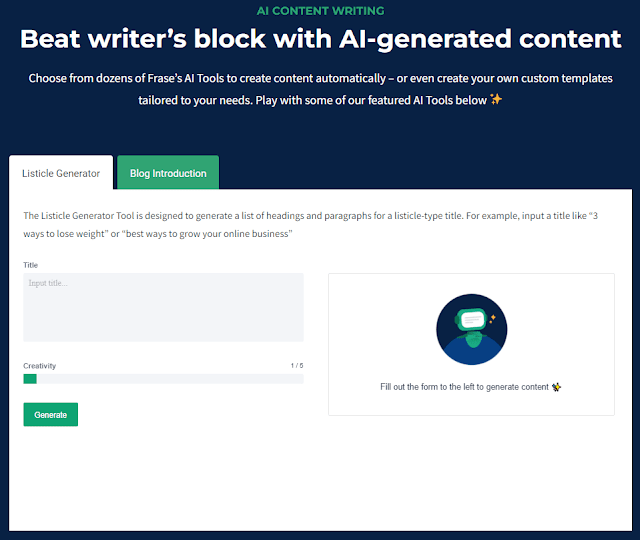
Moving beyond simple text generation, Frase functions as an intelligent assistant for research, content creation, and SEO optimization. It analyzes top-ranking search engine results for a given query to help users construct comprehensive content briefs within seconds.

- Key Strengths: Advanced SEO integration, automated content outlining, and deep research capabilities that ensure articles align with search engine ranking criteria.
- Pricing & Value: Structured across Solo, Basic, and Team plans ranging from roughly $14.99 to $114.99 per month, with proportional discounts for annual billing. Enterprise solutions are available upon request.
4. Article Forge
Article Forge operates on a fundamentally different paradigm than conversational prompt engines. Rather than requiring extensive briefs or interactive dialogue, this platform generates complete, end-to-end articles based solely on a target keyword.
- Key Strengths: Fully automated end-to-end content generation, efficient handling of bulk creation, and built-in assurances that generated text passes standard plagiarism checks like Copyscape.
- Pricing & Value: Offers a 30-day money-back guarantee with monthly and annual subscriptions. The Basic plan starts at $27/month (yielding up to 25k words), scaling through Standard and Unlimited tiers.
5. Rytr
Rytr.me has established itself as an accessible, cost-effective AI writing assistant tailored for small business owners, casual bloggers, and students seeking quick, SEO-friendly output.

- Key Strengths: Clean user interface, built-in plagiarism checking, multi-language support, and a surprisingly robust free tier suitable for low-volume users.
- Pricing & Value: Features a free plan capped at 5,000 characters per month. Paid options like the Saver Plan begin at an economical $9 per month ($90 annually), making it one of the most budget-friendly tools available.
6. Writesonic
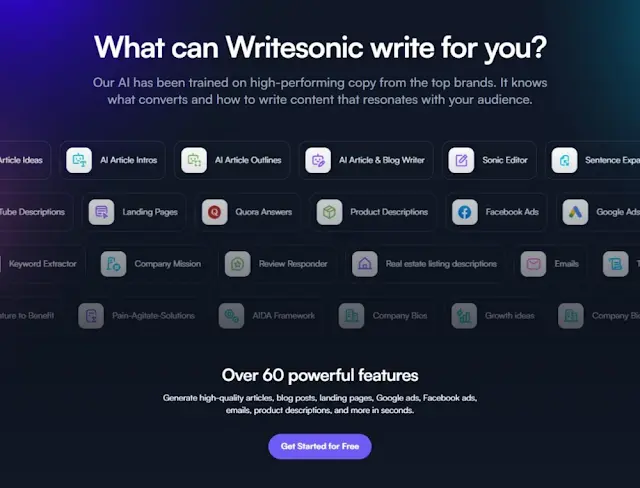
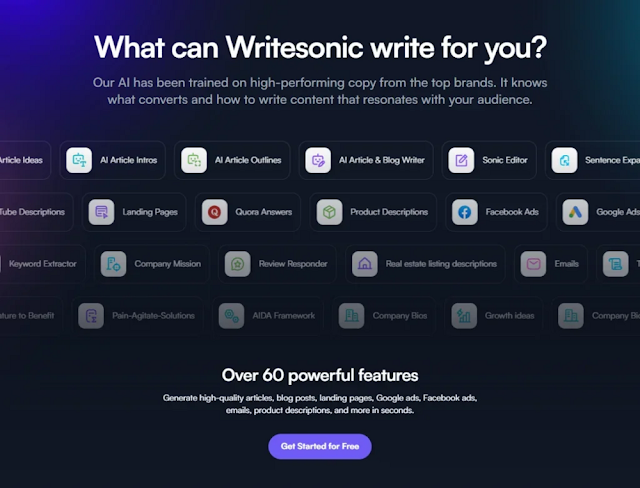
Writesonic bridges the gap between marketing copy and long-form blogging, offering specialized features supported by integrated grammar and plagiarism verification systems.
- Key Strengths: Comprehensive feature set including short-form marketing copy, long-form article writers, landing page copy, and robust editing integrations.
- Pricing & Value: Operates on a credit-based introductory trial system. Paid tiers are divided into Short-form ($15/month) and Long-form ($19/month) subscriptions, catering flexibly to diverse user needs.
7. CopySmith
Engineered specifically for enterprise-level demands, e-commerce managers, and high-volume marketing teams, CopySmith focuses on generating high-quality personal and professional documents, presentations, and product descriptions at scale.
- Key Strengths: Bulk content generation capabilities, robust e-commerce integrations (such as Shopify and WooCommerce), and intuitive template navigation.
- Pricing & Value: Offers a credit card-free trial, followed by structured paid tiers like the Starter Plan at $19/month and custom-tailored Enterprise solutions.
8. Hypotenuse.ai
For online retailers and digital merchants, Hypotenuse.ai provides specialized AI writing tools optimized specifically for e-commerce inventories and compelling product descriptions.
- Key Strengths: Specialized e-commerce workflows, batch product description generation, and an uncluttered interface designed for rapid adoption by retail staff.
- Pricing & Value: Utilizes trial-based evaluations rather than a permanent free plan, with paid options starting at $29/month (Starter Plan) and scaling to $59/month (Growth Plan).
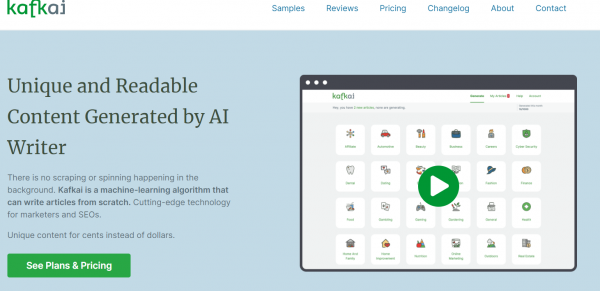
9. Kafkai
Kafkai positions itself as a specialized writing tool tailored for SEO professionals and niche site builders who require high-volume, niche-specific content generation.

- Key Strengths: Capable of producing automated, niche-targeted articles at scale with exceptionally low per-article costs on higher tier subscriptions.
- Pricing & Value: Structured across volume-based tiers ranging from the Writer Plan ($29/month for 100 articles) to the industrial-scale Printing Press and Industrial Printer plans ($129 to $199/month).
10. Peppertype.ai
Closing out our evaluation, Peppertype.ai is an agile AI content generator focused on blogging and digital copywriting, designed to help small business owners diversify their marketing output.
- Key Strengths: Rapid content ideation, varied content formats, and structured team collaboration features.
- Pricing & Value: Features an exploratory free trial, transitioning into a Personal Plan at $35/month and robust Team plans priced at $199/month.
Official Statements & Industry Perspectives
Industry analysts and software developers emphasize that the primary objective of AI content generation is not to replace human creativity, but to augment professional productivity. A leading spokesperson in the artificial intelligence development sector noted:

"Artificial intelligence is designed to shoulder the cognitive burden of first-draft creation, structuring, and keyword optimization. By eliminating the blank-page syndrome, AI empowers writers, marketers, and business owners to dedicate their energy to high-level strategy, emotional resonance, and editorial polish."
Furthermore, digital marketing experts stress the importance of maintaining strict quality control. Search engine guidelines continue to prioritize helpful, authoritative, and people-first content, regardless of whether AI tools contributed to the drafting process. Consequently, human review, fact-checking, and unique perspective injection remain non-negotiable components of any sustainable publishing strategy.
Future Outlook
The trajectory of AI content generation points toward deeper multimodal integration, heightened contextual awareness, and hyper-personalized brand voice replication. As foundational models become more sophisticated, the boundary between human-written and AI-assisted prose will continue to blur, making editorial integrity and unique brand storytelling the primary differentiators in a crowded digital marketplace.
Conclusion: Selecting the Right Tool for Your Workflow
Navigating the modern content landscape requires efficiency, adaptability, and strategic tool selection. While platforms like Jasper AI offer robust, comprehensive command over complex long-form writing, budget-conscious users may find exceptional value in streamlined alternatives like Rytr or Copy.ai. Evaluate your organization’s specific output volume, budgetary constraints, and technical requirements to select the optimal AI content partner for your publishing strategy.