

Executive Overview
For frontend developers, few moments match the quiet satisfaction of opening a pull request, swapping out a bulky, fifty-line JavaScript implementation for a pristine three-line CSS rule, and watching the diff turn overwhelmingly red. The deletion of code has long been celebrated as the ultimate metric of progress. Why rely on a complex ResizeObserver loop when you can accomplish the exact same layout shift with a native container query? Why lean on heavy JavaScript state handlers when selectors like :has() can dynamically adapt components based on their children?
These modern native features—born out of the W3C’s push to make CSS a smarter, more capable styling language—promise to unburden our scripts, boost runtime efficiency, and streamline codebases. Yet, a growing number of developers are discovering a deceptive trap hiding behind these localized victories.
While replacing JavaScript with advanced CSS features undoubtedly simplifies isolated snippets of code, it frequently compounds the systemic complexity of the wider application. When conditional logic is quietly shifted from predictable JavaScript runtimes into the shadowy depths of the CSS Cascade, layout engines, and DOM relationships, debugging transforms into a game of architectural hide-and-seek. This investigative report explores what happens when application logic is split between CSS and JavaScript, unpacks the hidden friction points of modern CSS migrations, and offers practical frameworks to keep system complexity in check.
Detailed Chronology: The Anatomy of a Modern CSS Migration
To understand how localized simplification can spawn systemic chaos, we must examine what happens step-by-step when a team migrates from imperative JavaScript logic to declarative CSS.
Scenario 1: The Multi-Owned Component Behavior
Consider a classic responsive card component. Historically, developers relied on a ResizeObserver script to track the dimensions of a card and dynamically toggle a utility class, such as card--wide, whenever the element’s width exceeded 480 pixels:
const card = document.querySelector('.card');

new ResizeObserver(([entry]) =>
  card.classList.toggle('card--wide', entry.contentRect.width > 480);
).observe(card);
.card--wide .card__body
display: grid;
grid-template-columns: 160px 1fr;
.card--wide .card__title
font-size: 1.5rem;
With the advent of CSS Container Queries, this script becomes entirely redundant. A developer can cleanly refactor the layout directly in the stylesheet:
.card
  container-type: inline-size;


@container (width > 480px)
  .card__body
    display: grid;
    grid-template-columns: 160px 1fr;
The pull request is approved before lunch. However, real-world migrations rarely occur in a single, atomic sweep. The new @container rule is added, and .card--wide .card__body is deleted. Yet, the old ResizeObserver script survives because it happens to be registered in a separate, isolated script file. Simultaneously, .card--wide .card__title survives because nobody searched the codebase for every instance of the legacy class.
A week later, a designer requests a subtle adjustment: move the responsive breakpoint from 480px to 600px. The developer updates the only breakpoint they know about—the @container rule in the stylesheet.
Between 480px and 600px, the card now exists in an unwritten, zombie state: its body remains single-column (because the container query hasn’t triggered yet), but its title scales up to 1.5rem (because the legacy JavaScript and orphan CSS class are still evaluating true). No developer wrote this layout state. To diagnose and fix the bug, an engineer must now simultaneously reason through two separate owners of the component’s behavior.

Scenario 2: The Unintended Layout Rearrangement
When developers declare container-type: inline-size, they often view it as a harmless opt-in: “Let my children query my width.” But browsers interpret this declaration much more broadly, inadvertently triggering a Block Formatting Context (BFC) and applying inline-size containment.
This single line of CSS can fundamentally alter three distinct layout behaviors completely unrelated to container queries:
- Margins Stop Collapsing: A paragraph with
margin-bottomsitting above the card will no longer merge its margin with the card heading’smargin-top. The margins now add up, physically altering component dimensions. - Floats Push Elements Aside: A card positioned after a floated image will no longer run behind the float; instead, it is forcefully pushed entirely beside it, shrinking its available width.
- Content-Sized Cards Collapse: Inline-size containment prevents an element from deriving its width from its contents. If a card is styled as
inline-block, floated, or set towidth: fit-content, its measured width can instantly collapse to0px, causing elements to seemingly vanish from the dashboard.
Scenario 3: The Overreaching Selector
The introduction of the :has() pseudo-class and native CSS nesting has dramatically flattened stylesheets, but it has also given rise to exceptionally high-specificity selectors that reach deep into component boundaries.
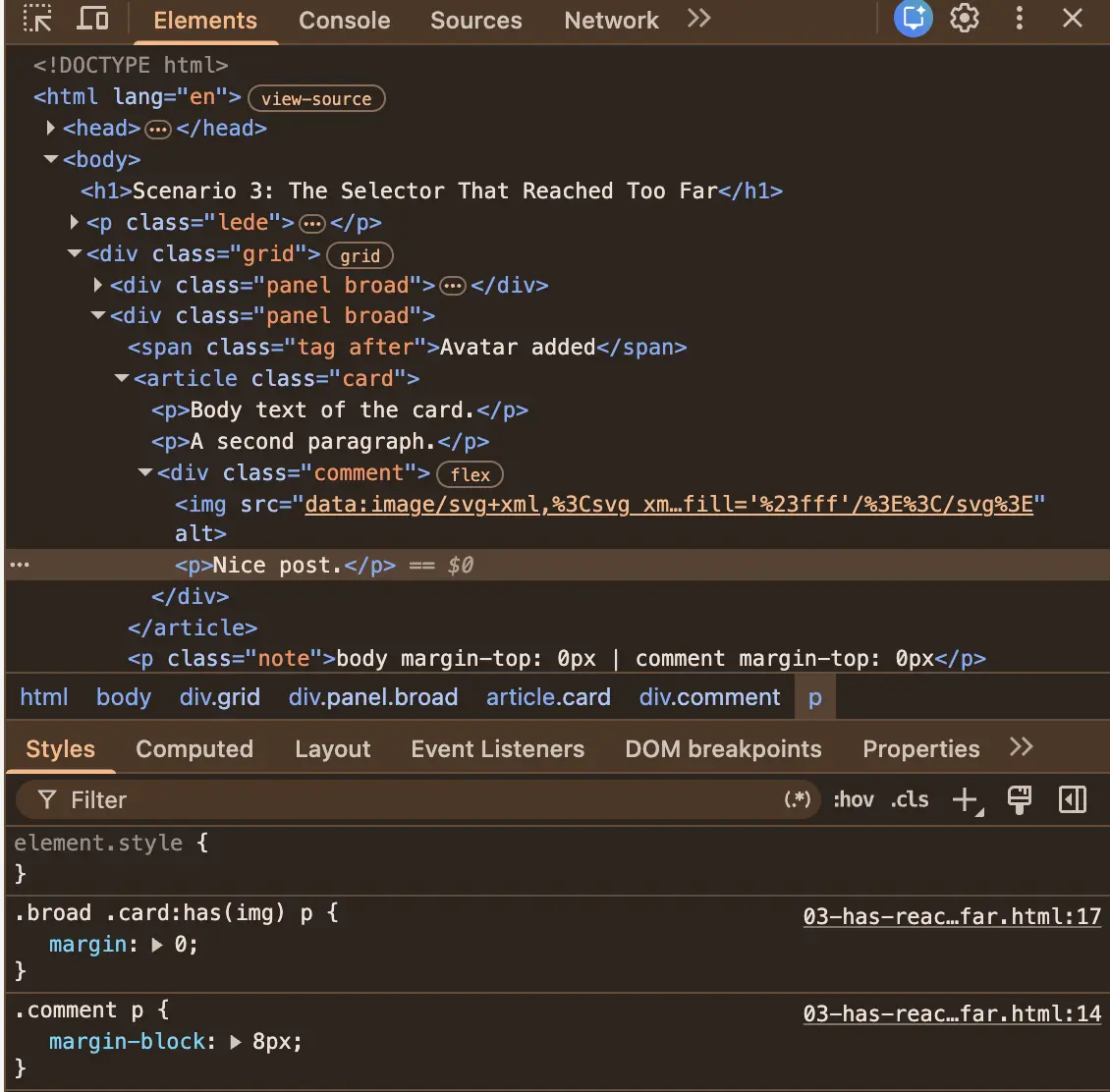
Consider an attempt to strip paragraph margins from card components containing hero images:
.card:has(img) p
  margin: 0;
While this appears safe in isolation, it can easily catch nested components entirely off guard. If a card contains a user comment module with its own internal paragraphs, those nested comment paragraphs will unexpectedly lose their spacing—even if the parent card does not currently contain a hero image. Because this state changes dynamically at runtime based on data ingestion, debugging "off spacing" bug reports becomes a grueling exercise in tracing invisible selector propagation.
Supporting Context & Metrics: Local Simplicity vs. System Complexity
The tension between writing concise code and maintaining an understandable system has sparked intense debate across the developer ecosystem. In April 2026, developer Igor Roztropiński published a widely discussed essay titled “Modern Frontend Complexity: Essential or Accidental?”, challenging the engineering community to reevaluate whether modern web architecture has truly simplified development or merely shifted cognitive overhead elsewhere.
The essay ignited passionate discourse on platforms like Reddit, where developers split sharply along ideological lines. Commentators argued that while modern CSS enables unprecedented layout flexibility, "less code on paper" does not automatically translate to "less complexity in practice."
To quantify this systemic impact, consider performance profiles when migrating behavior into native selectors. In benchmark tests evaluating list rendering performance with 5,000 rows, complex :has() selectors anchored high up in the DOM tree (such as styling dependencies tied to the body element) introduced compounding style-recalculation costs.
While an individual rule may add only 1.5ms of overhead—easily absorbed within a standard 60Hz frame budget—combining multiple seemingly harmless :has() rules can exponentially amplify browser restyling overhead. In empirical testing, conflicting selectors forced browsers to restyle upwards of 5,000 DOM nodes simultaneously upon a single class toggle, scaling latency sharply as dataset sizes expanded.

Official Statements and Industry Perspectives
Industry leaders and browser engineers have long recognized the delicate balance between enabling expressive new CSS features and protecting developers from performance footguns.
During the standardization process of the :has() pseudo-class, CSS Working Group members—including browser engineers from major vendors—deliberately debated implementing structural restrictions to safeguard against recursive layout thrashing and performance degradation. As noted in documentation by the Mozilla Developer Network (MDN), developers utilizing complex structural pseudo-classes must carefully weigh rendering costs, particularly when anchoring queries to broad ancestor elements like document bodies or large container grids.
Similarly, discussions surrounding native CSS nesting and specificity inheritance highlight the ongoing evolution of the cascade. As Miriam Suzanne noted in foundational CSS Working Group proposals regarding cascade layers, developers frequently struggle with managing specificity across mixed legacy and modern stylesheets. When unlayered legacy rules collide with layered modern component architectures, standard specificity hierarchies can produce unexpected overrides, challenging the assumption that newer features inherently play nicely with older codebases.
Future Outlook: Managing the Migration Gap
The core friction of modern frontend development boils down to a fundamental dichotomy: Most of what we read about a new feature is written from a greenfield perspective, but most of what we ship is a migration.
In a pristine, greenfield project, utilizing native CSS container queries, nesting, and :has() results in an architectural masterpiece. But in mature, legacy-laden codebases, introducing these features without a holistic migration strategy risks creating a fragile house of cards.
To bridge this gap safely, engineering teams must adopt disciplined migration checklists before merging pull requests that swap JavaScript for native CSS:
- The Orphan Check: Did the migration completely remove the legacy JavaScript event listeners, observers, and utility classes, or do dead files still linger?
- The Layout Boundary Audit: Does introducing a property like
container-typeinadvertently alter block formatting contexts, margin collapsing, or flex/grid child sizing? - The Selector Scope Test: Do high-specificity selectors (like
:has()or deeply nested rules) reach outside their intended component boundaries and affect nested children? - The Cascade Layer Alignment: Are new component styles isolated within explicit cascade layers, or are they clashing with unlayered legacy stylesheets?
- The Scale Profile: Have you profiled rendering performance with realistic production data volumes to ensure complex structural selectors do not trigger massive layout thrashing?
- The Dual-Owner Review: Are any component behaviors temporarily split between legacy scripts and new CSS rules during an incremental rollout?
Modern CSS is an extraordinary triumph for web engineering, empowering developers to build responsive, highly dynamic interfaces with a fraction of the traditional boilerplate. However, true architectural simplicity is not achieved merely by deleting lines of JavaScript. It is achieved only when new native features harmonize cleanly with the existing ecosystem of the browser rendering engine, the CSS cascade, and surrounding application logic. By treating migrations as systemic integrations rather than simple code swaps, teams can harness the full power of modern CSS without sacrificing the maintainability of their codebases.
