Amidst a grueling professional calendar punctuated by a multi-leg literary book tour, the integration of a new domestic canine companion, and the looming, demanding deadlines of manuscript completion, the pursuit of agricultural and gustatory research must somehow persist. The following dossier represents the first comprehensive capsule review cycle of the 2026 autumn apple harvest. Eschewing the luxury of extended monographs for each individual cultivar, this survey provides a rigorous, highly subjective, and unapologetically granular accounting of various heritage, modern, and obscure pomological specimens sampled across multiple regional microclimates—specifically highlighting contributions from Vermont’s Scott Farm and Wisconsin’s Brightonwoods Orchard.
Apples are, by their very nature, a manifestation of botanical chaos. Subject to the mercurial whims of seasonal shifts, regional soil composition, storage duration, and arboreal maturity, a single cultivar can radically transform from one harvest to the next. What follows is an investigative snapshot of ten distinct varieties evaluated through rigorous sensory analysis—comprising texture, skin integrity, flavor longevity, aromatic profile, and an unorthodox decimal-based scoring metric designed to inject faux-scientific precision into an inherently whimsical endeavor.
Detailed Chronology & Cultivar Assessments
1. Gravenstein
Origin/Source: Scott Farm (Vermont) / Historically Danish heritage.
Score: 7.5 / 10
Analysis: Historically speaking, navigating the Gravenstein has been a volatile proposition for American consumers, yet this particular iteration proved to be a quiet revelation. While falling slightly short of peak expected crispness, the fruit compensated with a prodigious volume of juice. The flavor profile exhibited profound notes of vanilla and rooibos tea, gracefully underpinned by subtle whispers of honey and elderflower. Crucially, the skin possessed an optimal structural pop that enhanced rather than detracted from the mastication experience.
2. Hubbardston Nonesuch
Origin/Source: Scott Farm (Vermont)
Score: 3.7 / 10
Analysis: Bearing a moniker reminiscent of a Depression-era snake oil salesman or a dusty agrarian gothic novel, the Hubbardston Nonesuch delivered a deeply underwhelming sensory journey. Across multiple evaluations spaced weeks apart, the fruit inflicted a distinct tongue-scrubbing astringency. The initial surge of juice rapidly dissipated into a perplexing, bright white nothingness punctuated by fleeting hints of florality. On subsequent sampling, the apple pivoted toward a hyper-sweet, sub-acid profile that completely forfeited its structural zip, ghosting the palate as abruptly as a phantom in the mist.
3. Lamb Abbey Pearmain
Origin/Source: Regional Harvest
Score: 7.5 / 10
Analysis: Five years prior, evaluations of this monastic-sounding cultivar yielded lukewarm impressions characterized by predictable mediocrity. However, the 2026 harvest revealed a stunning rehabilitation. Presenting as the platonic ideal of an apple, it offered a crisp-crunchy bite, an immaculate balance of sweetness and tartness, and a classic pome fruit profile laced with tangerine citrus and an unexpected, highly pleasant umami-savory depth. This dramatic seasonal evolution underscores a core tenet of pomology: apples are a volatile chaos fruit demanding recurrent testing across shifting timelines.
4. Hewes Crab (Virginia Crab)
Origin/Source: Specialized Orchard Stock
Score: 5.0 / 10
Analysis: Strictly speaking, crabapples occupy a specialized niche—historically utilized for hard cider production, artisanal jellies, rootstock improvement, or, alternatively, as non-lethal projectiles deployed to signal social distaste toward unruly youths. While the Hewes Crab evaluated here leaned slightly mealy and dry, its flavor architecture was undeniably fascinating. The fruit offered a bizarre convergence of pear, pineapple, and savory tamarind, ultimately resolving into a complex, uncanny butterscotch finish. It is an intellectual curiosity of an apple, meriting a passing grade strictly on the merits of its bizarre confectionary aftertaste.
5. Opalescent
Origin/Source: Regional Harvest
Score: 8.0 / 10
Analysis: Representing the definitive "glow-up" of the 2026 agricultural cycle, the Opalescent staged a monumental turnaround from its abysmal 2.5 rating during the previous year’s trials. Transformed from a structural and gustatory dud into an absolute stud, this year’s batch delivered dense, resounding crispness paired with a sharp, tart-sweet berry punch and a delicate floral undertone. It stands as a testament to the unpredictable year-over-year variance inherent to orchard cultivation.
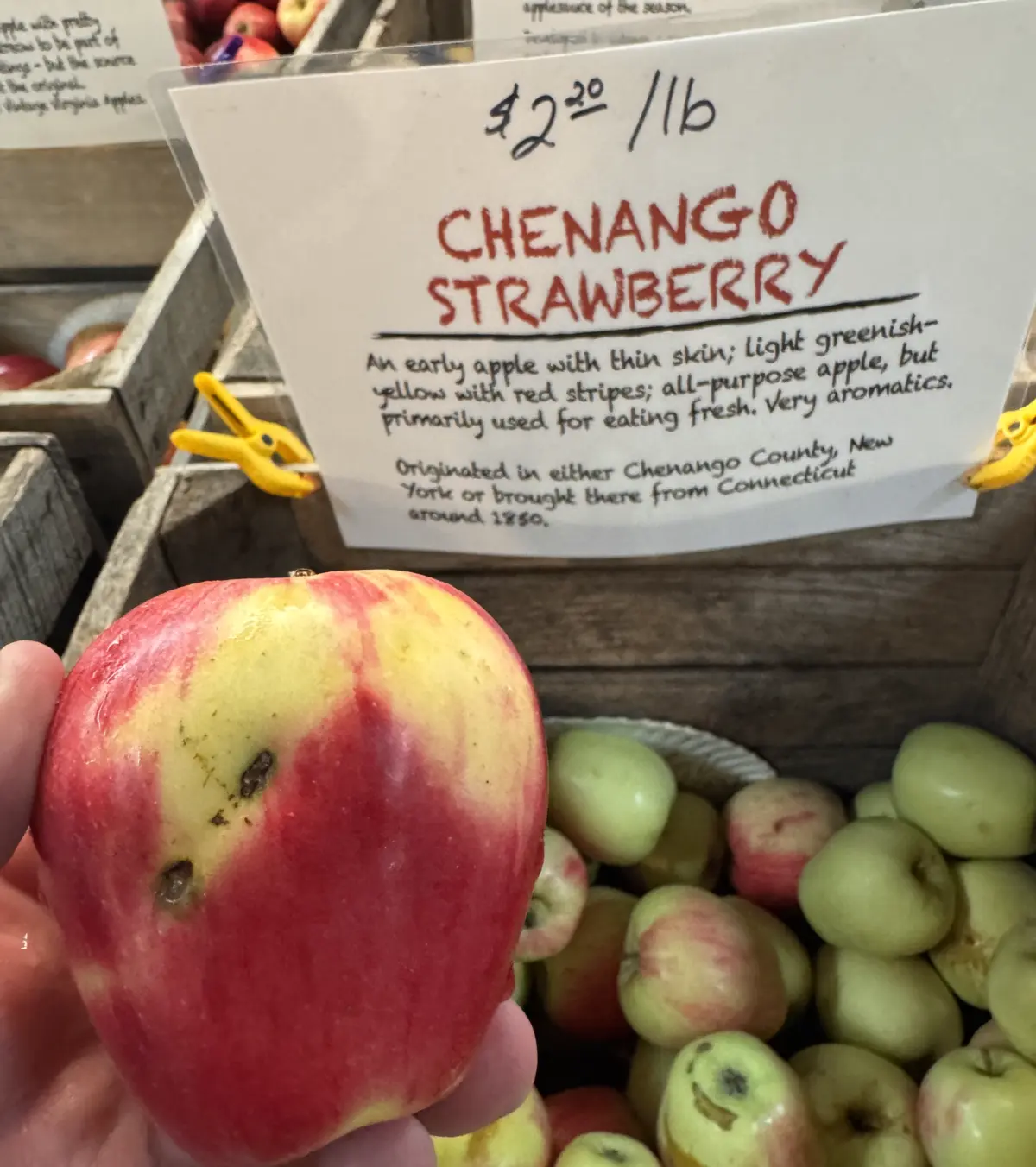
6. Chenango Strawberry
Origin/Source: Brightonwoods Orchard (Wisconsin)
Score: 4.0 / 10
Analysis: Inaugurating a multi-apple excursion through the orchards of Wisconsin, the Chenango Strawberry instantly impressed upon the olfactory senses with a profound, authentic strawberry aroma—a rare triumph of truth in advertising within the fruit kingdom. Unfortunately, the internal reality failed to match the bouquet. The tactile experience was compromised by a deeply gushy, pre-mushified internal consistency that rendered mechanical mastication entirely obsolete. It arrived at the palate pre-rendered as instant applesauce, limiting its overall appeal.
7. William’s Pride
Origin/Source: Regional Harvest
Score: 6.3 / 10
Analysis: Exhibiting a softer structural integrity without crossing the threshold into mealy degradation, William’s Pride delivered an exceptionally drippy, high-juice consumption experience. The flavor profile incorporated warming autumn pie spices—specifically cinnamon, clove, and nutmeg—culminating in a bizarre, tertiary aftertaste startlingly reminiscent of the atmospheric aroma inside a used bookstore. While lacking a necessary acidic punch to elevate its status, its structural juiciness secures a respectable mid-tier ranking.
8. Blenheim Orange
Origin/Source: Regional Harvest
Score: 7.0 / 10
Analysis: Characterized by a formidable, industrial-grade skin that resists initial dental penetration akin to heavy-duty polymer packaging, the Blenheim Orange houses an interior of staggering density. Evoking the sunny, bright disposition of a Cox’s Orange Pippin with its floral zip and electric lemon tickle, the flesh is nonetheless so compact it feels metaphorically akin to consuming an apple compressed by the gravitational pressures of a collapsing black hole. A challenging physical endeavor, yet richly rewarding in flavor.
9. Golden Nugget
Origin/Source: Regional Harvest
Score: 5.9 / 10
Analysis: Visually resembling a gnarled, subterranean goblin-growth recovered from the floor of an ogre’s lair, the Golden Nugget proved to be an aggressively paradoxical specimen. Delivering an initial green, unripened punch of severe tartness, the flavor profile swiftly morphed into a stark, aggressively unripe banana note—evoking the sensation of consuming tropical fruit straight from the branch prior to any conceivable maturation. Though lacking standard commercial palatability, its uncanny aromatic trajectory exerted a strange, hypnotic fascination over the reviewer’s palate.
10. Doctor Harvey
Origin/Source: Heritage Orchard Stock
Score: 5.1 / 10
Analysis: Formally designated as a culinary cooking apple rather than a fresh-eating specimen, this historical cultivar bypassed the expected pie-baking pipeline due to an excessively soft internal matrix that threatened to liquefy entirely under thermal exposure. Nevertheless, the fruit secured a passing score purely on the strength of its skin’s acoustic performance: a jaw-dropping, unprecedented ASMR-worthy structural pop upon biting. Accompanied by a gushing volume of juice and a fleeting berry-wine-cooler flavor profile that vanished like a fleeing fugitive, it remains a uniquely sensory experience.
Supporting Context & Metrics
Evaluating heirloom and specialty apples requires an acknowledgment of systemic agricultural variables. The regional data collected across Vermont and Wisconsin during the autumn 2026 cycle underscores the following metrics:
Geographic Distribution: Scott Farm (Vermont) and Brightonwoods Orchard (Wisconsin) serve as vital living archives for rare, pre-industrial pome varieties.
Texture Variance: Ranging from the asphalt-dense skins of the Blenheim Orange to the pre-mushed structural collapse of the Chenango Strawberry, structural integrity remains the single highest point of failure in heritage apple consumption.
Flavor Complexity: Modern palates conditioned toward monolithic sweetness (such as Honeycrisp or Gala) frequently misinterpret the complex, astringent, or savory-umami profiles native to 19th-century cultivars like the Hewes Crab or Lamb Abbey Pearmain.
Official Statements & Authorial Disclaimers
In the interest of full journalistic transparency, the author issues the following formal disclaimers regarding the scope and authority of this audit:
"I am not an appleologist, and any opinions I offer here should be viewed subjectively and honestly, suspiciously. Using decimals makes it seem like math, and lets me get a bit more granular, if anybody cares about that. Which you shouldn’t."
Furthermore, logistical realities—specifically balancing extensive literary tour dates across New Hampshire, Vermont, Ottawa, and Rhinebeck, New York, alongside canine rehabilitation and active manuscript creation—dictate that these capsule reviews represent merely the vanguard of an ongoing, highly saturated autumn consumption campaign.
Future Outlook
As the autumn season deepens and upcoming travel itineraries draw the research expedition deeper into New England orchards, consumers and literary enthusiasts alike can anticipate further dispatches from the front lines of pomological inquiry.
For readers seeking a deeper, narrative immersion into the darker psychological dimensions of pomology during this prime seasonal window, the literary thriller Black River Orchard—exploring the sinister intersection of small-town commerce and malevolent, sentient fruit—remains widely available. Signed and personalized hardcover editions can be procured directly via the Doylestown Bookshop for immediate postal fulfillment.
Further harvest evaluations will follow as seasonal cold storage yields subsequent maturity curves across experimental and heritage varieties.