

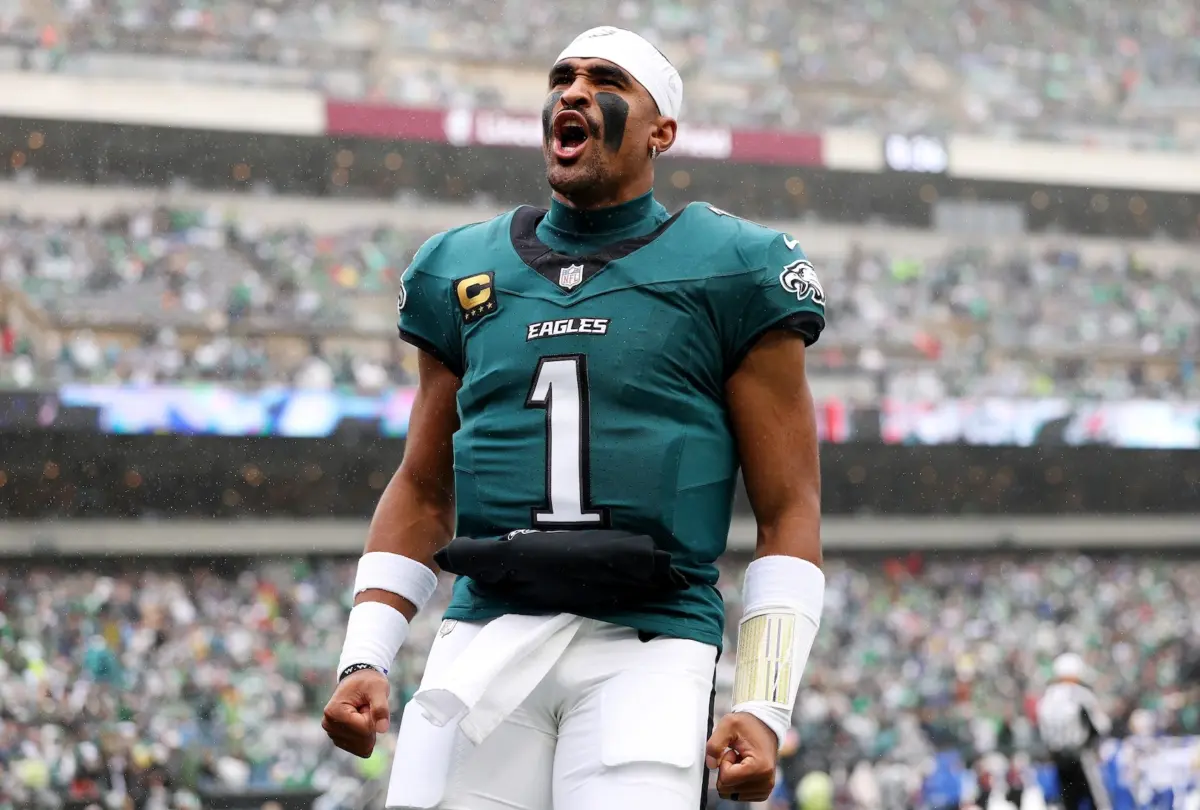
Executive Overview
The sports media ecosystem prides itself on relentless scrutiny, treating athletic performance as a crucible where character, commitment, and physical toughness are continuously tested. Yet, the alarming medical crisis surrounding Philadelphia Eagles franchise quarterback Jalen Hurts has laid bare a profound, systemic double standard within professional football.
Hurts has been ruled out for the remainder of the season following a severe medical emergency: the discovery of deep vein thrombosis that ultimately resulted in blood clots traveling to his lungs. The condition was initially detected after Hurts traveled to London for an international regular-season matchup against the Jacksonville Jaguars—a game he stubbornly played through, displaying the kind of physical resilience that in other athletes is routinely hailed as heroic.
Instead of drawing universal acclaim or immediate institutional concern, Hurts’s health crisis was met by pockets of skepticism, thinly veiled character assassinations, and egregious commentary questioning his leadership, toughness, and commitment to the team. Pundits and analysts openly wondered whether Hurts was utilizing his condition as a convenient exit strategy during a turbulent stretch for the franchise. This hostile reception reflects a troubling pattern.
For years, Hurts has navigated a unique gauntlet of criticism that fails to match the leniency and grace afforded to his peers—particularly white quarterbacks and coaches within the organization. When examined through a historical and cultural lens, the persistent disparagement of Jalen Hurts highlights an uncomfortable truth: in the modern sports industry, an unapologetically Black athlete who refuses to perform deference for the comfort of the mainstream media machine will inevitably find himself subjected to a distinct, racially coded standard of judgment.
Detailed Chronology of Events
The timeline of Jalen Hurts’s medical emergency underscores the severity of his condition and the dangerous environments elite athletes are sometimes expected to navigate.
- The London Trip: Prior to kickoff against the Jacksonville Jaguars at Wembley Stadium, Hurts began experiencing physical distress. Medical evaluations later revealed the presence of a superficial vein blood clot. Despite the underlying condition, Hurts took the field and played the game, embodying a gritty resolve under severe physical duress.
- Escalation to Deep Vein Thrombosis: Following the team’s return to Philadelphia, subsequent medical diagnostics delivered a far more alarming diagnosis. The condition had progressed from a localized superficial issue to a series of deep vein blood clots (DVT). Most critically, medical imaging confirmed that the clots had traveled to his lungs (pulmonary embolism), a potentially fatal condition that requires immediate and intensive medical intervention.
- Season-Ending Diagnosis: Agent Nicole Lynn publicly confirmed the severity of the situation, announcing that Hurts would be sidelined for the rest of the 2026 NFL season to focus entirely on rehabilitation and treatment. Medical professionals have expressed optimism regarding a full recovery, but the abrupt end to his campaign sent shockwaves through the franchise.
- The Media Backlash: Rather than generating immediate sympathy or systemic introspection regarding player welfare, the announcement triggered a wave of cynical commentary. Most notably, NFL Network analyst Michael Robinson publicly cast doubt on the timing and validity of the situation, suggesting on-air that Hurts’s absence was symptomatic of a broader "if everybody’s hurt, then I’m hurt too" attitude. Other analysts utilized the moment to reignite tired debates regarding Hurts’s pocket presence, leadership style, and overall fit as the long-term face of the franchise.
Supporting Context & Metrics: The Anatomy of Double Standards
To truly grasp the magnitude of the unfair burden placed on Jalen Hurts, one must analyze the contrasting treatment afforded to other key figures within the Philadelphia Eagles organization and across the broader NFL landscape.
The Make-or-Break Paradox
Entering the 2026 NFL season, sports talk radio and national pundits framed the campaign as an absolute, make-or-break referendum on Hurts’s career. Commentators eagerly pointed to offensive struggles as definitive proof of Hurts’s limitations, attempting to pin systemic offensive coordinator shortcomings and roster deficiencies squarely on the quarterback’s shoulders.
However, this exacting yardstick is conspicuously absent when applied to others. Head coach Nick Sirianni, despite presiding over an offense plagued by strategic regression and questionable staff hires—including the elevation of a visibly incompetent offensive coordinator—has largely escaped the existential hot seat applied to his starting quarterback. While fans have openly called for Sirianni’s dismissal, the media narrative has systematically insulated the coaching staff while amplifying the microscope on Hurts.
Comparative Standards Among Peers
The contrast becomes even starker when comparing Hurts to his contemporaries across the league. Analysts frequently hold Hurts to an impossible threshold of perfection, while praising quarterbacks like Justin Herbert or Brock Purdy with archetypal narratives of natural greatness or the beloved "underdog" persona.
Purdy’s rise from Mr. Irrelevant to starter in San Francisco is celebrated as a romantic football fairytale. Yet Hurts, who was famously benched in a National Championship game at Alabama before transferring to Oklahoma, clawed his way to a Heisman Trophy finalist finish, and was drafted in the second round to slowly build himself into a Super Bowl MVP-caliber player, is routinely treated as an overachiever living on borrowed time. When analysts like ESPN’s Dan Orlovsky proclaim that quarterbacks like Herbert represent "what it should look like," they implicitly dismiss the distinct operational profile of a dynamic, dual-threat quarterback who has already reached the pinnacle of the sport.
Official Statements and Institutional Reactions
The fallout from the medical diagnosis prompted statements from player representation, sports commentators, and league observers, illuminating the sharp divide between clinical reality and media sensationalism.
- Nicole Lynn, Agent: "Jalen is dealing with a serious medical situation involving deep vein thrombosis and pulmonary complications. His health and long-term well-being are our absolute priorities. He will miss the remainder of the season to focus on his recovery, and we expect him to make a full return to health."
- Michael Robinson, NFL Network (Media Commentary): Expressing skepticism common among televised pundits, Robinson’s on-air commentary implied that Hurts’s medical designation was a reaction to team adversity rather than an authentic health crisis, remarking on the perception that the quarterback was adopting an attitude of shared grievance.
- The Silence of Accountability: Notably missing from the initial wave of hot takes was any institutional self-reflection from the NFL or team medical staffs regarding the protocols that allowed a player with a developing blood clot to board an international flight and play an elite-level contact sport. The burden of proof was unfairly shifted onto the player to validate his own physical vulnerability.
Future Outlook and Cultural Implications
The Jalen Hurts health crisis transcends the boundaries of the Philadelphia Eagles’ 2026 campaign. It serves as a stark reminder of the cultural friction that occurs when an elite Black athlete refuses to bend to the expectations of a historically white sports media infrastructure.
The Cost of Unapologetic Authenticity
Hurts has never played the role of the eager-to-please media darling. He speaks with a measured, unflappable stoicism, declines to feed the daily cycle of manufactured controversy, and wears his cultural identity with quiet pride. In an industry where Black athletes are often subconsciously expected to perform gratitude, adopt a posture of extreme deference, or submit to the comfort zones of mainstream commentators, Hurts’s self-possession is frequently misinterpreted as aloofness or arrogance.
When athletes like Hurts, Kyrie Irving, or WNBA star Angel Reese achieve greatness on their own terms—refusing to apologize for their success or pander to critics—they are met with a coordinated wave of coded resistance. Critics label them "lazy," "selfish," or "problematic," only to be forced into defensive retreats when their on-field or on-court production shatters every negative narrative levied against them.
Moving Beyond the Hot-Take Culture
As Jalen Hurts embarks on a lengthy rehabilitation process aimed at a complete recovery, the sports media ecosystem is left to confront its own ethical shortcomings. The rush to judgment, the weaponization of medical emergencies for engagement metrics, and the persistent application of a double standard based on race and demeanor represent the worst impulses of modern sports journalism.
Ultimately, Hurts’s choice to play through a life-threatening medical condition in London was described by cynical observers as "godlike behavior"—a backhanded compliment born from the exhausting American expectation that Black men must work themselves to the brink of physical collapse to earn the basic respect of the sporting public. Moving forward, the only narrative worthy of sustained attention is not whether Hurts fits a pundit’s arbitrary aesthetic of what a quarterback "should look like," but rather how an industry can fundamentally reform its treatment of the human beings beneath the helmets.