

Executive Overview
In the grand tradition of agricultural journalism and subjective pomology, the annual evaluation of North America’s autumn harvest has officially commenced. Amid a demanding season defined by the rigorous expansion of a multi-city book tour, the integration of a new domestic canine companion into the household, and the final touches on an upcoming manuscript, the pursuit of the ultimate fruit remains unyielding.
While the sheer logistical hurdles of the season preclude exhaustive, standalone monographs for every individual pome this year, the imperative to document the flavor profiles, structural integrity, and existential anomalies of contemporary orcharding cannot be ignored. This installment serves as the first comprehensive capsule review of the current harvest cycle. Ranging from historic Vermont heirloom varieties to chaotic Wisconsin windfalls, this investigation explores the nuanced mechanics of taste, texture, and botanical unpredictability.

Employing a granular, albeit entirely subjective, numerical rating system, this audit evaluates ten distinct apple cultivars. Readers are advised to approach these conclusions with the skepticism warranted by any self-appointed, non-certified appleologist navigating the shifting tides of the autumn harvest.
Detailed Chronology and Cultivar Breakdown
The journey through this season’s orchard yields spans multiple geographic regions, drawing heavily from esteemed agricultural institutions such as Vermont’s Scott Farm and Wisconsin’s Brightonwoods Orchard. Each specimen presents a unique case study in flavor evolution, structural resilience, and sensory deception.

1. Gravenstein
- Origin: Scott Farm (Vermont) via European lineage (traditionally associated with Denmark)
- Rating: 7.5 / 10
The Gravenstein—frequently misattributed by the culturally uninitiated as a fictional surgeon rather than a venerable pomological artifact—delivered a surprisingly harmonious profile this season. While falling slightly short of optimal crispness, the fruit compensated with an abundance of juice and a sophisticated flavor architecture. Prominent tasting notes included deep undertones of vanilla and rooibos tea, underscored by subtle accents of honey and elderflower. The skin offered a satisfying structural pop without proving deleterious to the mastication process. Despite its reputation as a temperamental cultivar within North American soils, this particular Vermont-grown specimen proved to be an unmitigated delight.
2. Hubbardston Nonesuch
- Origin: Scott Farm (Vermont)
- Rating: 3.7 / 10
Evoking the nomenclature of a Depression-era agrarian frontier or a traveling purveyor of dubious medicinal tinctures, the Hubbardston Nonesuch proved to be a perplexing and ultimately disappointing culinary encounter. Evaluated across two distinct specimens separated by a fortnight, the apple consistently exhibited a tongue-scrubbing astringency. The initial flood of juice rapidly gave way to what can only be described as a bright white nothingness, punctuated by a faint, fleeting trace of floral elderflower. A subsequent tasting revealed a shift toward a sub-acid profile that had completely shed its structural zip, resolving into an ephemeral sweetness that vanished as swiftly as a literary specter. Decimals were deployed in the scoring not to imply scientific rigor, but to capture the fine-grained nature of a fundamentally mediocre fruit.

3. Lamb Abbey Pearmain
- Origin: Regional Orchard Stock
- Rating: 7.5 / 10
Revisited after a roughly five-year hiatus—during which it registered as little more than a polite, uninspired pedestrian pome—the Lamb Abbey Pearmain staged a triumphant return. Manifesting as the platonic ideal of what an apple ought to be, this iteration boasted a robust, crunchy-crisp flesh and an exemplary equilibrium between tartness and sugary brilliance. Eschewing the pear-like expectations sometimes harbored of its namesake family, the fruit delivered a classic apple profile augmented by a flash of citrus (reminiscent of tangerine) and a curious, highly pleasing umami undertone. This dramatic seasonal shift underscores a fundamental truth of orcharding: apples are chaotic entities that demand continuous re-evaluation from harvest to harvest.
4. Hewes Crab (Virginia Crab)
- Origin: Regional Harvest
- Rating: 5 / 10
Long utilized for the manufacture of hard cider, culinary jellies, or as an informal projectile for communicating mild social displeasure to unruly youths, the Hewes Crab stands as a monument to botanical eccentricity. These small-form crabapples exhibited a somewhat mealy, dry texture, yet compensated with a remarkably complex flavor cascade. The palate experienced an unusual convergence of pear, pineapple, and savory tamarind, ultimately resolving into an unexpected and distinct butterscotch finish. While hardly designed for casual, out-of-hand consumption, the sheer theatricality of its flavor development earns it a respectable mid-tier score.

5. Opalescent
- Origin: Regional Orchard Stock
- Rating: 8 / 10
In one of the most dramatic pomological redemption arcs of the decade, the Opalescent transformed entirely from its dismal performance during the previous harvest cycle—where it languished at a dismal 2.5 out of 10. The current batch revealed a profound glow-up, presenting dense, bracingly crisp flesh paired with a vibrant berry tartness and an underlying floral current. Moving swiftly from structural dud to elite contender, the Opalescent secured an impressive 8 out of 10, proving that perseverance pays off in the orchard just as it does in the literary arts.
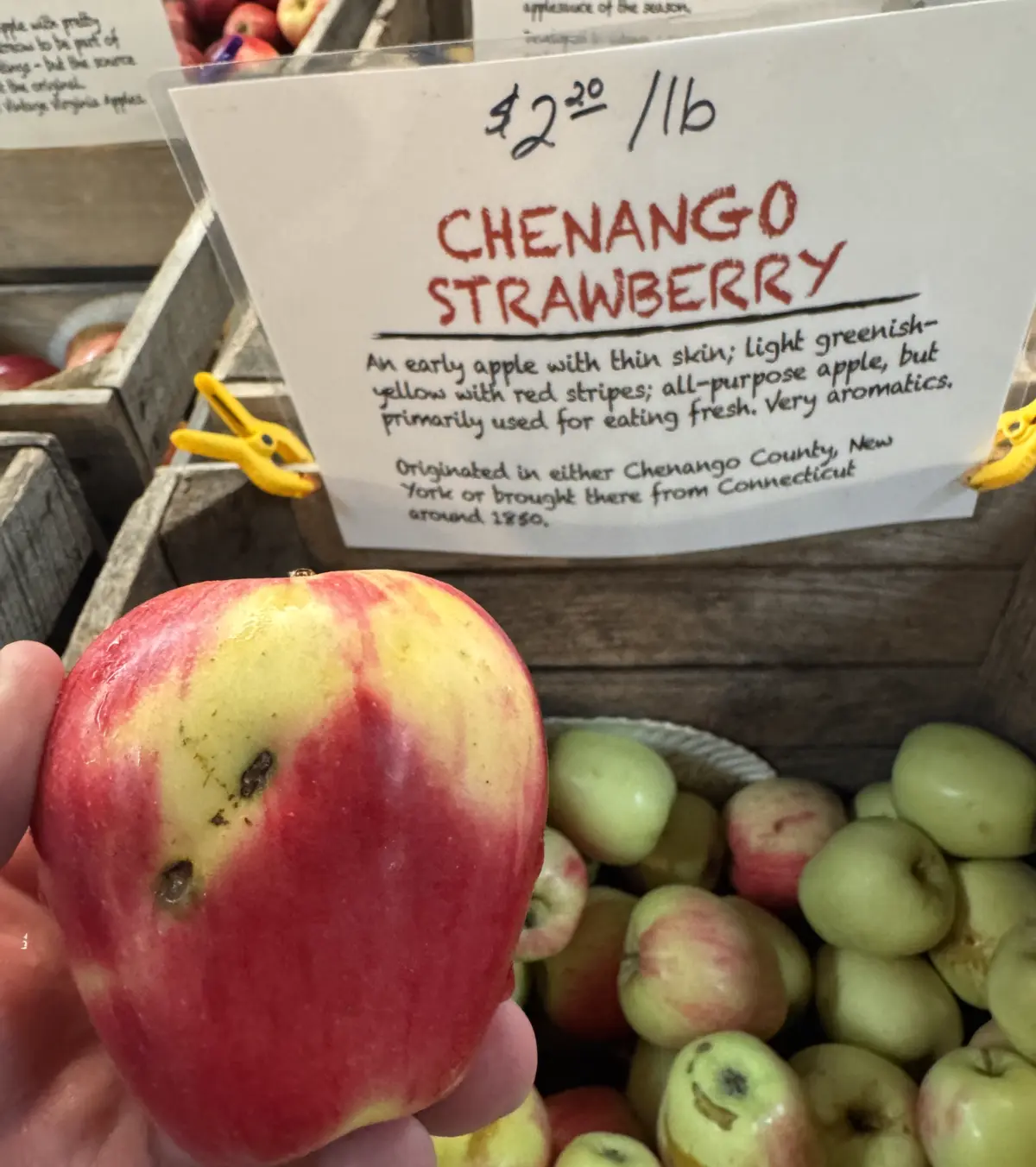
6. Chenango Strawberry
- Origin: Brightonwoods Orchard (Wisconsin)
- Rating: 4 / 10
Encountered during a pomological excursion in Wisconsin, the Chenango Strawberry made an immediate sensory impression. Upon breaking the skin, the fruit released a potent, authentic aroma of fresh strawberries—a rare feat in a horticultural naming convention. Unfortunately, the internal reality failed to match the aromatic promise. The textural integrity of the tested specimen was compromised, resulting in a pre-softened, gushy consistency that bypassed the need for dental engagement entirely. Despite its delightful nomenclature and fragrant introduction, the compromised texture relegated it to a sub-standard 4 out of 10.

7. William’s Pride
- Origin: Regional Orchard Stock
- Rating: 6.3 / 10
Characterized by a structural softness that mercifully avoided the traps of mealy mushiness, William’s Pride delivered an exceptionally juicy, drippy eating experience. The flavor profile incorporated classic autumnal pie spices—cinnamon, clove, and nutmeg—culminating in an extraordinary after-aftertaste that bore an uncanny resemblance to the ambient air of an antiquarian bookstore. While lacking the aggressive tartness required to elevate it to elite status, its undeniable moisture and distinct aromatic personality justified a solid, if measured, score.
8. Blenheim Orange
- Origin: Regional Orchard Stock
- Rating: 7 / 10
A decidedly dense and formidable specimen, the Blenheim Orange presented a skin so resilient it challenged the structural integrity of human enamel, evoking the trials of opening industrial polymer packaging. Once breached, however, the interior revealed the sunny, bright disposition characteristic of a Cox’s Orange Pippin, complete with an electric lemon zing and floral brightness. The primary drawback lay in its sheer density—eating it felt akin to navigating the gravitational pressures of a collapsing stellar body. Nevertheless, the flavor profile ultimately redeemed the workout.

9. Golden Nugget
- Origin: Regional Orchard Stock
- Rating: 5.9 / 10
Visually challenging and aggressively gnarled, the Golden Nugget resembled an agricultural anomaly unearthed from an ogre’s underbrush. Its flavor profile was an exercise in unyielding, unripened green tartness, progressing rapidly into the distinctly raw profile of an un-harvestable, tree-bound banana. While objectively bizarre and leaning heavily into unpleasantness, the fruit possessed a strange, compelling quality that engaged the intellect if not entirely the palate. Had it been granted the benefit of extended cold storage maturation, its trajectory might have mirrored that of a late-blooming GoldRush; as evaluated, it hovers just below the passing threshold.
10. Doctor Harvey
- Origin: Historic Heirloom Stock
- Rating: 5.1 / 10
Classified historically as a culinary apple intended for sauces and baking rather than raw consumption, the centuries-old Doctor Harvey variety proved too structurally soft for reliable pie production—threatening to dissolve into an unstructured puree. However, it offered a singular sensory redemption: the skin’s acoustic and physical pop upon initial puncture was utterly unparalleled in recent memory, delivering a premier ASMR experience. The flavor opened as a vibrant berry-infused wine cooler, gushing with juice before executing a rapid retreat from the palate. It secures a marginal pass largely on the strength of its magnificent rupture.

Supporting Context and Metrics
To provide structural clarity to this audit, the evaluated cultivars are organized by metric performance across texture, flavor complexity, and geographic origin:
| Cultivar | Region / Orchard | Texture Profile | Dominant Flavor Notes | Score (/10) |
|---|---|---|---|---|
| Opalescent | Regional | Crisp, Dense | Tart berry, Floral | 8.0 |
| Gravenstein | Scott Farm, VT | Juicy, Moderate Crisp | Vanilla, Rooibos, Elderflower | 7.5 |
| Lamb Abbey Pearmain | Regional | Crunchy-Crisp | Tangerine, Umami, Classic Apple | 7.5 |
| Blenheim Orange | Regional | Extremely Dense | Bright Lemon, Cox’s Orange | 7.0 |
| William’s Pride | Regional | Soft, Drippy | Pie spices, Bookstore air | 6.3 |
| Golden Nugget | Regional | Tough, Gnarly | Green banana, Unripe tartness | 5.9 |
| Hewes Crab | Regional | Mealy, Dry | Pear, Tamarind, Butterscotch | 5.0 |
| Doctor Harvey | Regional | Soft, Gushing | Berry wine cooler | 5.1 |
| Chenango Strawberry | Brightonwoods, WI | Gushy, Mushy | Strawberry aroma | 4.0 |
| Hubbardston Nonesuch | Scott Farm, VT | Astringent, Zipless | White nothingness, Sweetness | 3.7 |
Official Statements and Authorial Insights
Pomological evaluation, while ostensibly grounded in agronomy, remains an inherently subjective and autobiographical endeavor. As the autumn tour cycle extends through New England—with upcoming stops slated for New Hampshire, Vermont, Ottawa, and Rhinebeck, New York—the intersection of literature and agriculture grows increasingly pronounced.

Observers of contemporary dark fiction will note that this obsessive cataloging of pomes is not merely a seasonal hobby, but the thematic lifeblood of the author’s broader literary universe. For those seeking a deeper, albeit more sinister, exploration of pomological obsession during the harvest season, the literary thriller Black River Orchard—narrating the chilling convergence of a rural community and an orchard bearing malevolent fruit—remains widely available through independent booksellers such as the Doylestown Bookshop, complete with signed and personalized editions.
Future Outlook
As the harvest cycle advances into its chillier phases across New England and the Midwest, further pomological field research is guaranteed. Future reporting will investigate late-season heavyweights, frost-bitten windfalls, and the unpredictable variables of regional storage facilities. Readers are cautioned to maintain vigilance against overly optimistic marketing claims surrounding esoteric heirlooms, and to approach all future apple ratings with the requisite degree of suspicion.

Additional field dispatches and exhaustive scoring metrics will follow as the autumn weather deepens.