

Executive Overview
The global pantheon of pomology—the scientific study and cultivation of pome fruits—faces a peculiar renaissance. While mainstream agricultural markets remain heavily consolidated around a monotonous handful of supermarket cultivars (namely the Red Delicious, Gala, and Honeycrisp), a fierce counter-cultural vanguard is quietly reclaiming lost orchards, forgotten heritage strains, and esoteric cider apples.
In this second installment of an ongoing, highly contentious investigative audit of rare seasonal apples, our evaluation panel steps directly into the fray. Moving beyond the sterile, wax-coated uniformity of commercial grocers, this report examines seven distinct, unconventional apple varieties: Kickapoo Spice, St Edmunds Pippin, Sops of Wine, Fenceline Surprise, Americus Crab, Campfield (False?), and Graham.
Utilizing empirical sensory analysis—spanning texture metrics, tannin saturation, aromatic profiling, and structural integrity—this investigation grades each specimen on a strict 1.0 to 10.0 scale. What follows is a comprehensive breakdown of these cultivars, complete with historical deep-dives, structural critiques, and an authoritative look at the broader landscape of modern fruit acquisition.
Detailed Chronology of the Tasting Trials
The evaluation window commenced during the peak of the autumn harvest cycle. Specimens were procured directly from specialized orchards, regional heritage suppliers, and specialty purveyors. To ensure absolute objectivity, each apple was subjected to a battery of physical tests: skin permeability, flesh density, initial crack resistance ("the crunch factor"), sub-acidic sugar-to-acid ratios, and lingering aftertaste profiles.

1. Kickapoo Spice
- Score: 6.9 / 10.0
- Physical Profile: Dense structure; high-density core; unyielding skin.
Kicking off the roster with a nod to pop culture nomenclature that immediately evokes robust sensory impressions, the Kickapoo Spice presents itself as a structurally intimidating specimen. Ethnographically categorized as a "dense boy" and a "weird friend" within informal tasting circles, this apple does not yield easily to human dentition.
Analytically, the Kickapoo Spice leans heavily into its namesake. The flavor matrix is dominated by an exceptionally high spice component, characterized by heavy notes of nutmeg, underscored by secondary tones of cinnamon and clove. However, the specimen underperformed in systemic hydration; juice content was notably low. A troubling aftertaste redolent of freshly cut grass lingered on the palate, suggesting either a sub-optimal harvest window or insufficient maturation time in cold storage. Pomological science dictates that certain cultivars improve post-harvest, while others degrade rapidly. The Kickapoo Spice sits precisely on this knife-edge, earning a respectable, if cautionary, 6.9.
2. St Edmunds Pippin
- Score: 8.3 / 10.0
- Physical Profile: Rough-textured exterior; highly reactive, crisp skin architecture.
As the inaugural "proper" apple consumed in the official harvest rotation, the St Edmunds Pippin established a remarkably high baseline for the season. The exterior tactile experience is initially aggressive—the skin presents a coarse, sandpaper-like resistance. Yet, this superficial roughness gives way to a deeply satisfying acoustic and mechanical event upon the initial bite.
The St Edmunds Pippin delivers a sharp, resonant pop and crunch, accompanied by exceptional interior juiciness. Flavor-wise, the fruit achieves a masterclass in balance: bright, herbal undertones reminiscent of fennel pollen are seamlessly integrated with a sophisticated sweet-tart baseline. Despite its eccentricities, it stands as a premier example of a funky heritage apple that satisfies both the purist and the casual consumer.

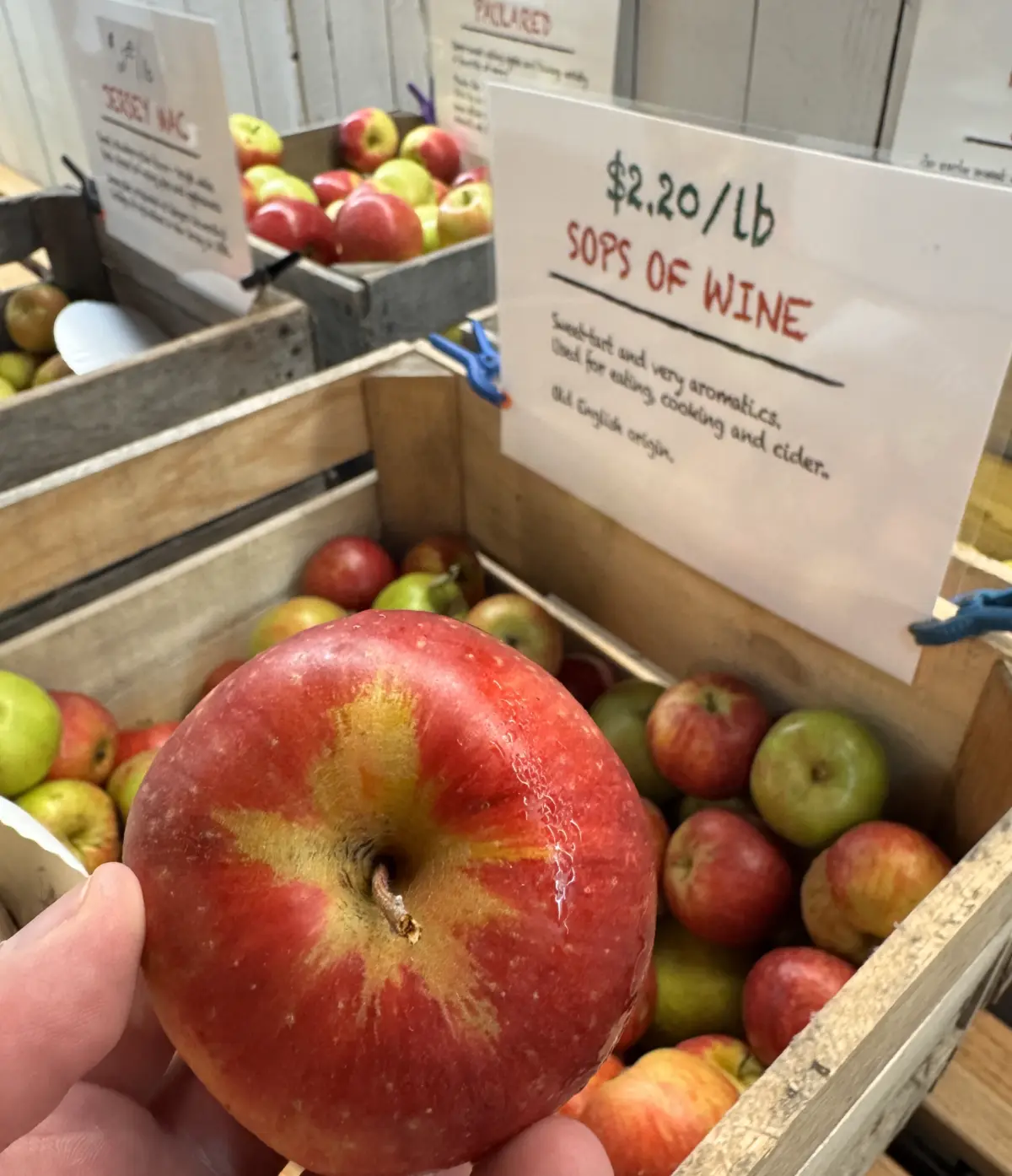
3. Sops of Wine
- Score: 3.5 / 10.0
- Physical Profile: Mealy interior matrix; structural degradation observed.
The Sops of Wine enters the historical record with centuries of accumulated folklore, though its modern incarnation proved profoundly underwhelming. While historical texts and anecdotal reports frequently cite variants of this fruit as possessing striking red-fleshed interiors or distinct varietal lines, the audited specimen offered none of these visual markers, leading researchers to question the exact botanical lineage of the batch.
The gustatory experience was marked by a severe dissonance between flavor and texture. Aromatically, the fruit exhibited pleasant, sub-acidic tendencies—leaning sweeter than tart—with subtle notes of vanilla and warm spice. Tragically, the structural integrity of the flesh had entirely collapsed. Exhibiting a distinctly mealy, gritty, and sand-like mouthfeel (consistent with an apple held far too long past its prime off the tree), the Sops of Wine failed to translate its promising chemical profile into an acceptable physical reality.
4. Fenceline Surprise
- Score: 1.0 / 10.0
- Physical Profile: Compromised structural firmness; rapid moisture dissipation.
True to its ominous moniker, the primary surprise delivered by the Fenceline Surprise is its utter lack of culinary merit. Marketed structurally as a "firm apple," the specimen tested arrived in a state of advanced internal degradation—functioning essentially as pre-chewed organic matter.
Upon consumption, the fruit surrendered almost all discernible flavor within milliseconds, leaving behind a fleeting, ghostly mist of pear-like ester notes before collapsing entirely into a sensation akin to chewing beach sand. Given its rapid decay relative to its acquisition date, the empirical conclusion is that this specific batch was compromised deep within the cold-storage pipeline. It narrowly escapes a zero-point rating solely due to its aesthetic geometry and the fleeting ghost of its pear-like top notes.

5. Americus Crab
- Score: 2.5 / 10.0
- Physical Profile: Rugged, highly tannic, diminutive crabapple architecture.
The Americus Crab challenges the conventional boundary between table fruit and industrial processing inputs. Functionally a crabapple, this cultivar defies casual snacking.
The sensory profile is an aggressive onslaught: intensely savory, exceptionally tart, physically tough, and saturated with high levels of astringent tannins. It is a fruit explicitly designed not for immediate, raw consumption by the human hand, but rather for specialized blending or culinary maceration. For the uninitiated, biting into an Americus Crab is an act of horticultural bravado. It scores low on immediate palatability, but earns minor points for sheer, unbridled character.
6. Campfield (False?)
- Score: 4.1 / 10.0
- Physical Profile: Chewy, high-tannin density profile; specialized cider morphology.
Labeled ambiguously as "(false)" in regional inventories, the Campfield presented an enigma to the auditing panel. Mechanically, the flesh possessed a dense, chewy consistency akin to a callus, while chemically flooding the mouth with an overabundance of sugar locked behind a wall of biting tannins.
The Campfield is, fundamentally, a cider apple—a classification that excuses its hostility toward the unfermented human palate. These cultivars require the biochemical alchemy of yeast and time to unlock their true potential.

Supporting Context & Metrics: The Historical Weight of Campfield
To fully contextualize the Campfield apple, one must examine its deep-rooted ties to colonial American history. Archival pomological records connect the Campfield lineage directly to early New Jersey agriculture and the pivotal figure of Matthew Canfield (alternately spelled Campfield).
An anti-royalist Puritan originating from Harleston, England, who arrived during the Great Puritan Migration of 1637, Canfield served as a founding father of the New Haven Colony, Norwalk, and Newark—locales where some of the North American continent’s finest early hard ciders were engineered.
Historical town records from New Haven and Newark outline the strict socio-agricultural mandates of the era:
- The Freeholder Mandate: Voting citizens ("freeholders") were legally mandated to cultivate a minimum of four acres of land, a regulation that directly catalyzed the rapid expansion of early American orchards.
- Civic Infrastructure & Pomology: Records indicate Canfield’s deep involvement in local governance—acting as a judge, customs collector, and committee member tasked with fence inspection and swine-damage assessments. Crucially, his land grants and civic duties were routinely tied to the obligation to plant and maintain fruit trees for winter fruit production and cider fermentation.
While the modern table-bound incarnation of the Campfield hybrid yields a modest 4.1 score, its historical DNA remains a cornerstone of North American cidermaking heritage.

Official Statements & Methodological Standards
The evaluation of heritage and wild-harvest pome fruits requires an uncompromising, multi-disciplinary approach. As commercial agriculture continues to homogenize global produce aisles, independent pomological auditing serves a vital archival function.
Our panel maintains that an apple cannot be judged merely by its sugar content. Factors including cell-wall rigidity, malic acid balance, phenolic compound concentrations (tannins), and post-harvest maturation trajectories are paramount. Cultivars like the Graham—which tested our panel’s dental fortitude with a density that evoked structural steel, yet rewarded the effort with an unmistakable, unreserved flavor profile mimicking commercial Juicy Fruit gum—prove that the biological world retains an astonishing capacity for chemical surprise. Earning an 8.0 out of 10 despite inflicting mild muscular fatigue on the jaw, the Graham stands as a testament to the unpredictable brilliance of heirloom breeding.
Future Outlook
As the autumn harvest cycle shifts geographically, the investigative focus of our pomological task force expands. With upcoming field research missions deploying directly into the historic orchards of New York, New England, and the agricultural corridors of Canada, the search for hyper-local, wild, and forgotten apple variants accelerates.
The industrial agricultural complex may preach the gospel of uniform, shelf-stable perfection, but the true frontier of flavor lies in the gnarled, forgotten trees lining old fence lines and colonial farmsteads. Consumers and orchardists alike are encouraged to bring forth their local rarities for future auditing.

The Great Pomological Audit continues. Stay vigilant, and keep eating the strange apples.