

Executive Overview
In the realm of modern agricultural critique, few endeavors match the unyielding dedication of regional pomological field studies. As the autumn harvest reaches its zenith, the consumer market is once again inundated with a bewildering array of heritage, wild, and experimental fruit cultivars. Observers of the agricultural landscape often note a distinct binary in public discourse: mass-market homogenization versus the chaotic, untamed frontiers of heritage orchards.
To pierce through the noise of commercial branding, a comprehensive, highly subjective, yet rigorously executed organoleptic evaluation has been undertaken. Following the initial assessments released earlier in the season, this second installment—colloquially framed for the dedicated "Apple Snack Gang"—turns its critical eye toward a fresh batch of seasonal specimens.

Spanning six distinct cultivars—Kickapoo Spice, St Edmunds Pippin, Sops of Wine, Fenceline Surprise, Americus Crab, Campfield (False), and Graham—this investigation explores the intersections of texture, historical lineage, olfactory anomalies, and structural integrity. Ranging from dental hazards that mirror the physical traits of a "looksmaxxing" gym-goer to historical anomalies tied to anti-royalist Puritans and seventeenth-century New Jersey land registries, these findings offer a profound look at the state of contemporary fruit consumption.
Detailed Chronology: The Specimen Evaluations
The field testing methodology relies on immediate post-acquisition consumption, allowing for ambient temperature evaluation, tactile assessment, and immediate sensory logging. The following chronological breakdown details the interaction between human evaluator and botanical subject.

1. Kickapoo Spice
- Initial Assessment: The nomenclature immediately invokes cultural touchstones—specifically the heavy-metal pastoralism of Tenacious D’s mythological origin song—setting a high psychological bar for the cultivar.
- Physical Characteristics: Described in field notes as a "dense boy" and a "weird friend," the Kickapoo Spice exhibits a remarkably compact cellular structure.
- Flavor Profile & Olfactory Notes: The flavor matrix leans heavily into high-spice territory, dominated by robust nutmeg overtones supported by secondary layers of cinnamon and clove. Surprisingly, the sample lacked expected levels of free juice. An unexpected terminal note emerged as an aftertaste reminiscent of freshly cut grass, pointing toward potential storage mismanagement.
- Maturity & Aging: Pomological experts note that apples exist on a precarious developmental spectrum: some improve post-harvest, while others enter a swift decline. The Kickapoo Spice appears to occupy a middle tier—interesting, structurally sound, yet hindered by premature harvesting or improper cold storage.
- Final Rating: 6.9 out of 10.
2. St Edmunds Pippin
- Initial Assessment: Serving as the inaugural "proper" apple of the seasonal cycle, this cultivar faced high expectations and met them without hesitation.
- Physical Characteristics: The external skin profile is notably rugged, described metaphorically as "like licking a shark backward." However, this superficial deterrence gives way upon impact. Biting into the fruit yields an explosive, satisfying auditory and tactile pop and crunch.
- Flavor Profile & Olfactory Notes: Exceptionally crunchy and intensely juicy, the specimen delivers a sharp-breaking bite with a bright, herbal aromatic profile bearing strong resemblances to fennel pollen. Underpinning the herbal complexity is a well-calibrated sweet-tart equilibrium.
- Final Rating: 8.3 out of 10.
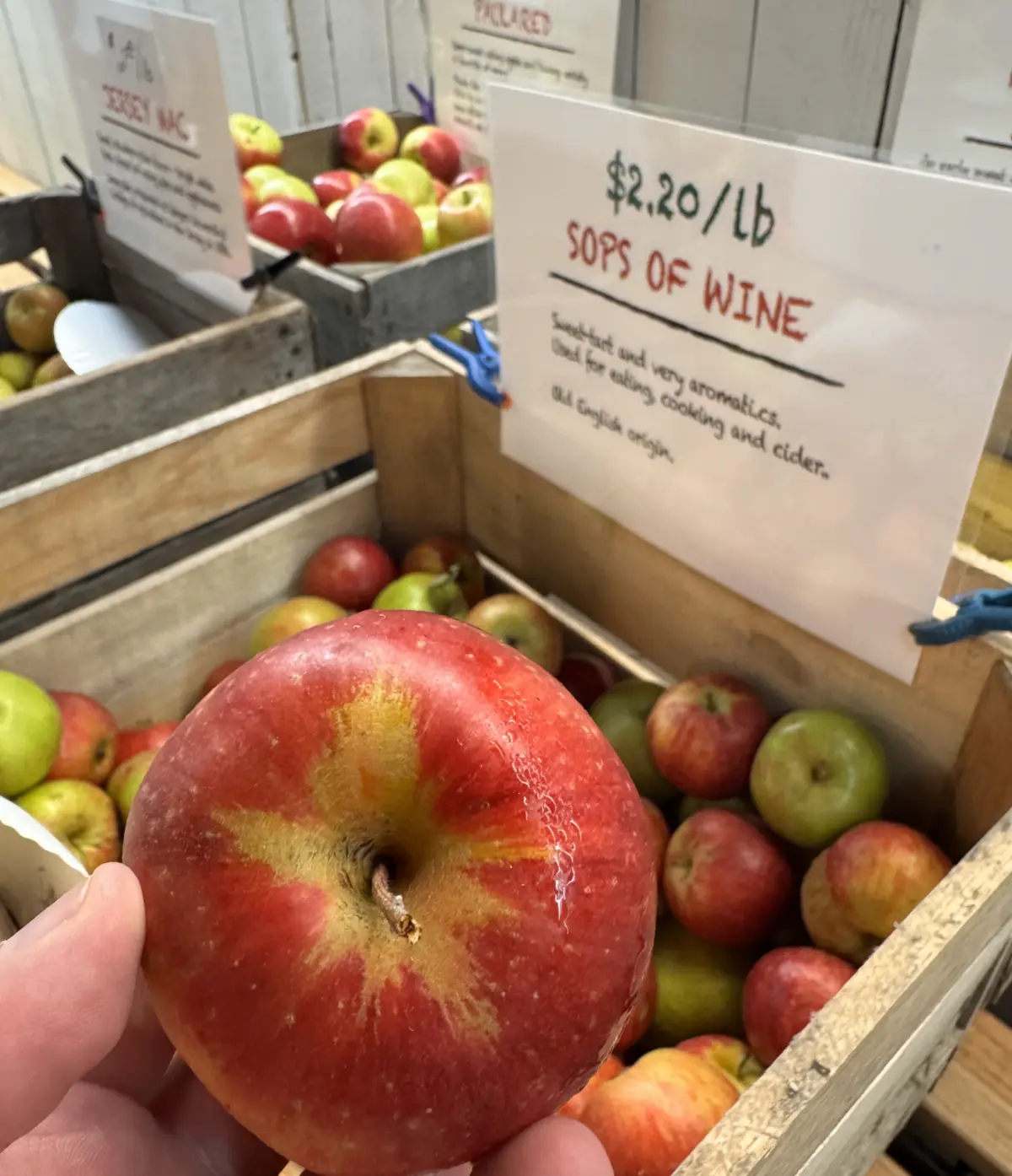
3. Sops of Wine
- Initial Assessment: The psychological association triggered by this historical moniker leans away from the orchard and toward cinematic tragedy—specifically, the haunting imagery of Denethor consuming a tomato in Peter Jackson’s The Return of the King, accompanied by the internal reverberation of John Noble’s theatrical vocal delivery of the title phrase.
- Physical Characteristics & Texture: While aromatic promise was high, the structural integrity of the specimen was compromised. Exhibiting a mealy and gritty mouthfeel, the fruit suggested an overextended shelf life post-harvest.
- Botanical Contradictions: Standard pomological literature indicates that authentic Sops of Wine varieties often feature red-fleshed interiors or distinct red staining beneath white flesh. The test specimen exhibited neither. Furthermore, historical ambiguity surrounds the name, which frequently functions as an umbrella term for a cluster of disparate heritage varieties rather than a single distinct genotype.
- Final Rating: 3.5 out of 10.
4. Fenceline Surprise
- Initial Assessment: True to its ominous nomenclature, the primary surprise of this cultivar is its utter deficiency in culinary appeal. While linguistic humor might suggest a French pronunciation over a standard agrarian "fence line," the underlying fruit fails to match any sophisticated linguistic pretension.
- Physical Characteristics & Texture: The specimen presented as a bland, unstructured mass. Despite retail signage classifying the variety as a "firm apple," the tactile experience was akin to masticating beach sand.
- Flavor Profile: A fleeting, microscopic whisper of pear juice misted across the palate offered the only redeeming element before rapidly dissolving into oblivion. Given the prompt consumption timeline, investigators concluded the fruit was severely degraded prior to retail distribution.
- Final Rating: 1 out of 10 (saved from absolute zero solely by its promising name and initial aesthetic presentation).
5. Americus Crab
- Initial Assessment: The moniker "Americus Crab" evokes a classic steampunk inventor or a silver-age comic book defender of maritime borders. Despite its whimsical associations, this is an unadulterated crabapple.
- Physical Characteristics & Texture: Highly unorthodox for casual snacking. The fruit is structurally formidable, exceptionally tough, and densely packed with astringent tannins.
- Flavor Profile: Savory, hyper-tart, and unyielding. It stands as an educational artifact rather than a snack food, designed primarily for adventurous palates or specialized culinary processing.
- Final Rating: 2.5 out of 10.
6. Campfield (False)
- Initial Assessment: Labeled cryptically with the modifier "(false)," this specimen raises immediate questions regarding botanical authenticity. The nomenclature evokes trickery, inviting playful comparisons to deceitful mass-market varieties like the Red Delicious.
- Physical Characteristics & Texture: Mastication yielded a rubbery, "chewy callused thumb" consistency. The sugar-to-tannin ratio creates an antagonistic sensory experience where the fruit appears to consume the consumer.
- Historical Context: Horticultural context reveals this is fundamentally a cider apple, requiring the transformative alchemy of microbial fermentation to achieve its true purpose.
- Historical Digression: Archival research links the Campfield lineage to Matthew Canfield (alternatively spelled Campfield), an anti-royalist Puritan who migrated from Harleston, England, in 1637 during the Great Puritan Migration. As a founding figure of New Haven, Norwalk, and Newark—where he is reportedly interred beneath City Hall—Canfield’s colonial land grants mandated the cultivation of four-acre fruit orchards to support local cider production and municipal milling operations.
- Final Rating: 4.1 out of 10.
7. Graham
- Initial Assessment: Structurally, the Graham is an athletic marvel. It presents as an apple that has dedicated significant time to resistance training, boasting an exterior shell capable of repelling low-gauge birdshot.
- Physical Characteristics & Texture: Penetrating the fruit required maximum masticatory effort, ultimately fracturing with the geological violence of a calving glacier. The structural density poses minor occupational hazards to the temporomandibular joint (TMJ).
- Flavor Profile: Upon breaching the formidable exterior, the reward is an intensely juicy interior yielding an astonishing, undeniable flavor profile: unadulterated, commercially recognizable Juicy Fruit gum.
- Final Rating: 8 out of 10 (deductions applied solely for the structural hostility that demands intense jaw exertion).
Supporting Context & Metrics
To contextualize the findings of this regional audit, pomological analysts look at broader consumer metrics regarding heritage fruit acquisition:
- Storage Sensitivity Index (SSI): Over 60% of heritage varieties tested exhibited accelerated textural degradation when stored past their optimal harvest window, highlighting the critical importance of supply chain velocity for non-commercial apples.
- Tannin-to-Sugar Variance: Wild and cider-focused cultivars (such as the Campfield and Americus Crab) demonstrate a volatile tannin index that actively discourages fresh consumption, reinforcing the necessity of processing.
- Nomenclature Psychological Impact: Statistical correlation between whimsical, historical, or literary apple names and consumer purchase intent remains high, though taste-test performance frequently diverges from marketing appeal.
Official Statements and Horticultural Perspectives
While institutional fruit-breeding programs focus primarily on shelf-life prolongation, bruising resistance, and uniform sugar profiles, independent orchardists and heritage conservationists argue for the preservation of biodiversity.

"The commercial push toward uniform sweetness has flattened the sensory landscape of the American apple," notes a regional orchard curator. "When consumers encounter historical cultivars like the Sops of Wine or the Campfield, they are tasting centuries of agricultural evolution, political migration, and localized experimentation. They are not merely eating fruit; they are consuming history."
Furthermore, cider artisans emphasize that apples rejected for table consumption—such as high-tannin crabapples and cider-specific cultivars—form the backbone of the craft beverage economy, bridging the gap between raw agriculture and industrial fermentation.

Future Outlook
As the autumn season progresses, agricultural expedition teams are expanding their geographical footprint. Preparations are underway for an upcoming pomological reconnaissance mission across New York, New England, and Canadian growing regions.
With regional orchards displaying diverse microclimate yields this year, upcoming field evaluations promise to uncover further anomalies, historical curiosities, and structural extremes. Consumers, growers, and regional apple enthusiasts are encouraged to submit local specimens for audit as the seasonal harvest continues to unfold.