

Executive Overview
In the grand pantheon of seasonal gastronomy, few rituals hold as much quiet anticipation—or as much potential for utter disappointment—as the annual biting into the autumn apple harvest. While casual consumers are largely content to tread the predictable waters of the grocery store monoliths (the ubiquitous Honeycrisp, the fading Red Delicious, the dependable Gala), a dedicated faction of pomological extremists continues to dive headfirst into the chaotic, sprawling abyss of heritage varieties, wild anomalies, and eccentric cider cultivars.
Welcome, once again, to the front lines of the Apple Snack Gang.
Following a wildly divergent first installment of seasonal fruit evaluations, this second wave of reviews tears into a fresh batch of specimens with surgical precision and unhinged enthusiasm. Across seven distinct varieties analyzed in this reporting period—spanning strange historical imports, deceptive skins, botanical impostors, and jaw-shattering behemoths—the spectrum of flavor, texture, and existential dread has rarely been broader.
From the nutmeg-heavy, lawn-hinted enigma of the Kickapoo Spice to the unexpected, nostalgic punch of Juicy Fruit gum delivered by the hyper-dense Graham, this audit explores the absolute bleeding edge of modern fruit consumption. Critics and orchardists alike often speak of terroir, Brix scores, and crispness. But rarely do they account for the psychological warfare waged by an over-ripened Sops of Wine or the steampunk-adjacent swagger of the Americus Crab. This report compiles the comprehensive data, official organoleptic scores, historical digressions, and consumer warnings born from this latest round of high-stakes taste-testing.

Detailed Chronology of the Tasting Trials
The evaluation window commenced under crisp autumn skies, utilizing a strict, unsparing methodology: ocular inspection, tactile assessment, acoustic resonance testing upon impact, and, finally, mastication.
1. Kickapoo Spice: The Dense Anomaly
- Score: 6.9 / 10
- Profile: High spice component (heavy nutmeg, cinnamon, clove), non-juicy, lingering cut-grass finish.
The trials opened with a specimen bearing a name straight out of a classic rock ballad: the Kickapoo Spice. Physically described by evaluators as a "dense boy" and a "weird friend," this apple immediately signaled that it was not built for the faint of heart.
Upon first bite, the dominant characteristics were overwhelmingly aromatic. Eschewing the conventional watery brightness of mass-market fruit, the Kickapoo Spice leaned heavily into an aggressive spice cabinet profile. Nutmeg reigned supreme, flanked by supporting notes of cinnamon and clove. However, structural shortcomings held it back from true greatness. The fruit lacked meaningful juiciness, presenting instead a dry density that concluded with an unusual aftertaste reminiscent of freshly cut grass. Pomological experts note that apples of this lineage exist on a razor’s edge regarding storage: some varieties elevate their complexity off the tree, while others begin a swift descent into mediocrity the moment they are severed from the branch. The Kickapoo Spice landed comfortably in the middle, earning a solid, if memetically appreciated, 6.9 out of 10.
2. St Edmunds Pippin: The Apex Predator of Crunch
- Score: 8.3 / 10
- Profile: Sharp-breaking, fennel pollen herbal notes, balanced sweet-tart duality, aggressive skin texture.
Serving as the inaugural "proper" apple of the season, the St Edmunds Pippin offered an immediate masterclass in seasonal redemption. Despite possessing a skin rough enough to invite comparisons to "licking a shark backward," the fruit more than compensated with its acoustic and mechanical performance.

Biting into the St Edmunds Pippin delivered a satisfying, sharp-breaking pop and crunch. Flavor-wise, it punched well above its weight class, introducing a bright, herbal complexity with distinct undertones of fennel pollen, gracefully anchored by a harmonious sweet-tart balance. It stands as a prime archetype for how a "weird, funky" heritage apple can simultaneously achieve universal culinary satisfaction. It walked away with a stellar 8.3 out of 10.
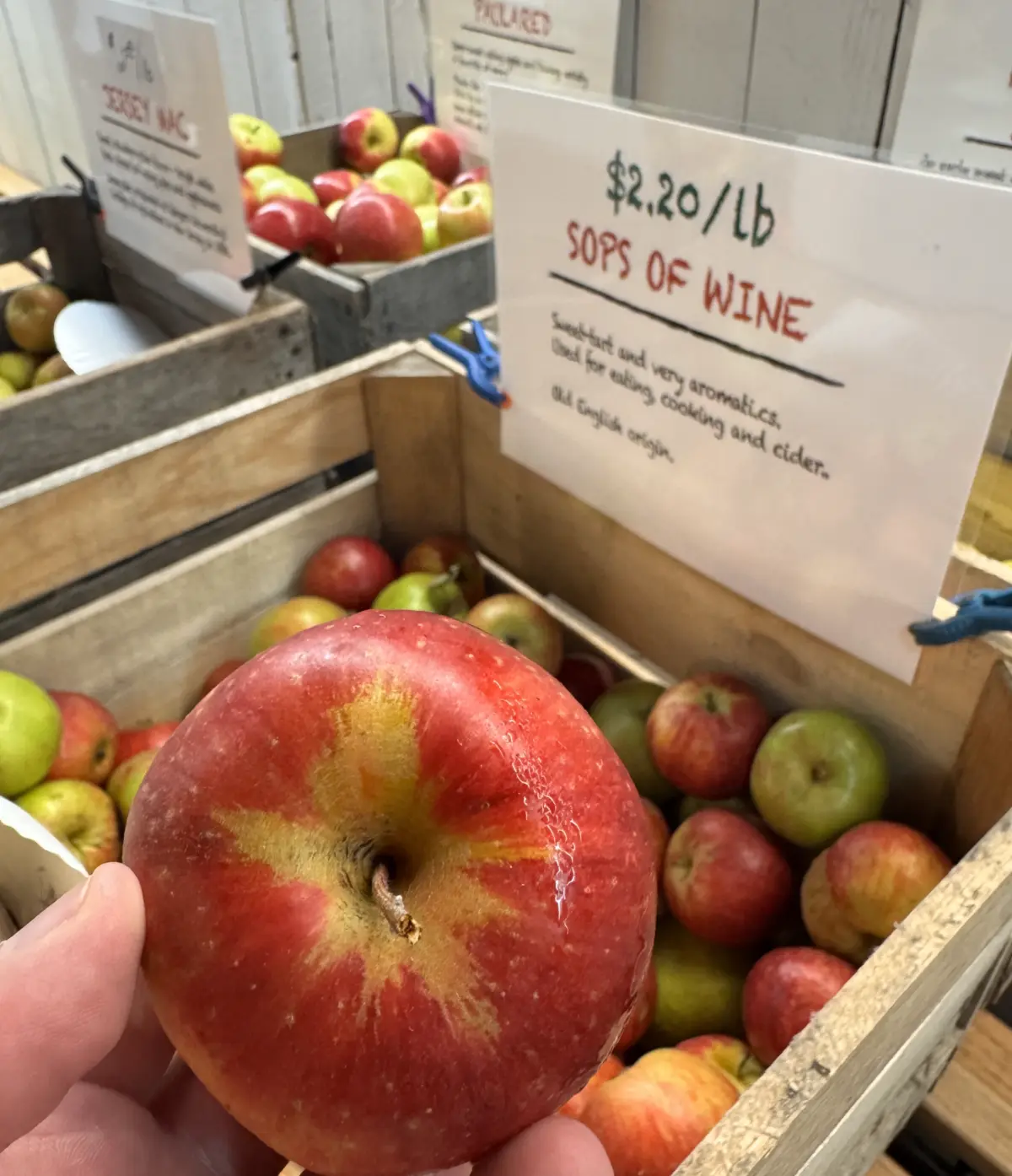
3. Sops of Wine: Texture Failure and Historical Ghosts
- Score: 3.5 / 10
- Profile: Subacid, vanilla-spice notes, compromised mealy/gritty texture, historical ambiguity.
The Sops of Wine brought psychological interference into the testing suite. Merely sighting the name triggered intrusive cinematic memories of Denethor dramatically consuming a tomato in The Lord of the Rings, complete with the phantom resonance of John Noble’s voice echoing through the tasting chamber.
Unfortunately, the physical fruit failed to live up to even cinematic standards. Having rested off the tree for a few days prior to consumption, the apple suffered from severe textural degradation, resulting in a mealy and gritty mouthfeel. While its flavor profile maintained a degree of interest—offering a subacid sweetness paired with subtle vanilla and spice notes—the structural integrity was entirely compromised. Compounding the confusion was pomological taxonomy itself: while historical texts often cite Sops of Wine as possessing striking red-stained flesh, this particular specimen offered no such drama, leading investigators to wonder if the name represents a singular cultivar or merely a generalized umbrella term for miscellaneous historical discards. It limped across the finish line with a disappointing 3.5 out of 10.
4. Fenceline Surprise: The Nadir of the Harvest
- Score: 1.0 / 10
- Profile: Bland mush, faint pear mist illusion, extreme structural failure, beach-sand finish.
If the tasting trials require a cautionary tale, look no further than the Fenceline Surprise. The only true surprise delivered by this variety was the sheer audacity of its mediocrity.

Marketed with signage labeling it a "firm apple," the specimen presented instead as an absolute disaster of bland mush. A fleeting, highly transient whisper of pear juice registered during the initial microsecond of contact before vanishing entirely, leaving evaluators with a lingering sensation akin to chewing on beach sand. Whether a victim of a perpetually grumpy harvest batch or advanced post-harvest decay, the Fenceline Surprise was a total loss. It narrowly escaped a score of absolute zero solely on the strength of its linguistic wordplay and an aesthetically pleasing exterior. Final verdict: 1 out of 10.
5. Americus Crab: The Steampunk Invader
- Score: 2.5 / 10
- Profile: Savory, hyper-tart, highly tannic, structurally impenetrable, strictly non-culinary for raw snacking.
Sifting through the wilder fringes of the orchard brought investigators face-to-face with the Americus Crab—a cultivar whose very nomenclature evokes a Victorian steampunk inventor or a silver-age comic book superhero ("America’s Crab: The Crustacean Crusader").
As a crabapple, however, it refuses to pander to casual palates. Highly savory, eye-wateringly tart, physically unyielding, and saturated with tannins, the Americus Crab is decidedly not designed for casual, out-of-hand consumption. It is an artifact of a bygone era of wild fruit—challenging, abrasive, and utterly polarizing. For the purist seeking a thrill, it rates a niche 2.5 out of 10.
6. Campfield (False?): The Puritanical Cider Relic
- Score: 4.1 / 10
- Profile: Chewy, high-tannin structure, excessive sweetness, historic provenance tracing back to early American settlers.
Labeled intriguingly as Campfield (False?), this apple arrived bearing all the hallmarks of a tricksy artifact straight out of Middle-earth. Structurally, it offered a bizarrely chewy, callused-thumb consistency. It walked a strange tightrope: overly sweet on the front end, yet aggressively heavy in tannins on the back end, creating the unsettling sensation that the fruit was attempting to consume the consumer.

However, historical records rescue the Campfield from total dismissal. Archival research links the apple to Matthew Canfield (variously spelled Campfield), an anti-royalist Puritan who fled Harleston, England, during the Great Puritan Migration of 1637. As a founding father of New Haven, Norwalk, and Newark—where he famously cultivated required orchard lands and traded in winter-fruit hard ciders—Canfield’s botanical lineage runs deep through early American history. Because this apple is fundamentally engineered for the fermentation vat rather than human jaws, it earns a respectable 4.1 out of 10.
7. Graham: The Gym-Rat Fruit of Nostalgia
- Score: 8.0 / 10
- Profile: Extreme density, glacier-breaking hardness, unadulterated Juicy Fruit gum flavor profile.
The grand finale of the testing cycle belonged to the Graham, an apple so structurally fortified it appeared to have spent its off-season in a rigorous bodybuilding regimen. Boasting an exterior density capable of deflecting ballistic projectiles, biting into a Graham required levels of mechanical force that pushed evaluators to the brink of temporomandibular joint (TMJ) strain.
When the shell finally fractured—breaking with the catastrophic energy of a calving glacier—the reward was entirely disproportionate to the effort. The interior yielded a flavor profile so astonishingly precise that investigators double-checked their notes: unadulterated, unrestrained, straight-from-the-wrapper Juicy Fruit chewing gum. This unexpected, synthetic-tasting nostalgia elevated the experience immensely, securing an 8.0 out of 10, penalizing it only slightly for the sheer dental hazard required to access it.
Supporting Context & Metrics
To contextualize the vast variance in this season’s crop, pomologists rely on a combination of tactile metrics, chemical balance (sugar-to-acid ratios), and historical lineage tracking. The 2026 data indicates a growing divergence between modern dessert apples and heritage/cider variants.

| Variety Name | Structural Integrity (1-10) | Flavor Complexity (1-10) | Primary Culinary Application | Final Audit Score |
|---|---|---|---|---|
| Kickapoo Spice | 6.0 | 7.5 | Fresh / Spice-forward | 6.9 |
| St Edmunds Pippin | 8.5 | 8.0 | Fresh / Balanced Snacking | 8.3 |
| Sops of Wine | 3.0 | 4.0 | Historical Curiosity | 3.5 |
| Fenceline Surprise | 1.0 | 1.5 | Compost / Avoid | 1.0 |
| Americus Crab | 5.0 | 2.0 | Foraging / Novelty | 2.5 |
| Campfield (False?) | 4.0 | 4.5 | Hard Cider Production | 4.1 |
| Graham | 9.0 | 8.5 | Fresh (with jaw protection) | 8.0 |
Official Statements and Industry Perspectives
While the scientific and gustatory findings speak largely for themselves, orchard keepers and historical preservationists continue to debate the categorization of anomalous heritage apples.
"We are seeing an unprecedented influx of heirloom specimens that defy standard supermarket metrics," noted an anonymous regional pomologist. "Consumers have been trained to expect uniformity—a red, shiny, moderately sweet orb with no surprises. When they encounter something like a Campfield or an Americus Crab, they experience severe cognitive dissonance. Fruit is historical, chaotic, and occasionally combative."
Furthermore, representatives from regional agricultural cooperatives emphasize that storage duration heavily dictates the survival of heritage varieties. "An apple like the Fenceline Surprise or Sops of Wine sitting on a display shelf for even forty-eight hours too long transitions rapidly from a crisp heritage marvel to a mealy tragedy. Timing is everything."
Future Outlook
As the autumn harvest shifts geographic centers, the scope of investigation must expand. With evaluators packing their bags for upcoming excursions across New York, New England, and the wider expanse of Canada, the pipeline for fresh pomological data remains robust.

Regional orchards in the northern latitudes are projected to yield exceptional late-season crops, driven by optimal temperature swings between crisp autumn nights and sun-drenched afternoons. Consumers, orchard tourists, and apple purists are officially placed on notice: travelers traversing the Northeastern United States and Canadian borderlands are strongly encouraged to bring forward their finest, strangest, and most structurally intimidating local cultivars for inspection.
The war against bland, industrialized fruit is far from over. The Apple Snack Gang marches onward.