

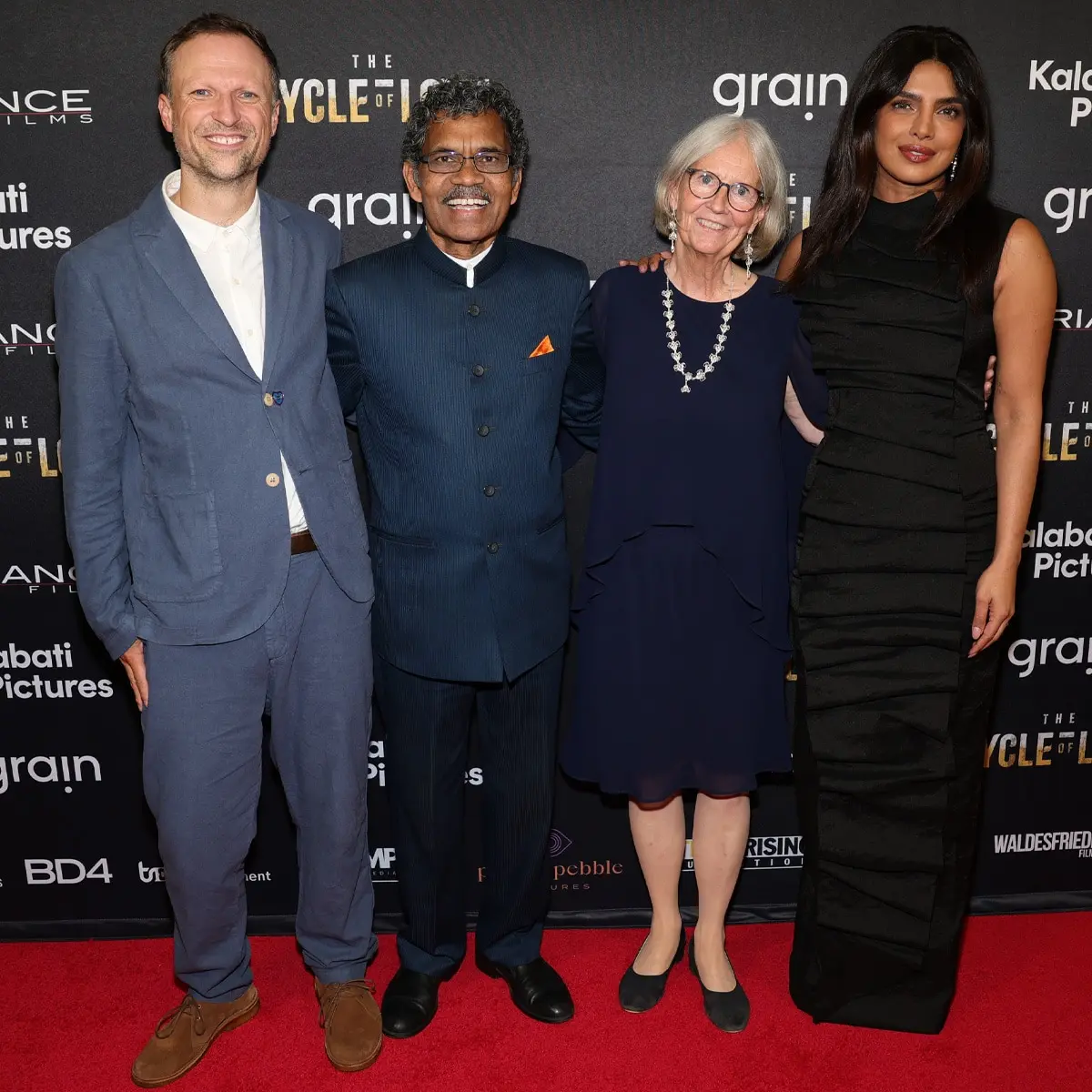
In an era saturated with algorithmic matchmaking and rapid-fire digital swiping, true tales of enduring, barrier-defying romance have become a cinematic rarity. Enter The Cycle of Love, a sweeping new documentary executive-produced by global superstar Priyanka Chopra Jonas. Based on Per J. Andersson’s acclaimed 2017 biographical book, The Amazing Story of the Man Who Cycled From India to Europe for Love, the film chronicles the astonishing true story of Pradyumna Kumar "PK" Mahanandia and Lotta Von Schedvin.
PK, an impoverished Indian street portraitist born into the lowest rung of the ancient caste system, and Lotta, a privileged Swedish art student visiting New Delhi in 1975, embarked on a romance that defied geography, socio-economic divides, and societal expectations. When circumstances forced them apart, PK did not settle for long-distance letters; instead, he sold his meager belongings, bought a second-hand ladies’ bicycle, and pedaled 6,000 miles across continents to reunite with his bride.
At the New York premiere of the documentary, Priyanka Chopra Jonas—whose own high-profile whirlwind romance and marriage to pop icon Nick Jonas captured global headlines—spoke candidly about why this narrative resonated so deeply. Describing the project as a "ray of sunlight" in a fractured world, Chopra’s involvement highlights a growing appetite for authentic human connection in modern entertainment. As The Cycle of Love transitions from the page to the silver screen, it anchors a massive cultural wave of page-to-screen adaptations hitting theaters and streaming platforms over the next few years.
Detailed Chronology: A 6,000-Mile Odyssey of the Heart
The Fateful Encounter in New Delhi (1975)
The story of PK and Lotta began in the bustling, sensory-overloaded environment of New Delhi in 1975. PK, a student at the College of Art in Delhi, was earning a modest living as a street portraitist near the city center fountain. His artistic talent had begun to turn heads, but his personal life was grounded in the harsh realities of growing up as a member of the Dalit community—historically designated as "untouchables" within India’s rigid caste system.
Lotta Von Schedvin, a Swedish student traveling through India with friends, happened upon PK’s makeshift studio and asked him to sketch her portrait. Unbeknownst to either of them at the time, this routine transaction would alter the course of their lives permanently. Struck by her presence, PK recalled a childhood prophecy made by an astrologer who told him that his future wife would be a musician born under the sign of Taurus, who owned a forest, and came from a distant foreign land. When Lotta returned the following day for a second sitting, PK boldly informed her that she was destined to be his wife.
Rather than being unnerved, Lotta was captivated. She agreed, subsequently writing home to inform her astounded parents in Sweden that she had met her life partner.
Marriage and Separation
Following their whirlwind courtship, the couple traveled to PK’s ancestral village of Kandhapada in the eastern Indian state of Odisha. There, in a traditional ceremony officiated by PK’s father, they were wed.
However, the realities of international logistics and education soon interrupted their bliss. Lotta was forced to return to Sweden to complete her studies, while PK remained in New Delhi to finish his master’s degree in fine art. Separated by thousands of miles and restricted by financial limitations, the newlyweds relied on international mail to sustain their bond. PK knew he needed to reach Sweden to be with his wife permanently, but commercial air travel was entirely out of reach for a struggling art student.
The Epic Pedaling Journey
Faced with insurmountable financial barriers, PK made a decision that sounds like the stuff of modern mythology: if he could not afford a plane ticket, he would ride a bicycle.
He purchased a used ladies’ bicycle, packed a sleeping bag, a tent, and his essential art supplies, and pointed his handlebars toward Europe. His journey was as much an internal evolution as it was a physical trial. As director Orlando Von Einsiedel noted, the cycle was representative of PK "learning to love himself so he can love others."
PK’s expedition was fraught with naive optimism and geographical ignorance. Armed with little more than his artistic talent, he relied entirely on the kindness of strangers. In a memorable anecdote from the film, PK recounts meeting a "Belgian hippie" with a map—an essential item PK had initially omitted—who gently informed him that Borås, the Swedish town where Lotta lived, was located in Sweden, not Switzerland.
"It was a bit of a blow," PK admitted, "to realize I had to go even farther than I thought."
Along the way, when visa complications barred him from cycling through certain geopolitical hotspots like Pakistan, PK experienced his very first airplane flight—a jarring technological leap for a man traversing continents primarily by leg power. Approximately four months after departing from Delhi, battered, weary, and profoundly transformed, PK pedaled into Borås.
Supporting Context & Metrics: Breaking Barriers and Building Legacies
The cultural resonance of The Cycle of Love extends far beyond its sweeping romantic premise; it serves as a profound examination of systemic inequality and cross-cultural synthesis.
Dismantling the Caste System
PK’s upbringing as a Dalit in India subjected him to institutionalized bullying and social discrimination. Yet, upon arriving in Sweden, he encountered an entirely different societal framework. Lotta, conversely, hailed from Swedish nobility; her grandfather was a prominent landowner.
"We met—East and West, he was untouchable, I was from nobility," Lotta recounted to The Telegraph. "He was ashamed of the caste system, I was ashamed to be part of the nobility—but we are a unifying force."
Raising a Cross-Cultural Family
The couple settled in Borås, where they raised two children, Karl Mahanandian Von Schedvin and Emilie Von Schedvin. Seeking to instill a balanced global perspective, PK and Lotta ensured their children understood their dual heritage. While the family frequently traveled back to India so the children could connect with PK’s homeland, they were raised with Scandinavian values.
Emilie Von Schedvin, who later wrote about the Indian caste system for her university thesis, noted the unique privilege of her upbringing: "The values we were brought up with are something we want to share, because we are so privileged to have that foundation—of seeing people for who they are and not the labels that they carry."
Karl added with a touch of humor regarding their childhood in homogeneous Swedish kindergartens: "People thought we must be adopted, because in Swedish kindergarten everyone is blond."
Official Statements & Industry Perspectives
The journey of bringing PK and Lotta’s story to the screen has drawn high-profile backing, most notably from executive producer Priyanka Chopra Jonas. Speaking at the New York premiere of the documentary on August 20, Chopra emphasized the emotional necessity of such storytelling in the modern cultural landscape.
"Everything about it is so heartwarming," Chopra told E! News, "and just makes me feel like, in a crazy world right now, it’s a ray of sunlight."
Reflecting on her own marriage to Nick Jonas—whom she wed in a lavish, three-day celebration in India in late 2018 just months after they began dating—Chopra expressed profound admiration for the longevity of PK and Lotta’s relationship, which has now spanned nearly five decades.
"They are so cute together," Chopra told the BBC at the premiere. "They hold hands, they’re affectionate. I want that after 50 years, it’s amazing."
Director Orlando Von Einsiedel underscored that the documentary is designed to challenge viewers’ perceptions of human endurance, while subjects PK and Lotta continue to view their enduring union as an active counter-narrative to global pessimism. As Lotta noted, "Every day we read what bad shape the world is in, and we see this as our message."
Future Outlook & The Adaptation Boom
The Cycle of Love made its theatrical debut at New York’s Angelika Film Center before expanding to Los Angeles and select markets. Its release is part of a massive, industry-wide wave of literary and historical adaptations heading to screens over the next few years.
As studios lean heavily into pre-established intellectual property and true-story adaptations, audiences can expect an unprecedented influx of book-to-screen projects. From high-profile cinematic epics like Christopher Nolan’s The Odyssey (slated for July 2025) and Denis Villeneuve’s sci-fi conclusion Dune: Part 3 (December 2026), to serialized television adaptations like HBO’s multi-year Harry Potter series and Netflix’s animated Midnight Sun, the entertainment ecosystem is prioritizing narratives with built-in literary footprints.
Within the romance and drama sector, adaptations of best-selling novels—ranging from Emily Henry’s Beach Read and Funny Story to Rachel Reid’s hockey romance Heated Rivalry—signal that audiences continue to crave deep emotional engagement. Yet, among these fictional escapes, documentaries like The Cycle of Love offer a grounded reminder that reality can often produce love stories far more unbelievable, and infinitely more inspiring, than fiction.