

Executive Overview
The technological zeitgeist of the early 2000s is indelibly marked by peer-to-peer file sharing, a decentralized frontier where copyright battles and rapid digital distribution collided. Among the most prominent names of that era was LimeWire—a household moniker for millions seeking decentralized media exchange. Fast-forward to the contemporary digital landscape, and the brand has undergone one of the most radical corporate and technological pivots in internet history. Today, LimeWire has re-emerged not as a client for downloading MP3s, but as a sophisticated, Web3-integrated AI content publishing platform and generative studio.
By merging the power of state-of-the-art generative artificial intelligence models—such as Stable Diffusion and DALL-E—with blockchain-based content ownership and robust monetization frameworks, LimeWire has positioned itself at the intersection of creation, distribution, and decentralized finance (DeFi). The platform addresses a persistent challenge in the modern creator economy: how artists, designers, and everyday users can generate digital assets efficiently, maintain true ownership via Non-Fungible Tokens (NFTs), and secure reliable revenue streams through ad-sharing models and native cryptocurrency tokens ($LMWR).
This investigative report examines LimeWire’s architectural transformation, its generative AI toolset, its blockchain integration strategies, its tiered pricing models, and the broader implications of its ecosystem for the future of digital art and content creation.
Detailed Chronology and Technological Evolution
To understand LimeWire’s current positioning in the generative AI market, one must analyze the trajectory that brought the platform from its controversial past to its modern iteration.
The 2000s: The P2P Pioneer
Founded in 2000 by Mark Gorton, original LimeWire software operated as a Gnutella-network-based file-sharing client written in Java. At its peak, it rivaled and often surpassed competitors like Napster and Kazaa in daily active users. However, legal battles brought by the Recording Industry Association of America (RIAA) culminated in a landmark 2010 federal court ruling that forced the shutdown of the original software due to widespread copyright infringement liabilities. For over a decade, the brand lay dormant, remembered primarily as a relic of early internet culture.
The Rebirth: Transition to Web3 and Digital Collectibles
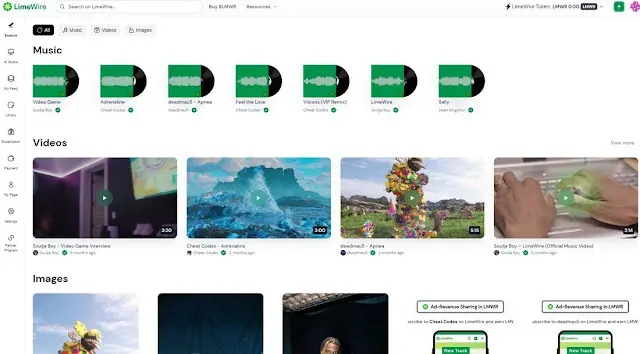
In 2022, serial entrepreneurs Julian and Paul Zehetmayr acquired the LimeWire brand rights with a vision entirely divorced from peer-to-peer file sharing. Rather than resurrecting the legal grey areas of file distribution, the new leadership sought to leverage the brand’s immense global recognition to build a legitimate, creator-first digital marketplace. Initially launched as a marketplace for digital collectibles and music NFTs—attracting high-profile endorsements and content from mainstream artists like Deadmau5, Soulja Boy, and Sean Kingston—the platform quickly recognized the shifting tides of technology.
Integration of Generative AI
By 2023, the democratization of artificial intelligence tools catalyzed a structural evolution within LimeWire Studio. Recognizing that content consumption must be preceded by content creation, the platform integrated sophisticated generative AI models. This transformation shifted LimeWire from a passive marketplace into an active creation suite. Users could now prompt, render, mint, and monetize digital assets natively within a single ecosystem. Today, the platform operates as a hybrid generative AI engine and Web3 publishing network, continually expanding its technological capabilities from static imagery toward multimodal media generation.
Supporting Context, Architecture, and Metrics
LimeWire’s current technological stack and economic framework are built on a dual foundation: centralized, high-performance cloud-based AI rendering, and decentralized, blockchain-backed asset verification.
The Generative AI Studio Architecture
At the core of LimeWire’s creation suite is its AI Studio, which interfaces with industry-standard and advanced generative algorithms, including:
- Stable Diffusion (Versions 2.1 and XL): Allowing users to render highly detailed, photorealistic, or stylized images using natural language prompts.
- DALL-E 2: Offering conceptual versatility and rapid prompt-to-image translation.
- Proprietary Models: LimeWire’s ongoing research and development division is actively training bespoke AI models tailored specifically to the stylistic demands of its user base.
The interface is engineered to bridge the gap between amateur enthusiasts and professional digital artists. Users input textual prompts ranging from brief descriptive keywords to complex, parameter-heavy instructions. Furthermore, the platform incorporates style-switching matrices that allow creators to instantaneously pivot between aesthetic frameworks—such as cinematic, digital art, pixel art, anime, and analog film—without altering their foundational prompt structure. Samplers and prompt-guidance settings give advanced creators granular control over iterations, aspect ratios, and detail enhancement.
Blockchain Infrastructure and Automated Minting
What fundamentally separates LimeWire from traditional AI generation tools like Midjourney or OpenAI’s ChatGPT is its native integration with blockchain technology. Once an image, graphic, or multimedia file is generated and finalized within the studio, the creator is presented with the option to publish.
Upon publication, LimeWire automatically initiates a smart contract execution, minting the creation as a Non-Fungible Token (NFT) on either the Polygon or Algorand blockchain. This automated minting process imbues the digital asset with an immutable cryptographic signature, establishing verified provenance and permanent ownership records.
Creators retain absolute autonomy over the distribution parameters of their minted assets:
- Public Discovery: Creators can list their AI-generated art publicly, making it searchable across the LimeWire community. This fosters organic engagement, community-driven discovery, and secondary market trading.
- Subscriber-Only Exclusivity: Creators can gate their content, restricting access exclusively to premium subscribers, thereby fostering an intimate patronage model similar to platforms like Patreon, but augmented by digital ownership.
The Economic Engine: Ad Revenue Sharing and $LMWR Tokens
LimeWire has engineered a multi-tiered monetization structure designed to financially reward active participants within its ecosystem. The financial framework rests on two primary pillars: ad-revenue distribution and the platform’s native utility token, $LMWR.
- Ad-Revenue Share: When creators publish content that is viewed by other users on the platform, LimeWire redistributes up to 70% of the associated ad revenue directly back to the creator. This creates a passive income stream for designers and digital artists who simply share their generated outputs publicly.
- $LMWR Token Economics: Earnings are distributed monthly in $LMWR, LimeWire’s native cryptocurrency. These tokens are fully liquid and traded on major centralized and decentralized exchanges, including Kraken, ByBit, and Uniswap. Beyond cashing out earnings, users utilize $LMWR tokens as an internal currency to purchase additional AI generation credits and prompt tokens across the platform.
- Secondary Market Royalties: When collectors trade AI-generated NFTs within the LimeWire community, original creators automatically earn a baseline 2.5% royalty on secondary sales, establishing a perpetual revenue loop for popular digital artists.
Platform Subscription Tiers
To accommodate varying user needs—from casual hobbyists to high-volume professional digital agencies—LimeWire employs a structured credit and subscription model:
- Free Tier:
- Cost: $0/month
- Credits: 10 complimentary credits upon signup (permitting up to approximately 20 image generations per day).
- Ad Revenue Share: 50%.
- Standard Tier:
- Cost: $9.99/month
- Credits: 1,000 credits per month (up to 2,000 image generations).
- Perks: Early access to new AI models, 50% ad revenue share, Pro profile badge, full creation history, faster processing speeds, and an ad-free interface.
- Advanced Tier:
- Cost: $29/month
- Credits: 3,750 credits per month (up to 7,500 image generations).
- Perks: 60% ad revenue share, early model access, Pro profile, and priority rendering queues.
- Pro Tier:
- Cost: $49/month
- Credits: 5,000 credits per month (up to 10,000 image generations).
- Perks: 70% ad revenue share, Pro profile badge, and unthrottled processing priority.
- Elite/Enterprise Tier:
- Cost: $99/month
- Credits: 11,250 credits per month (up to 22,500 image generations).
- Perks: Maximum 70% ad revenue share, comprehensive creation history, dedicated server allocation, and VIP creator status.
Official Statements and Industry Perspective
The strategic evolution of LimeWire reflects a broader industry movement toward empowering individual creators through decentralized technologies. In corporate disclosures and interviews surrounding the platform’s relaunch, leadership has consistently emphasized the democratization of creative tools.
"Our mission is to tear down the technical and financial barriers that have traditionally separated creative vision from commercial viability," platform representatives have noted. "By combining the limitless potential of generative AI with the verifiable ownership models of Web3, we are not just building another image generator—we are constructing an entire economy where creators own their labor, monetize their art seamlessly, and build direct, unmediated relationships with their audiences."
Industry analysts point out that LimeWire’s strategy effectively solves the "monetization vacuum" plaguing many standalone AI tools. While platforms like OpenAI and Midjourney provide extraordinary creative capabilities, they primarily operate as closed-loop utility software where users must export files and seek monetization elsewhere. LimeWire integrates creation, verification, distribution, and monetization into a single verticalized pipeline, offering a compelling alternative for digital creators seeking friction-free commercialization.
Future Outlook
As the generative AI landscape matures, LimeWire’s roadmap indicates an aggressive expansion beyond its current foundational capabilities. While image generation remains the primary anchor of the LimeWire AI Studio, the platform has announced definitive plans to roll out multimodal creation tools, specifically targeting AI music generation and AI video synthesis.
Given the platform’s early success in attracting mainstream musical artists like Soulja Boy and Deadmau5, the introduction of native AI music and video tools could catalyze a significant shift in how digital media is produced, licensed, and consumed. The integration of audio and video generation into the existing $LMWR token economy and automated NFT minting pipeline will likely attract a new wave of filmmakers, musicians, and digital producers to the ecosystem.
Conclusion
LimeWire’s transformation from a controversial 2000s peer-to-peer file-sharing network into a cutting-edge generative AI and Web3 publishing platform is a testament to adaptive corporate reinvention. By successfully merging advanced machine learning models like Stable Diffusion with blockchain-backed asset ownership, ad-revenue sharing, and the $LMWR cryptocurrency token, LimeWire has established a comprehensive framework for the modern creator economy.
For digital artists, designers, and multimedia producers looking to experiment with generative art while retaining true ownership and securing tangible revenue streams, LimeWire offers a uniquely robust, accessible, and forward-looking ecosystem. As the platform prepares to introduce upcoming music and video generation suites, its role as a democratizing force in digital media creation is poised to expand even further.