

Frontend Complexity: When Native Features Create System-Wide Friction
Executive Overview
For years, the narrative surrounding modern CSS has been overwhelmingly triumphant. With the advent of native nesting, CSS container queries, the :has() relational pseudo-class, and advanced cascade layers, developers have been handed tools that make writing complex reactive layouts infinitely more elegant. Replacing 50 lines of JavaScript with a handful of clean, declarative CSS rules feels like an unmitigated victory. A pull request that leaves a diff looking predominantly red is routinely praised by peers, merged before lunch, and celebrated as a textbook example of codebase hygiene.
However, a dangerous illusion often accompanies these sweeping optimizations. While a modern CSS feature can drastically simplify a localized snippet of code, it can simultaneously introduce subtle, compounding complexities into the wider application. When conditional logic is quietly shifted from JavaScript into stylesheets, or when advanced formatting contexts interact with legacy components, the global system becomes significantly harder to reason about.
Gabriel Shoyombo, in his ongoing exploration of browser evolution and frontend architecture, addresses a critical blind spot in modern web development: What happens when logic is split between CSS and JavaScript, and how do we debug conditional styles without a clear view of what triggered them? This investigation explores the hidden friction of refactoring, analyzing how local simplicity frequently masks system-wide complexity, and providing a practical blueprint for managing migrations safely.
Detailed Chronology: The Anatomy of a Modern Refactoring Pitfall
To understand how localized CSS improvements can destabilize a frontend architecture, it is helpful to trace a typical migration lifecycle. Consider a common pattern: transforming a JavaScript-driven ResizeObserver component into a sleek, native container query.
The Before-State: Explicit JavaScript Ownership
In the original implementation, a dashboard card relies on a JavaScript ResizeObserver to evaluate its own width and toggle a modifier class (.card--wide):
const card = document.querySelector('.card');

new ResizeObserver(([entry]) =>
  card.classList.toggle('card--wide', entry.contentRect.width > 480);
).observe(card);
Paired with this script, the CSS explicitly dictates the layout and typography changes triggered by that class:
.card--wide .card__body
  display: grid;
  grid-template-columns: 160px 1fr;


.card--wide .card__title
  font-size: 1.5rem;
The Refactor: Introducing Container Queries
Developers identify this pattern as an ideal candidate for modernization. By adopting CSS Container Queries, the JavaScript script is deleted entirely, and the styles are rewritten natively:
.card
  container-type: inline-size;


@container (width > 480px)
  .card__body
    display: grid;
    grid-template-columns: 160px 1fr;
On paper, this is a masterpiece of modern engineering. Yet, migrations in real-world enterprise applications rarely happen in a single, atomic sweep.
The Aftermath: Dual-Owner Decay
A week after merging the pull request, silent bugs emerge. A heading on a tablet-sized viewport has grown unexpectedly; a dashboard card has vanished entirely; comment spacing is inexplicably misaligned. None of these visual defects exist in the newly written container query rules. Instead, they arise from orphaned code left behind by the migration:

- The Surviving Observer: Because the
ResizeObserverwas registered in a separate, decoupled utility file, it survives the pull request. - The Forgotten Selector: The
.card--wide .card__titlerule remains in a global stylesheet because no one cross-referenced the class name globally. - The Unsynced Breakpoint: A designer requests a breakpoint adjustment, prompting a developer to update the new
@containerrule to600px, completely unaware that the old JavaScript observer is still toggling classes at480px.
Between 480px and 600px, the application enters an unwritten, unintended intermediate state: the card displays a single-column body alongside an oversized title. Finding this bug requires investigating multiple decoupled layers across both JavaScript and CSS.
Supporting Context & Metrics: The Four Scenarios of Architectural Friction
Shoyombo categorizes these systemic failures into distinct behavioral scenarios, mirroring the dynamics of roommates sharing a crowded apartment. Each scenario demonstrates how an isolated modern CSS feature disrupts existing system rules.
Scenario 1: The Behavior with Two Owners
As demonstrated above, when JavaScript and CSS share ownership over a component’s responsive state, synchronization inevitably breaks down. A native feature only reduces complexity when it completely replaces its predecessor and does not disrupt the baseline equilibrium of neighboring elements.
Scenario 2: The Roommate Who Rearranges the Room (Block Formatting Contexts)
When developers declare container-type: inline-size, their intent is localized: they want child elements to query the container’s width. However, according to specification standards outlined by the MDN Web Docs, this single declaration applies both style and inline-size containment, automatically establishing a new block formatting context (BFC).
This innocent declaration fundamentally alters three core layout behaviors completely unrelated to container queries:
- Margins Stop Collapsing: Margins that previously bled through the element’s boundaries now remain strictly trapped inside, compounding padding and spacing calculations across parent-child structures.
- Floats Push Elements Aside: Elements that previously ran beneath floated images are forcibly pushed into restricted grid columns, altering document flow.
- Content-Sized Cards Collapse: Elements whose dimensions rely entirely on their contents (such as flex items, inline-block elements, or boxes set to
width: fit-content) collapse instantly to0pxwidth when inline-size containment is applied without an explicit contextual size.
Scenario 3: The Loud Housemate (The CSS Cascade and Specificity)
Modern tools like the :has() pseudo-class and native CSS nesting enable incredibly concise selectors. However, brevity frequently breeds unintended reach.
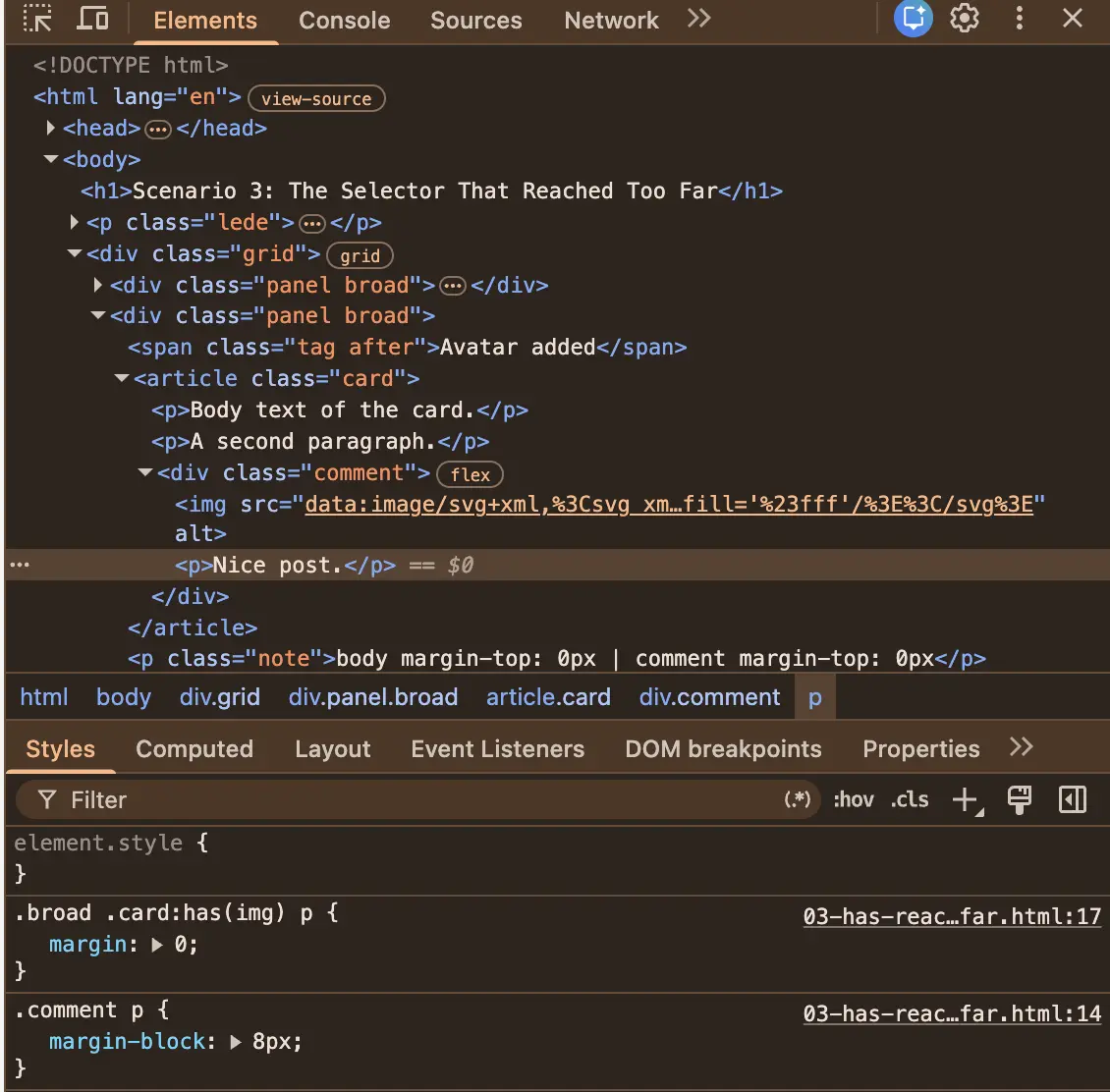
Consider a rule designed to remove paragraph margins inside cards featuring a hero image:
.card:has(img) p
  margin: 0;
If a complex component tree houses a nested comment section containing its own styling rules (.comment p margin-block: 8px; ), a card without an image will still inadvertently suppress paragraph spacing if a user dynamically injects an avatar elsewhere in the component tree at runtime. Furthermore, native nesting borrows specificity via the & selector using the behavior of :is(), inadvertently elevating low-weight selectors into cascading priority wars against global class rules.
Scenario 4: The Housemate Slow to Pay Rent (Performance and Rendering Costs)
A pervasive myth in frontend optimization is that shifting logic from JavaScript to CSS guarantees execution speed improvements. While CSS avoids the overhead of manual DOM script parsing, it hands raw computational burdens directly to the browser’s rendering engine.
To quantify this, performance benchmarks comparing JavaScript class toggles against deep selector chains utilizing :has() reveal critical performance bottlenecks. While a single :has() selector anchored safely to a component root incurs a negligible performance penalty (roughly 1.5ms), combining multiple structural selectors across extensive lists creates compound layout thrashing.

In a benchmark test evaluating a 5,000-row data grid, interacting :has() rules forced the browser to restyle all 5,001 elements simultaneously on a single class toggle—incurring a rendering cost of over 30ms on constrained hardware, nearly missing the 16.7ms frame budget required for smooth 60Hz scrolling.
Official Statements and Industry Perspectives
The tensions highlighted by Shoyombo reflect a broader, ongoing debate within the frontend community regarding accidental versus essential complexity.
In April 2026, developer Igor Roztropiński published a widely discussed essay titled "Modern Frontend Complexity: essential or accidental?", prompting intense industry reflection across developer platforms such as Reddit. Commenting on the recurring trend of minimalism in frontend engineering, a prominent community member noted:
"All these articles are like ‘We can do it with less!’ but then they don’t do it with less. They just do less."
Conversely, counter-arguments emphasize the transformative power of modern native browser capabilities over heavy JavaScript abstractions. As another prominent developer observed:
"There are tons of scenarios where a front-end framework introduces more accidental complexity than it’s worth… I don’t even need to go into how massively CSS has improved interactivity over the recent years, but hey nobody cares about anything apart from JS anymore."
This dichotomy underscores the core thesis of Shoyombo’s research: Greenfield experimentation encourages ideal architectural assumptions, whereas real-world engineering requires managing legacy migrations. Most documentation and feature announcements are authored from a greenfield perspective, yet nearly all enterprise engineering involves continuous, messy migrations across legacy codebases.
Future Outlook: Managing Complexity in the Age of Smart CSS
As CSS continues to evolve into an intelligent, reactive language capable of handling complex state evaluations natively, architectural discipline must evolve in parallel. Refactoring away JavaScript is a worthy goal, but it must never be treated as a purely subtractive exercise.
When planning a migration involving modern CSS features, engineering teams must adopt rigorous auditing protocols. Before merging a pull request that replaces scripts with declarative styles, developers should explicitly answer a comprehensive set of diagnostic questions:
- Complete Removal: Have all associated JavaScript event listeners, utility classes, and deprecated selectors been completely purged from the codebase?
- Containment Impact: Does the introduction of container queries or style containment inadvertently alter block formatting contexts, margins, or flex/grid item behaviors for neighboring elements?
- Cascade Reach: Do concise selectors utilizing
:has()or native nesting reach beyond their intended component boundaries to override unrelated legacy styles? - Specificity Weight: Does nested selector specificity inadvertently clash with existing design system architecture or unlayered global styles?
- Rendering Cost: Have performance traces been recorded to ensure complex relational selectors do not trigger massive document-wide style recalculations across large data sets?
- System-Wide Cohesion: Have all components interacting with the modified element been tested across various responsive viewports and dynamic runtime states?
Modern CSS is an extraordinary triumph of web standards, granting developers unprecedented expressive power. However, simplicity at the local level does not automatically translate to simplicity at the system level. By treating CSS and JavaScript not as competing alternatives, but as interconnected roommates sharing a single rendering ecosystem, teams can harness the full power of modern features without sacrificing application stability.
