

Executive Overview
Deep within the hyper-arid expanses of Peru’s Pisco Formation lies a geological archive that has long captivated the paleobiological community. Among the fossilized remains of ancient leviathans, sharks, and marine sloths, scientists recently unspooled a biological anomaly that redefines our understanding of mammalian morphology. Meet Scaphokogia huachafo, an extinct pygmy sperm whale that lived approximately 6 million years during the Late Miocene.
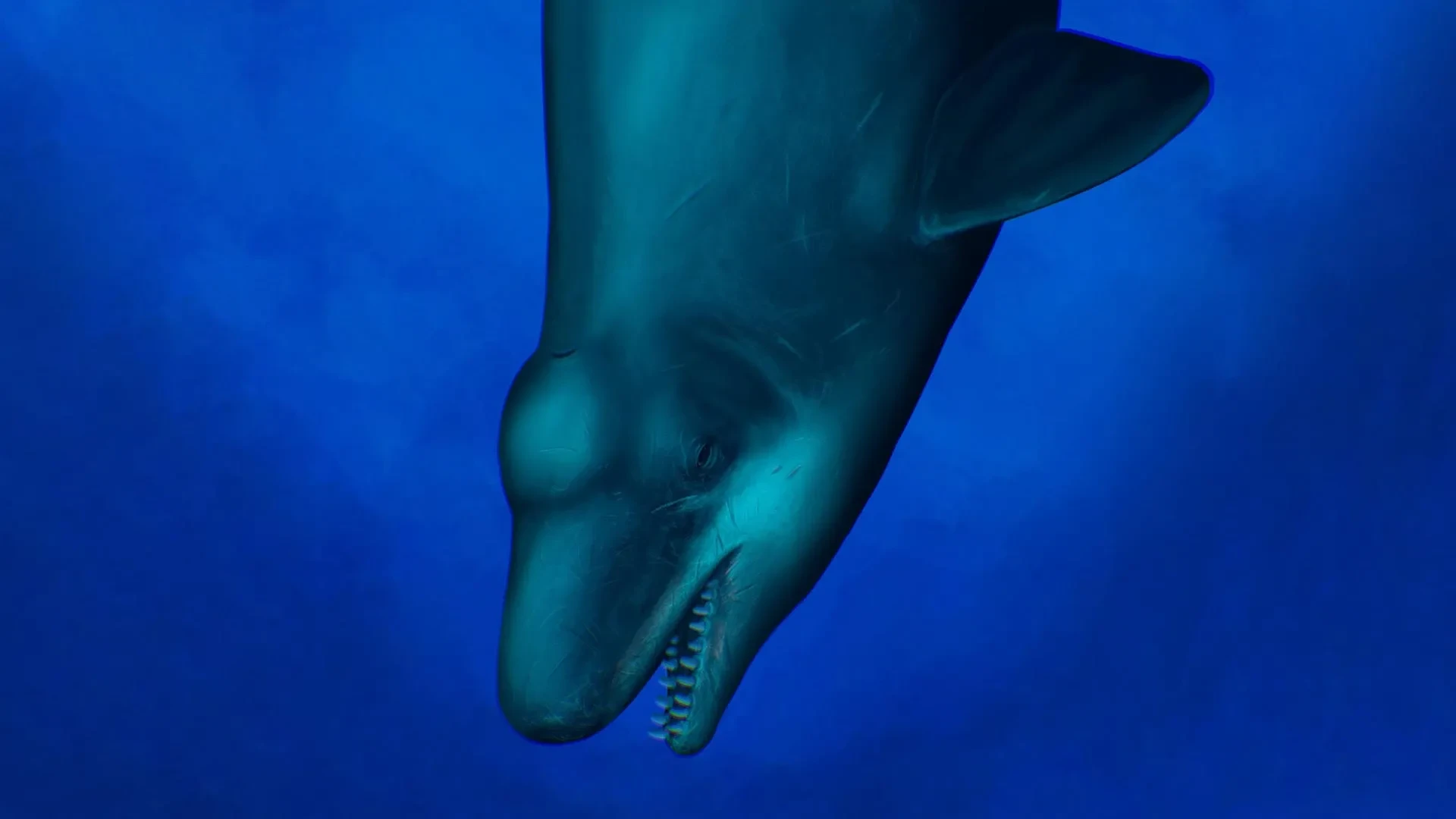
Possessing a skull so remarkably and violently skewed that it initially confounded investigators, this 2.7-meter cetacean showcases what is now widely considered the most extreme facial asymmetry ever documented in a mammal. Far from being the byproduct of post-mortem geological distortion or structural pathology, the creature’s crooked anatomy was entirely natural—an evolutionary masterpiece forged to conquer a specialized and vanished ecological niche.
While modern toothed whales—such as sperm whales and orcas—are well known for cranial asymmetry, which accommodates the complex fatty organs required for echolocation, Scaphokogia huachafo took this biological quirk to an unprecedented extreme. Both of its bony nostrils migrated entirely to the left side of its skull, while its facial bones grew in profoundly disparate sizes and orientations. Its oversized, downward-curving snout and bizarre proportions defied every established convention of mammalian symmetry.
So outlandish was the creature’s appearance that researchers opted to enshrine its whimsical extravagance in its scientific name, drawing from the Peruvian Spanish colloquialism huachafo, used to describe things excessively flashy, bizarre, or flamboyant. This comprehensive report explores the discovery, anatomical mechanics, ecological strategies, and scientific implications of one of evolution’s most fascinating biological experiments.
Detailed Chronology: From the Pisco Desert to the University of Zurich
The journey of Scaphokogia huachafo from an obscure fossilized fragment to a landmark evolutionary discovery spans nearly three decades of fieldwork, institutional analysis, and meticulous anatomical reconstruction.
Mid-1990s: Discovery in the Pisco Desert
The specimen was originally recovered during the mid-1990s by paleontological field teams operating in the Pisco Formation of southern Peru. Renowned globally for its exceptional preservation of Miocene marine vertebrates—owing to rapid burial rates and anoxic sediment conditions—the site routinely yields three-dimensionally intact skeletons. When the cranium of the unusual pygmy sperm whale was extracted, its jagged, thoroughly lopsided profile immediately set it apart from standard cetacean finds. However, due to the sheer extremity of its distortion, the fossil was initially sidelined, viewed by many as an intractable puzzle of taphonomic damage.
2015: The Undergraduate Breakthrough
The specimen remained largely unexamined until 2015, when Aldo Benites-Palomino, then an undergraduate researcher at the Museo de Historia Natural in Lima, encountered the skull while preparing his Bachelor’s thesis. Working under the guidance of seasoned paleontologists, Benites-Palomino was struck by the dramatic, almost cartoonish asymmetry of the cranium. The foundational question of his initial investigation was deceptively simple: Had the skull genuinely evolved this shape, or was it merely a casualty of tectonic flattening and sediment compaction over millions of years?
Late 2010s to Early 2020s: Rigorous Taphonomic and Anatomical Analysis
To answer this critical question, Benites-Palomino—subsequently transitioning to doctoral research at the University of Zurich’s Department of Paleontology—embarked on a multi-year collaborative study alongside international experts, including co-author and doctoral advisor Gabriel Aguirre-Fernández.
The research team subjected the fossil to rigorous micro-morphological inspections. They analyzed the cranial sutures, checking for signs of stress fractures, micro-faults, or crushing indicative of tectonic displacement. To their astonishment, every suture was fully closed and fused, free of any pathological warping. The bone density and structural integrity confirmed that the skull’s eccentric shape was entirely biological.
Present Day: Formal Classification and Naming
Following exhaustive comparative analyses with both extant and extinct odontocetes, the team officially described the animal as a new species: Scaphokogia huachafo. Now serving as an assistant professor at Friedrich-Alexander-Universität Erlangen-Nürnberg (FAU), Benites-Palomino continues to champion the find as a prime example of evolutionary extremes. The formal publication of the discovery has shifted the paleontological consensus regarding the functional limits of mammalian cranial development.
Supporting Context & Metrics: Anatomy, Ecology, and Evolution
To fully appreciate the significance of Scaphokogia huachafo, one must examine the specific anatomical adaptations that allowed it to thrive during the Late Miocene, roughly 6.3 to 5.6 million years ago.
The Mechanics of Extreme Asymmetry
In typical vertebrates, bilateral symmetry is the rule, ensuring balanced locomotion and sensory processing. Yet, cetaceans—specifically odontocetes (toothed whales)—pioneered cranial asymmetry to optimize their biosonar apparatus. The melon, a fatty organ in the forehead used for echolocation, requires specialized asymmetry in the underlying nasal passages and facial bones to channel and modulate sound waves.
Scaphokogia huachafo, however, discarded the baseline template entirely:
- Nasal Migration: Both bony nostrils are shifted completely to the left side of the cranium, abandoning even the transitional symmetry seen in modern relatives.
- Facial Bone Disparity: The bones comprising the upper jaw and forehead differ drastically in both size and spatial positioning on opposing sides of the midline.
- The Snout: The animal possessed an oversized, tube-shaped snout strengthened by dense, hyper-mineralized bone and ossified cartilage.
Quantitative Metrics of the Specimen
- Geological Age: Late Miocene epoch, spanning between 6.3 and 5.6 million years ago.
- Estimated Body Length: Approximately 2.7 meters (8.8 feet), aligning it with the size class of modern pygmy sperm whales (Kogia breviceps).
- Snout Deflection Angle: The rostrum points downward at a striking 31-degree angle relative to the horizontal axis of the cranium.
- Cervical Flexion: Reconstruction of the joint connecting the skull to the first neck vertebra (the atlas) indicates the animal could pivot its head downward by an astonishing 55 degrees.
A Specialized Benthic Hunter
While modern sperm whales are pelagic hunters diving into abyssal trenches to capture squids with acoustic precision, Scaphokogia huachafo pursued an entirely different lifestyle. Its anatomy points unambiguously toward benthic (seafloor) foraging in shallow coastal waters.
The heavy, tube-shaped snout acted as a natural biomechanical ballast, shifting the animal’s center of gravity forward and downward. Combined with its hyper-flexible neck articulation, this architecture allowed the whale to cruise horizontally just above the sediment layer, orienting its facial apparatus directly downward toward the seafloor.
Lacking the sensitive facial vibrissae (whiskers) or specialized visual systems typically used by bottom-dwelling marine mammals, Scaphokogia likely relied on its hyper-specialized, asymmetrical echolocation array. Its biological sonar was fine-tuned to ping through soft coastal sediments, detecting buried invertebrates or burrowing fish hidden out of sight.
Official Statements and Expert Insights
The bizarre nature of the discovery has generated profound commentary from the researchers who decoded its secrets.
"Cranial asymmetry in toothed whales is directly linked to the development of fatty structures in the forehead that are involved in sound production. But in Scaphokogia huachafo, this asymmetry went far beyond the area around the blowhole. Both bony nostrils are shifted entirely to the left side of the skull, while the facial bones differ dramatically in size and position. The skull looks completely crooked."
— Aldo Benites-Palomino, Lead Author and Assistant Professor at FAU
The choice of the species epithet huachafo reflects both the scientific awe and cultural appreciation the team held for the specimen.
"In Peru, huachafo is an everyday word for anything that is flashy, over-the-top, bizarre, extravagant or difficult to categorize aesthetically. When we looked at the proportions of this whale—with its face strongly shifted to the left and its oversized, downward-curving snout—it broke every rule of symmetry and elegance seen in living cetaceans. Its anatomy is so extravagant and odd that huachafo seemed the perfect name for it."
— Aldo Benites-Palomino
Addressing the initial skepticism surrounding the fossil’s preservation, Benites-Palomino elaborates on the painstaking verification process:
"The initial suspicion with skulls this distorted is always taphonomy—that the specimen may have been flattened or twisted by sediment pressure over millions of years. But the sutures are fully closed, and there are no fractures, pathologies or deformations elsewhere on the skull. This was genuine biology, not a result of poor preservation."
The functional implications of this unique biological architecture are further clarified by co-author Gabriel Aguirre-Fernández:
"The entire cranio-cervical complex is modified to point the snout directly toward the bottom. The combination of dense bone, the downward-curving snout and the flexible neck articulation allowed the animal to move directly above the seabed and feed close to the sediment."
— Gabriel Aguirre-Fernández, Co-Author and Doctoral Advisor at the University of Zurich
Future Outlook: Unlocking the Mysteries of Miocene Marine Ecosystems
The formal description of Scaphokogia huachafo opens new avenues of inquiry in evolutionary biology, paleoecology, and functional morphology. As researchers continue to comb through the rich sedimentary layers of the Pisco Formation and other Miocene deposits worldwide, several key questions remain on the horizon.
1. Broadening the Scope of Cetacean Evolution
The discovery forces evolutionary biologists to re-evaluate the plasticity of mammalian skulls. If a mammal could evolve a cranium this asymmetrical and remain an efficient, viable predator, it suggests that developmental pathways in cetaceans possess a far greater degree of freedom than previously modeled. Future developmental biology studies may look at the genetic switches governing cranial neural crest cells in modern odontocetes to understand how such extreme leftward shifts were genetically coordinated.
2. Reconstructing Miocene Coastal Communities
The niche occupied by Scaphokogia huachafo—benthic, echolocating coastal foraging—represents an evolutionary strategy that has no direct modern analog. As global ocean temperatures, current systems, and polar ice caps shifted toward the end of the Miocene, the shallow marine ecosystems of the eastern Pacific underwent massive restructuring. Understanding the extinction drivers of Scaphokogia will provide valuable context regarding how marine mammal communities respond to profound climatic and ecological shifts.
3. Advanced Digital Modeling and Biomechanical Simulations
While current osteological analyses have mapped the range of motion and static load-bearing capabilities of the skull, researchers are now turning to advanced computational tools. Future phases of this research will likely involve Finite Element Analysis (FEA) and Computational Fluid Dynamics (CFD). By digitally reconstructing the soft tissues, melon structure, and hydrodynamic profile of Scaphokogia huachafo, scientists hope to simulate how the animal produced sound waves and hunted along the prehistoric seafloor.
Ultimately, Scaphokogia huachafo stands as a testament to the boundless creativity of natural selection. In a natural world that frequently rewards streamlined symmetry, this crooked-faced Miocene pioneer proves that sometimes, the road less traveled—or in this case, violently skewed to the left—is the ultimate key to survival.
