In the fast-moving world of Consumer Packaged Goods (CPG), the graveyard of startups is littered with ambitious companies that scaled too fast, miscalculated unit economics, or fell victim to the siren song of premature mass-retail distribution. For Hero Bread—a low-carb, zero-sugar bakery innovator founded by Cole Glass in 2019—the path to market dominance was anything but a straight line.
Facing an existential crisis in 2022 due to unsustainable early partnerships and depleted capital reserves, the company executed a masterclass in strategic pivoting. Under the stewardship of YuChiang Cheng—who initially stepped in as interim Chief Marketing Officer on behalf of 444 Capital before ascending to the chief executive role in November 2023—Hero Bread pulled back from high-profile operational overreaches, doubled down on a hybrid direct-to-consumer (DTC) and multi-retailer model, and redefined the operational playbook for functional food startups.
Today, Hero Bread stands as a shining example of modern CPG resilience. Generating $54 million in annual revenue, boasting a retail footprint spanning over 10,000 doors (including major nationwide partners like Target), and backed by a war chest of over $68.5 million in total funding—including a rapid $21 million funding round secured in under 90 days in mid-2024—the brand has transformed from a financially strained upstart into a culinary staple.
This is the definitive account of Hero Bread’s evolution, exploring the hard-learned lessons of its early missteps, the strategic genius of its DTC-first revival, and the visionary leadership required to survive and thrive in a hyper-competitive market.
Detailed Chronology: From Allergy-Driven Inception to Operational Overhaul
Chapter 1: The Genesis and the Subway Stumble (2019–2022)
The story of Hero Bread begins not in a corporate boardroom, but out of personal necessity. In 2019, founder Cole Glass conceptualized the brand to combat severe food allergies triggered by pollen, which severely restricted his dietary intake—particularly when it came to traditional, gluten- and carbohydrate-heavy baked goods. Glass envisioned a future where bread could be functional, macro-friendly, and indistinguishable in taste and texture from traditional artisan loaves, yet entirely devoid of net carbs and sugar.
As the product formulation took shape, the race for scale began. By October 2021, Hero Bread secured what appeared to be a golden ticket: a landmark partnership with fast-food giant Subway. The logic was straightforward: align with a global powerhouse to place Hero’s innovative, low-carb bread options directly into the hands of millions of consumers nationwide, driving instant brand awareness and trial.
However, the reality of execution quickly clashed with corporate theory. For an early-stage startup, servicing a behemoth like Subway required an intricate logistical and financial infrastructure that Hero Bread simply did not possess at the time.
"We were just too small at the time and couldn’t service it, didn’t have the resources and all the infrastructure put in place to effectively deliver that," reflects YuChiang Cheng. "So we backed out of it."
The Subway partnership, while invaluable for initial exposure, proved economically unsustainable. Unit economics cratered under the weight of operational friction, and the company found itself rapidly burning through its capital reserves. Hero Bread was standing at a dangerous crossroads.
Chapter 2: The Emergency Pivot and the DTC Renaissance (2022–2023)
In 2022, YuChiang Cheng entered the picture as an investor representing 444 Capital, quickly transitioning into the role of interim Chief Marketing Officer to help staunch the bleeding. Recognizing that mass retail was burning cash before the brand had built proper supply chain maturity, Cheng engineered an aggressive strategic shift.
Hero Bread pivoted away from sprawling, capital-intensive B2B partnerships and leaned heavily into a Direct-to-Consumer (DTC) model via its proprietary e-commerce platform (hero.co). This tactical retreat was designed with a dual purpose:
Direct Customer Feedback Loop: Selling directly to consumers allowed the product and marketing teams to harvest real-time data, preferences, and critiques without the filter of traditional retail gatekeepers.
Organic Word-of-Mouth Engine: Cultivating an elite community of dedicated brand advocates who could authentically evangelize the product’s unique value proposition across digital channels.
This foundational stabilization laid the groundwork for Cheng’s official appointment as Chief Executive Officer in November 2023. Armed with a clearer operational roadmap, Cheng began steering the company toward its next evolutionary phase: a calculated, measured return to brick-and-mortar retail, backed by proven demand metrics from its DTC ecosystem.
Supporting Context & Metrics: Scaling Smart in a Saturated Market
Hero Bread’s subsequent resurgence is best understood through the lens of hard data and disciplined execution. Rather than relying on guesswork, the leadership team built an analytical framework that governed every product launch and retail expansion.
The Power of Core SKUs
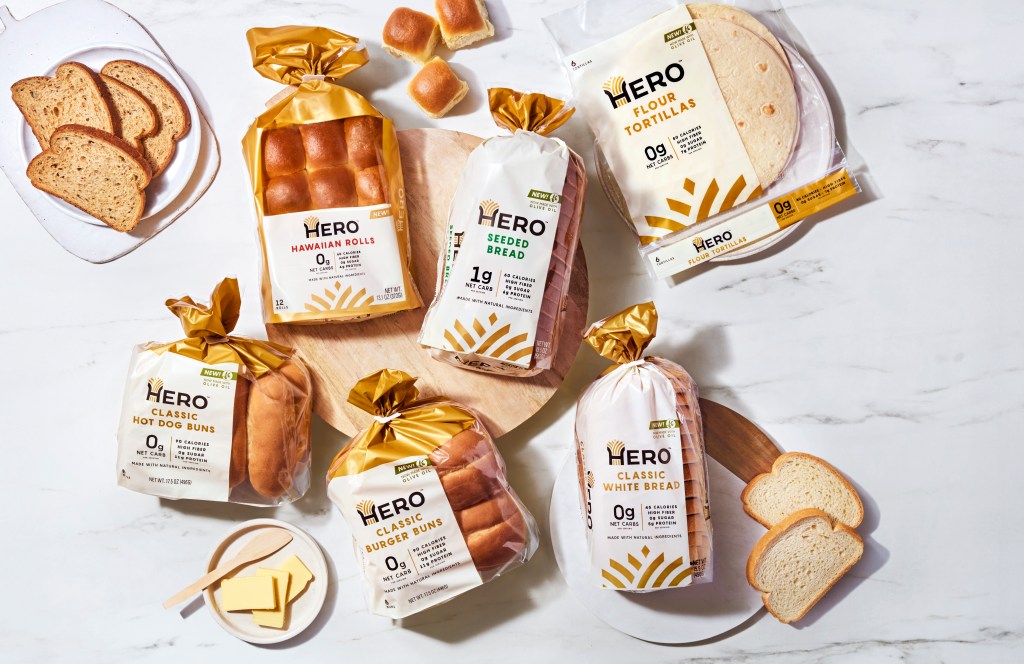
Before expanding its catalog, Hero Bread streamlined its initial product offerings to five foundational staples designed for weekly, repeat household purchases:
White Bread
Seeded Bread
Burger Buns
Hot Dog Buns
Flour Tortillas
By focusing on mainstream taste profiles and everyday pantry staples, the brand ensured that when it re-entered physical retail, its products addressed high-frequency consumer habits.
Strategic Retail Channel Experimentation
When deciding how to re-enter brick-and-mortar retail, traditional CPG wisdom often dictates choosing a single lane—such as natural food grocers (Whole Foods, Sprouts) or conventional mass-market grocers (Publix, Target). Hero Bread deliberately broke the mold.
Instead of selecting a single channel, the company launched simultaneously across varied retail environments, including Market District, Publix, and Sprouts. The goal was simple: let consumer demand dictate the winning channel. Within six months, the products were performing exceptionally across all test environments.
"We were very, very fortunate in that," Cheng notes. "So instead of picking [retail] channels, we decided to pick retailers that were more enthusiastic regardless of what channel they were in."
Financial Milestones & Funding Momentum
The empirical proof of Hero Bread’s turnaround is reflected in its stellar financial milestones:
Revenue Growth: The company closed out the previous fiscal year with $54 million in annual revenue.
Retail Footprint Expansion: Hero Bread more than doubled its physical store presence over a two-year span, scaling from approximately 4,000 doors to over 10,000 doors, highlighted by a major nationwide rollout into Target stores.
Capital Infusion: Demonstrating intense investor confidence, Hero Bread closed a $21 million funding round in under 90 days in June 2024. Co-led by Cleveland Avenue, DNS Capital, and Composite Ventures, this round pushed the company’s total lifetime funding past $68.5 million.
Official Statements & Industry Insights
Throughout his tenure, CEO YuChiang Cheng has maintained a transparent, resilient philosophy regarding the realities of modern entrepreneurship and brand building. In exclusive commentary, Cheng elaborated on the delicate balance between e-commerce agility and retail economics, as well as the psychological fortitude required to lead a high-growth startup.
Balancing Affordability and Concierge Convenience
While retail expansion offers the undeniable benefits of economies of scale—allowing companies to move truckloads of pallets far more affordably than shipping individual parcels via e-commerce—DTC retains a vital, irreplaceable function in Hero Bread’s overarching ecosystem.
"You can move tons of pallets on a truck much more affordably than you can send individual packages through ecommerce," Cheng explains.
Consequently, retail provides everyday affordability for the core product line. Meanwhile, DTC acts as a high-touch, concierge testing ground for artisanal and experimental offerings that cannot easily be mass-produced for standard grocery shelves.
This philosophy gave birth to the Crafted Collection, featuring small-batch items hand-baked in Sonoma, California, utilizing brown butter crafted by a Michelin-starred chef—including croissants and lemon poppy seed scones. It also enabled high-profile, exclusive brand collaborations, such as the widely celebrated partnership with Auntie Anne’s to launch co-branded pretzel bites.
The DTC Incubation Model
Beyond luxury and novelty items, DTC serves as an empirical sandbox for new product development. A prime example is Hero Bread’s expansion into bagels.
In December 2024, the company launched bagels as a limited-edition online exclusive. "We weren’t sure if people would want to buy bagels from us," Cheng admits. "So we initially made them in smaller batches, sold them at hero.co, and they quickly became one of our best-selling items." Armed with verifiable conversion data and enthusiastic customer validation, Hero Bread successfully transitioned the bagels to physical retail shelves within six months.
Defining Entrepreneurial Resilience
Reflecting on the turbulent journey from the brink of financial insolvency to a thriving $54 million enterprise, Cheng rejects the notion that success is defined solely by an unbroken string of victories.
"It’s how many times you can try again, regardless of how many times you’ve fallen down or how much blood you get on your face," Cheng states. "There is a level of courage that is really necessary."
Future Outlook: The Third Chapter of Hero Bread
As Hero Bread looks toward the horizon, the brand is actively writing what Cheng describes as the "third chapter" of its business playbook. This next phase is characterized by a relentless commitment to meeting consumers wherever they choose to shop.
Rather than viewing e-commerce and brick-and-mortar retail as competing factions, Hero Bread treats them as a synergistic ecosystem. The digital storefront fuels innovation, community engagement, and rapid prototyping, while physical retail delivers mass accessibility and operational scale.
With a hardened supply chain, a heavily validated product line, an expanding retail footprint exceeding 10,000 doors, and robust financial backing exceeding $68.5 million, Hero Bread has successfully converted early vulnerabilities into enduring corporate strength.
As the brand continues to court both dedicated health enthusiasts and conventional bread lovers alike, its trajectory serves as an authoritative masterclass in CPG management: listen to the consumer, master your unit economics, and never mistake the first stumble for the final chapter.