

Executive Overview
Every website hits its operational and aesthetic peak on the exact day it launches. The final code branch merges cleanly into production, the design system aligns down to the pixel, and the digital storefront goes live in a state of pristine, unblemished perfection.
It will never look that good again.
This is not because the site breaks; modern web infrastructure is remarkably resilient, and core pages rarely suffer catastrophic failures. Instead, websites decay through a slow, quiet process of attrition. Markets shift, competitive landscapes evolve, messaging nuances pivot, and minor design inconsistencies accumulate. The carefully crafted digital ecosystem built by your team gradually falls out of alignment with the living, breathing company it represents. Within a year, that once-cutting-edge URL becomes a digital period piece: functional, technically intact, but fundamentally behind the curve.
For decades, digital product teams, designers, and developers have treated this entropy as an immutable law of nature—a logistical tax paid for maintaining an online presence.
However, the rise of specialized artificial intelligence agents is poised to challenge this assumption. Companies are beginning to explore the concept of autonomous websites—digital properties that do not merely exist statically on a server, but continuously optimize, update, and self-heal in the background.
Yet, as platform builders rush to deliver fully automated web maintenance, they have collided with a surprising psychological and operational barrier: almost nobody actually wants a website that changes entirely on its own.
In this deep-dive report, we examine the philosophy of website decay, the counterintuitive realities of building autonomous web platforms, and how the future of web design requires a nuanced balance between machine efficiency and human taste.
Detailed Chronology: The Journey Toward Website Autonomy
The evolution of website maintenance has moved through distinct eras, shifting from completely manual interventions to automated pipelines, and finally to the threshold of true machine agency.
Phase 1: The Era of Static Maintenance (Early 2000s – 2010s)
In the traditional paradigm, keeping a website updated required continuous human labor. Whether a company used a traditional Content Management System (CMS) like WordPress or a custom-coded stack, updates were manual. If a design token changed, a developer had to hunt down every instance of the old color hex code across various stylesheets. If an image was uploaded uncompressed, it stayed heavy until a developer noticed a dip in page speed scores.
This model worked when the velocity of business was slower, but it created immense backlogs. Marketing teams waited weeks for developer bandwidth to execute minor copy tweaks, and technical debt mounted quietly behind the scenes.
Phase 2: The Continuous Integration Boom (2015s – 2023)
The maturation of CI/CD (Continuous Integration and Continuous Delivery) pipelines, automated testing, and modern frontend frameworks (such as Next.js and Tailwind CSS) brought structural relief. Deployment became frictionless. Platforms like Vercel and Netlify allowed teams to push code changes globally in seconds.
Yet, CI/CD pipelines only execute what humans tell them to execute. They cannot notice that a pricing page fails to reflect last week’s rebranding effort. They cannot autonomously decide to compress a bloated asset uploaded by a rushed copywriter. They are engines of execution, not agents of awareness.
Phase 3: The Birth of the Autonomous Platform (2024 – Present)
Recognizing the gap between static codebases and continuous market shifts, modern software architects began building platforms designed to close the loop. A prime example of this shift is Fimo, an autonomous website platform engineered to let AI agents manage the underlying health and hygiene of digital properties.
When developers first approached full website autonomy, the prevailing assumption was absolute delegation: Hand the entire site over to the AI agents, let them write, edit, optimize, and publish continuously, and get out of the way.
It sounded like the logical endpoint of automation. In practice, however, early users experienced immediate hesitation. The friction had nothing to do with algorithmic capability; it stemmed from the fundamental organizational truth that a website has no single owner. Different departments—design, engineering, marketing, and executive leadership—each lay claim to different components of a site, and each demands a vastly different threshold of autonomy.
Supporting Context & Metrics: The Anatomy of Digital Decay
To understand why autonomous agents are necessary, one must quantify the invisible maintenance load that drains engineering and design talent daily. Industry analyses of medium-to-large enterprise websites reveal startling metrics regarding site degradation:
- 80% of Maintenance is Rule-Bound: The vast majority of tasks required to keep a website healthy—such as checking WCAG accessibility compliance, updating broken meta tags, fixing rotated links, and propagating design system tokens—are entirely repetitive and governed by strict rules rather than subjective taste.
- The Compression and Asset Penalty: Over 60% of marketing-led page updates introduce unoptimized media assets within the first six months of a site’s lifecycle, directly impacting Core Web Vitals and search engine optimization (SEO) rankings.
- The Bottleneck Effect: Product teams spend an estimated 15% to 25% of their sprint cycles handling reactive, low-level hygiene tickets rather than building core product features or high-value conversion funnels.
Categorizing the Work: Chores, Art, and Identity
Building systems like Fimo forced engineers to categorize web management into three distinct buckets to resolve the psychological resistance users felt toward full automation:
+-----------------------------------------------------------------+
|                    THE WEB MANAGEMENT SPECTRUM                  |
+--------------------------+------------------+-------------------+
| 1. THE CHORES (80%)      | 2. THE BORDERLAND| 3. THE UNTOUCHABLE|
| Rule-bound, repetitive,  | Context-dependent| Pure taste, brand |
| zero-taste tasks.        | task ownership.  | identity, & vision|
| (Accessibility, broken   | (E.g., Default   | (Creative direction|
| links, asset sizing)     | dark mode toggle)| & core messaging) |
+--------------------------+------------------+-------------------+- The Chores (The 80%): These are tasks defined by logic, not aesthetics. Fixing contrast ratios, validating heading hierarchies, and updating outdated API endpoints belong here. No one joins a company for their exceptional ability to spot a missing
altattribute. Handing this work over to autonomous agents provides immediate, friction-free relief. - The Untouchable Core: At the opposite end of the spectrum sits work that cannot be delegated at any price. An AI can check whether a page adheres to a style guide, but it cannot determine what a page should feel like or whether a creative direction resonates on an emotional level. This realm belongs exclusively to human taste and strategic vision.
- The Borderland (The Context-Dependent Zone): Between chores and untouchables lies a vast gray area where the line of autonomy varies entirely by organizational role.
Consider a practical, highly common website change: Switching the default landing theme to dark mode.
An autonomous agent can execute this transition across a massive codebase in milliseconds. However, who holds the authority to make that decision?
- For the brand designer, the default theme is not a trivial settings toggle; it is a profound statement regarding how the brand wishes to present its identity to the world upon first impression. They demand absolute control over this call.
- For the software engineer, it is a simple conditional logic change with clear technical rationale—the exact sort of routine update they would gladly let an agent apply autonomously to clear their queue.
Because the definition of "right" depends heavily on where an individual’s professional value lies, rigid, global automation settings fail. Control must be granular, adaptable, and scoped on a per-task and per-person basis.
Official Insights & Architectural Philosophy
Pierre Burgy, co-founder of platforms pioneering this space, highlights the core realization uncovered during the development of autonomous web infrastructure:
"The point of autonomy was never to remove you from your website. It was to remove the decay."
This distinction reframes the entire AI agent paradigm. The goal is not to replace human creativity with synthetic output, but to act as a tireless digital janitor and optimization engine that prevents the slow accumulation of technical and visual debt.
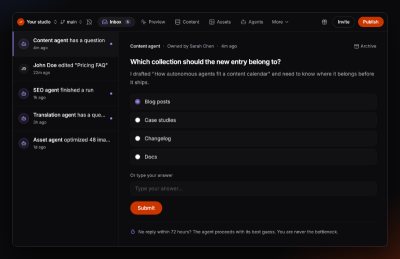
To achieve this, platforms have moved away from simple binary toggles (such as "Approve" vs. "Delegate") and toward agent composition. Instead of choosing from a generic menu of pre-set behaviors, teams construct specialized agents tailored to specific operational boundaries:
- The Accessibility Agent: Configured to run continuously and unattended, instantly patching contrast failures and DOM structure regressions as code changes.
- The Asset Optimization Agent: Silently compressing uploaded media, verifying vector scaling, and ensuring responsive layouts across edge viewports.
- The Content & Translation Agents: Kept under close human supervision, drafting localized copy or phrasing updates that require human sign-off before hitting production.
Crucially, these agents are dynamic. Trust is not granted blindly on launch day; it is earned iteratively over time. As administrators review historical execution logs, inspect before-and-after change diffs, and watch agents successfully resolve edge cases without breaking production, the boundary of autonomy naturally expands. What required manual approval last month can safely be delegated today.
Future Outlook: The Self-Optimizing Digital Horizon
As we look toward the remainder of the decade, the traditional static website model faces obsolescence. The expectation of dynamic, hyper-personalized, and self-maintaining digital experiences will redefine what users and enterprises demand from the web.
- Eradication of the "Periodic Redesign": The multi-million-dollar, disruptive "website redesign every three years" cycle will likely fade. Continuous, micro-evolutionary updates driven by AI agents will ensure websites adapt fluidly alongside market shifts without requiring traumatic, ground-up teardowns.
- Shift from Builders to Curators: Frontend developers and designers will increasingly transition from manual executors of code to architects of agentic workflows—defining the guardrails, taste parameters, and brand constraints within which autonomous systems operate.
- Resilience Through Transparency: The widespread adoption of autonomous websites will depend entirely on the auditability of AI actions. Platforms that fail to provide clear, verifiable execution logs and instant rollback mechanisms will face fierce resistance from risk-averse enterprises.
Ultimately, the fear of the autonomous website—the anxiety that machines will alter our digital homes without permission—misses the true danger of the modern internet. The real risk has never been an agent changing your site too much; the real risk is a site that never changes at all.
By delegating the endless cycle of digital decay to intelligent agents, teams can finally reclaim their time, focusing their human judgment exclusively on the fraction of work that truly matters: imagination, strategy, and exceptional taste.