

Executive Overview
In the rapidly evolving landscape of artificial intelligence and decentralized technologies, few brand resurrections are as unexpected—or as strategically ambitious—as that of LimeWire. Once universally recognized in the mid-2000s as a peer-to-peer (P2P) file-sharing juggernaut at the center of the digital music revolution and subsequent legal battles, LimeWire has completely shed its legacy identity. Today, it has re-emerged as a cutting-edge generative AI content publishing platform and Web3 creative studio.
This transformation is not merely a nostalgic exploitation of brand equity; it represents a fundamental re-architecting of how digital creators generate, distribute, and monetize intellectual property. By synthesizing state-of-the-art text-to-image AI models—such as Stable Diffusion and DALL-E 2—with blockchain infrastructure built on Polygon and Algorand, LimeWire provides a comprehensive ecosystem. Here, artists, musicians, designers, and everyday users can transform simple text prompts into ownable digital assets, mint them automatically as Non-Fungible Tokens (NFTs), cultivate subscriber communities, and earn real-world revenue via ad-sharing mechanisms and its native utility token, LMWR.
This report provides an in-depth investigation into LimeWire’s modern architecture, its monetization paradigms, its tiered subscription models, and its strategic roadmap as it prepares to expand beyond image generation into multi-modal video and audio creation.
Detailed Chronology and Platform Evolution
The Ghost of 2000s P2P
To fully appreciate LimeWire’s current iteration, one must contextualize its origins. Launched in 2000 as a Java-based file-sharing client, LimeWire became a cultural touchstone of the early internet era. Alongside platforms like Napster and Kazaa, it democratized music discovery while plunging the traditional music industry into an existential copyright crisis. Following a landmark 2010 federal court ruling (Arista Records LLC v. Lime Wire LLC), the original P2P network was permanently shuttered, leaving the brand dormant for over a decade.
The Web3 and AI Pivot
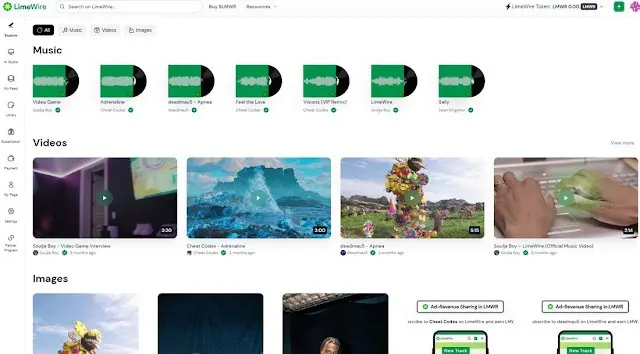
In 2022, serial entrepreneurs Paul and Julian Zehetmayr acquired the LimeWire brand with a vision to repurpose it for the creator economy. Initially conceptualized as a marketplace for digital collectibles and music NFTs—attracting early high-profile adopters such as electronic music icon Deadmau5, hip-hop artist Soulja Boy, and reggae-pop star Sean Kingston—the platform quickly recognized the seismic shift toward generative artificial intelligence.
By integrating AI image generation capabilities into LimeWire Studio, the platform bridged the gap between raw AI art creation and blockchain-backed provenance. Creators no longer just generated images; they minted them, traded them, and built recurring revenue streams from them. This historical pivot effectively decoupled the modern LimeWire from its file-sharing past, positioning it instead as a forward-looking infrastructure provider for the decentralized creative class.
Supporting Context & Metrics: Inside the LimeWire Studio Ecosystem
LimeWire’s modern platform architecture relies on a synergy between advanced neural networks, Web3 tokenomics, and traditional subscription-based content gating. Understanding its underlying mechanics requires a granular look at its operational pillars.
Advanced AI Image Generation Models
At its core, LimeWire Studio functions as an intuitive yet powerful generative art interface. Rather than locking users into a proprietary, closed-source engine, the platform integrates multiple industry-standard diffusion models, including:
- Stable Diffusion 2.1
- Stable Diffusion XL (SDXL)
- DALL-E 2
This multi-model approach allows creators to select the ideal engine for their specific aesthetic goals. Users can draft simple, conversational prompts or construct intricate, highly detailed multi-variable instructions. Furthermore, LimeWire features style-switching tools that enable creators to seamlessly transition an output across various artistic movements and mediums:
- Cinematic: High-drama lighting, depth of field, and photorealistic rendering.
- Digital Art & Pixel Art: Tailored for modern illustrators and retro-gaming enthusiasts.
- Anime: Optimized for Japanese animation styling and vibrant character design.
- Analog Film: Replicates the grain, color grading, and texture of historical photographic mediums.
Advanced parameters, including custom samplers and prompt guidance scales, give experienced digital artists granular control over detail density and structural coherence.
Automated Blockchain Minting
One of LimeWire’s most frictionless innovations is its automated NFT minting pipeline. Once a user finalizes a creative output within LimeWire Studio, they are given the option to publish it. Upon publication, the platform automatically mints the creation as an NFT on either the Polygon or Algorand blockchain.
This process requires no deep technical knowledge of smart contracts or gas optimization from the creator. The resulting digital asset is embedded with a verifiable cryptographic signature, securing its authenticity and establishing immutable proof of ownership.
Dual Distribution: Public Discovery vs. Exclusive Gating
Creators retain absolute autonomy over how their minted assets are distributed across the network:
- Public Release: Content is indexed across the platform, making it discoverable to the entire LimeWire community. Publicly available NFTs can be bought, sold, and traded by enthusiasts, driving community engagement and secondary-market velocity.
- Subscriber-Only Access: Creators can lock specific posts, images, or series behind a paywall, making them accessible exclusively to dedicated fans who subscribe to their LimeWire profile. This creates an intimate, direct-to-consumer monetization channel akin to Patreon or OnlyFans, but supercharged with verifiable digital ownership.
Official Statements and Revenue Architecture
LimeWire’s leadership has consistently emphasized that the platform is designed to be a democratizing force for creators. By removing the traditional barriers between creation, distribution, and monetization, LimeWire aims to ensure that artists retain financial control over their work.
The Ad-Revenue Share Model
Unlike traditional social media networks that retain 100% of platform ad revenue or offer meager creator funds, LimeWire introduces a transparent revenue-sharing structure. When creators publish images, music, or videos on the platform, they are entitled to a substantial percentage of all ad revenue generated when other users view their content. Depending on the creator’s subscription tier, this revenue share ranges from 50% up to 70%.
LMWR Tokens: The Utility Engine
All earnings generated through ad-revenue sharing, secondary-market NFT royalties (creators earn a 2.5% royalty every time their content is traded), and direct subscriptions are paid out in LMWR, LimeWire’s native utility cryptocurrency.
- Liquidity and Exchange Integration: Monthly LMWR payouts can be readily withdrawn and traded on numerous tier-one cryptocurrency exchanges, including Kraken, ByBit, and Uniswap.
- Platform Utility: Beyond cashing out, users can utilize LMWR tokens natively within the ecosystem to purchase additional prompt credits, fund AI generations, and access exclusive community features.
Subscription Tiers and Pricing Structure
To accommodate everyone from casual hobbyists to professional enterprise designers, LimeWire implements a flexible credit-based pricing model. Every tier grants access to state-of-the-art AI generation tools, but scales in terms of monthly credit allocations, image generation limits, ad-revenue percentages, and platform perks.
1. Free Tier
- Cost: $0 / month
- Credits: 10 free credits upon sign-up
- Generation Capacity: Up to 20 AI images per day
- Ad-Revenue Share: 50%
- Best For: Casual users wanting to experiment with generative art without financial commitment.
2. Basic Plan ($9.99 / month)
- Credits: 1,000 credits per month
- Generation Capacity: Up to 2,000 image generations
- Ad-Revenue Share: 50%
- Perks: Early access to newly integrated AI models, Pro profile badge, full creation history, faster processing speeds, and an ad-free experience.
3. Plus Plan ($29 / month)
- Credits: 3,750 credits per month
- Generation Capacity: Up to 7,500 image generations
- Ad-Revenue Share: 60%
- Perks: Pro profile badge, priority rendering queues, full creation history, early model access, and zero ads.
4. Pro Plan ($49 / month)
- Credits: 5,000 credits per month
- Generation Capacity: Up to 10,000 image generations
- Ad-Revenue Share: 70% (Maximum Tier)
- Perks: Comprehensive creator suite access, Pro profile badge, highest-priority rendering speeds, and full historical archiving.
5. Advanced / Enterprise Plan ($99 / month)
- Credits: 11,250 credits per month
- Generation Capacity: Up to 22,500 image generations
- Ad-Revenue Share: 70%
- Perks: Maximum generation capacity, dedicated support, Pro profile badge, early access to beta features, and complete ad-free navigation.
Future Outlook
As the generative AI market matures, LimeWire is positioning itself not as a static art tool, but as a dynamic, multi-modal media ecosystem.
Multi-Modal Expansion: AI Music and Video
While LimeWire’s current primary focus remains centered on advanced AI image generation, the platform has outlined an aggressive product roadmap for the immediate future. Strategic development is already underway to introduce native AI music and video generation tools.
This expansion will profoundly alter the platform’s value proposition. By enabling creators to generate synchronized video content and original musical compositions via text prompts—and subsequently minting those multi-media assets as blockchain-backed NFTs—LimeWire will bridge the gap between static digital art and full-scale cinematic and audio production.
Proprietary AI Model Development
Beyond integrating third-party diffusion architectures like Stable Diffusion and DALL-E, LimeWire is actively investing in the research and development of its own proprietary AI models. Developing an in-house model will allow the platform to offer unique stylistic outputs, faster render times, and greater customization that cannot be replicated on generic open-source platforms.
Conclusion
LimeWire’s metamorphosis from a controversial P2P file-sharing network into a sophisticated generative AI and Web3 publishing platform stands as one of the most fascinating corporate pivots of the digital age. By harmonizing accessible text-to-image AI tools, automated blockchain minting, lucrative ad-revenue sharing, and community-driven subscriptions, LimeWire has built a robust engine for the modern creator economy. As it prepares to roll out multi-modal audio and video tools alongside its proprietary AI models, LimeWire offers a compelling glimpse into the future of decentralized, AI-augmented artistic expression.