In the digital landscape, few challenges are as universally acknowledged yet persistently frustrating as the art of naming. "Naming is hard" is more than a cliché whispered in code reviews and design retrospectives; it is a fundamental friction point in product development. The language we choose shapes not only how we conceptualize interface elements, user workflows, and structural hierarchies, but it actively dictates the conversations we have around them. When a designer, a front-end engineer, a product manager, and a customer speak in different dialects about the exact same UI component, chaos ensues. Confusion breeds redundancy, low feature adoption, bloated style sheets, and siloed design systems.
This authoritative guide delves deep into the anatomy of naming across the digital product ecosystem. From HTML classes and CSS variables to complex multi-brand design token taxonomies, UI layer hierarchies, and user-facing feature names, we examine the methodologies, frameworks, and expert resources required to establish a cohesive product language. By bridging the linguistic gap between disciplines, product teams can eradicate friction, streamline collaboration, and build intuitive digital experiences that resonate instantly with users.
Detailed Chronology: The Evolution of Naming Conventions in Digital Design
To understand how modern digital ecosystems manage nomenclature, we must examine how design and engineering have evolved from unstructured wild-west coding to highly disciplined design systems.
1. The Era of Ad-Hoc Styling (Late 1990s – Early 2010s)
In the early days of the web, naming was entirely subjective. Developers relied on idiosyncratic abbreviations (#nav2, .txt_box, .red-button) that made sense to the author but created maintenance nightmares for teams. There was zero alignment between visual design files (often static Photoshop or Sketch comps) and codebases. As projects scaled, technical debt exploded simply because no one could safely refactor or repurpose a class without breaking an unmapped dependency.
2. The Rise of Methodologies and Systems (2012 – 2018)
Recognizing the structural chaos of growing codebases, the industry introduced strict methodologies like BEM (Block, Element, Modifier), SMACSS, and OOCSS. These frameworks imposed mathematical predictability on HTML classes and CSS selectors. Simultaneously, design systems emerged. Pioneers like Nathan Curtis began formalizing how design tokens should be categorized, shifting the conversation from hardcoded hex values to semantic abstractions. Naming was no longer an afterthought; it became an architectural discipline.
3. The Multi-Brand, Multi-Theme Complexity (2018 – Present)
Today, digital products rarely exist in a single vacuum. Enterprise organizations manage multi-brand architectures (e.g., Intuit overseeing Mailchimp, QuickBooks, TurboTax, and Mint) and multi-themed applications (such as Vodafone UK managing complex variations across global markets). Design tokens now travel across platforms—from Figma design files straight to iOS, Android, and web codebases. Consequently, naming has transformed into a sophisticated taxonomy mapping challenge, demanding rigorous governance, structured collections, and cross-functional dictionaries.
Supporting Context & Metrics: Overcoming Generic and Specific Pitfalls
The core dilemma in naming digital artifacts usually boils down to two dangerous extremes: names that are too generic and names that are too specific.
The Generic Trap: Naming a component .box, a variable $color-primary-light, or a layer Rectangle 4 strips the element of its contextual meaning. When everything is generic, developers and designers must constantly inspect code or layout context to understand intent, slowing down velocity.
The Specific Trap: Naming a component .homepage-hero-blue-cta-button paints the team into a corner. The moment that button moves to the checkout flow or changes its brand accent color, the name becomes wildly inaccurate and misleading, inviting technical debt.
Striking the balance requires looking at how industry leaders approach specialized naming categories.
1. Thinking Outside the Box with Classnames
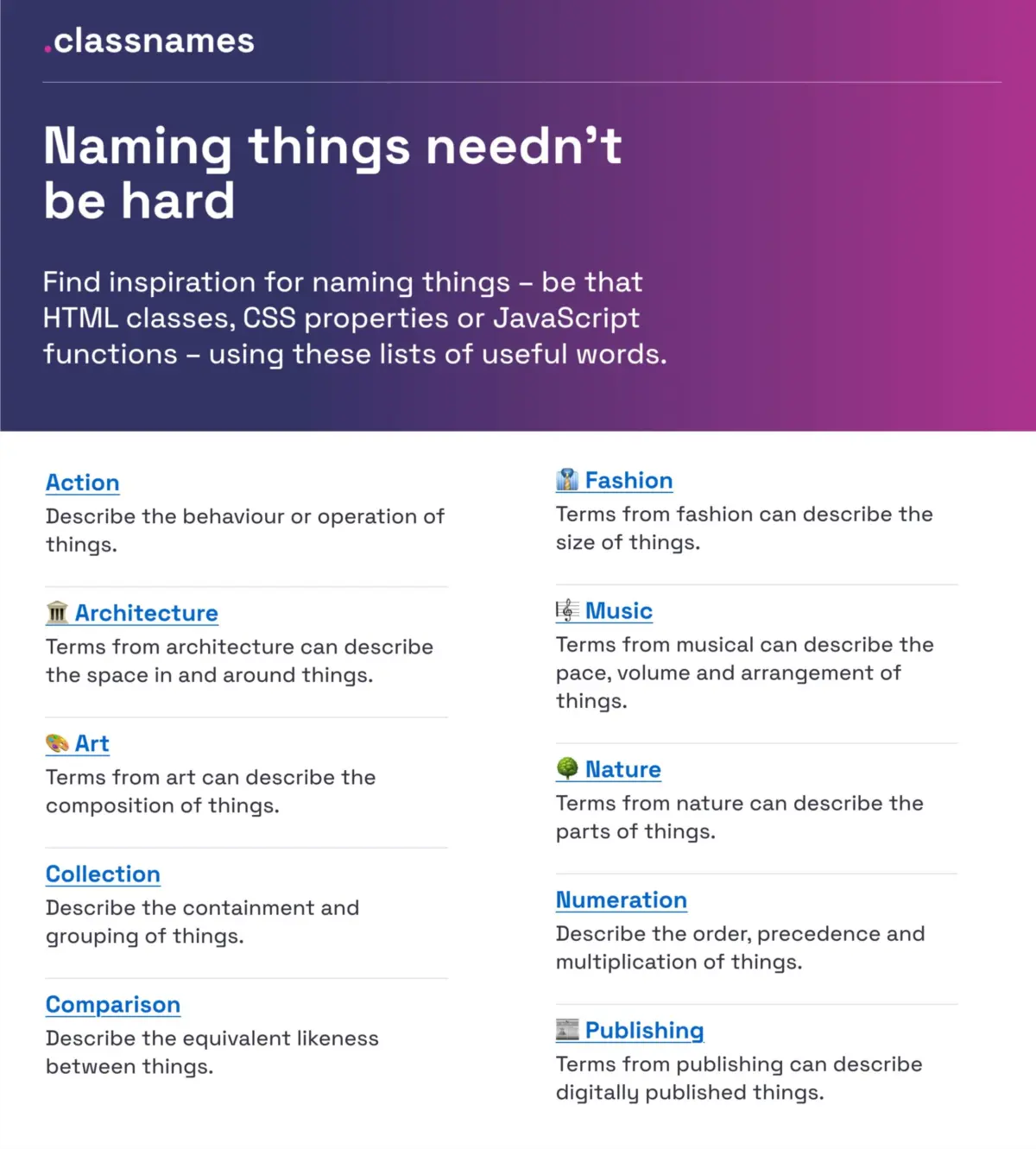
When engineers or designers struggle to find evocative terms for HTML classes, CSS properties, or state handlers, relying on standard technical vocabulary often falls short. Resources like Paul Robert Lloyd’s Classnames project offer a liberating shift in perspective. The site provides thematically grouped lists of words categorized by behavior, likeness, order, grouping, and association. More importantly, it introduces non-traditional vocabularies drawn from nature, art, theater, music, architecture, fashion, and publishing—allowing teams to craft semantic, memorable identifiers that avoid naming collisions.
2. Taming the Color Spectrum
Color nomenclature has historically defaulted to arbitrary hex codes or overly literal descriptions (#333333 vs. dark-grey). David Aerne’s expansive Color Names repository tackles this by indexing over 30,000 unique color names sourced from community contributions and varied references. Paired with interactive pickers and search utilities like the Color Parrot, teams can assign human-readable, context-agnostic names to their palette foundations, easing verbal communication during design reviews.
3. Structuring Layers and Groups in Design Files
Inconsistent file organization in design tools like Figma or Sketch directly translates to messy handoffs. Javier Cuello’s guidelines on design naming best practices emphasize that an effective layer or group name must be:
Logical in structure
Short and meaningful
Universally understood across engineering and product teams
De-coupled from visual properties (avoiding names like Blue-Box-DropShadow in favor of functional names like Card-Container)
Architectural Deep Dive: Design Tokens and UI Component Taxonomy
As design systems mature, the architecture of their naming conventions must scale accordingly. Two monumental case studies highlight how enterprise-grade organizations solve this problem.
Intuit’s Flexible Design Token Taxonomy
Managing multiple flagship financial and marketing products under one corporate umbrella requires a bulletproof token system. Nate Baldwin’s documentation of Intuit’s design token taxonomy highlights the painstaking process of evolving beyond rigid brand-specific themes. By shifting toward a tiered token structure, Intuit established a foundational architecture that serves wildly disparate user experiences while maintaining unified design language governance.
Vodafone UK’s Variables Taxonomy Map
Similarly, the Vodafone UK Design System team developed a comprehensive Variables Taxonomy Map (available via the Figma Community). This framework breaks down the anatomy and categorization of design tokens into an orchestrated system of collections. Building upon foundational frameworks like Nathan Curtis’s token naming methodologies, Vodafone’s map delineates four distinct layers:
Brand/Primitives: Raw values (colors, spacing scales).
This explicit lineage ensures that any stakeholder can inspect a token name and instantly trace where it originates, where it is applied, and what semantic role it fulfills. For teams building similar structures, Romina Kavcic’s Design Token Naming Guide & Builder along with her Design Token Names Inventory spreadsheet provide interactive frameworks to map out components, categories, states, and roles without losing sight of the bird’s-eye view.
Standardizing UI Component Names
When searching for the right nomenclature for standard UI patterns—such as accordions, tabs, modals, or tooltips—reinventing the wheel is counterproductive. Iain Bean’s Component Gallery aggregates real-world examples from dozens of established design systems across more than 50 distinct UI components, documenting the various aliases each component goes by in the wild. Complemented by visual dictionaries like Name That UI, teams can instantly align on industry-standard terminology.
Official Statements and Industry Insights
Industry leaders consistently emphasize that naming is not merely a technical chore, but a core pillar of user experience and team communication.
"The right name is the one that is well-understood and used by both the team and the users. So much time is wasted speaking about the very same thing but in different dialects—the designer’s dialect, the developer’s dialect, the product manager’s dialect, and the user’s dialect. That is what often causes frustration and confusion."
— Design Systems Thought Leadership
When evaluating feature discovery and adoption, product strategist Erin Gannon notes in her landmark guide, "What Do We Call This Thing?", that poor feature adoption is frequently a symptom of poor discoverability rooted in confusing nomenclature.
"Good names are driven by user needs and problems. They should signal the value or outcome of a feature (the job-to-be-done), and—most importantly!—tap into the user’s own language. Ask people to explain a feature in their own words, and then use the words they use."
Furthermore, when naming entirely new products, services, or internal brand verticals, open-source repositories like Onym provide structured methodologies, brainstorming prompts, vetting exercises, and etymological guides to steer teams away from confusing jargon and toward resonant, clear identities.
Future Outlook: The Horizon of Semantic Product Design
Looking forward, the evolution of naming conventions is bound closely to the advancement of automated tooling, token-syncing pipelines, and AI-assisted design systems. As design-to-code bridges (such as direct Figma-to-repository token transformers) become standard operating procedure, the margin for linguistic error shrinks drastically.
Future product ecosystems will likely feature automated linting tools that actively monitor for naming drift between design tokens and codebase variables, flagging semantic mismatches before code ever hits production. Moreover, as AI agents increasingly assist in generating UI components and writing code, standardized taxonomies will serve as the core prompt-engineering foundation for automated generation. Teams that invest in rigorous, user-centered, and multi-tiered naming structures today are not just cleaning up their style sheets—they are future-proofing their entire product development lifecycle against systemic confusion.
By continuously auditing naming conventions, maintaining shared taxonomies, and actively listening to the language our users speak, we can transform naming from a perpetual bottleneck into our most powerful tool for digital clarity.