

Executive Overview
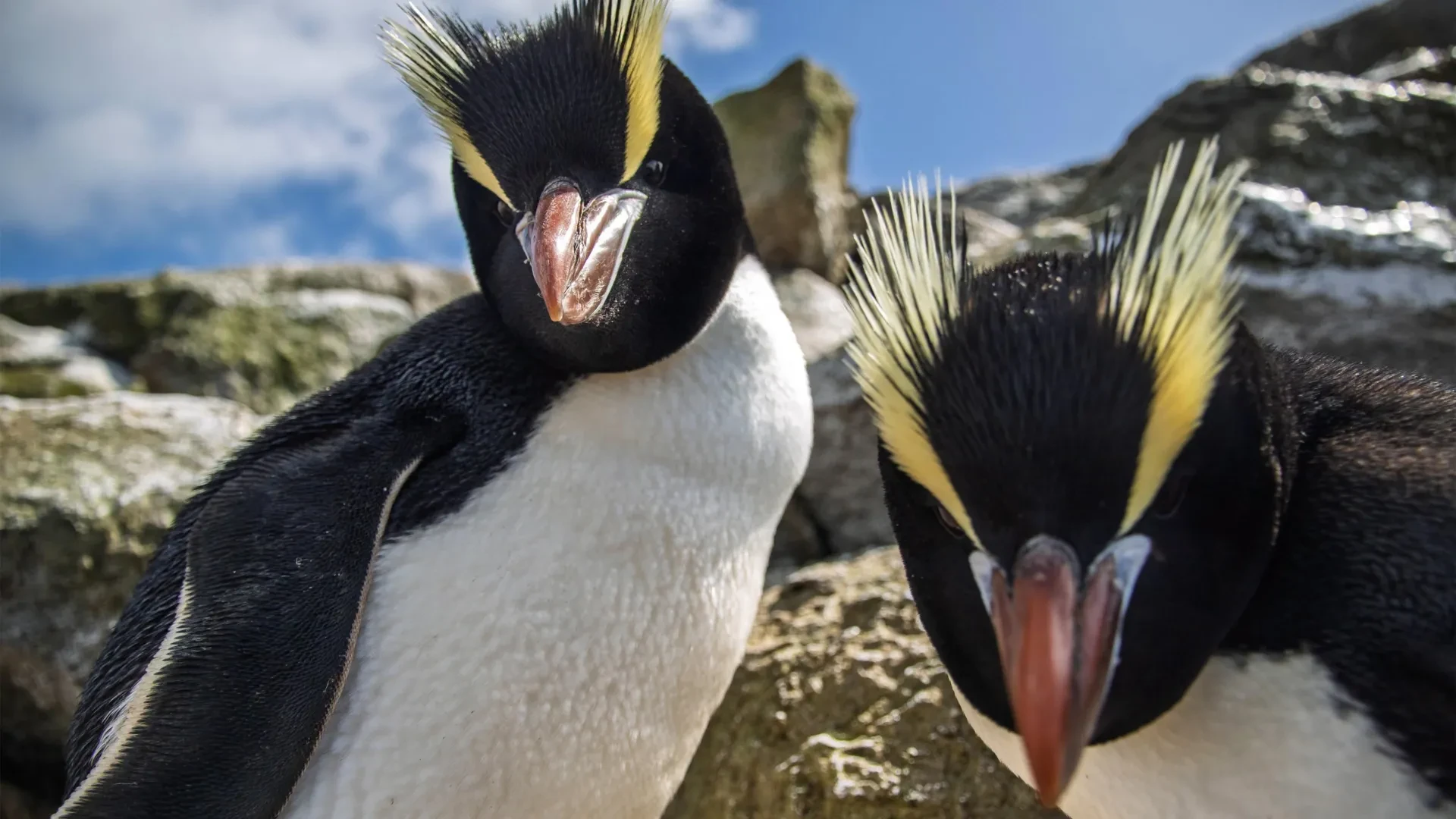
In the remote, tempestuous reaches of the Southern Ocean, a profound and startling ecological divide has been brought to light. A comprehensive new study conducted by researchers at the University of Otago (Ōtākou Whakaihu Waka) has exposed a striking split in the fortunes of one of the world’s most enigmatic and least understood seabirds: the Erect-crested penguin (Eudyptes sclateri).
Published in the journal PLOS ONE, the research shatters long-held assumptions regarding the stability and distribution of the species. Historically, conservationists operated under the broad generalization that the global population of Erect-crested penguins was facing a uniform, gradual slide toward extinction across its exceedingly narrow breeding range. However, the first-ever comprehensive population survey of the entire species—utilizing advanced drone technology between 2022 and 2024—reveals a starkly bifurcated reality.
One primary population, anchored in the microscopic confines of the Bounty Islands, has remained remarkably stable for at least a quarter of a century. Just a few hundred kilometers away, however, the much larger Antipodes Islands have witnessed a catastrophic population collapse, plunging by more than 40 percent since the mid-1990s.
Led by Dr. Thomas Mattern of the Tawaki Project—a collaborative initiative uniting the University of Otago’s Departments of Zoology and Marine Science alongside the Antarctic Research Trust and the Global Penguin Society—this investigation introduces the concept of "Schrödinger’s Penguin." Much like the famous quantum physics thought experiment, where a cat remains simultaneously alive and dead until the box is opened, the plight of the Erect-crested penguin remained hidden behind a veil of aggregated data. Only by "opening the box" and examining the two island groups independently have scientists realized that broad, global conservation assessments can dangerously mask localized crises and create a false sense of security.
Detailed Chronology: From Historical Blind Spots to Modern Drone Mapping
The story of the Erect-crested penguin is one defined by isolation, extreme environments, and persistent scientific neglect. Breeding exclusively on two remote, storm-lashed subantarctic island groups located approximately 800 kilometers southeast of New Zealand’s South Island, these birds have long eluded rigorous, systematic population tracking.
The 1970s Baseline and the Persistence of Error
For decades, conservation strategies for the Erect-crested penguin relied heavily upon speculative population estimates generated in the 1970s. These early figures were often cobbled together from rudimentary foot surveys, anecdotal accounts from passing sealers and scientific expeditions, and sweeping extrapolations of colony density.
Compounding this data deficit was the sheer inaccessibility of the birds’ breeding habitats. The Bounty and Antipodes islands are characterized by sheer, wave-battered cliffs, treacherous boulder beaches, and hyper-volatile weather patterns that make sustained human fieldwork perilous and logistically nightmarish. Consequently, conservation scientists lacked a reliable baseline against which to measure modern population trajectories.
The Shift to Advanced Aerial Surveillance (2022–2024)
Recognizing the urgent need for empirical data, an international coalition of researchers—spearheaded by Dr. Mattern, Dr. Klemens Pütz of the Antarctic Research Trust, and global seabird specialists—launched an ambitious surveying campaign. Operating between 2022 and 2024, the team bypassed the physical limitations of traditional ground counts by deploying high-resolution drone technology.
By flying systematic aerial sweeps over every known breeding colony across both the Bounty and Antipodes island groups, the researchers were able to capture hyper-detailed photographic mosaics. These images allowed automated and manual counting of every visible breeding pair, yielding an unprecedented, mathematically robust census of the entire global species.
Unsettling the Long-Standing Status Quo
When the drone data was fully processed and cross-referenced with historical surveys dating back to the mid-1990s, the findings completely overturned the established ecological dogma.
Historically, the Antipodes Islands—spanning a substantial landmass—were considered the undisputed stronghold of the species. Conversely, the Bounty Islands, a cluster of barren granite islets totaling a mere 50 hectares in area, were thought to support only a fraction of the total population.
The 2022–2024 surveys revealed a startling reversal. The tiny Bounty Islands were found to host approximately 27,800 breeding pairs, a figure nearly rivaling the Antipodes Islands’ count of roughly 29,800 pairs. Even more alarming was the trajectory: while the Bounty colonies had held their ground for 25 years, the Antipodes colonies had steadily unraveled, dropping by over 40 percent since 1995.
Supporting Context & Metrics: Unpacking the "Schrödinger’s Penguin" Paradox
To fully appreciate the urgency of the Otago study, one must examine the specific environmental pressures, mathematical paradoxes, and ecological metrics that define the Erect-crested penguin’s modern struggle for survival.
The Mathematics of the Paradox
The researchers coined the term "Schrödinger’s Penguin" to illustrate a profound danger in modern conservation science: the averaging out of localized demographic trends.
| Population Metric | Bounty Islands | Antipodes Islands | Global Combined Assessment |
|---|---|---|---|
| Landmass Area | ~50 hectares | ~40 times larger than Bounty | Combined range |
| Breeding Pairs (Current) | ~27,800 pairs | ~29,800 pairs | ~57,600 pairs |
| Population Trend (25+ Years) | Stable (unchanged since mid-1990s) | Severely Declining (>40% drop) | Masked / Statistically Averaged |
| IUCN Red List Implication | Indicates high local security | Highlights acute, urgent crisis | Risks shifting status from "Endangered" to "Vulnerable" |
As Dr. Mattern explains, combining these two disparate populations into a single global metric creates a statistical illusion. If averaged out, the species’ global threat ranking on the International Union for Conservation of Nature (IUCN) Red List could theoretically improve from "Endangered" to "Vulnerable."
This seemingly positive shift would be entirely fraudulent in biological terms. It would obscure the active collapse of the Antipodes population while simultaneously lowering the perceived guard on the Bounty Islands—the species’ last truly stable stronghold—leaving them dangerously exposed to emerging anthropogenic threats such as industrial fishing.
Cascading Pressures on the Antipodes Islands
Why are the Antipodes penguins disappearing while their Bounty counterparts hold firm? Researchers point to a complex matrix of compounding ecological pressures:
- Predation and Colony Fragmentation: As Antipodes colonies shrink, they lose the critical mass required for collective mobbing and defense against native subantarctic skuas (Catharacta lonnbergi). Skuas are aggressive aerial predators that specialize in stealing eggs and young chicks. Fragmented colonies mean easier pickings for skuas, accelerating the downward spiral.
- The Rockhopper Ripple Effect: Co-author Dr. Klemens Pütz highlights a historical ecological shift in the Southern Ocean. During the latter half of the 20th century, Eastern Rockhopper penguins suffered catastrophic population collapses driven by warming ocean waters. With Rockhoppers nearly wiped out on the Antipodes (now numbering fewer than 1,000 breeding pairs), local skua populations likely redirected their predatory focus entirely toward the remaining Erect-crested penguins, intensifying predation pressure.
- Severe Climatic Events and Habitat Degradation: Climate change in the Southern Ocean has triggered an increase in the frequency and intensity of destructive storms. These meteorological events cause massive coastal landslides on the steep, unstable slopes of the Antipodes Islands, literally washing away breeding sites, crushing nests, and fracturing the structural integrity of local colonies.
- Divergent Foraging and Migration Routes: Behavioral tracking suggests that the two populations utilize entirely different marine habitats during the non-breeding season. Antipodes penguins undertake grueling migrations deep into the volatile Antarctic Polar Frontal Zone. In contrast, Bounty penguins tend to remain closer to their nesting grounds, benefiting from more sheltered, nutrient-rich local waters. These divergent routes expose the Antipodes birds to harsher oceanographic shifts and fluctuating food availability.
Official Statements and Expert Insights
The implications of the Otago study have sent ripples through the international seabird conservation community. Experts stress that management frameworks must evolve rapidly to address micro-population realities rather than relying on macro-level assumptions.
"The results overturn a long-standing assumption. The tiny Bounty Islands… were found to hold almost as many breeding pairs as the Antipodes Islands… even though the latter is 40 times larger and historically considered the species’ stronghold."
— Dr. Thomas Mattern, Lead Researcher, Tawaki Project, University of Otago
Dr. Mattern has been vocal about the policy dangers of over-simplifying wildlife assessments. He cautions against the bureaucratic temptation to celebrate a cleaner, averaged global status report at the expense of on-the-ground reality:
"A single, ostensibly improved threat ranking is like putting the lid back on Schrödinger’s box, trading a convenient illusion for the stronger protection the Bounty Islands population actually needs."
— Dr. Thomas Mattern
Addressing the cascading ecological pressures unique to the Antipodes, Dr. Klemens Pütz emphasizes the interconnected nature of subantarctic marine food webs:
"As Rockhoppers disappeared, skuas may have turned to Erect-crested penguin eggs and chicks instead, creating an invisible squeeze on the surviving Erect-crested population that standard global counts completely missed."
— Dr. Klemens Pütz, Antarctic Research Trust
Conservation biologists point out a glaring inequity in public and institutional engagement. While New Zealand’s other endemic endangered penguin—the hoiho (Megadyptes antipodes, or yellow-eyed penguin)—receives robust public funding, national media attention, and active coastal management, the Erect-crested penguin has largely languished in obscurity. Because its breeding grounds are so remote, out of sight has truly meant out of mind.
Future Outlook: A New Paradigm for Subantarctic Conservation
The revelations from the University of Otago study necessitate an immediate and thorough overhaul of how New Zealand and international bodies manage the conservation of subantarctic marine species.
1. Granular Policy and Population-Specific Management
Conservation strategies can no longer treat the Erect-crested penguin as a single, homogenous management unit. Regulatory frameworks—including those enforced by the New Zealand Department of Conservation (DOC)—must recognize the Antipodes population as a critically imperiled sub-unit requiring active, targeted intervention, potentially including predator management or habitat stabilization.
Simultaneously, the Bounty Islands population must be safeguarded not as a "surplus" that offsets losses elsewhere, but as a fragile, irreplaceable stronghold that remains vulnerable to external pressures.
2. Guarding Against Industrial Overfishing
As noted by the research team, the stability of the Bounty Islands population could be severely compromised by commercial activities operating on the high seas and within surrounding subantarctic fisheries. Establishing strict marine protection zones, limiting industrial fishing fleets around both island groups, and monitoring incidental bycatch are non-negotiable steps for securing the species’ future.
3. Integrating Climate Resilience
With warming ocean temperatures and increasingly violent storms reshaping the subantarctic landscape, predictive climate modeling must be integrated into future penguin monitoring programs. Understanding how shifts in the Antarctic Polar Frontal Zone affect the migratory and foraging success of Antipodes penguins will be vital in anticipating future demographic shocks.
Conclusion
The study by Dr. Mattern and his colleagues serves as both a scientific breakthrough and a stern warning. By refusing to let the Erect-crested penguin remain trapped inside Schrödinger’s box, the researchers have exposed a hidden extinction crisis unfolding in New Zealand’s backyard. Protecting these remarkable seabirds will require moving past convenient statistical illusions and confronting the complex, localized realities of a rapidly changing Southern Ocean.
