In the sprawling landscape of digital product design and software engineering, an old adage persists: "There are only two hard things in Computer Science: cache invalidation and naming things." While coined decades ago by Martin Fowler, this sentiment remains the unarticulated pain point of modern multidisciplinary teams. Naming is far more than a superficial cosmetic exercise; it is the fundamental architecture of human thought and collaboration within a digital workspace. The language we establish shapes how we conceptualize interfaces, write maintainable code, and converse across departmental silos.
When nomenclature fails, confusion reigns. Teams routinely find themselves locked in semantic gridlock over colors, icons, UI components, and feature sets, while struggling to build cohesive taxonomies for design tokens, HTML classes, and programmatic variables. Poor naming choices typically manifest in two destructive extremes: names that are too generic (rendering them utterly ambiguous and devoid of context) and names that are too specific (stripping away vital flexibility, scalability, and reusability).
This comprehensive guide serves as an authoritative resource for product designers, front-end developers, and design system architects. By exploring a curated ecosystem of modern frameworks, open-source repositories, and industry case studies—ranging from Intuit’s token taxonomy to Vodafone’s multi-brand variable maps—we will dissect the methodologies required to establish a unified lexicon. Ultimately, mastering the art and science of naming eliminates friction, bridges the gap between disparate team dialects, and directly drives user adoption.
Detailed Chronology and Evolution of Digital Taxonomies
To understand how modern design systems and codebases approach naming, it is vital to examine how digital taxonomy has evolved. In the early days of the web, naming was largely an ad-hoc, localized affair. Developers wrote HTML classes based on immediate visual appearance (e.g., .red-box or .bold-text), while designers organized Photoshop layers with arbitrary titles like Rectangle 40 or Layer Copy 3.
As digital products scaled into enterprise-grade multi-platform applications, this lack of standardized nomenclature led to catastrophic technical debt and design drift.
The Semantic Web Era (Late 2000s): The industry began moving away from presentation-driven naming toward semantic structures. Instead of styling an element based on what it looked like, developers adopted patterns that described what it was (e.g., .sidebar-navigation or .article-header).
The Rise of Design Systems (Mid-2010s): With the birth of comprehensive design systems (pioneered by early adopters in enterprise tech), the necessity for cross-discipline alignment became paramount. Designers and developers needed a shared vocabulary that bridged the gap between Figma libraries and React component trees.
The Design Token Revolution (Present Day): Modern engineering and design workflows now rely on "design tokens"—agnostic data entities that store design decisions. Managing thousands of tokens across multiple brands, themes, and viewports has elevated naming from a minor housekeeping task to a critical engineering discipline.
Today, forward-thinking organizations treat taxonomy as a first-class citizen of the software development lifecycle. By utilizing structured repositories and community-driven guides, teams are systematically replacing guesswork with rigorous, scalable nomenclature.
Supporting Context, Resources, and Methodologies
Navigating the complexities of naming requires more than intuition; it demands proven frameworks and robust external resources. Below is an exhaustive breakdown of the tools, methodologies, and expert insights shaping modern digital nomenclature across various domains.
1. General Inspiration for Code and Classes
When building HTML classes, CSS properties, or JavaScript functions, finding the right spark of inspiration can prevent generic, uninspired code.
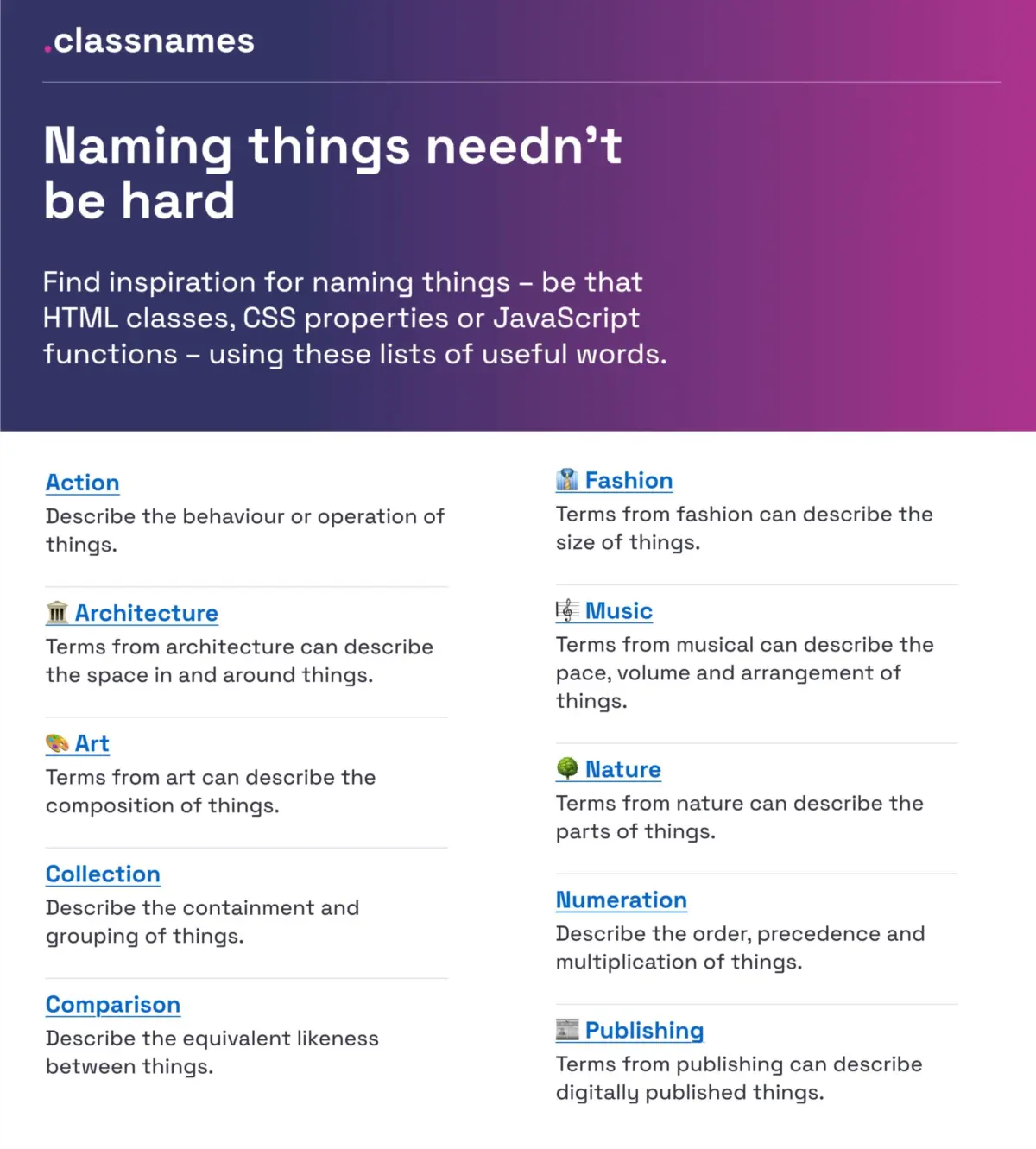
Classnames (by Paul Robert Lloyd): This brilliant resource provides thematically grouped lists of words designed to get developers and designers thinking outside the box. Moving far beyond traditional technical jargon, the site organizes terms by behavior, likeness, order, grouping, and association. Furthermore, it features unexpected themed collections drawn from nature, art, theater, music, architecture, fashion, and publishing, offering fresh linguistic angles for complex UI architecture.
2. Standardizing Color Palettes
Naming colors programmatically has historically been a subjective nightmare. Terms like "dark blue," "ocean," or "midnight" mean different things to different stakeholders.
Color Names Repository (by David Aerne / meodai): A monumental open-source repository featuring over 30,355 unique color names sourced from diverse references and thousands of community contributions. Integrated with tools like Color Parrot and comprehensive color pickers, this repository acts as an indispensable reference guide for establishing predictable, shared color tokens across design and code.
3. Layer and Group Hygiene in Design Files
Inconsistent file structures in design tools like Figma or Sketch lead to broken handoffs and developer frustration. Javier Cuello has codified a rigorous set of Design Naming Best Practices that outline how to structure layers, groups, and components consistently.
Core Principles: An effective name must possess a logical structure, remain concise yet meaningful, be universally understood across the team, and—crucially—avoid direct reference to visual properties (e.g., use Button/Primary rather than Blue-Rectangle-With-Shadow). Cuello provides extensive do’s and don’ts to govern sizes, colors, groups, and nested components.
4. Architecting Design Token Taxonomies at Scale
Building a flexible design token taxonomy that survives multi-brand and multi-product environments is one of the toughest challenges in modern design engineering.
The Intuit Case Study: Intuit—the parent organization behind powerhouse financial and productivity tools like Mailchimp, QuickBooks, TurboTax, and Mint—faced the monumental task of unifying diverse brand identities under a single token architecture. Nate Baldwin’s published case study details how the team diagnosed the pain points of their legacy taxonomy, established strict structural criteria, and deployed a foundational token system that scales effortlessly across distinct product ecosystems.
Vodafone UK Variables Taxonomy Map: Demonstrating how to orchestrate a complex, multi-brand, multi-themed architecture, Vodafone UK’s Figma community resource breaks down token anatomy into a meticulously organized system of collections. Building upon Nathan Curtis’s foundational work on token naming, this mapping strategy establishes clear lineage across four distinct layers—ranging from raw brand primitives and semantics right through to page-level implementations.
Design Token Naming Guide & Builder (by Romina Kavcic): An interactive tool designed to demystify design token creation. It allows teams to configure custom naming structures by defining components, categories, states, and roles. Paired with her Design Token Names Inventory spreadsheet, Kavcic offers a bird’s-eye view of entire token libraries, allowing teams to filter, scale, and adapt variables without losing structural integrity.
5. Demystifying UI Component Nomenclature
When struggling to name a specific interface pattern, looking at established design systems is the most reliable shortcut.
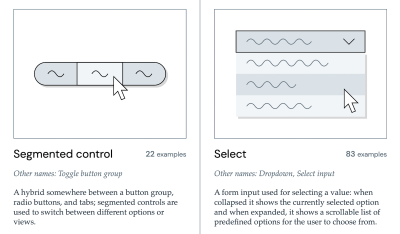
The Component Gallery (by Iain Bean): A definitive collection cataloging more than 50 real-world UI components (ranging from accordions to visually hidden elements) harvested from production-grade design systems. It documents the various aliases and alternative names each component goes by in the wild, eliminating guesswork during component library construction.
Name That UI: A specialized visual dictionary serving as a rapid-reference tool for identifying and labeling common UI components accurately.
6. Crafting High-Adoption Feature Names
Low feature adoption in digital products is frequently traced back to poor discoverability rooted in confusing nomenclature. Users must discover a feature, understand its value, try it out, and seamlessly integrate it into their existing workflows.
Erin Gannon’s Practical Guide: As outlined in her seminal UX design framework, effective feature naming must be strictly anchored in user needs and problem spaces. Names should actively signal the value or outcome of a feature (its "job-to-be-done") by tapping directly into the user’s native vocabulary rather than internal corporate jargon.
7. Product and Service Naming
Beyond micro-components and code variables, naming an entire digital product or service requires a dedicated branding methodology.
Onym: An open-source repository organizing tools, ideation methodologies, brainstorming prompts, vetting frameworks, sprint guides, and etymological resources. It serves as a comprehensive compass for product teams embarking on brand naming initiatives.
Official Statements and Industry Consensus
Industry leaders and design system directors continually emphasize that linguistic alignment is the bedrock of organizational efficiency.
"The language we use shapes the way we think about things, but also the conversation we have about it. When designers speak one dialect, developers another, and product managers a third, the resulting friction is inevitable. True velocity is achieved only when cross-functional teams share a single, unambiguous vocabulary."
— Design Systems Thought Leadership Consensus
Experts widely agree that technical debt is rarely just a code problem—it is frequently a communication problem. When an organization fails to codify its taxonomy, it inadvertently builds software in silos, leading to duplicated components, fragmented user experiences, and inflated maintenance costs. By investing in shared glossaries, naming conventions, and automated linters, engineering and design leaders are shifting nomenclature from an afterthought to a core pillar of operational excellence.
Future Outlook: The Next Frontier of Digital Taxonomy
As the digital product design ecosystem continues to mature, the future of naming will inevitably intersect with advanced automation, artificial intelligence, and programmatic token pipelines.
AI-Assisted Nomenclature: We are entering an era where AI models trained on enterprise design systems can automatically flag naming anomalies, suggest semantic improvements, and ensure adherence to W3C Design Token Community Group (DTCG) specifications.
Standardized Cross-Platform Tokens: The formalization of universal token specifications will allow design tokens to flow seamlessly from Figma variables directly into iOS, Android, and Web codebases without manual translation, making rigorous hierarchical naming more critical than ever.
Living Glossaries: Future design system tooling will likely feature real-time, synchronized glossaries embedded directly within IDEs and design canvases, ensuring that whenever a new component or feature is conceptualized, its name is instantly vetted against organizational standards.
Wrapping Up
Ultimately, the "right" name is simply the one that is universally understood, embraced, and actively utilized by both the multidisciplinary team and the end user. Countless hours are wasted daily simply because teams discuss the exact same underlying concept using entirely different dialects—the designer’s dialect, the developer’s dialect, the product manager’s dialect, and the user’s dialect. This linguistic fragmentation is the silent killer of productivity and user engagement.
If your product suffers from low feature adoption or your codebase feels brittle and incomprehensible, inspect your names first. Pay close attention to emergent naming conflicts, catalog them in a dedicated backlog, and resolve them systematically. Standardizing your taxonomy is one of the most high-leverage investments an engineering and design organization can make—drastically reducing friction, eliminating confusion, and empowering teams to build superior digital experiences together.