The landscape of freelance writing has shifted irrevocably. Artificial intelligence tools are no longer speculative novelties or futuristic experiments; they are deeply embedded infrastructural components of the modern digital economy. For the contemporary freelance writer, choosing to ignore these technologies is no longer a badge of artisanal honor—it is an economic disadvantage. Those who refuse to adapt find themselves working exponentially harder for diminishing returns, trapped in the mechanical friction of drafting, formatting, and administrative overhead.
However, a dangerous chasm has opened within the freelance community. On one side are the struggling writers who treat AI either as an existential threat to be ignored or as a lazy digital ghostwriter, vomiting out unedited, homogenized text that clients can spot within seconds. On the other side are the thriving professionals. These practitioners use AI as a force multiplier—an intelligent sous-chef that handles the cognitive drag and tedious logistics of the profession, freeing up human bandwidth for high-value tasks: strategic thinking, investigative interviews, deep subject matter expertise, and authentic client relationship management.
This guide explores 10 strategic ways freelance writers can integrate artificial intelligence into their daily operations to enhance productivity and quality, rather than compromising the unique human value they bring to the market.
Detailed Chronology: The Evolution of Writing Assistants in the Modern Workflow
To understand how to successfully wield AI today, it is helpful to trace how these tools evolved from blunt instruments into nuanced collaborators.
Phase One: The Novelty Era (2022–2023). Early language models arrived with massive hype. Writers treated them as magic buttons, attempting to generate entire articles with a single, barebones prompt. The resulting output was plagued by robotic cadences, factual hallucinations, and a complete lack of original voice. Trust plummeted, and many clients explicitly banned AI-generated content.
Phase Two: The Triage and Assistance Era (2023–2025). As tools like ChatGPT and Claude matured, savvy freelancers realized that asking an algorithm to write a piece was the wrong approach. Instead, they began using AI for micro-tasks: overcoming writer’s block, summarizing long research documents, and organizing outlines. The focus shifted from creation to collaboration.
Phase Three: The Integrated Ecosystem Era (Present Day). Today, AI functions as a fully integrated operational suite. Through platforms like Perplexity for grounded real-time research, Otter.ai for transcription synthesis, and advanced conversational agents like Claude Cowork for business tracking, freelance writers manage entire pipelines of work seamlessly. AI has transitioned from a parlor trick into an indispensable administrative and creative co-pilot.
Supporting Context & Metrics: The Modern Freelancer’s AI Toolkit
Integrating AI into a freelance writing business requires moving past generic prompts and adopting a deliberate methodology across 10 specific operational pillars.
1. Beating the Blank Page Syndrome
The psychological barrier of the blank document is one of the greatest silent killers of productivity. Writers often know their subject intimately, yet staring at a pristine white screen induces cognitive paralysis.
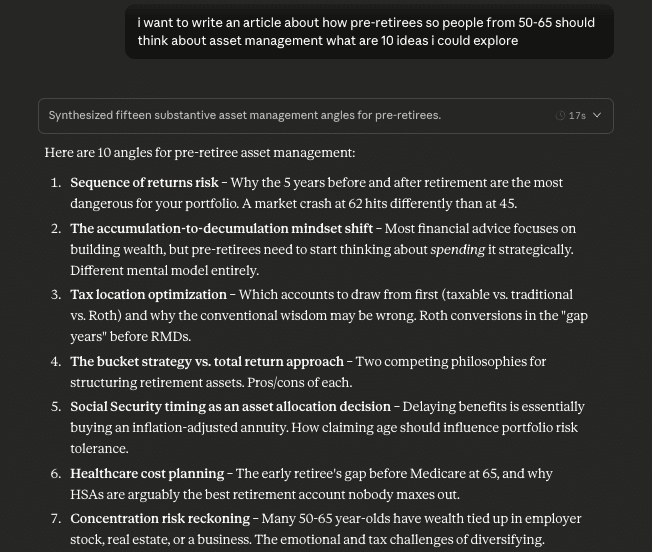
AI shines precisely at this ignition point. The goal is not to have the model write the article, but to generate immediate stimuli that you can react against. By asking tools like ChatGPT or Claude for ten distinct structural angles, alternative opening paragraphs, or potential reader pain points, you break the paralysis. Even if 80% of the suggestions are unusable, the remaining 20% acts as a cognitive lever, shifting your brain from a state of passive anxiety into active editing and ideation.
2. Streamlining the Outlining Process
A robust outline is the architectural blueprint of any successful blog post, long-form feature, or client pitch. Yet, mapping out complex arguments from rough notes can consume hours.
Writers can feed their raw, unstructured research notes, target audience data, and core objectives into an AI assistant, prompting it to propose logical hierarchies, subheadings, and section formats. Many writers establish custom prompt frameworks—such as intake templates in Claude—that systematically categorize their thoughts before spitting out tailored structural options. This cuts hours of logistical planning down to minutes, occasionally surfacing structural angles or sub-topics the writer may have initially overlooked.
3. Accelerated Research and Triage
Modern freelance writing demands deep research: analyzing lengthy whitepapers, digging through academic studies, and reviewing industry reports. AI radically accelerates this initial data triage.
Document Summarization: Paste lengthy PDFs or articles into a language model to extract core arguments, summaries, and vital statistics instantly.
Grounded Search: Platforms like Perplexity Pro provide verified, real-time web searches complete with inline citations, eliminating hours of wandering through unverified web sources and preventing embarrassing citation errors (such as accidentally sourcing a dead stat from 2014).
Transcript Synthesis: After conducting Subject Matter Expert (SME) interviews, webinar viewings, or conference reviews, feeding audio transcripts into an AI tool allows you to quickly group expert insights by thematic relevance before drafting begins.
4. Crafting Cold Emails and Letters of Introduction (LOIs)
Client acquisition relies heavily on consistent outreach, but drafting hundreds of personalized Letters of Introduction (LOIs) is mentally exhausting.
AI can generate initial frameworks, drafting multiple versions of an introductory cold email or marketing pitch to marketing agencies. However, this is where human intervention is non-negotiable. While an AI can construct 70% to 80% of the email’s structure, the final, crucial 20%—specifically the hyper-personalized opening line referencing a recent company milestone, award, or piece of company content—must be executed by the writer. This final human touch prevents your message from blending in with the sea of generic, unedited AI copy flooding agency inboxes.
5. Perfecting Headlines and Narrative Hooks
An exceptional article is worthless if its headline fails to command attention in a crowded digital marketplace. Crafting a title that is simultaneously compelling, un-clickbaity, highly specific, and concise is notoriously difficult.
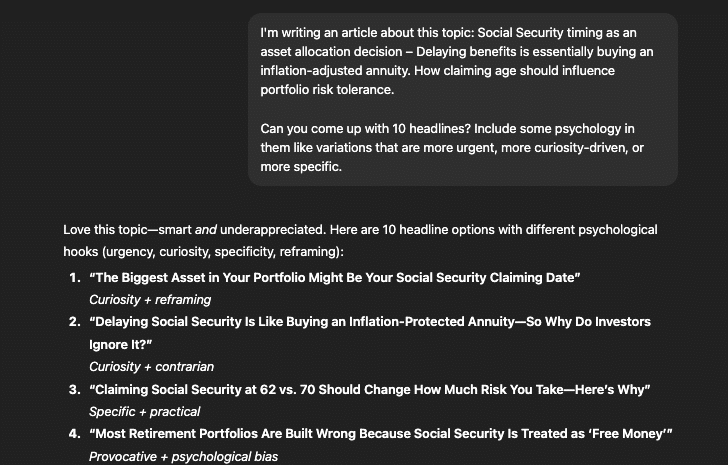
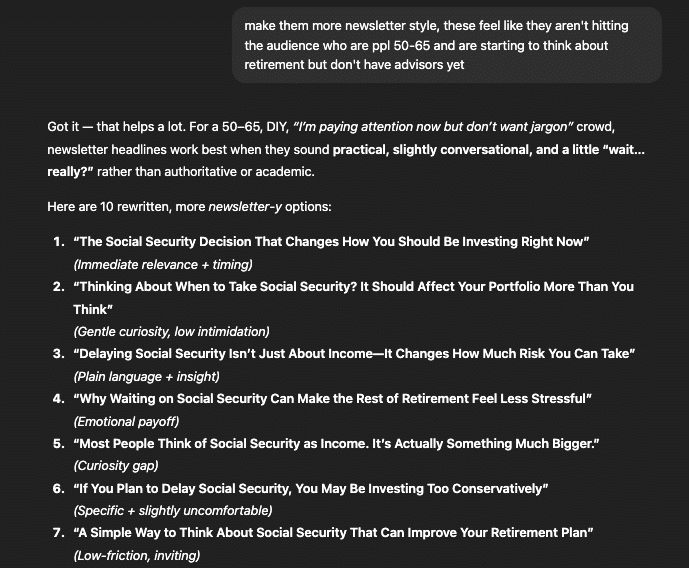
AI acts as an infinite headline generator. Prompting a model for ten distinct headline variations—tailored to emphasize urgency, curiosity, or data-driven specificity—eliminates the agony of staring at a blank title field. Writers can cherry-pick the strongest elements from multiple AI suggestions, blending them into a headline that resonates with their distinct editorial voice. The same iterative process applies to crafting gripping introductory hooks that immediately pull the reader into the narrative.
6. Advanced Editing and Proofreading
Human cognitive bias makes proofreading your own work nearly impossible; your brain instinctively fills in what it intends to read rather than catching what is actually written on the page.
AI provides a tireless, objective second set of eyes. Pasting a draft into an assistant and prompting it to flag wordiness, convoluted syntax, or logical gaps cleans up prose efficiently. Writers can even assign personas to the AI—asking it to act as an unsparing developmental editor or as the specific target audience member, detailing what parts of the argument remain confusing or unconvincing. Coupled with dedicated grammar tools like Grammarly, this step ensures technical precision while preserving the writer’s authentic tone.
7. Multichannel Content Repurposing
Writing a 1,500-word authoritative blog post is only half the battle; modern freelancers must promote their work across LinkedIn, X (formerly Twitter), newsletters, and other social channels. Writing distinct promotional copy from scratch for every platform is inefficient.
By feeding your completed article into an AI assistant, you can generate a robust distribution package with precise prompts:
Extract five distinct LinkedIn post hooks utilizing data points from the piece.
Draft a multi-part conversational thread summarizing core takeaways.
Summarize key highlights for inclusion in a weekly email newsletter.
This transforms a single piece of long-form writing into 5 to 10 distinct promotional assets, maximizing audience reach without requiring an exhaustive amount of redundant labor. Furthermore, mastering this repurposing workflow establishes a high-value skill that freelancers can turn around and sell directly to clients as an upsell service.
8. Comprehensive Interview Preparation
High-quality quotes stem from high-quality, probing interview questions. When interviewing subject matter experts (SMEs)—especially in unfamiliar industries—pre-interview research is vital to avoid wasting the expert’s time with elementary questions.
Writers can use tools like Perplexity to gather up-to-the-minute data on an industry, then prompt an AI assistant to generate ten sharp, nuanced questions designed to elicit specific, engaging insights. This preparation not only elevates the standard of the resulting article but also alleviates pre-interview anxiety for the writer.
9. Managing and Navigating Interview Transcripts
Conducting long-form interviews yields mountains of raw transcript text. Navigating a 10,000-word Otter.ai transcript to locate one specific statistic or quote about compliance or industry trends can derail a writing schedule.
Utilizing built-in conversational features within transcription tools allows writers to query the transcript directly. Asking the AI to pull out the most impactful quotes, summarize the expert’s primary arguments, or organize the sprawling dialogue by thematic categories cuts administrative navigation time down to seconds. Crucially, writers must verify every pulled quote against the original audio file before publishing to ensure total accuracy and contextual integrity.
10. Administrative Tracking and Marketing Metrics
Most creative professionals detest spreadsheets, yet tracking marketing outreach—letters of introduction, follow-up cadences, and client conversion rates—is vital for a sustainable freelance business.
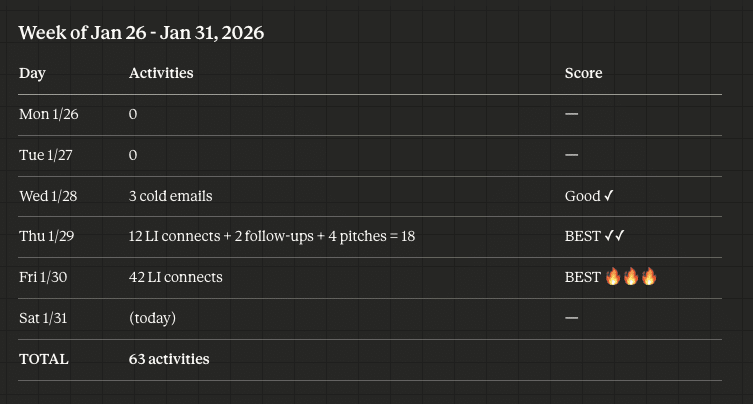
Advanced models like Claude Cowork can function as an interactive CRM and marketing tracker. By logging outreach sessions conversationally (e.g., noting who was contacted, the platform used, and the response received), the AI maintains a real-time historical record. At the end of the month, writers can request detailed analytical summaries:
How many LOIs and follow-ups were sent?
What percentage converted into discovery calls and paid clients?
Which specific niches or angles yielded the highest response rates?
By gamifying these metrics with weekly scorecards (Good, Better, Best), writers can diagnose bottlenecks in their marketing funnel, refine their outreach copy, and stay consistently motivated without ever updating a traditional spreadsheet.
Official Statements & Industry Perspectives
Industry leaders and seasoned digital entrepreneurs emphasize that the integration of artificial intelligence is fundamentally a test of professional discipline.
"AI tools aren’t new anymore. If you’re a freelance writer and you’re not using them, you’re working harder than you need to," notes Sean Ogle, founder of Location Rebel. "The freelancers who are thriving right now use AI to handle the tedious parts of the job so they can focus on the work that actually matters: the thinking, the interviews, the expertise, the relationships. The ones who are struggling are either ignoring AI entirely or using it as a crutch to produce mediocre content that clients can spot a mile away."
This sentiment underscores a broader industry consensus: technology should absorb the operational friction, leaving human talent free to focus on empathy, critical analysis, original reporting, and deep strategic alignment.
What NOT to Do With AI: Avoiding the Traps
While the expansion of artificial intelligence offers immense upside, misusing these tools can instantly destroy a freelance writing career. To protect your professional reputation, adhere to these strict boundaries:
Never outsource original thought and voice. If you let an AI write your entire article from start to finish, you are no longer a writer—you are a prompt engineer producing commoditized noise.
Never skip fact-checking. AI models are prone to hallucinating facts, statistics, and citations. Publishing unverified claims destroys client trust and professional credibility.
Never rely on unedited templates. Clients can instantly recognize the structural rhythms, clichés, and overused transition phrases (such as "In today’s fast-paced digital world…") that characterize lazy, unedited AI generation.
Never compromise confidentiality. Avoid pasting sensitive proprietary client data, unreleased financial reports, or non-public personal information into public AI models, as this may violate non-disclosure agreements (NDAs) and privacy standards.
Future Outlook
The trajectory of the freelance writing industry over the next decade is clear. Artificial intelligence will continue to saturate baseline content creation, driving the market value of generic, low-effort writing down toward zero.
Simultaneously, the demand for high-touch, deeply researched, human-centric journalism, expert interviewing, and strategic content creation will skyrocket. Clients are beginning to recognize that while anyone can prompt an algorithm to generate 1,000 words, only a skilled human professional can conduct a rigorous interview, synthesize conflicting industry data, establish genuine trust, and deliver an authentic narrative perspective.
For freelance writers, the mandate is straightforward: master the machine to eliminate the administrative drag, and double down on the distinctly human qualities that make your expertise truly indispensable. Start by integrating one or two of these workflows into your daily routine today, and scale your operational efficiency as you discover what fits your unique creative process.