

Executive Overview
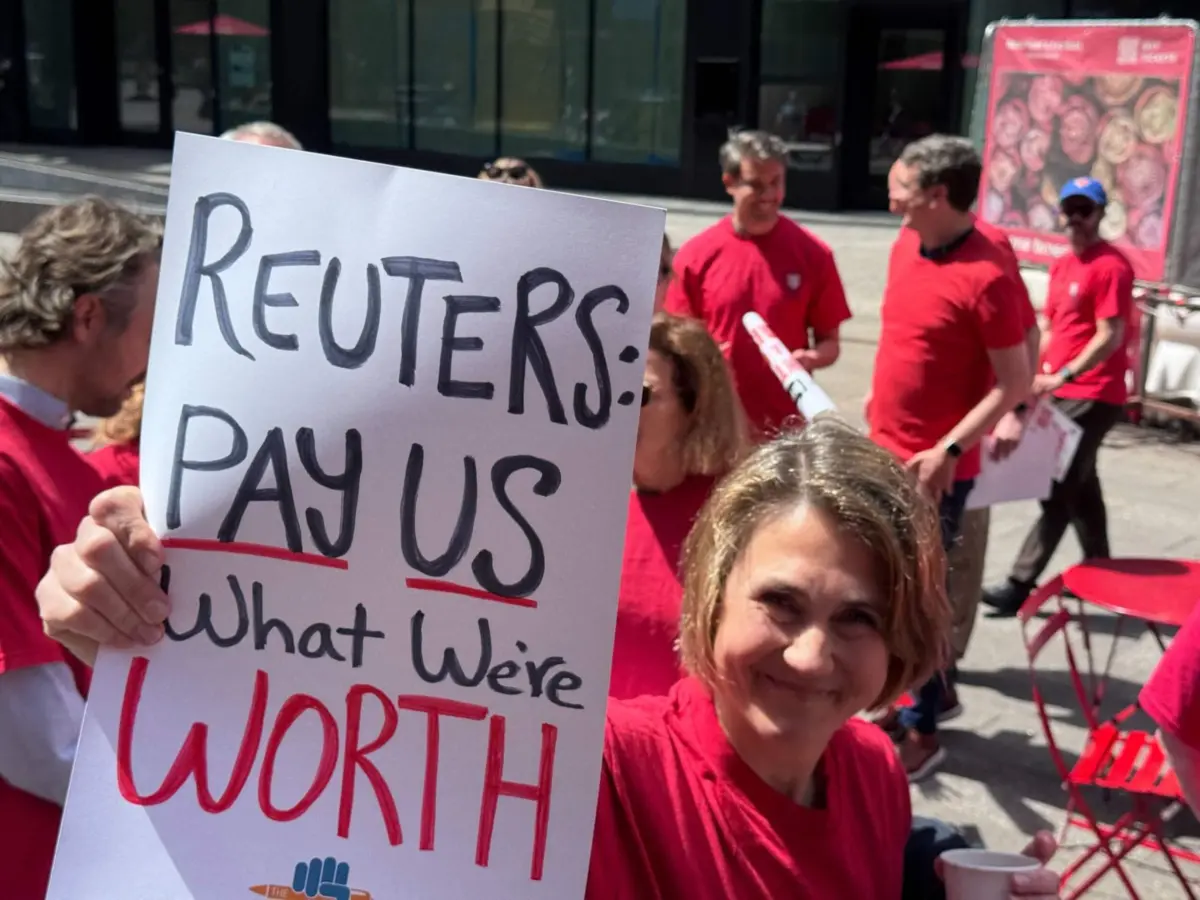
Tensions between media management and newsroom labor have reached a critical juncture at one of the world’s most prestigious news agencies. In an overwhelming show of solidarity and frustration, unionized journalists at Reuters across the United States voted to authorize a broad strike. Representing nearly 300 vital workers—including reporters, photographers, videographers, producers, graphic designers, and social media strategists—the NewsGuild-affiliated union has given its bargaining committee the ultimate leverage: the power to call an open-ended work stoppage whenever leadership deems it necessary.
This decisive vote is the culmination of more than a year of grueling, stalled contract negotiations. While both sides have reportedly inched forward on minor operational matters, an unbridgeable chasm remains regarding core economic realities. At the heart of the dispute are three defining issues of modern media labor: stagnant wages that have failed to keep pace with inflation and soaring living costs, the existential threat and economic windfall of artificial intelligence (AI), and institutional overreach regarding non-union managerial staff encroaching on traditional reporting duties.
Though Reuters employs more than 2,600 journalists globally across 165 countries, a strike by the U.S. contingent would deal a severe blow to the wire service’s daily operations. Reuters journalists based in the United States have recently been at the forefront of monumental global and domestic stories, ranging from major political elections and high-stakes corporate scandals to critical infrastructure breakdowns. A walkout would silence many of the organization’s premier scoops and exclusive investigative reports, threatening to disrupt the flow of real-time financial and geopolitical intelligence that institutional clients worldwide have relied upon for decades.
As the shadow of a potential strike looms larger than at any point in recent history, the stakes are exceptionally high. Should the bargaining committee pull the trigger, it would mark the first open-ended strike by Reuters journalists since 1980—far surpassing a brief 24-hour warning strike held in 2022. This comprehensive report examines the deep-seated grievances driving the labor dispute, the stark financial disconnect between corporate profits and worker compensation, the ethical and economic battlegrounds surrounding generative AI, and what this looming showdown means for the future of international journalism.
Detailed Chronology and Background of the Dispute
To understand how a historic institution like Reuters arrived at the precipice of a crippling labor strike, one must examine the timeline of deteriorating relations between the newsroom and the boardroom. Contract negotiations have dragged on for well over twelve months, characterized by what union representatives describe as corporate intransigence and a willful refusal to acknowledge the economic realities faced by frontline media workers.
The Breakdown at the Bargaining Table
For more than a year, the NewsGuild bargaining committee has sat across from Reuters management attempting to forge a sustainable, forward-looking collective bargaining agreement. While representatives from both sides acknowledge that modest progress has been achieved on peripheral workplace policies, the foundational pillars of the contract—namely, compensation, technological adaptation, and job security—remain fiercely contested.
Joseph Ax, a national affairs correspondent and vice chair of the guild, encapsulated the prevailing sentiment within the newsroom following the strike authorization vote. "We’ve made progress on a lot of issues, but with the core issues that remain—and especially with wages—there’s still a pretty significant gap," Ax stated. "It’s time for management to get serious so that we can have a contract and get back to doing our work."
Despite repeated efforts by the union to find a reasonable middle ground, negotiations hit a brick wall over compensation structures and structural protections against emerging workplace threats. The frustration eventually boiled over, prompting the membership to organize a formal strike authorization vote. While the ballot does not mean workers are walking off the job immediately, it serves as a loaded weapon in the hands of the union leadership, signaling that patience has officially run out.
A History of Labor Unrest
Labor friction at Reuters is not entirely unprecedented, but an open-ended strike would represent a dramatic escalation from past practices. In 2022, hundreds of Reuters journalists staged a 24-hour walkout to protest stalled contract negotiations, successfully signaling their discontent to leadership. However, that action was strictly time-limited and designed primarily as a warning shot.
To find a precedent for an indefinite, open-ended work stoppage of this magnitude, labor historians and veteran staffers must look back more than four decades to 1980. The fact that current employees are contemplating a return to tactics not seen since the Reagan era underscores the depth of the current crisis. It suggests that contemporary journalists view the current threats to their livelihood—ranging from the unchecked integration of artificial intelligence to systemic wage erosion—as existential rather than merely transactional.
Supporting Context and Metrics: Profits, AI, and the Economic Disconnect
The core of
the labor dispute is fundamentally economic. As Reuters navigates a rapidly shifting digital landscape defined by automation and algorithmic content curation, a stark ideological divide has emerged over how the fruits of modern media production are distributed.
The Wage Stagnation Crisis
According to union leadership, Reuters journalists have not received a single across-the-board cost-of-living raise in two years. In an economic environment marked by persistent inflation, rising housing costs, and soaring out-of-pocket medical expenses, this prolonged wage freeze has placed immense financial strain on newsroom personnel.
The gap between what the union is asking for and what management is offering highlights the profound disagreement over employee valuation:
- The Union’s Proposal: The guild is seeking a 4% wage increase for the first year of the new contract, retroactive to December 2025, followed by guaranteed annual raises of 3.75% in subsequent years.
- The Company’s Counteroffer: Management has countered with a non-retroactive 3% wage increase for the first year, paired with meager guaranteed raises of just 1.25% for the following two years.
For rank-and-file workers, the company’s proposal amounts to a real-term pay cut when measured against historical inflation trends. Andy Sullivan, a Washington, D.C.-based correspondent and member of the union’s bargaining committee, noted that members have shared harrowing personal stories of struggling to pay rent, manage medical bills, and keep up with basic household expenses.
The AI Boom and Corporate Profitability
What makes the wage stagnation particularly galling to Reuters journalists is the company’s robust financial health. Far from struggling to stay afloat in a declining media market, Reuters is experiencing significant financial growth, driven largely by technological licensing deals.
In its most recent quarterly earnings report, parent company Thomson Reuters announced a stellar 12% year-over-year revenue increase, hauling in $232 million for the quarter. This financial windfall is heavily attributed to AI content licensing agreements, wherein major tech conglomerates such as Microsoft and Meta pay millions of dollars to ingest Reuters’ vast archives and real-time reporting to train their proprietary large language models.
This dynamic has created a profound ethical and economic paradox within the newsroom. Journalists are producing the high-value intellectual property that powers multi-billion-dollar artificial intelligence systems, yet they are being told by management that corporate coffers are too constrained to provide fair, cost-of-living-adjusted wages.
"When they sit at the table and tell us, ‘Times are tough, and we can’t really afford to pay you guys,’ that’s clearly not true," Sullivan remarked. "And it’s just disappointing that they’re sticking with this line, and they expect us to swallow it."
The Artificial Intelligence Battleground
Beyond basic salary concerns, artificial intelligence has emerged as a multi-faceted battleground in the negotiations. The union is not merely fighting for a slice of the AI revenue pie; it is fighting for professional survival and quality control.
The union’s demands regarding AI center on three primary pillars:
- Revenue Sharing: Because tech giants utilize newsroom journalism to train generative AI models, workers argue they deserve a direct share of the proceeds. While reporters have historically accepted that their salaries cover the direct sale of news stories to traditional media clients, feeding proprietary reporting into automated systems to train replacement bots crosses a red line. As Joseph Ax explained, "What we didn’t necessarily sign up for is to have our stories fed to AI models for content, so that they can build better and smarter robots that could eventually take our jobs. That’s the part of it that we’re seeking to get a piece of."
- Enhanced Severance: Recognizing the inevitability of automation-driven workforce reductions, the union is demanding significantly enhanced severance packages for any workers laid off as a direct result of AI implementation.
- Mandatory Human Oversight: To protect the journalistic integrity and factual accuracy that defines the Reuters brand, the union is pushing for ironclad commitments that any content generated or assisted by AI must be subjected to rigorous human verification and oversight.
The Rise of "MINOs" (Managers in Name Only)
Compounding the anxiety over artificial intelligence is a traditional structural grievance that has intensified in recent years: the blurring of lines between union and management duties.
Union journalists are increasingly grappling with a phenomenon where certain editors—classified as management and therefore excluded from union protections—routinely perform core reporting and writing tasks. Reporters find themselves forced to compete with their own editors for bylines and prominent placements, effectively eroding the union’s jurisdictional boundaries.
Staffers have coined a sardonic acronym for these individuals: MINOs, or "Managers in Name Only." According to union members, these individuals spend the vast majority of their working hours generating original reporting and writing stories rather than fulfilling administrative, supervisory, or true editorial oversight roles. This practice not only undermines union solidarity but also creates an unfair internal hierarchy that disadvantages dues-paying staff writers.
Official Statements and Industry Impact
As the threat of a strike looms large over international media circles, the official response from corporate leadership has been notably restrained, contrasted sharply by the vocal and unified stance of newsroom representatives.
Management Silence
As of press time, Reuters corporate management has not publicly responded to requests for comment regarding the strike authorization vote or the specific economic demands put forward by the NewsGuild. This strategic silence reflects a corporate communications playbook designed to minimize public leverage for the union while internal mediation and bargaining sessions continue behind closed doors. However, media analysts note that stonewalling an overwhelmingly united newsroom could severely backfire if the bargaining committee decides to issue a formal strike notice.
The Operational Vulnerability of a Global News Giant
While a strike by 300 U.S.-based workers represents a fraction of Reuters’ total global headcount of 2,600 journalists spread across 165 countries, industry experts agree that the domestic bureau serves as an indispensable anchor for the wire service’s global product.
U.S. journalists are routinely responsible for covering the world’s most influential financial markets, regulatory bodies, and political power centers. Andy Sullivan emphasized the irreplaceable nature of the domestic workforce, noting that unionized reporters have recently anchored coverage of major domestic and international milestones, including the midterm elections, high-profile corporate corruption scandals like the Nvidia disclosures, and critical operational breakdowns at federal agencies like the Federal Aviation Administration (FAA).
If a walkout occurs, the disruption to the news cycle would be immediate and profound. "There wouldn’t be any sort of exclusives, any scoops, any of the real distinctive coverage that Reuters clients have come to depend on," Sullivan warned. For an organization whose primary business model relies on delivering unassailable, real-time scoops to financial institutions, media outlets, and corporate subscribers worldwide, even a temporary blackout of U.S. reporting could result in catastrophic client dissatisfaction and substantial financial fallout.
Future Outlook: What Lies Ahead for Reuters and Media Labor
The strike authorization vote by Reuters journalists is more than a localized contract dispute; it serves as a bellwether for the entire journalism industry at a moment of profound technological and economic transition.
As traditional media companies transition into hybrid tech-media entities—relying heavily on software licensing, algorithmic data distribution, and AI partnerships—the fundamental compact between media owners and newsroom employees is being rewritten. Workers are no longer willing to accept flat wages while executive compensation rises and corporate revenue is supercharged by technological innovations built on the backs of human reporters.
Potential Scenarios
- A Last-Minute Bargaining Breakthrough: Pressured by the immense financial risk of a high-profile strike and the potential loss of exclusive reporting during a critical news cycle, Reuters management may return to the bargaining table with improved financial concessions. This could include a compromise on the wage scale, retroactivity terms, and initial guardrails on AI deployment.
- A Short Warning Strike: Similar to the 2022 action, the bargaining committee could call a limited 24- or 48-hour strike to demonstrate resolve and force management’s hand without triggering an indefinite operational crisis.
- An Open-Ended Historic Strike: If corporate leadership remains entrenched and refuses to close the significant gap on wages and technological protections, Reuters could witness its first open-ended newsroom strike in over 44 years. Such an action would fundamentally disrupt global financial reporting and establish a militant precedent for unionized media workers across the globe.
Conclusion
The battle lines at Reuters reflect the defining struggle of twenty-first-century journalism: balancing the relentless pursuit of technological efficiency and corporate profitability against the basic dignity, fair compensation, and job security of the human beings who uncover the truth.
As the NewsGuild bargaining committee weighs its next moves, the entire media landscape is watching closely. Whether Reuters management chooses to invest in its human capital or risk an unprecedented disruption to its global news empire will send a powerful message to media workers everywhere about the true value of journalism in the age of artificial intelligence.
