

Executive Overview
Every digital product, corporate portal, and marketing landing page experiences a definitive peak on its launch day. The final Git branch is merged, the staging environment is cleared, and the site goes live precisely as envisioned by its creators. For a brief, intoxicating moment, the system is pristine.
It will never be this good again.
This gradual descent into obsolescence is rarely catastrophic. Sites do not typically implode overnight; rather, they experience a silent, systemic decay. Market shifts occur, messaging strategies evolve, competitors push aggressive redesigns, and the meticulously engineered digital storefront slowly falls out of sync with the living organization behind it. A year later, a website often functions as a digital period piece: fully operational, yet fundamentally behind the curve.
For decades, digital teams have accepted this decay as an immutable law of nature—a frustrating tax paid for maintaining an online presence. However, the maturation of autonomous artificial intelligence agents promises to rewrite this paradigm. By continuously optimizing, auditing, and updating websites post-launch, autonomous platforms aim to ensure that a digital property improves over time rather than drifts into irrelevance.
Yet, as industry practitioners attempt to implement full-scale website autonomy, they have collided with an unexpected friction point that has little to do with computational limits: almost nobody actually wants a website that changes entirely on its own.
In this deep-dive investigation, we examine the philosophical, architectural, and organizational challenges of building autonomous web systems. Drawing insights from Pierre Burgy, co-founder of the autonomous website platform Fimo, we explore why "full autonomy" is a flawed industry goal, how teams must renegotiate their relationship with digital infrastructure, and why the ultimate promise of AI agents is not about removing humans from the loop—it is about systematically eliminating digital decay.
Detailed Chronology: The Evolution from Static Handcrafting to Autonomous Maintenance
To understand the current pivot toward agentic web operations, it is necessary to trace how web development and maintenance have evolved over the last three decades.
[The Static Era (1995–2010)] ──> [The CMS & CI/CD Era (2010–2023)] ──> [The Autonomous Agent Era (2024–Present)]
- Manual HTML/CSS coding         - WordPress, Drupal, Headless CMS        - Continuous background optimization
- Deployments require FTP        - Automated staging & pipeline builds    - Rule-bound chores managed by AI
- Maintenance is episodic        - Updates are human-initiated            - Dynamic trust boundaries & agent composition
1. The Static and Early CMS Era (1995–2010)
In the early days of the commercial internet, websites were handcrafted documents or managed via early Content Management Systems (CMS) like WordPress and Drupal. Maintenance was strictly episodic. A site was launched, left alone for months, and then subjected to a disruptive, expensive "redesign" every three to five years. During the intervening periods, broken links accumulated, accessibility standards shifted, and design tokens fractured.
2. The Modern Development Pipeline Era (2010–2023)
The maturation of modern frontend frameworks (React, Vue, Svelte), design systems, and CI/CD (Continuous Integration/Continuous Deployment) pipelines drastically improved release velocity. Automated testing suites emerged to catch broken builds before they hit production.
Despite these engineering marvels, a core bottleneck remained: human attention. While CI/CD pipelines automate the technical deployment of code, they cannot write new marketing copy, adjust accessibility semantics when content changes, or ensure that a design-system token update propagates across legacy landing pages. Code pipelines require human engineers to initiate and direct every change. Consequently, when engineering teams move on to new feature development, the website enters a state of operational stasis.
3. The Autonomous Agent Era (2024–Present)
The current paradigm shift introduces Large Language Models (LLMs) and goal-directed autonomous agents capable of perceiving site environments, executing code modifications, running tests, and proposing optimizations without constant human prompting. Platforms like Fimo represent a vanguard movement attempting to bridge the gap between static human oversight and hyper-dynamic AI execution.
However, early implementations revealed a paradox: when given full authority to edit, optimize, and publish changes across an entire web architecture, human stakeholders experienced intense hesitation. Absolute autonomy felt less like an assistant and more like an uninvited co-pilot rewriting the brand identity behind closed doors.
Supporting Context & Metrics: Deconstructing the Maintenance Burden
The friction surrounding autonomous websites stems from a fundamental misunderstanding of what a website actually is. A website is not a monolithic application; it is a collaborative nexus where design, engineering, copywriting, and executive strategy intersect.
When developers and platform architects analyze the daily lifecycle of a digital property, website maintenance tasks can be categorized into three distinct operational piles:
┌────────────────────────────────────────────────────────┐
│               THE WEBSITE MAINTENANCE SPLIT            │
├────────────────────────────────────────────────────────┤
│ 1. The Chores (80%)      Rule-bound, repetitive,       │
│                            joyless tasks (a11y, tokens,│
│                            broken links, uncompressed  │
│                            images).                    │
├────────────────────────────────────────────────────────┤
│ 2. The Untouchables      Brand identity, core value    │
│    (<5%)                   propositions, subjective    │
│                            aesthetic judgment.         │
├────────────────────────────────────────────────────────┤
│ 3. The Gray Area         Context-dependent decisions   │
│    (15–20%)                where the boundary shifts   │
│                            based on stakeholder role.  │
└────────────────────────────────────────────────────────┘
Pile 1: The Chores (Rule-Bound Operations)
Accounting for roughly 80% of routine site maintenance, this category includes tasks that are strictly rule-driven and utterly devoid of subjective artistic taste:
- Ensuring WCAG accessibility compliance as dynamic content shifts.
- Propagating a design-system token update across hundreds of legacy subpages.
- Identifying and replacing broken metadata tags or missing
alttext attributes. - Compressing oversized image assets uploaded during rushed marketing pushes.
Nobody is hired for their visionary talent in spotting missing meta descriptions. These tasks represent cognitive drag. Handing these chores over to an autonomous agent is universally welcomed because the work is governed by objective rules rather than subjective taste.
Pile 2: The Untouchables (Subjective Judgment)
At the opposite end of the spectrum lies the core work of human creators. An agent can verify contrast ratios, confirm heading hierarchies, and check copy against a style guide. However, an agent cannot inherently decide what a page should feel like or whether a creative leap aligns with the company’s long-term vision.
This human-centric domain involves high-level taste, strategic pivots, and brand positioning. This is why sweeping, uncritical automation feels jarring to creative teams: it threatens to automate the very judgment they were hired to provide.
Pile 3: The Gray Area (Role-Dependent Boundaries)
The most challenging operational segment lies between tedious chores and untouchable creative direction. Crucially, the boundary line in this gray area is not fixed across an organization; it varies depending on who is evaluating the change.
Consider a practical example: changing the default user interface theme to dark mode upon landing.
- The Developer: Views this as a straightforward configuration update with a clear technical rationale—the kind of task they are happy to delegate to an agent to execute and log.
- The Brand Designer: Views the default theme as a profound statement of brand identity and visual hierarchy. They demand absolute veto power over how the brand is initially perceived by incoming visitors.
This dichotomy proves that "right" and "wrong" in website operations are not universal software settings. They are functions of where individual value resides within an enterprise.
Official Insights & Architectural Philosophy
In light of these findings, platform builders have had to radically rethink how autonomy is administered. Pierre Burgy and his engineering team discovered that providing a simple master toggle—switching a website from "Manual" to "Autonomous"—fails to satisfy cross-functional teams.
Moving Beyond the Master Toggle
If the line of autonomy is inherently personal and role-dependent, static UI toggles are insufficient. The unit of control must shift from a binary system setting to the composition of the agent itself.
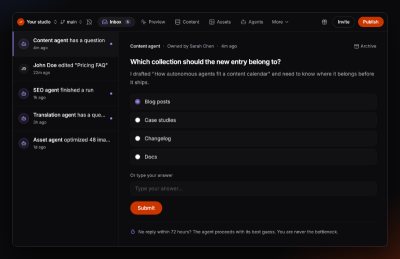
In advanced autonomous platforms, users do not select from a rigid menu of pre-set behaviors. Instead, they compose specialized agents, defining granular permissions for what each agent is permitted to inspect, modify, or publish:
- The Accessibility Agent: Configured to run continuous audits and deploy fixes autonomously without requiring human sign-off.
- The Content & Brand Agent: Configured in a read-only or suggestion-only mode, flagging stylistic updates for human review before deployment.
- The Asset Optimization Agent: Authorized to compress images, audit scripts, and purge unused CSS safely in the background.
Trust Through Observability
Trust in autonomous systems cannot be established via marketing promises; it must be earned through transparent execution logs and deterministic auditing. Modern platforms provide comprehensive execution histories, diff viewers (showing exact before-and-after states), and rollback mechanisms.
When an agent quietly rectifies an oversight—such as patching a broken redirect loop or resolving a newly introduced layout shift—and presents a transparent audit trail to the engineering lead, psychological friction diminishes. Trust compounds not through blind faith, but through verifiable outcomes.
Future Outlook: The Imperative of Continuous Evolution
As organizations navigate the generative AI era, the debate surrounding website autonomy will mature from skepticism to strategic integration. The industry is arriving at a critical realization: the frozen website is a far greater business risk than an actively managed, autonomous digital footprint.
Websites that remain static in an accelerating digital marketplace do not stay secure; they simply atrophy. They lose search engine visibility, drift away from emerging accessibility mandates, and fail to reflect the dynamic realities of the businesses they represent.
The ultimate promise of autonomous web architectures is not to displace human creativity, but to liberate digital creators from administrative decay. By delegating rule-bound chores to tireless agents, teams can reclaim their cognitive bandwidth, directing human judgment precisely where it matters most: crafting exceptional experiences, defining visionary brand identities, and telling compelling stories.
The point of website autonomy was never to remove humans from the loop. It was to remove the decay.
