

Executive Overview
In the current landscape of enterprise software, artificial intelligence is frequently treated as an indiscriminate upgrade. Product teams face relentless pressure from executive leadership and competitive market forces to integrate generative AI features into existing workflows. The prevailing assumption—often termed "pro-innovation bias" in organizational research—suggests that adding autonomous capabilities will invariably save time, reduce operational overhead, and elevate user productivity.
However, a recurring friction plagues these deployments. Users find that an AI feature designed to save them time on a specific task merely forces them to spend an equivalent amount of time checking, verifying, and correcting the results. Far from streamlining operations, poorly integrated intelligence introduces an invisible administrative tax. Workers inherit the responsibilities of proofreaders and quality-assurance auditors for systems that frequently output errors dressed up in confident, fluent prose.
To address this widespread design failure, product organizations require a rigorous practical audit framework. This audit is not a substitute for strategic planning or high-level investment decisions; rather, it serves as a pre-design instrument. By evaluating a proposed AI feature against four foundational questions, product teams can determine precisely where artificial intelligence earns its place, what specific adjustments it demands of the human user, and which parts of a workflow must remain strictly under human control.
Detailed Chronology: The Anatomy of an Enterprise AI Misstep
To understand the practical mechanics of this audit, one need only examine a case study from a large health insurer. A product team within the organization set out to streamline the workload of benefits appeals specialists. Their proposed solution was an AI-driven tool designed to write full written determinations for benefits appeals automatically.
Phase 1: The Initial Misguided Deployment
On paper, the technology functioned precisely as specified. The model ingested case details, referenced policy guidelines, and generated complete, coherent draft determinations. The product team expected adoption rates to soar and case-handling times to plummet.
Instead, the exact opposite occurred. Specialists rapidly abandoned the feature. Those who persisted in using the tool actually took longer to complete each case than their colleagues who ignored the AI entirely and continued writing determinations manually.
A rapid evaluation with the specialists surfaced the core issue: reading an AI-written determination carefully enough to sign off on it took roughly as long as writing the document from scratch. Moreover, the specialists were forced to hunt for subtle, counter-intuitive mistakes—errors the AI hallucinated that a trained human specialist would never have made. The automation did not eliminate labor; it merely converted generation labor into verification labor, adding friction to a task these professionals had already mastered.
Phase 2: The Operational Realignment
Recognizing the failure of the initial release, the product team rescoped the feature. They recognized that the technology itself was not inherently flawed; rather, it was assigned to the wrong part of the workflow.
In the second version, the AI’s role was fundamentally re-engineered. Instead of drafting the final text, the system was programmed to surface relevant policy provisions and cite prior decisions specific to each incoming appeal. The actual writing of the determination was left entirely in the hands of the human specialist.
The impact was immediate. The tedious manual search step disappeared from the workflow, review times plummeted, and the core analytical and drafting responsibilities remained securely with the human expert. The underlying artificial intelligence technology was identical in both versions; the critical variable was simply which part of the task the machine handled.
Supporting Context & Metrics: Finding the Break-Even Line
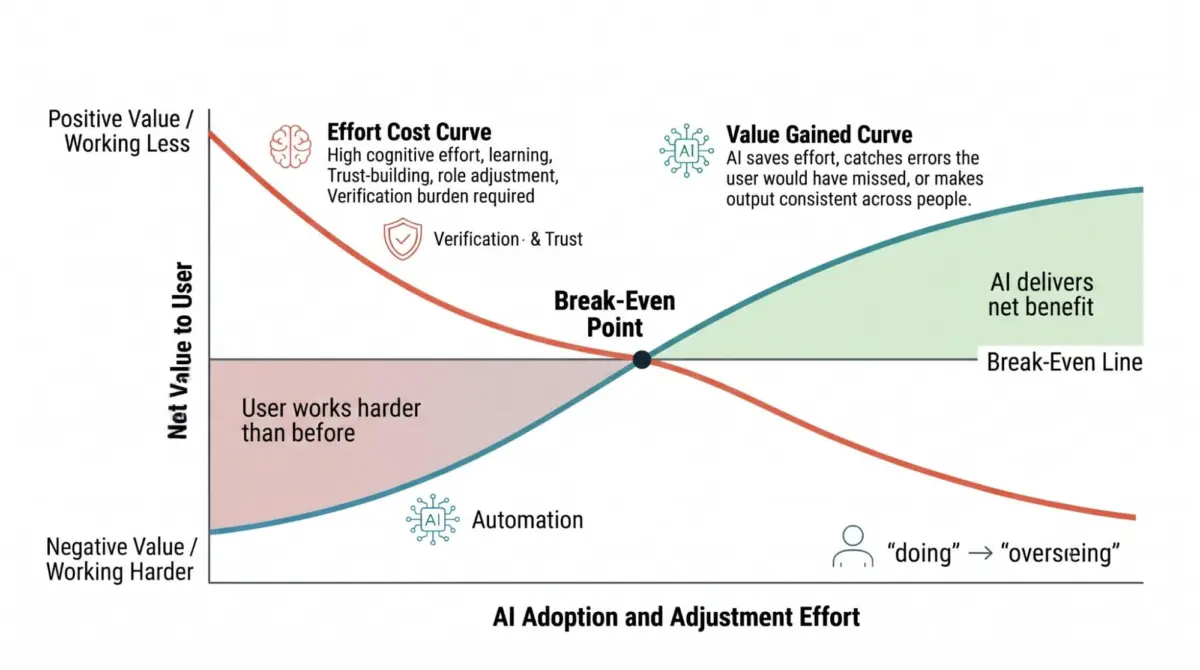
Every interface modification imposes a cognitive cost on the user before it yields any tangible return. Users must mentally reconstruct their operational mental model, locate relocated interface elements, and establish a baseline level of trust regarding what the system outputs.
Human cognitive architecture imposes strict physiological limits on this adaptation process. Landmark psychological research, such as Nelson Cowan’s 2001 review of working memory capacity, establishes that human working memory can hold only about four distinct items in mind at once. Introducing an enterprise AI feature draws heavily from this same limited cognitive reserve.
The Dynamics of Professional Identity and Cognitive Load
Handing synthesis tasks over to an AI transforms the user from an active creator into a passive checker. Handing over recommendations as well shrinks the job description to little more than signing off on machine decisions. This shift carries profound psychological and professional consequences.
In a 2025 study led by Sophia Ackerhans and colleagues, researchers found that physicians asked to sign off on AI-assisted clinical decisions experienced a severe perceived threat to their professional identity. Furthermore, attempts to mitigate this discomfort by providing explanations of the AI’s underlying reasoning often had a paradoxical effect: while transparency slightly improved user trust, it simultaneously heightened the perceived threat to professional autonomy.
An AI feature successfully earns its place in an enterprise environment only when its net returns surpass the total adjustment costs imposed on the user. We can conceptualize this threshold as the break-even line.
[Value Gained]
      ^
      |                   / (Net Benefit Above Break-Even Line)
      |                  /
      |    _____________/. <-- Break-Even Point
      |   /
      |  / (Initial Working Effort Exceeds Returns)
      +---------------------------------------------------->
                                Time / Familiarity
Returns generally manifest in three distinct forms:
- Errors Caught: The system flags oversights or anomalies the user would likely have missed (e.g., fraud screening algorithms).
- Time Saved: The system accelerates repetitive, highly structured execution pathways.
- Synthesis Achieved: The system aggregates disparate datasets to uncover hidden patterns across scale.
The Four Audit Questions
To locate the break-even line prior to committing engineering resources, product teams must evaluate proposed features against four rigorous questions:
Question 1: Does this reduce the total effort the task takes for this user?
Product teams must account for all cognitive, physical, and verification demands. Fewer clicks mean nothing if the user is forced to work harder to verify the output. For instance, pre-filling a repetitive tracking field often relocates labor rather than eliminating it, as the user must now audit every auto-populated entry. Furthermore, user segmentation is critical: an AI risk summary may heavily benefit a junior analyst lacking deep pattern recognition libraries, while adding pure overhead for a senior expert.
Question 2: Does this beat the way the user does the task now?
The automated approach must be measured directly against existing user workarounds, spreadsheets, and established routines. AI excels when tasks involve genuine ambiguity, scale, speed, or cross-system consistency. However, if a user has already mastered a fast, reliable route to a known answer, introducing an AI-driven interaction layer creates unnecessary friction.
Question 3: Can the user catch the errors?
Every AI model hallucinates or errs. Product teams must evaluate the visibility of potential errors and the severity of their consequences. When error visibility is low and stakes are high, automation bias—a well-documented psychological phenomenon explored by Raja Parasuraman and Dietrich Manzey in 2010—compels humans to uncritically defer to automated output. To counteract this, high-stakes features must incorporate robust provenance display, showing users precise data sources and retrieval timestamps.

Question 4: After a year of using this, can the user still tell when the AI is wrong?
While routine administrative automation is beneficial, delegating core analytical judgment to machines causes human verification skills to atrophy over time. Radiological studies by Thomas Dratsch and colleagues (2023) demonstrate that misleading AI suggestions rapidly degrade diagnostic accuracy across all experience levels. If a feature replaces human judgment without providing ongoing feedback mechanisms, users will lose their capacity to audit the system effectively within twelve months.
Official Statements and Strategic Frameworks
Industry analysts and product leaders increasingly emphasize that generative AI features must be governed by strict architectural constraints rather than speculative enthusiasm.
"An AI feature earns its place when what it returns beats what it costs the user to adjust, for one user doing one task," notes leading UX research authority NN/g. "Treating enterprise AI as a binary ‘yes/no’ roadmap item invites systemic failure."
To operationalize this philosophy, product teams are urged to embed specific design conditions directly into project requirements on day one:
| Audit Question | AI Earns Its Place When… | AI Costs the User When… | Enforced Design Condition |
|---|---|---|---|
| 1. Total Effort | The task requires synthesizing vast inputs and resolving judgment bottlenecks. | The task follows a fast manual procedure; verification matches original work. | Name the specific user segment served; build clear exits for others. |
| 2. Current Method | AI wins on ambiguity, scale, speed, and consistency. | The user’s existing method already reaches answers quickly and reliably. | Strip AI from steps adequately handled by current workflows. |
| 3. Error Detection | Errors are visually obvious, stakes are low, and correction is cheap. | Errors are subtle, stakes are high, and verification requires delegated skills. | Provenance display and verification prompts, or cancel the build. |
| 4. Long-term Skill | AI absorbs high-volume grunt work while humans retain judgment calls. | AI absorbs core judgment calls with zero quality feedback loops. | Build mandated mechanisms into the workflow to maintain verification skills. |
Future Outlook: Operationalizing the 60-Minute Audit
As organizations move past the initial wave of superficial AI experimentation, the differentiator between market-leading software and bloated enterprise tools will be disciplined scope management.
Product teams can conduct a comprehensive AI audit in under sixty hours—or even a structured 60-minute workshop—before a single line of code is written. By actively involving frontline practitioners (such as loan officers, medical specialists, and compliance analysts) in early roadmap evaluations, organizations can accurately map mental effort and verify utility.
When presenting audit results to executive leadership, designers must pivot away from abstract arguments against adoption and instead present actionable scope adjustments. Re-scoping a feature from an autonomous generator to a targeted research assistant transforms a risky, high-friction liability into a streamlined, high-value asset.
Ultimately, human attention remains a finite resource. No matter how advanced language models become, the cognitive bandwidth available to a worker in a single working day is fixed. By carefully calculating the human cost of adjustment and matching it against concrete operational returns, product teams can successfully navigate roadmap pressures and deliver AI tools that genuinely serve their users.
