

Executive Overview
The design and product communities have fallen headfirst into a trap of architectural laziness: conversational tunnel vision. Because Large Language Models (LLMs) are natively trained on dialogue and text-based exchanges, the tech industry has collectively decided that the chat bubble is the natural, default home for every conceivable AI capability.
While a chat interface is powerful, versatile, and ideal for exploratory queries, it is merely one instrument in a vast UX toolkit. Treating it as a universal container for all digital interactions ignores a fundamental rule of great product design: modality must match context, user intent, and cognitive load. When an interface forces a user to adapt to the machine rather than adapting to the user, it introduces unnecessary physical friction, psychological tax, and cognitive overload.
This article investigates the systemic flaws of the "do-it-all chatbot," introduces a rigorous taxonomy of input and output modalities, and provides an actionable framework—the Task Audit and Input/Output Alignment Matrix—to help product teams engineer AI tools that fit seamlessly into the real world.
Detailed Chronology: The Rise of the Chat Bubble and Its Discontents
To understand how product teams became trapped in the conversational paradigm, we must trace the modern AI boom.
- Phase 1: The Generative AI Gold Rush (2022–2023). Following the public release of transformer-based conversational agents, companies raced to embed AI into their software. To minimize time-to-market, engineering teams leveraged existing API wrappers and draped them in the simplest possible wrapper: a blank text box. The chat interface became the universal symbol of "AI integration."
- Phase 2: The Proliferation of Friction (2023–2024). As enterprises adopted these conversational tools across diverse sectors—from healthcare to heavy industry—users began to report severe fatigue. Forcing accountants, field engineers, and medical professionals to compose complex natural-language prompts for structured tasks created a heavy linguistic barrier. Furthermore, dense text outputs replaced glanceable dashboards, demanding slow, sequential reading where rapid visual verification was required.
- Phase 3: The Modality Reckoning (Present). Leading UX and product design teams are pushing back against the "chat-first" dogma. Organizations are beginning to realize that true AI maturity requires breaking free from the text box. By evaluating physical workspaces, sensory constraints, and cognitive load, designers are pivoting toward multi-modal architectures that combine voice, tactile inputs, graphical user interfaces (GUIs), and ambient alerts.
Supporting Context & Metrics: The Human Cost of Misaligned Modalities
To grasp the failure of conversational tunnel vision, consider a real-world stress test: a traveler jogging through a bustling, loud airport terminal. They are dragging a roller bag, holding a cup of coffee, and trying to check their airline app to find a gate change.
If the airline’s AI assistant defaults to a standard chat interface, it immediately fails the input modality test. It forces the traveler to stop walking, balance their hot beverage, and manually type a lengthy booking reference number into a microscopic text box. Once sent, the system fails the output modality test. Instead of flashing a high-contrast, bold gate number, the AI returns a multi-paragraph narrative explaining atmospheric weather patterns, burying the critical piece of data at the very bottom.
While the traveler might ultimately make their flight, they carry a lingering sense of anxiety and frustration. This scenario highlights a core metric of bad UX: adaptation load.
When interfaces fail to match the user’s environment, they impose two heavy taxes:

- The Linguistic Input Barrier: A blank text box causes choice paralysis. Users must guess what the AI can do and translate abstract thoughts into precise, technical prompts. For instance, asking an AI to filter a dataset via text requires composing complex logic, whereas a traditional GUI filter button allows instant execution through recognition rather than recall.
- The Cognitive Output Burden: Text is a serial medium. Reading paragraph-length AI responses forces the human brain to process information sequentially. In high-stakes environments—such as a doctor reviewing patient vitals or a stock trader monitoring a price spike—forced reading introduces dangerous delays, replacing instant visual pattern recognition with a sluggish reading assignment.
Official Statements and Industry Frameworks
Design leaders and human-computer interaction (HCI) experts emphasize that modality selection must be driven by empirical evidence rather than interface convention.
Defining Modality and the Cognitive Spectrum
Modality refers to the sensory channels a person uses to interact with a system: seeing, hearing, touching, speaking, or typing. Modalities exist on a cognitive spectrum, scaling from low-effort, ambient interactions (such as a push notification or a single-tap confirmation) to high-effort, focused, and multi-modal experiences (such as writing complex code or drafting visual layouts).
The Task Audit: Moving from Assumption to Evidence
To bridge the gap between user intent and interface design, product teams must conduct a formal Task Audit before writing a single line of code. This audit relies on three core research methodologies:
- Contextual Inquiry and Observation: Researchers observe users in their natural environments (warehouses, hospital floors, field sites) to uncover hidden physical constraints, such as mandatory protective gear or glaring sunlight.
- Focused Interviews: One-on-one sessions with end-users and stakeholders uncover deep-seated mental models, decision points, and verification anxieties.
- Collaborative Workshops: Cross-functional teams (PMs, engineers, designers, and analysts) build a shared Task Inventory to map every step of a workflow and establish required fidelity levels.
The Input/Output Alignment Matrix
Once field data is gathered, teams use an Input/Output Alignment Matrix to pair user intent with the optimal interface mechanism:

| User Intent | Optimal Input Modality | Optimal Output Modality | Environmental Fit |
|---|---|---|---|
| Quick Status Check | Voice or Single-tap Button | Audio or Push Notification | Hands-busy, Eyes-busy (e.g., Technician on ladder) |
| Specific Detail Query | Natural Language Chat | Short Text Summary | Focused, low-density data need |
| Complex Analysis | GUI (Filters, Sliders) | Visual Dashboard (Charts, Tables) | Desk-based, high-resolution screen |
| Creative Generation | Multi-modal (Image + Text) | Interactive Canvas | Design or drafting environment |
| Monitoring / Alert | Passive (background system) | Push Notification or Audio Alert | Any environment; task is ambient awareness |
| Guided Task Completion | Structured Form or Wizard | Inline Confirmation + Progress Indicator | Focused workflow requiring validation feedback |
Case Study: Adaptive Modality for Field Technicians
The practical power of this framework is best illustrated by a real-world deployment for a national utility provider servicing high-voltage electrical grids.
The Problem
Field technicians working in bucket trucks at significant heights previously relied on ruggedized tablets to access technical manuals and log status updates. However, physical reality intervened: technicians wore heavy protective gloves, making precise touchscreen interactions nearly impossible. Furthermore, trying to read complex, text-heavy diagnostic reports on a glare-washed screen while monitoring live high-voltage wires created severe cognitive overload and heightened safety risks.
The Research and Resolution
Through a structured Task Audit, researchers utilized contextual observation and interviews to document these "hands-busy, eyes-busy" constraints.
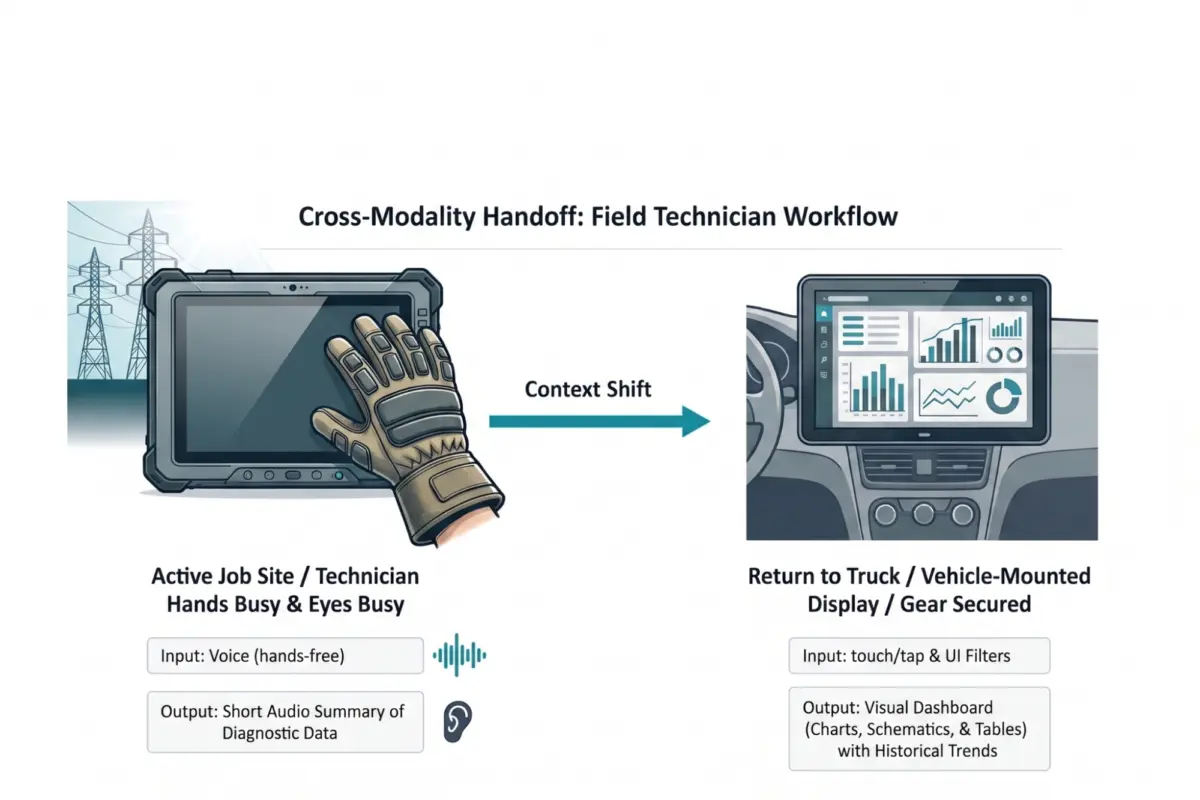
The resulting solution implemented an adaptive cross-modality handoff:

- On the Job Site: Technicians use voice input to query diagnostic data while wearing heavy gloves. The AI responds with a short audio summary, delivering critical fault information directly to the technician’s ear without requiring them to look away from dangerous equipment.
- Inside the Vehicle: Once technicians return to their truck and remove safety gear, the system automatically transitions workflows to a 15-inch vehicle-mounted visual dashboard, enabling parallel processing of complex electrical grid maps and historical trend data.
This evidence-based redesign reduced diagnostic time by 20% and dramatically increased daily tool adoption among field crews.
Future Outlook: The Multi-Modal Ecosystem
The future of AI interface design is not a single, monolithic chat window. It is a diverse, adaptable ecosystem of visual, vocal, haptic, and ambient modalities calibrated precisely to human intent and environmental context.
As AI models become more sophisticated, our interfaces must mature accordingly. By stepping away from the screen, conducting rigorous task audits, and matching input and output modalities to the physical and cognitive realities of users, designers can eliminate adaptation friction. The conversational interface will always remain a valuable tool in the kit—but it is high time we stop forcing every digital square peg into a round chat-bubble hole.
