For decades, the standard trajectory of web development followed a predictable rhythm: when faced with a complex browser limitation, the default developer response was to install an npm package. Need to format relative time? Install timeago.js. Want deep object cloning? Reach for lodash.clonedeep. Require an accessible modal dialog or an HTTP request wrapper? Pull in a11y-dialog or axios.
Installed once and rarely questioned, these packages accumulate silently inside the package.json file. Tests pass, features ship, and the dependencies remain static fixtures of the codebase. However, the modern web platform has undergone a dramatic architectural shift. Browser vendors have aggressively closed the gap between native capabilities and user-land libraries, integrating robust APIs directly into the core engine.
Today, auditing a typical mid-sized JavaScript application reveals between 60KB and 90KB of minified and gzipped dependencies—and significantly more in raw uncompressed bytes—that are completely redundant. The features required to power these libraries are now native web standards. Yet, most engineering teams continue to ship this technical debt because dependencies are rarely audited against modern browser maturity cadences. While security scanning tools like npm audit run regularly to flag vulnerabilities, teams seldom ask a more foundational architectural question: Is this library still executing a task the modern browser cannot handle on its own?
By systematically evaluating dependencies against the Baseline framework—a cross-industry standard for tracking feature availability across major browsers—development teams can safely strip out tens of kilobytes of redundant JavaScript. This guide provides an investigative look into how developers can systematically audit their codebases, eliminate unnecessary third-party abstractions, and transition back to native web platform primitives.
Detailed Chronology: The Evolution of Native Web Capabilities
To understand why so many long-standing libraries are suddenly obsolete, it is necessary to examine how rapidly the web platform has evolved. Historically, browser fragmentation and inconsistent implementations forced developers to rely on abstraction layers.
The Era of Polyfills and Abstractions (2010–2018)
In the early 2010s, native APIs were notoriously unreliable. Internationalization (Intl) was in its infancy, asynchronous requests required complex browser-specific wrappers (such as ActiveXObject legacy fallbacks for XMLHttpRequest), and DOM manipulation lacked unified accessibility primitives. Developers relied heavily on jQuery, heavy utility suites like Lodash, and robust data libraries like Moment.js to ensure consistent cross-browser behavior.
The Rise of Standardized Modules and Frameworks (2018–2022)
As modern ES6 syntax matured, modular JavaScript became the norm. However, core gaps remained. Native HTTP fetching via fetch() lacked built-in request timeouts without cumbersome AbortController setups. Native modals required extensive manual scripting to handle focus trapping, Escape key listeners, and screen reader announcements. Consequently, developer workflows became dependent on specialized micro-libraries to fill these gaps.
The Baseline Standard and Native Parity (2023–Present)
The turning point arrived with the formalization of the Baseline project, driven by the WebDX Community Group. Baseline provides a transparent, standardized metric for determining when a web feature is safe to use across all major engines (Chrome, Edge, Firefox, and Safari).
Under the Baseline framework, features are classified into two critical states:
Newly Available: Supported across all major browser engines, but recently introduced (requiring a 30-month window before reaching ubiquity).
Widely Available: Supported universally across all major engines for more than 30 months, representing safe, production-ready native APIs.
This predictability has allowed browser vendors to ship complex, high-performance features directly to the engine level—rendering entire categories of utility libraries unnecessary.
Supporting Context & Metrics: Breaking Down the Dependency Bloat
When assessing the bloat within a standard production build, waste does not usually come from a single monolithic file. Instead, it accumulates through small, localized micro-dependencies. Analyzing these dependencies in functional clusters reveals the true scope of potential bundle-size reductions.
Cluster 1: Internationalization (The Largest Immediate Win)
Internationalization is historically responsible for massive, unnecessary bundle overhead. Developers routinely pull in specialized packages to handle formatting tasks that the browser’s native Intl namespace now resolves natively and with superior performance.
Relative Time: Libraries like timeago.js are frequently used to convert timestamps into human-readable strings like "3 hours ago". This is fully replaced by Intl.RelativeTimeFormat, which is Baseline Widely Available.
Numbers, Currency, and Lists: Packages handling compact number notation, currency formatting, or array list joining (such as managing Oxford commas) are completely covered by Intl.NumberFormat and Intl.ListFormat.
Durations: While humanize-duration was once indispensable, the native Intl.DurationFormat provides a direct platform equivalent. However, because Intl.DurationFormat is categorized as Newly Available, enterprise applications with broad audience demographics must exercise caution or implement progressive enhancement.
The Math: Removing packages such as timeago.js, numeral, and pluralize instantly cuts roughly 14 KB of gzipped JavaScript from the production bundle.
Cluster 2: HTTP Clients
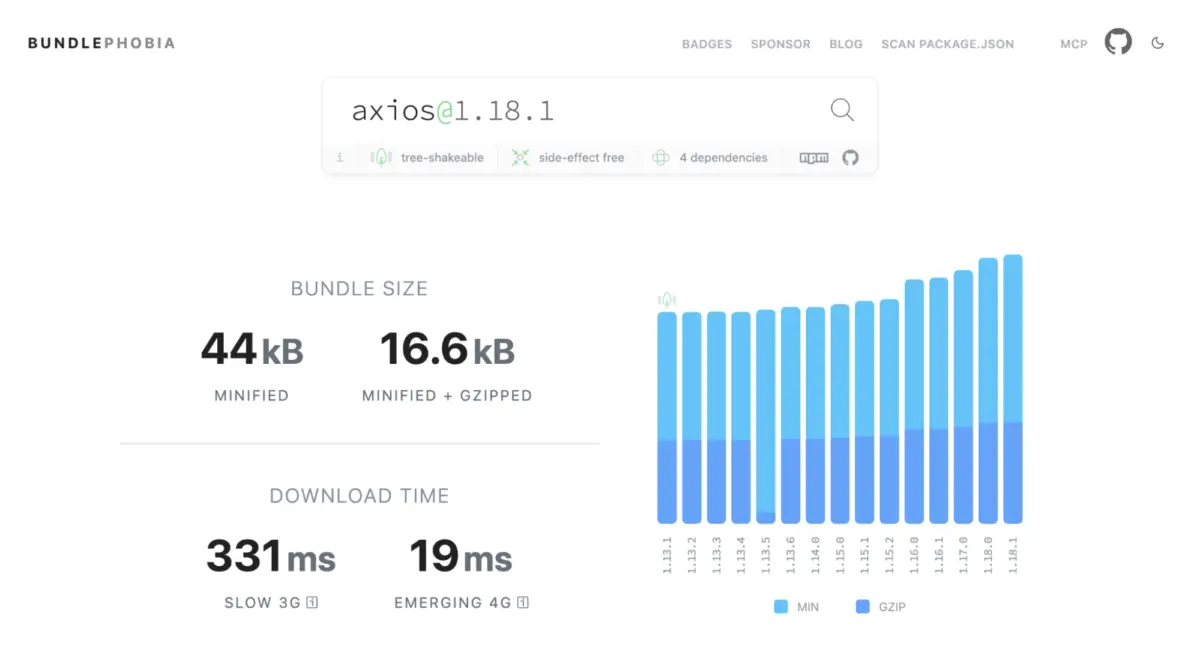
Heavy network abstraction libraries like axios (approx. 17 KB gzipped) and superagent (approx. 19 KB gzipped) are staples in modern web development. While they offer developer ergonomics, native fetch—when paired with native request timeouts via AbortSignal.timeout()—handles the vast majority of standard GET and POST operations natively.
While advanced features like automatic request retries and global interceptors still require custom wrappers if transitioning away from axios, standardizing simple API interactions around native fetch yields immediate performance dividends.
Cluster 3: UI Primitives & Accessibility Modals
Building accessible user interfaces used to require assembling an intricate web of micro-packages: a11y-dialog for modals, tippy.js for tooltips, focus-trap to keep keyboard navigation contained, and body-scroll-lock to prevent background scrolling.
The introduction of native browser features has completely transformed this space:
The <dialog> element (Widely Available) natively handles focus trapping, Escape key dismissal, top-layer rendering (eliminating z-index conflicts), and backdrop styling via ::backdrop.
The Popover API and CSS Anchor Positioning replace external tooltip and floating-panel libraries entirely, managing light-dismiss behaviors and viewport overflow handling via clean CSS rules rather than heavy JavaScript calculations.
The Math: Stripping out redundant UI primitive libraries eliminates approximately 24 KB of gzipped dependencies, while simultaneously improving native accessibility compliance.
Cluster 4: Utility Libraries (Lodash Subsets)
While importing the entire Lodash library is rare today, individual modular packages such as lodash.clonedeep and lodash.groupby remain common.
Grouping:Object.groupBy() and Map.groupBy() natively replace utility grouping functions.
Deep Cloning:structuredClone() provides a native, high-performance mechanism for deep cloning objects, handling complex types like Date, Map, Set, and ArrayBuffer without external dependencies.
Set Operations: Native Set objects now support built-in mathematical methods including .intersection(), .union(), and .difference().
Official Statements and Industry Insights
Engineering leaders and core web platform advocates emphasize that transitioning away from third-party libraries is not merely an exercise in reducing bytes; it is a strategic shift toward long-term maintainability.
"The web platform is moving faster than at any point in its history," notes a senior developer advocate within the WebDX community. "When teams rely on external libraries for features that browsers now optimize at the engine level, they aren’t just adding payload weight—they are introducing potential supply-chain vulnerabilities, parsing overhead, and maintenance friction that the platform itself has already solved."
Furthermore, performance analysts highlight the compounding cost of JavaScript execution. Unlike native browser APIs—which are implemented in highly optimized C++ or Rust within the browser engine—user-land JavaScript libraries must be downloaded, parsed, compiled, and executed on the client’s main thread. Reducing bundle sizes by 60KB to 90KB directly translates to measurable improvements in Core Web Vitals, particularly Interaction to Next Paint (INP) and Time to Interactive (TTI) on mid-tier mobile devices.
Future Outlook: What Lies Ahead for Native Web Architecture
Looking toward the horizon, the boundary between application code and browser primitives will continue to blur. Several upcoming specifications and platform features are poised to eliminate even more dependencies over the next 24 to 36 months:
Temporal API Stable Adoption: While the Temporal API introduces a revolutionary approach to date-and-time manipulation, its current reliance on heavy polyfills (ranging from 19KB to 44KB gzipped) makes immediate adoption counterproductive for public-facing sites. However, as stable support rolls out across all major browser engines, legacy date libraries like moment and dayjs will finally become obsolete.
Advanced CSS Anchoring and State Management: Ongoing enhancements to CSS anchoring specifications will continue to shift UI positioning logic out of JavaScript runtimes and entirely into the style engine.
Standardized Routing and View Transitions: Native primitives for page transitions and client-side routing are steadily maturing, pointing toward an ecosystem where framework-agnostic native behaviors reduce dependency bloat further.
Implementing a Sustainable Audit Framework
To prevent regression, engineering organizations should adopt a repeatable quarterly audit process:
Step 1: List production dependencies using npm ls --omit=dev --depth=0.
Step 2: Measure real bundle impact using bundle analyzers (source-map-explorer or Vite/Webpack visualizers) rather than relying solely on static repository sizes.
Step 3: Cross-reference features against webstatus.dev or MDN Baseline badges.
Step 4: Evaluate replacement candidates against a strict three-question framework: Is the native feature Baseline-safe for our specific user demographics? What is the net cost of any required polyfills? Does the native API fully cover our specific use cases?
Step 5: Leverage progressive enhancement, utilizing runtime feature detection to safely deploy native APIs to modern browsers while maintaining lightweight fallbacks where necessary.
By treating dependency management as an ongoing architectural habit rather than a one-time setup task, development teams can continuously reclaim performance, streamline maintenance, and let the modern web platform do what it was built to do.