

Executive Overview
When front-end developers and UX engineers are tasked with building a web interface that feels tactile, bouncy, or destructive, the industry instinct is almost always the same: reach for a physics engine. Frameworks like Matter.js, Cannon.js, or custom WebGL solutions have long been heralded as the gold standard for creating immersive, gamified websites. Yet, true innovation often demands questioning established dogmas.
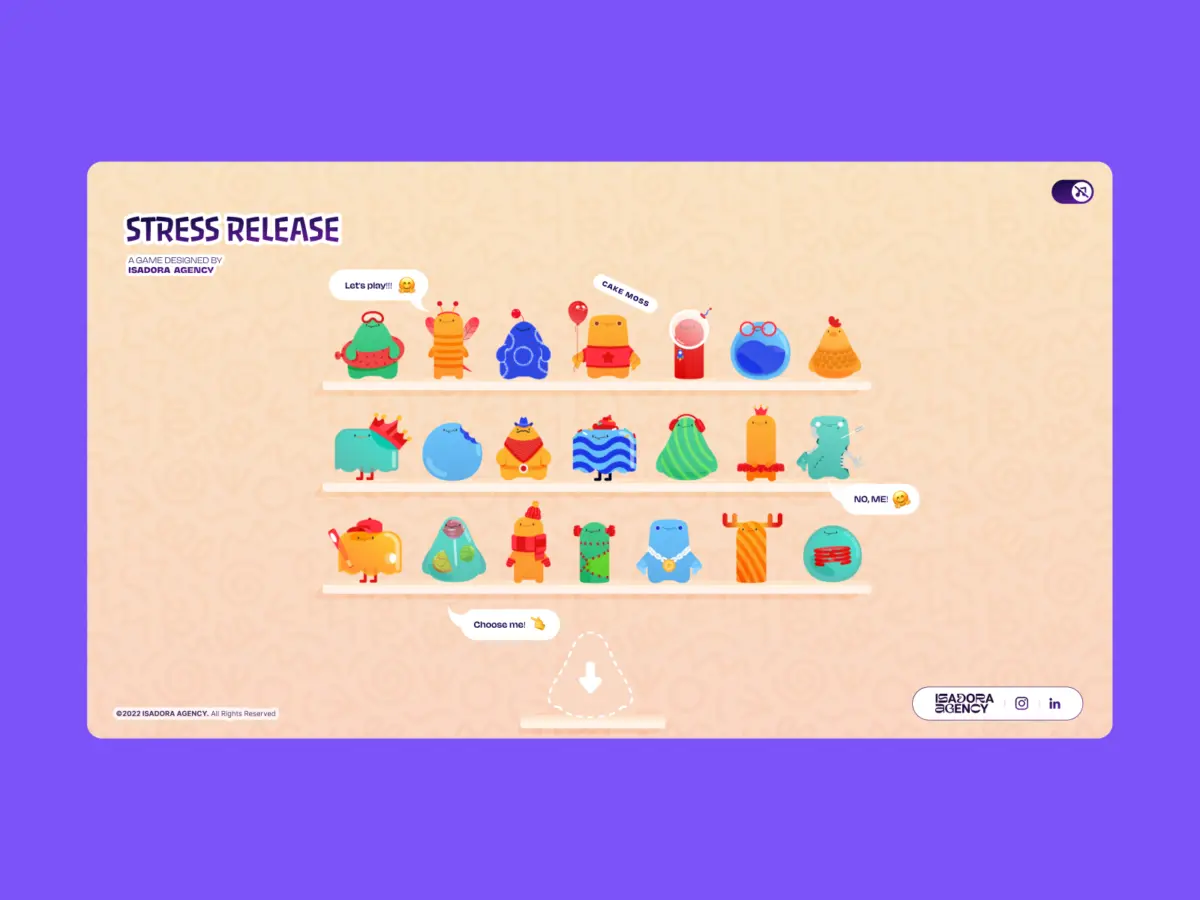
When the engineering and design team at Isadora Agency set out to build Stress Release—a digital stress-relief squeeze toy designed to let burnt-out creatives smash, stretch, and distort animated UI characters—they initially explored the traditional physics route. The primary objective was straightforward yet demanding: construct a highly tactile experience where every user click yielded a satisfying, squishy, and immediate reaction.
However, as the prototyping phase progressed, a fundamental philosophical and technical realization emerged: physics engines produce plausible motion, but animators produce intentional motion. When building an interactive artwork where precise keyframes dictate the narrative weight and aesthetic rhythm of an interface, algorithmic approximation is often a liability.
Instead of relying on WebGL or heavy physics libraries, the development team engineered a real-time stress-relief interface using programmatic Lottie state controls, native DOM manipulation, and distance-based mathematics. This article examines the architectural rationale behind this decision, detailing how balancing code with artistic direction can yield absolute deterministic control over complex web animations.
Detailed Chronology: From Physics Frameworks to Programmatic Precision
The development trajectory of Stress Release offers a compelling case study in modern front-end architectural decision-making. The project began with the traditional approach to interactive web physics, eventually pivoting toward a purely DOM-and-Lottie-driven workflow.
Phase 1: The Initial Attraction to Physics Engines
In the early days of conceptualization, the engineering team assumed that a robust 2D physics engine was mandatory. After all, if characters were going to be squeezed, deformed, and bounced around a browser viewport, gravity, momentum, and collision detection seemed indispensable.
Initial spikes utilized standard web physics libraries to map drag-and-drop vectors and impact velocities. The characters would stretch and compress based on velocity calculations. However, this introduced a critical creative friction point: the physics engines were entirely agnostic to the character’s personality. A gentle poke and a hard smash often yielded mathematically similar, albeit numerically scaled, deformations. The artistic nuances crafted by the animation team—such as a specific build-up phase before an expressive recoil—were systematically flattened by generalized physics formulas.
Phase 2: Recognizing the Limits of Algorithmic Approximation
The turning point arrived when the team reviewed bespoke .json Lottie files delivered by the motion designers. For instance, a signature "mega squeeze" reaction required an exact 181-frame build-up followed by a precisely timed release sequence.

Running these animations through a physics wrapper meant surrendering frame-by-frame authority to stochastic algorithms. The team realized they did not need characters to act like random rubber balls bouncing uncontrollably across a canvas; they needed characters to react in specific, highly engineered, and deeply expressive ways. Consequently, the physics engines were entirely scrapped in favor of programmatic state management via Lottie’s native API.
Phase 3: Implementing Radial Input Mapping and DOM Integration
By leaning into the Document Object Model (DOM) and Lottie’s runtime SVG rendering capabilities, the developers bypassed external rendering loops. Interactions were orchestrated by binding native desktop clicks and mobile touch events directly to DOM nodes.
To create the illusion of a tactile, physical impact, the architecture required accurate spatial awareness. When a user clicked a character, the system converted page coordinates into the character’s local coordinate space using fundamental geometry:
// Character's center point in its own coordinate space
var x_center = parseFloat($("#playChar").width() / 2);
var y_center = parseFloat($("#playChar").height() / 2);

// Click position relative to the character's top-left corner
var offset = $("#playChar").offset(); // document-relative position
var X = parseFloat(e.pageX - offset.left);
var Y = parseFloat(e.pageY - offset.top);

// Vector from center to click point
var a = parseFloat(X - x_center);
var b = parseFloat(Y - y_center);
By passing these vectors through the Pythagorean theorem (var distance = Math.hypot(a, b);), the engine established a concentric, dartboard-like scoring and reaction grid. Distance zones dictated everything from point rewards to the exact repositioning of an explosion effect overlay, grounding abstract digital interactions in deterministic math.

Supporting Context & Metrics: Performance, Responsiveness, and Optimization
While abandoning physics engines solved artistic alignment challenges, it introduced a new set of engineering hurdles—chiefly concerning file sizes, rendering performance, and multi-device consistency.
The Weight of Rich Vector Animations
Lottie JSON files are notoriously heavy, especially when dealing with complex vector paths, nested compositions, and alpha channels. Stress Release featured 21 distinct character animations alongside multiple explosion variants. Loading all assets simultaneously without optimization would have crippled time-to-interactive (TTI) metrics and introduced catastrophic frame drops on mobile devices.
To maintain a fluid 60 frames-per-second experience, the engineering team deployed an aggressive dual-tier optimization strategy:
- The Shelf View (High Density, Low Fidelity): When users browsed the character selection shelf, 21 separate animations played concurrently. To prevent CPU throttling, the implementation instantiated Lottie with reduced quality settings and execution speeds:
shelf = lottie.loadAnimation( container: document.getElementById("charShelf" + i), renderer: "svg", loop: true, autoplay: true, path: "assets/shelf/" + shelfFolders[i] + "/" + shelfFolders[i] + ".json", ); lottie.setQuality(0.5); // 50% quality - reduces interpolation calculations shelf.setSpeed(0.6); // 60% speed - fewer frame calculations per second - The Play View (Single Focus, Full Fidelity): Once a user selected a character to interact with, the application destroyed background instances and dedicated full rendering power to a single, high-fidelity Lottie player:
playChar = lottie.loadAnimation(
 container: document.getElementById("playChar"),
 renderer: "svg",
 loop: true,
 autoplay: true,
 path: chosenChar.url,
);
lottie.setQuality(1); // full quality - only one animation at a time
Responsive Design via CSS Custom Properties
Another major advantage of avoiding WebGL and proprietary canvas contexts was native responsiveness. Scaling collision boxes, raycasting vectors, and touch targets across varying viewport sizes in WebGL often requires complex matrix math and viewport recalculations.

By building within the DOM, Stress Release leveraged CSS variables to handle responsive resizing fluidly. By recalculating custom properties on every window resize event, the UI layout adapted dynamically while Lottie’s internal SVGs scaled naturally within their bounding containers:
const appHeight = () =>
  const doc = document.documentElement;
  doc.style.setProperty("--doc-height", `$window.innerHeightpx`);
  doc.style.setProperty("--doc-width", `$doc.clientWidthpx`);
;
window.addEventListener("resize", appHeight);
appHeight();
Official Perspectives and Industry Implications
The architectural choices made during the creation of Stress Release highlight a broader philosophical debate in modern front-end engineering: When should developers choose simulation over choreography?
Industry consensus has frequently skewed toward heavy libraries under the assumption that "interactivity equals physics." However, creative digital agencies and UI/UX studios are increasingly recognizing that narrative-driven web applications demand absolute control.
When animators spend weeks refining easing curves, anticipatory frames, and follow-through mechanics, passing those assets into a black-box physics simulation can strip away the emotional resonance of the design. By mapping Lottie’s native timeline capabilities directly to DOM events, developers can preserve the exact intent of the art direction without sacrificing interactivity.

"By mapping Lottie’s native timeline capabilities to the DOM, you can deliver incredibly rich, tactile user experiences while maintaining absolute control over the art direction."
This approach shifts the role of the front-end developer from a physics simulator tuner to an orchestration engineer. Code ceases to act as an unpredictable force generator and instead serves as a precise trigger mechanism—listening to user intent, calculating spatial coordinates, and executing handcrafted artistic visions with unwavering reliability.
Future Outlook: The Evolution of Tactile Web Experiences
As web technologies continue to evolve, the boundary between static interfaces and deeply tactile digital environments will continue to blur. With advancements in browser rendering engines, WebAssembly optimizations, and improved vector animation toolsets, developers have more granular control than ever over how users interface with digital products.
However, the core lesson of Stress Release remains timeless: technology should always serve art direction, never dictate it.

Whether building gamified marketing campaigns, stress-relief applications, or highly animated enterprise dashboards, engineering teams must evaluate whether their tech stacks honor the meticulous work of their design departments. When absolute deterministic control is required, reaching for heavier frameworks may not be the answer. Sometimes, the most powerful tool in a developer’s arsenal is a clean DOM element, a well-optimized Lottie file, and a foundational understanding of distance-based mathematics.
